 02873009677
 contact@envyenglish.vn

1. Questions
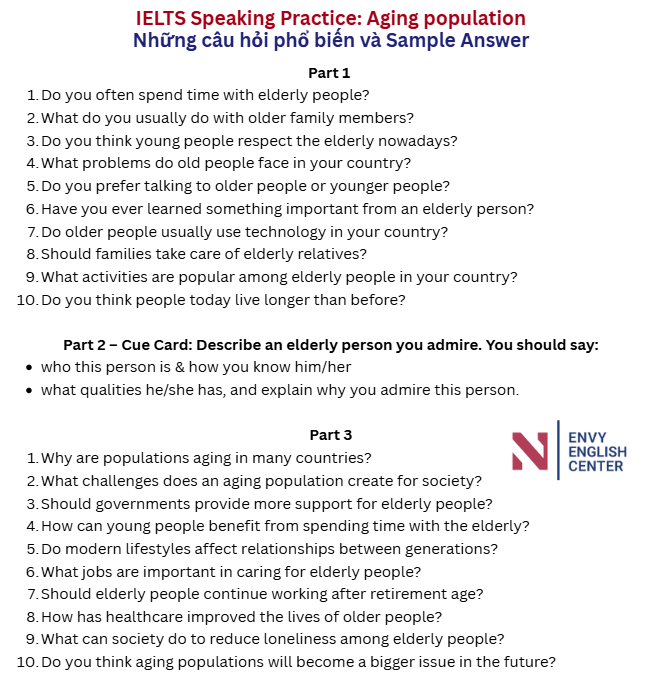
Part 1 – Aging Population
Do you often spend time with elderly people?
What do you usually do with older family members?
Do you think young people respect the elderly nowadays?
What problems do old people face in your country?
Do you prefer talking to older people or younger people?
Have you ever learned something important from an elderly person?
Do older people usually use technology in your country?
Should families take care of elderly relatives?
What activities are popular among elderly people in your country?
Do you think people today live longer than before?
Part 2 – Cue Card: Describe an elderly person you admire.
You should say:
who this person is
how you know him/her
what qualities he/she has
and explain why you admire this person.
Part 3 – Aging Population Discussion (10 Questions)
Why are populations aging in many countries?
What challenges does an aging population create for society?
Should governments provide more support for elderly people?
How can young people benefit from spending time with the elderly?
Do modern lifestyles affect relationships between generations?
What jobs are important in caring for elderly people?
Should elderly people continue working after retirement age?
How has healthcare improved the lives of older people?
What can society do to reduce loneliness among elderly people?
Do you think aging populations will become a bigger issue in the future?
2. Questions & Answers
Question 1: Do you often spend time with elderly people?
Yes, I spend quite a lot of time with my grandparents because we are very close emotionally. Whenever I visit them, we usually have long conversations about family matters, education, and life experiences. I particularly enjoy listening to their stories because they provide valuable perspectives that younger people may not fully understand. In my opinion, spending time with elderly relatives helps strengthen family bonds and mutual understanding between generations.
Emotionally close (adj.phr): thân thiết về mặt tình cảm
e.g: She is emotionally close to her grandmother.
Life experiences (n.phr): trải nghiệm cuộc sống
e.g: Older people often share valuable life experiences.
Valuable perspectives (n.phr): góc nhìn giá trị
e.g: Elderly people can offer valuable perspectives on social issues.
Strengthen family bonds (v.phr): gắn kết gia đình
e.g: Family meals help strengthen family bonds.
Question 2: What problems do old people face in your country?
Many elderly people in my country face health-related and financial difficulties as they grow older. Some of them suffer from chronic illnesses and require constant medical care, which can be quite expensive. In addition, certain elderly individuals experience loneliness because younger family members are often too busy with work or study commitments. As a result, mental health issues among older generations have become increasingly concerning in recent years.
Health-related difficulties (n.phr): khó khăn liên quan đến sức khỏe
e.g: Aging populations create many health-related difficulties.
Chronic illness (n.phr): bệnh mãn tính
e.g: Elderly people are more vulnerable to chronic illnesses.
Medical care (n.phr): chăm sóc y tế
e.g: Governments should improve access to medical care.
Study commitments (n.phr): trách nhiệm học tập
e.g: Students often struggle to balance study commitments and social life.
Question 3: Do you think young people respect the elderly nowadays?
I think many young people still respect the elderly, although modern lifestyles have changed intergenerational relationships to some extent. In traditional cultures, older people are often viewed as wise and experienced individuals whose opinions deserve consideration. However, younger generations today tend to become more independent and sometimes communicate less frequently with elderly family members. Nevertheless, I believe respect for older people remains an important cultural value in many societies.
Intergenerational relationships (n.phr): mối quan hệ giữa các thế hệ
e.g: Technology has influenced intergenerational relationships.
To some extent (adv.phr): ở một mức độ nào đó
e.g: Social media affects communication to some extent.
Wise and experienced (adj.phr): khôn ngoan và giàu kinh nghiệm
e.g: Elderly people are often considered wise and experienced.
Cultural value (n.phr): giá trị văn hóa
e.g: Respecting parents is an important cultural value in Asia.
Question 4: What problems do old people face in your country?
Many elderly people in my country face health-related and financial difficulties as they grow older. Some of them suffer from chronic illnesses and require constant medical care, which can be quite expensive. In addition, certain elderly individuals experience loneliness because younger family members are often too busy with work or study commitments. As a result, mental health issues among older generations have become increasingly concerning in recent years.
Chronic illness (n.phr): bệnh mãn tính
e.g: Elderly people are more vulnerable to chronic illnesses.
Medical care (n.phr): chăm sóc y tế
e.g: Governments should improve access to medical care.
Study commitments (n.phr): trách nhiệm học tập
e.g: Students often struggle to balance study commitments and social life.
Mental health issues (n.phr): vấn đề sức khỏe tinh thần
e.g: Loneliness may lead to mental health issues.
Question 5: Do you prefer talking to older people or younger people?
I personally enjoy talking to both age groups because each offers different perspectives and experiences. Older people tend to provide thoughtful advice and practical knowledge gained through life experience, while younger people are usually more energetic and open-minded. However, if I had to choose, I would probably prefer speaking with older individuals because their opinions are often more mature and insightful. I think conversations with elderly people can help younger generations develop a broader understanding of life.
Open-minded (adj): cởi mở
e.g: Young people are often more open-minded toward change.
Life experience (n.phr): kinh nghiệm sống
e.g: Elderly people have valuable life experience.
Insightful opinion (n.phr): ý kiến sâu sắc
e.g: The professor gave several insightful opinions.
Broader understanding (n.phr): sự hiểu biết rộng hơn
e.g: Traveling gives people a broader understanding of the world.
Question 6: Have you ever learned something important from an elderly person?
Yes, I have learned many valuable lessons from elderly family members, especially my grandparents. They often teach me the importance of patience, discipline, and emotional resilience during difficult situations. For example, my grandfather once told me that success usually requires long-term effort and perseverance rather than immediate results. I think advice from older generations can be extremely meaningful because it is based on real-life experience.
Emotional resilience (n.phr): khả năng phục hồi tinh thần
e.g: Challenges help people build emotional resilience.
Long-term effort (n.phr): nỗ lực lâu dài
e.g: Academic success requires long-term effort.
Perseverance (n): sự kiên trì
e.g: Perseverance is necessary for personal growth.
Real-life experience (n.phr): trải nghiệm thực tế
e.g: Elderly people often speak from real-life experience.
Question 7: Do older people usually use technology in your country?
Nowadays, many older people in my country are becoming more familiar with technology than before. Although some elderly individuals still struggle with digital devices, others use smartphones and social media regularly to communicate with relatives and access information. In particular, applications related to messaging and video calls have become increasingly popular among older generations. I believe technology can improve elderly people’s quality of life if they receive proper guidance and support.
Become familiar with (v.phr): trở nên quen thuộc với
e.g: Older people are gradually becoming familiar with technology.
Digital devices (n.phr): thiết bị kỹ thuật số
e.g: Children spend too much time using digital devices.
Video calls (n.phr): cuộc gọi video
e.g: Families often communicate through video calls.
Quality of life (n.phr): chất lượng cuộc sống
e.g: Healthcare improvements increase quality of life.
Question 8: Should families take care of elderly relatives?
Yes, I believe families should take responsibility for caring for elderly relatives whenever possible. Older family members often dedicated many years to supporting younger generations, so they deserve care and emotional support in return. Furthermore, elderly people usually feel more comfortable and secure when they are surrounded by their loved ones. However, in cases where families are unable to provide proper care, professional nursing services may also be necessary.
Take responsibility for (v.phr): chịu trách nhiệm về
e.g: Parents should take responsibility for their children.
Emotional support (n.phr): hỗ trợ tinh thần
e.g: Elderly people require emotional support from family members.
Surrounded by loved ones (adj.phr): được bao quanh bởi người thân yêu
e.g: Most elderly people want to be surrounded by loved ones.
Professional nursing services (n.phr): dịch vụ chăm sóc chuyên nghiệp
e.g: Some families depend on professional nursing services.
Question 9: What activities are popular among elderly people in your country?
Many elderly people in my country enjoy activities that are relaxing and socially engaging. For example, some of them participate in morning exercise groups, go for walks in parks, or practice traditional forms of exercise such as tai chi. Others prefer social activities like chatting with neighbors, attending community events, or spending time with grandchildren. I think these activities help elderly individuals maintain both physical health and emotional well-being.
Socially engaging (adj.phr): mang tính giao tiếp xã hội
e.g: Community clubs provide socially engaging activities.
Morning exercise group (n.phr): nhóm tập thể dục buổi sáng
e.g: Parks are often crowded with morning exercise groups.
Community event (n.phr): sự kiện cộng đồng
e.g: Community events strengthen social connections.
Emotional well-being (n.phr): sức khỏe tinh thần
e.g: Exercise improves emotional well-being.
Question 10: Do you think people today live longer than before?
Yes, I definitely think life expectancy has increased significantly compared to previous generations. One major reason is that healthcare systems and medical technology have improved dramatically over the past few decades. In addition, people nowadays are generally more aware of healthy lifestyles, including balanced diets and regular exercise. Consequently, many individuals are able to maintain better physical health and live longer lives.
Life expectancy (n.phr): tuổi thọ trung bình
e.g: Life expectancy has risen in many developed countries.
Healthcare systems (n.phr): hệ thống y tế
e.g: Governments should invest in healthcare systems.
Healthy lifestyles (n.phr): lối sống lành mạnh
e.g: Exercise contributes to healthy lifestyles.
Balanced diet (n.phr): chế độ ăn cân bằng
e.g: A balanced diet improves overall health.
Cue Card: Describe an elderly person you admire.
One elderly person whom I truly admire is my grandfather, who has had a tremendous influence on my personality and way of thinking. He is currently in his seventies and used to work as an engineer for many years before retiring. Even though he is quite old now, he remains highly active, disciplined, and intellectually curious.
I have known him my entire life because we are very close as a family. Ever since I was a child, he has always encouraged me to study hard and become an independent person. What I appreciate most about him is his calm personality and strong sense of responsibility. Whenever our family encounters difficulties, he always remains patient and tries to solve problems rationally instead of reacting emotionally.
Another reason I admire him is his dedication to lifelong learning. Despite his age, he still reads newspapers regularly, follows technological developments, and enjoys learning new things. For example, he recently learned how to use smartphones and online applications in order to communicate more conveniently with relatives. I find this particularly inspiring because many elderly people are often reluctant to adapt to modern technology.
Moreover, he possesses a great deal of practical wisdom gained through decades of life experience. Whenever I feel uncertain about academic pressure or future career choices, he gives me thoughtful advice that helps me feel more confident and motivated. His experiences have taught me the importance of perseverance, discipline, and emotional resilience.
In addition, he treats everyone respectfully regardless of their age or social background, which has influenced the way I interact with other people. I believe his kindness and maturity have earned him a great deal of respect from both family members and neighbors.
Overall, I admire my grandfather because he represents the qualities I hope to develop in myself in the future, including wisdom, responsibility, discipline, and lifelong curiosity.
Have a tremendous influence on (v.phr): có ảnh hưởng lớn đến
e.g: Parents have a tremendous influence on children’s behavior.
Intellectually curious (adj.phr): ham học hỏi
e.g: Successful students are often intellectually curious.
Strong sense of responsibility (n.phr): tinh thần trách nhiệm cao
e.g: Managers need a strong sense of responsibility.
Lifelong learning (n.phr): học tập suốt đời
e.g: Lifelong learning is important in modern society.
Question 1: Why are populations aging in many countries?
There are several factors contributing to aging populations in many parts of the world. Firstly, advances in healthcare and medical technology have significantly increased life expectancy, allowing people to live much longer than previous generations. Secondly, birth rates in many countries have declined because younger people are choosing to have fewer children due to financial pressure and changing lifestyles. In addition, urbanization and career-oriented attitudes have influenced family planning decisions among modern couples. As a result, the proportion of elderly people within the population continues to rise steadily.
Contribute to (v.phr): góp phần vào
e.g: Pollution contributes to environmental problems.
Medical technology (n.phr): công nghệ y tế
e.g: Medical technology has improved dramatically.
Birth rate (n.phr): tỷ lệ sinh
e.g: Some developed countries have low birth rates.
Career-oriented attitude (n.phr): tư duy ưu tiên sự nghiệp
e.g: Career-oriented attitudes are common among young adults.
Question 2: What challenges does an aging population create for society?
An aging population can create numerous economic and social challenges for governments and communities. One major issue is the increasing demand for healthcare services and retirement benefits, which may place financial pressure on public systems. Furthermore, countries with aging populations often experience labor shortages because there are fewer young workers entering the workforce. Another concern is that elderly individuals may face social isolation and mental health problems if they lack family or community support. Therefore, societies must develop long-term strategies to address these demographic changes effectively.
Healthcare services (n.phr): dịch vụ y tế
e.g: Rural areas need better healthcare services.
Retirement benefits (n.phr): phúc lợi hưu trí
e.g: Governments spend large amounts on retirement benefits.
Labor shortage (n.phr): thiếu hụt lao động
e.g: Some industries are facing severe labor shortages.
Demographic changes (n.phr): thay đổi nhân khẩu học
e.g: Governments must prepare for demographic changes.
Question 3: Should governments provide more support for elderly people?
Yes, I strongly believe governments should provide greater support for elderly citizens because they are often more vulnerable financially and physically. Many older individuals require affordable healthcare, stable pensions, and accessible public services in order to maintain a decent quality of life. In addition, governments could establish more community centers and social programs to reduce loneliness among the elderly. I think supporting older generations is both a social responsibility and a sign of a compassionate society.
Vulnerable (adj): dễ bị tổn thương
e.g: Elderly people are financially vulnerable after retirement.
Accessible public services (n.phr): dịch vụ công dễ tiếp cận
e.g: Disabled citizens need accessible public services.
Quality of life (n.phr): chất lượng cuộc sống
e.g: Healthcare improvements increase quality of life.
Compassionate society (n.phr): xã hội nhân văn
e.g: Helping the poor creates a more compassionate society.
Question 4: How can young people benefit from spending time with the elderly?
Young people can gain valuable knowledge and emotional maturity by spending time with elderly individuals. Older generations often share practical wisdom and life experiences that cannot easily be learned from books or the Internet. Moreover, conversations with elderly people may help younger individuals develop patience, empathy, and better communication skills. I also think these interactions strengthen family relationships and encourage greater respect between generations.
Emotional maturity (n.phr): sự trưởng thành cảm xúc
e.g: Difficult experiences help people gain emotional maturity.
Practical wisdom (n.phr): sự khôn ngoan thực tế
e.g: Grandparents often provide practical wisdom.
Empathy (n): sự đồng cảm
e.g: Volunteering activities help students develop empathy.
Respect between generations (n.phr): sự tôn trọng giữa các thế hệ
e.g: Traditional cultures emphasize respect between generations.
Question 5: Do modern lifestyles affect relationships between generations?
Yes, modern lifestyles have significantly influenced relationships between different generations. Nowadays, many young adults are extremely busy with work, education, and personal responsibilities, which reduces the amount of time they spend with elderly family members. In addition, technological differences sometimes create communication barriers between younger and older people. However, technology can also help families stay connected through messaging applications and video calls despite physical distance.
Personal responsibilities (n.phr): trách nhiệm cá nhân
e.g: Adults often struggle to balance personal responsibilities and work.
Communication barriers (n.phr): rào cản giao tiếp
e.g: Language differences create communication barriers.
Stay connected (v.phr): giữ kết nối
e.g: Social media helps families stay connected.
Physical distance (n.phr): khoảng cách địa lý
e.g: Technology reduces the impact of physical distance.
Question 6: What jobs are important in caring for elderly people?
There are several professions that play an essential role in caring for elderly individuals. Healthcare workers such as doctors, nurses, and caregivers are particularly important because they provide medical treatment and daily support. In addition, social workers and psychologists can help older people cope with emotional difficulties and social isolation. I also believe that community volunteers contribute greatly by assisting elderly people with everyday activities and companionship.
Healthcare worker (n.phr): nhân viên y tế
e.g: Healthcare workers are essential during health crises.
Daily support (n.phr): hỗ trợ hằng ngày
e.g: Some elderly people require daily support.
Social isolation (n.phr): sự cô lập xã hội
e.g: Elderly people may suffer from social isolation.
Companionship (n): sự bầu bạn
e.g: Pets can provide companionship for elderly individuals.
Question 7: Should elderly people continue working after retirement age?
I think elderly people should have the freedom to continue working if they are physically healthy and genuinely enjoy their jobs. Some older individuals possess valuable expertise and experience that can still benefit businesses and society. Moreover, continuing to work may help elderly people remain mentally active and socially engaged after retirement. However, I do not believe they should feel pressured to work if they prefer to rest and spend time with their families.
Valuable expertise (n.phr): chuyên môn giá trị
e.g: Senior employees possess valuable expertise.
Mentally active (adj.phr): minh mẫn
e.g: Reading helps elderly people stay mentally active.
Socially engaged (adj.phr): tham gia xã hội tích cực
e.g: Volunteering keeps retired people socially engaged.
Feel pressured to (v.phr): cảm thấy bị áp lực phải
e.g: Students should not feel pressured to follow certain careers.
Question 8: How has healthcare improved the lives of older people?
Healthcare advancements have dramatically improved the quality of life for elderly people in many ways. Modern medical treatments and improved healthcare systems allow older individuals to manage chronic illnesses more effectively and live longer lives. In addition, regular health check-ups and preventive care help detect diseases earlier, which increases treatment success rates. As a result, many elderly people today can remain active and independent for much longer than previous generations.
Healthcare advancement (n.phr): tiến bộ y tế
e.g: Healthcare advancements increase life expectancy.
Chronic illness (n.phr): bệnh mãn tính
e.g: Elderly people are more vulnerable to chronic illnesses.
Preventive care (n.phr): chăm sóc phòng ngừa
e.g: Preventive care reduces healthcare costs.
Treatment success rate (n.phr): tỷ lệ điều trị thành công
e.g: Early diagnosis improves treatment success rates.
Question 9: What can society do to reduce loneliness among elderly people?
I believe society can take several practical measures to reduce loneliness among elderly individuals. Firstly, local communities should organize social activities and community programs specifically designed for older people so that they can interact with others regularly. Secondly, families should make greater efforts to spend quality time with elderly relatives rather than focusing exclusively on work or personal responsibilities. In addition, governments could invest in senior centers and support services that encourage social participation and emotional well-being. Ultimately, maintaining strong social connections is essential for both the physical and mental health of elderly people.
Practical measures (n.phr): biện pháp thực tế
e.g: Governments should take practical measures to reduce pollution.
Community programs (n.phr): chương trình cộng đồng
e.g: Community programs benefit elderly residents.
Quality time (n.phr): thời gian chất lượng
e.g: Parents should spend quality time with their children.
Social participation (n.phr): sự tham gia xã hội
e.g: Community activities encourage social participation.
Question 10: Do you think aging populations will become a bigger issue in the future?
Yes, I believe aging populations will become a much more serious issue in the future, especially in developed countries with declining birth rates. As the proportion of elderly citizens continues to rise, governments may face increasing pressure on healthcare systems, pensions, and public services. In addition, labor shortages could negatively affect economic growth and productivity in many industries. Therefore, societies will need long-term policies and innovative solutions to manage the consequences of demographic aging effectively.
Declining birth rate (n.phr): tỷ lệ sinh giảm
e.g: Japan is experiencing a declining birth rate.
Public services (n.phr): dịch vụ công
e.g: Governments invest heavily in public services.
Economic growth (n.phr): tăng trưởng kinh tế
e.g: Technology contributes to economic growth.
Innovative solutions (n.phr): giải pháp đổi mới
e.g: Climate change requires innovative solutions.
Nếu bạn đang bắt đầu từ con số 0 hoặc đã học nhưng “dậm chân tại chỗ”, Envy English Center có thể đồng hành cùng bạn:
Test trình độ miễn phí theo format IELTS để biết chính xác điểm mạnh – điểm yếu.
Nhận lộ trình học cá nhân hóa từ 0 → 6.5+, phù hợp tốc độ và mục tiêu.
Trực tiếp học với giáo viên IELTS 8.0+, chuyên “gỡ rối” Speaking & Writing – hai kỹ năng khó nâng band nhất.
Đặc biệt, khi đăng ký trong tuần này, bạn được tặng bộ từ vựng chuẩn IELTS band 7+.
📞 Hotline: 028 7300 9677 / 0948 197 270 (Zalo)
🌐 Website: envyenglish.vn
📍 Địa chỉ: 46/5 Tân Cảng, Phường Thạnh Mỹ Tây, Quận Bình Thạnh, TP.HCM


Thông tin gửi đi không thành công, vui lòng thử lại sau.
Nếu bạn cần liên hệ gấp, vui lòng gọi hotline
02873009677

Cảm ơn bạn đã gửi thông tin đến Envy English Center.
Chúng tôi sẽ liên hệ với bạn sớm nhất khi có thể.
Nếu bạn cần liên hệ gấp, vui lòng gọi hotline
02873009677
Thông tin gửi đi không thành công, vui lòng thử lại sau.
Nếu bạn cần liên hệ gấp, vui lòng gọi hotline
02873009677
Bạn đang có một bài test chưa hoàn thành.
Bạn có muốn tiếp tục bài test đó không?
Bạn có chắc là muốn gửi bài test này không?

Số câu trả lời đúng/40

Số câu trả lời đúng/40
Thông tin gửi đi không thành công, vui lòng thử lại sau.
Nếu bạn cần liên hệ gấp, vui lòng gọi hotline
02873009677
Thời gian làm bài kiểm tra đã hết.
Cảm ơn bạn đã cố gắng.
