 02873009677
 contact@envyenglish.vn

1. Questions
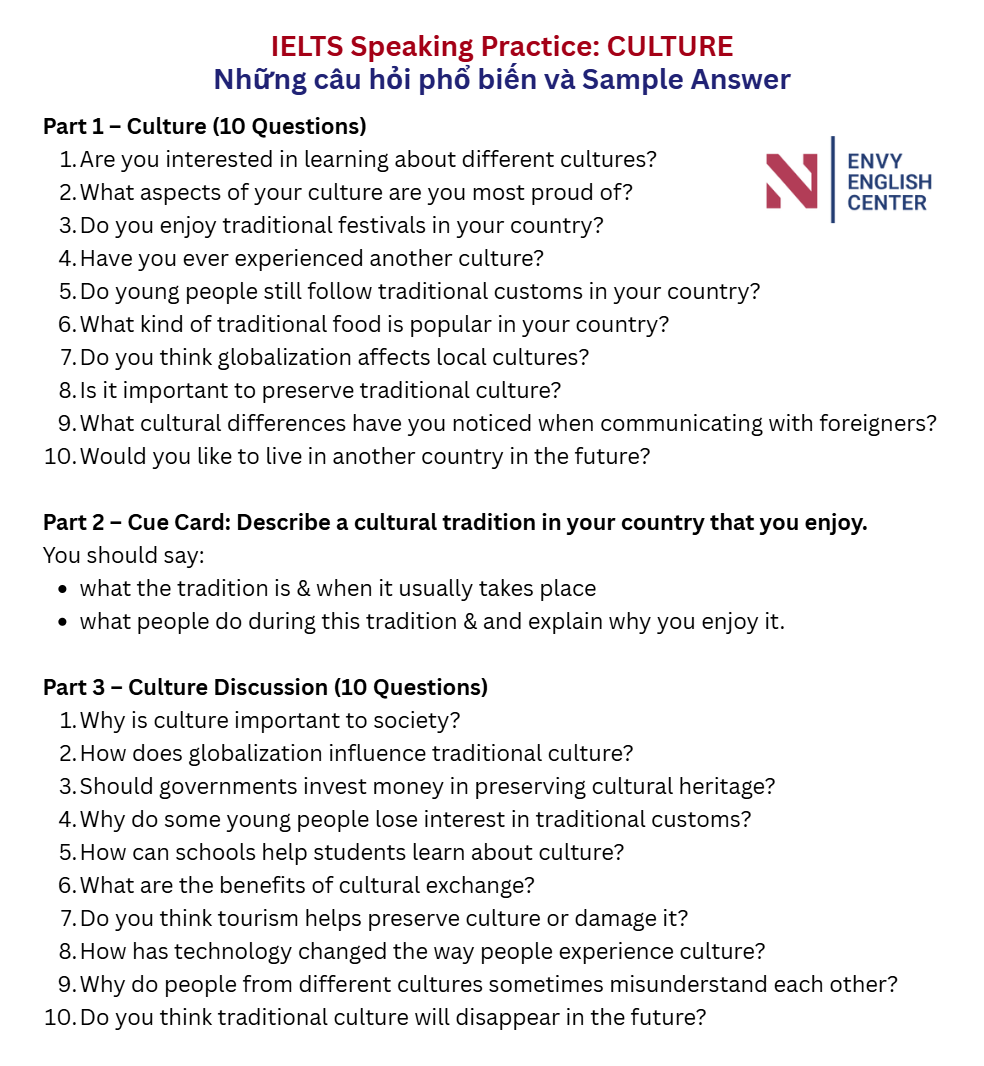
Part 1 – Culture (10 Questions)
Are you interested in learning about different cultures?
What aspects of your culture are you most proud of?
Do you enjoy traditional festivals in your country?
Have you ever experienced another culture?
Do young people still follow traditional customs in your country?
What kind of traditional food is popular in your country?
Do you think globalization affects local cultures?
Is it important to preserve traditional culture?
What cultural differences have you noticed when communicating with foreigners?
Would you like to live in another country in the future?
Part 2 – Cue Card: Describe a cultural tradition in your country that you enjoy.
You should say:
what the tradition is
when it usually takes place
what people do during this tradition
and explain why you enjoy it.
Part 3 – Culture Discussion (10 Questions)
Why is culture important to society?
How does globalization influence traditional culture?
Should governments invest money in preserving cultural heritage?
Why do some young people lose interest in traditional customs?
How can schools help students learn about culture?
What are the benefits of cultural exchange?
Do you think tourism helps preserve culture or damage it?
How has technology changed the way people experience culture?
Why do people from different cultures sometimes misunderstand each other?
Do you think traditional culture will disappear in the future?
2. Questions & Answers
Question 1: Are you interested in learning about different cultures?
Yes, I am extremely interested in learning about different cultures because it helps me broaden my perspective on the world. I enjoy discovering how people from various cultural backgrounds think, communicate, and live their daily lives. In addition, learning about other cultures allows me to become more open-minded and respectful toward cultural differences. I think cultural knowledge is particularly important nowadays because globalization has connected people more closely than ever before.
Broaden someone’s perspective (v.phr): mở rộng góc nhìn
e.g: Traveling can broaden people’s perspectives.
Cultural background (n.phr): nền tảng văn hóa
e.g: Students come from diverse cultural backgrounds.
Open-minded (adj): cởi mở
e.g: Open-minded people adapt more easily to new environments.
Cultural differences (n.phr): sự khác biệt văn hóa
e.g: International students should respect cultural differences.
Question 2: What aspects of your culture are you most proud of?
One aspect of my culture that I am particularly proud of is the strong sense of family connection in Vietnamese society. Family members usually support one another emotionally and financially, especially during difficult times. I also admire the respect that younger generations show toward elderly people because this reflects important traditional values. Furthermore, Vietnamese cuisine and traditional festivals are unique cultural features that attract many international visitors.
Sense of family connection (n.phr): sự gắn kết gia đình
e.g: Asian cultures often emphasize a strong sense of family connection.
Traditional values (n.phr): giá trị truyền thống
e.g: Parents should teach children traditional values.
Vietnamese cuisine (n.phr): ẩm thực Việt Nam
e.g: Vietnamese cuisine is popular worldwide.
International visitors (n.phr): du khách quốc tế
e.g: Cultural festivals attract international visitors.
Question 3: Do you enjoy traditional festivals in your country?
Yes, I really enjoy traditional festivals because they create a joyful and meaningful atmosphere for families and communities. During major celebrations such as Lunar New Year, people usually gather together, prepare traditional food, and participate in cultural activities. I particularly appreciate these festivals because they help preserve cultural identity and strengthen relationships among family members. Moreover, traditional celebrations provide younger generations with opportunities to learn more about their cultural heritage.
Joyful atmosphere (n.phr): bầu không khí vui vẻ
e.g: Festivals create a joyful atmosphere in communities.
Cultural identity (n.phr): bản sắc văn hóa
e.g: Traditional clothing represents cultural identity.
Strengthen relationships (v.phr): củng cố mối quan hệ
e.g: Family activities strengthen relationships.
Cultural heritage (n.phr): di sản văn hóa
e.g: Historical sites are part of cultural heritage.
Question 4: Have you ever experienced another culture?
Yes, I have experienced other cultures mainly through communicating with international students and consuming foreign media. For example, I often watch documentaries, movies, and online content produced in different countries, which helps me understand various lifestyles and cultural values. In addition, studying English has given me opportunities to interact with people from diverse backgrounds. Although I have not traveled abroad extensively, I believe these experiences have still improved my cultural awareness significantly.
Consume foreign media (v.phr): tiếp cận truyền thông nước ngoài
e.g: Teenagers frequently consume foreign media online.
Diverse backgrounds (n.phr): nền tảng đa dạng
e.g: Universities welcome students from diverse backgrounds.
Cultural awareness (n.phr): nhận thức văn hóa
e.g: Traveling improves cultural awareness.
Lifestyle (n): lối sống
e.g: Urban lifestyles are often fast-paced.
Question 5: Do young people still follow traditional customs in your country?
I think many young people still follow traditional customs, although modern lifestyles have influenced their attitudes to some extent. Important traditions related to family gatherings and major festivals are still widely practiced in Vietnam. However, some younger individuals are becoming more influenced by global culture and may pay less attention to certain traditional practices. Nevertheless, I believe traditional customs continue to play an important role in shaping cultural identity.
Traditional customs (n.phr): phong tục truyền thống
e.g: Rural areas preserve traditional customs more effectively.
Modern lifestyles (n.phr): lối sống hiện đại
e.g: Modern lifestyles affect family relationships.
Global culture (n.phr): văn hóa toàn cầu
e.g: Social media spreads global culture rapidly.
Shape cultural identity (v.phr): định hình bản sắc văn hóa
e.g: Language helps shape cultural identity.
Question 6: What kind of traditional food is popular in your country?
Vietnam is famous for a wide variety of traditional dishes that are both flavorful and healthy. One of the most popular foods is pho, which is a noodle soup consisting of broth, rice noodles, herbs, and meat. In addition, dishes such as banh mi and spring rolls are widely enjoyed by both local people and international tourists. I think Vietnamese cuisine is highly appreciated because it combines fresh ingredients with balanced flavors.
Flavorful (adj): đậm đà hương vị
e.g: Vietnamese dishes are flavorful and healthy.
Fresh ingredients (n.phr): nguyên liệu tươi
e.g: Restaurants should use fresh ingredients.
Balanced flavors (n.phr): hương vị cân bằng
e.g: Good chefs create balanced flavors.
International tourists (n.phr): khách du lịch quốc tế
e.g: Vietnamese food attracts international tourists.
Question 7: Do you think globalization affects local cultures?
Yes, globalization has a significant impact on local cultures in both positive and negative ways. On the one hand, it allows people to learn about different traditions and promotes international cultural exchange. On the other hand, globalization may weaken traditional customs because young people are increasingly influenced by foreign lifestyles and entertainment. Consequently, some cultural practices gradually become less common over time. I believe societies should find a balance between modernization and cultural preservation.
Cultural exchange (n.phr): giao lưu văn hóa
e.g: International travel promotes cultural exchange.
Foreign lifestyles (n.phr): lối sống nước ngoài
e.g: Young people are influenced by foreign lifestyles.
Cultural preservation (n.phr): bảo tồn văn hóa
e.g: Museums contribute to cultural preservation.
Modernization (n): hiện đại hóa
e.g: Modernization changes traditional societies rapidly.
Question 8: Is it important to preserve traditional culture?
Yes, I strongly believe preserving traditional culture is extremely important because it reflects a nation’s history, identity, and values. Traditional customs and cultural practices help younger generations understand their roots and maintain a sense of belonging. Furthermore, cultural heritage contributes to tourism and strengthens national pride. Without proper preservation efforts, many valuable traditions could gradually disappear in the future.
Sense of belonging (n.phr): cảm giác thuộc về
e.g: Family traditions create a sense of belonging.
National pride (n.phr): niềm tự hào dân tộc
e.g: Sporting events increase national pride.
Preservation effort (n.phr): nỗ lực bảo tồn
e.g: Governments should increase preservation efforts.
Gradually disappear (v.phr): dần biến mất
e.g: Some minority languages are gradually disappearing.
Question 9: What cultural differences have you noticed when communicating with foreigners?
One noticeable difference is communication style because people from different cultures express opinions and emotions differently. For example, some Western cultures tend to value direct communication, whereas many Asian cultures emphasize politeness and indirectness. In addition, attitudes toward personal space, punctuality, and social etiquette may vary considerably across cultures. I think understanding these differences is important for avoiding misunderstandings and building effective relationships.
Communication style (n.phr): phong cách giao tiếp
e.g: Communication styles vary between cultures.
Direct communication (n.phr): giao tiếp trực tiếp
e.g: Western societies often prefer direct communication.
Social etiquette (n.phr): phép xã giao
e.g: Travelers should respect local social etiquette.
Avoid misunderstandings (v.phr): tránh hiểu lầm
e.g: Clear communication helps avoid misunderstandings.
Question 10: Would you like to live in another country in the future?
Yes, I would definitely like to experience living in another country for a certain period of time. Living abroad could provide valuable opportunities for personal growth, cultural learning, and professional development. I would especially enjoy experiencing different educational systems and interacting with people from diverse backgrounds. However, I think I would still want to maintain strong connections with my home country and cultural roots.
Personal growth (n.phr): phát triển bản thân
e.g: Traveling contributes to personal growth.
Professional development (n.phr): phát triển nghề nghiệp
e.g: International experience supports professional development.
Diverse backgrounds (n.phr): nền tảng đa dạng
e.g: Universities attract students from diverse backgrounds.
Cultural roots (n.phr): cội nguồn văn hóa
e.g: People should not forget their cultural roots.
Describe a cultural tradition in your country that you enjoy.
One cultural tradition in my country that I truly enjoy is Tet Holiday, which is the Vietnamese Lunar New Year celebration. It is considered the most important traditional festival in Vietnam and usually takes place between late January and early February according to the lunar calendar. During this period, families gather together to celebrate the beginning of a new year and wish for good fortune, happiness, and prosperity.
Before Tet arrives, people often clean and decorate their houses carefully because they believe it symbolizes a fresh start and brings positive energy for the upcoming year. In addition, many families prepare traditional dishes such as banh chung, pickled vegetables, and various types of sweets. Children are usually very excited because they receive lucky money from older relatives in red envelopes, which is believed to bring good luck.
Another activity that I particularly enjoy is visiting relatives and close friends during the holiday. Vietnamese people often spend time talking, sharing meals, and exchanging New Year wishes with one another. As a result, Tet creates a warm and joyful atmosphere that strengthens family bonds and social relationships. Furthermore, many traditional activities such as lion dances, fireworks, and cultural performances are organized in public spaces, making the celebration even more lively and memorable.
What I appreciate most about this tradition is that it helps preserve Vietnamese cultural identity despite the influence of globalization and modern lifestyles. Even though many people nowadays have busy schedules, Tet remains an occasion when families prioritize spending time together. I also believe this tradition teaches younger generations important values such as gratitude, respect for elderly people, and appreciation for family connections.
Overall, Tet is my favorite cultural tradition because it combines meaningful customs, delicious food, and strong emotional connections among family members and communities.
Lunar calendar (n.phr): âm lịch
e.g: Tet is celebrated according to the lunar calendar.
Fresh start (n.phr): khởi đầu mới
e.g: Many people view the New Year as a fresh start.
Lucky money (n.phr): tiền lì xì
e.g: Children receive lucky money during Tet Holiday.
Warm atmosphere (n.phr): bầu không khí ấm áp
e.g: Family gatherings create a warm atmosphere.
Cultural performance (n.phr): màn trình diễn văn hóa
e.g: Traditional festivals often include cultural performances.
Preserve cultural identity (v.phr): bảo tồn bản sắc văn hóa
e.g: Museums help preserve cultural identity.
Modern lifestyles (n.phr): lối sống hiện đại
e.g: Modern lifestyles affect traditional customs.
Family connections (n.phr): sự gắn kết gia đình
e.g: Tet strengthens family connections.
Part 3 – Discussion
Question: Why is culture important to society?
Culture plays a vital role in society because it shapes people’s identities, values, and ways of life. It provides individuals with a sense of belonging and helps communities maintain social cohesion through shared traditions and beliefs. In addition, culture preserves historical knowledge and allows younger generations to understand their origins more clearly. I also believe cultural diversity contributes to creativity and mutual understanding among people from different backgrounds.
Sense of belonging (n.phr): cảm giác thuộc về
e.g: Traditions create a sense of belonging within communities.
Social cohesion (n.phr): sự gắn kết xã hội
e.g: Shared values strengthen social cohesion.
Historical knowledge (n.phr): kiến thức lịch sử
e.g: Museums preserve historical knowledge.
Cultural diversity (n.phr): sự đa dạng văn hóa
e.g: Cultural diversity enriches society.
Question: How does globalization influence traditional culture?
Globalization influences traditional culture in both positive and negative ways. On the positive side, it promotes cultural exchange and allows people to learn more about traditions from different countries. However, globalization can also weaken local customs because younger generations are increasingly influenced by foreign entertainment, fashion, and lifestyles. As a result, some traditional practices gradually become less popular over time. Therefore, societies should balance modernization with efforts to preserve cultural heritage.
Cultural exchange (n.phr): giao lưu văn hóa
e.g: Tourism encourages cultural exchange.
Foreign entertainment (n.phr): giải trí nước ngoài
e.g: Teenagers consume large amounts of foreign entertainment.
Local customs (n.phr): phong tục địa phương
e.g: Rural areas preserve local customs more effectively.
Cultural heritage (n.phr): di sản văn hóa
e.g: Historical buildings are valuable cultural heritage.
Question: Should governments invest money in preserving cultural heritage?
Yes, I strongly believe governments should invest in preserving cultural heritage because it represents a country’s history and national identity. Historical sites, traditional festivals, and ancient art forms are valuable cultural assets that should be protected for future generations. In addition, cultural heritage can attract tourists and contribute significantly to economic development. Without proper investment and preservation efforts, many important traditions and historical landmarks could gradually disappear.
National identity (n.phr): bản sắc dân tộc
e.g: Traditional clothing reflects national identity.
Cultural asset (n.phr): tài sản văn hóa
e.g: Ancient temples are important cultural assets.
Economic development (n.phr): phát triển kinh tế
e.g: Tourism contributes to economic development.
Historical landmark (n.phr): địa danh lịch sử
e.g: Governments should protect historical landmarks.
Question: Why do some young people lose interest in traditional customs?
There are several reasons why some young people become less interested in traditional customs nowadays. Firstly, globalization and social media expose them to foreign cultures and modern lifestyles, which may seem more attractive or fashionable. Secondly, some traditional practices are viewed as outdated or irrelevant to contemporary life. In addition, many young individuals have busy academic or professional schedules and therefore spend less time participating in cultural activities. Nevertheless, I think education and family influence still play an important role in preserving cultural awareness among younger generations.
Contemporary life (n.phr): cuộc sống hiện đại
e.g: Some traditions no longer fit contemporary life.
Cultural awareness (n.phr): nhận thức văn hóa
e.g: Schools should improve students’ cultural awareness.
Professional schedule (n.phr): lịch trình công việc
e.g: Busy professional schedules reduce family time.
Participate in cultural activities (v.phr): tham gia hoạt động văn hóa
e.g: Students should participate in cultural activities.
Question: How can schools help students learn about culture?
Schools can help students learn about culture through both academic subjects and extracurricular activities. For example, history and literature classes often teach students about traditional customs, historical events, and national values. In addition, schools can organize cultural festivals, exhibitions, and exchange programs to provide more practical experiences. I believe these activities help students develop greater appreciation for both their own culture and other cultures around the world.
Extracurricular activity (n.phr): hoạt động ngoại khóa
e.g: Extracurricular activities improve social skills.
Cultural festival (n.phr): lễ hội văn hóa
e.g: Schools organize cultural festivals annually.
Exchange program (n.phr): chương trình trao đổi
e.g: Exchange programs promote cultural understanding.
Practical experience (n.phr): trải nghiệm thực tế
e.g: Students benefit from practical experience.
Question: What are the benefits of cultural exchange?
Cultural exchange offers numerous benefits for both individuals and societies. Firstly, it helps people become more open-minded and respectful toward cultural differences. Secondly, interacting with people from diverse backgrounds improves communication skills and broadens global understanding. Moreover, cultural exchange can strengthen international relationships and encourage cooperation between countries. I think these interactions are increasingly important in today’s interconnected world.
Open-minded (adj): cởi mở
e.g: Traveling helps people become more open-minded.
Global understanding (n.phr): hiểu biết toàn cầu
e.g: International education improves global understanding.
International relationship (n.phr): quan hệ quốc tế
e.g: Trade strengthens international relationships.
Interconnected world (n.phr): thế giới kết nối
e.g: Technology has created an interconnected world.
Question: Do you think tourism helps preserve culture or damage it?
I think tourism can both preserve and damage culture depending on how it is managed. On the positive side, tourism encourages governments and local communities to protect historical sites and traditional customs because they attract visitors and generate income. However, excessive tourism may commercialize cultural practices and reduce their original meaning over time. In some cases, overcrowding and irresponsible tourist behavior can also damage cultural landmarks. Therefore, sustainable tourism is necessary to balance economic benefits with cultural preservation.
Commercialize (v): thương mại hóa
e.g: Some festivals have become overly commercialized.
Cultural landmark (n.phr): địa danh văn hóa
e.g: Tourists often visit famous cultural landmarks.
Sustainable tourism (n.phr): du lịch bền vững
e.g: Countries should promote sustainable tourism.
Generate income (v.phr): tạo ra thu nhập
e.g: Tourism generates income for local communities.
Question: How has technology changed the way people experience culture?
Technology has transformed cultural experiences in many significant ways. Nowadays, people can easily access music, films, literature, and historical information from different cultures through the Internet. Social media and digital platforms also allow cultural traditions to spread much faster than before. In addition, virtual tours and online exhibitions make cultural learning more accessible to people worldwide. However, some people argue that digital experiences may reduce direct participation in traditional cultural activities.
Digital platform (n.phr): nền tảng số
e.g: Digital platforms spread information rapidly.
Virtual tour (n.phr): chuyến tham quan ảo
e.g: Museums now offer virtual tours online.
Accessible (adj): dễ tiếp cận
e.g: Online education is accessible to many learners.
Direct participation (n.phr): sự tham gia trực tiếp
e.g: Festivals encourage direct participation in cultural activities.
Question: Why do people from different cultures sometimes misunderstand each other?
People from different cultures sometimes misunderstand each other because communication styles, social norms, and values vary considerably between societies. For example, behaviors considered polite in one culture may be viewed differently in another. In addition, language barriers and differences in body language can easily create confusion during conversations. I think cultural awareness and respectful communication are essential for reducing misunderstandings and building stronger international relationships.
Social norm (n.phr): chuẩn mực xã hội
e.g: Social norms vary across cultures.
Language barrier (n.phr): rào cản ngôn ngữ
e.g: Language barriers affect communication.
Body language (n.phr): ngôn ngữ cơ thể
e.g: Body language differs between cultures.
Respectful communication (n.phr): giao tiếp tôn trọng
e.g: Respectful communication prevents conflicts.
Question: Do you think traditional culture will disappear in the future?
No, I do not think traditional culture will disappear completely, although some customs may become less common over time. Many governments, schools, and cultural organizations are making significant efforts to preserve traditional practices and educate younger generations about their cultural heritage. In addition, people often continue celebrating important festivals and maintaining family traditions even in modern societies. Therefore, I believe traditional culture will continue to evolve rather than vanish entirely.
Cultural organization (n.phr): tổ chức văn hóa
e.g: Cultural organizations preserve historical traditions.
Preserve traditional practices (v.phr): bảo tồn tập tục truyền thống
e.g: Communities should preserve traditional practices.
Cultural heritage (n.phr): di sản văn hóa
e.g: Historical buildings are part of cultural heritage.
Evolve (v): phát triển, tiến hóa
e.g: Languages evolve over time.
Nếu bạn đang bắt đầu từ con số 0 hoặc đã học nhưng “dậm chân tại chỗ”, Envy English Center có thể đồng hành cùng bạn:
Test trình độ miễn phí theo format IELTS để biết chính xác điểm mạnh – điểm yếu.
Nhận lộ trình học cá nhân hóa từ 0 → 6.5+, phù hợp tốc độ và mục tiêu.
Trực tiếp học với giáo viên IELTS 8.0+, chuyên “gỡ rối” Speaking & Writing – hai kỹ năng khó nâng band nhất.
Đặc biệt, khi đăng ký trong tuần này, bạn được tặng bộ từ vựng chuẩn IELTS band 7+.
📞 Hotline: 028 7300 9677 / 0948 197 270 (Zalo)
🌐 Website: envyenglish.vn
📍 Địa chỉ: 46/5 Tân Cảng, Phường Thạnh Mỹ Tây, Quận Bình Thạnh, TP.HCM

Thông tin gửi đi không thành công, vui lòng thử lại sau.
Nếu bạn cần liên hệ gấp, vui lòng gọi hotline
02873009677

Cảm ơn bạn đã gửi thông tin đến Envy English Center.
Chúng tôi sẽ liên hệ với bạn sớm nhất khi có thể.
Nếu bạn cần liên hệ gấp, vui lòng gọi hotline
02873009677
Thông tin gửi đi không thành công, vui lòng thử lại sau.
Nếu bạn cần liên hệ gấp, vui lòng gọi hotline
02873009677
Bạn đang có một bài test chưa hoàn thành.
Bạn có muốn tiếp tục bài test đó không?
Bạn có chắc là muốn gửi bài test này không?

Số câu trả lời đúng/40

Số câu trả lời đúng/40
Thông tin gửi đi không thành công, vui lòng thử lại sau.
Nếu bạn cần liên hệ gấp, vui lòng gọi hotline
02873009677
Thời gian làm bài kiểm tra đã hết.
Cảm ơn bạn đã cố gắng.
