 02873009677
 contact@envyenglish.vn

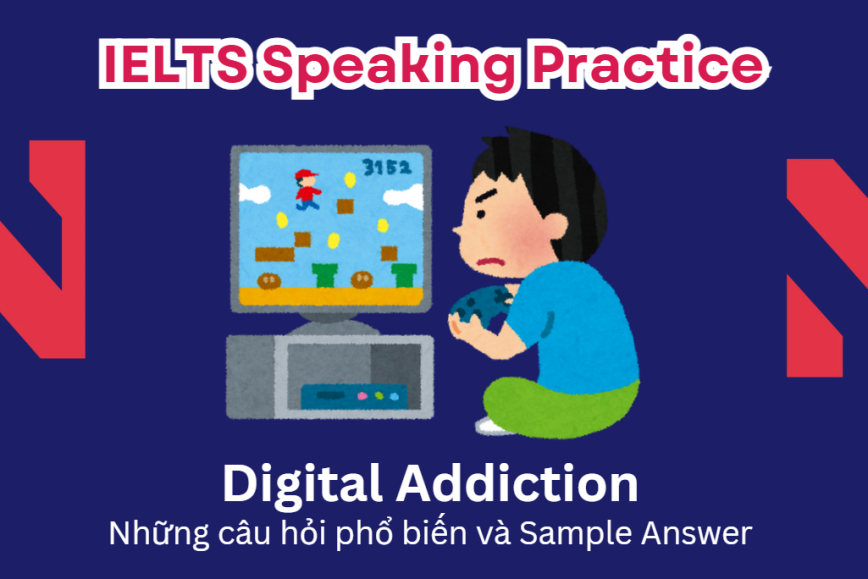
1. Questions
Part 1: Digital Addiction (10 Questions)
How much time do you spend using digital devices every day?
Do you think you use your phone too much?
What digital devices do you use most often?
Do you find it difficult to stay away from social media?
How has technology changed your daily routine?
Do you usually use your phone before sleeping?
Do you think young people are too dependent on technology?
Have you ever tried reducing your screen time?
What do people usually do online in your country?
Do you think digital addiction is a serious problem?
Part 2: Cue Card
Describe a time when you spent too much time using digital devices.
You should say:
what device you used
what you were doing
why you spent so much time on it
and explain how you felt afterward.
Part 3: Digital Addiction Discussion (10 Questions)
Why are people becoming addicted to digital devices?
What are the negative effects of digital addiction?
Do social media platforms encourage addictive behavior?
How can people reduce screen time?
Should parents limit children’s use of technology?
Is technology making communication better or worse?
Why do young people spend so much time online?
Should schools teach digital responsibility?
How has technology changed human relationships?
Do you think digital addiction will become more serious in the future?
2. Questions & Answers
Question 1: How much time do you spend using digital devices every day?
I spend quite a lot of time using digital devices every day because most of my studying, communication, and entertainment activities depend on technology. On average, I probably spend several hours using my laptop and smartphone for academic work, social media, and online research. Although technology is extremely useful, I sometimes feel that my screen time becomes excessive. Therefore, I try to manage it more carefully.
Screen time (n.phr): thời gian sử dụng màn hình
e.g: Teenagers often have high screen time.
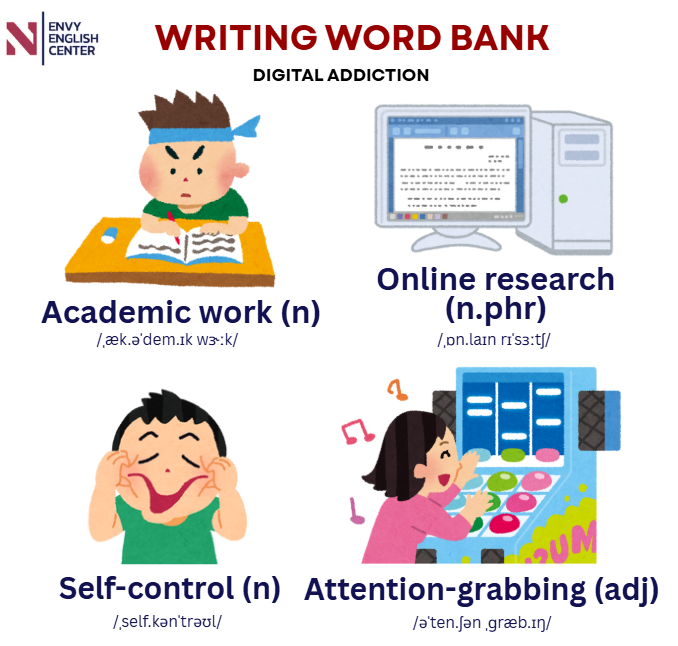
Academic work (n.phr): công việc học tập
e.g: Students use laptops for academic work.
Online research (n.phr): nghiên cứu trực tuyến
e.g: Universities encourage online research.
Excessive use (n.phr): sử dụng quá mức
e.g: Excessive phone use affects health.
Question 2: Do you think you use your phone too much?
Yes, honestly, I think I sometimes use my phone more than necessary, especially for social media and entertainment. It is very easy to lose track of time while scrolling through online content or messaging people. Although smartphones are convenient and useful, overusing them can reduce productivity and concentration. I am trying to develop healthier digital habits gradually.
Lose track of time (v.phr): mất ý thức về thời gian
e.g: People lose track of time online.
Digital habit (n.phr): thói quen kỹ thuật số
e.g: Teenagers develop digital habits.
Reduce productivity (v.phr): giảm năng suất
e.g: Distractions reduce productivity.
Healthy balance (n.phr): sự cân bằng lành mạnh
e.g: Students need healthy balance.
Question 3: What digital devices do you use most often?
The devices I use most frequently are my smartphone and laptop because they are essential for studying, communication, and entertainment. I use my laptop mainly for academic tasks such as writing assignments and researching information, while my phone is more connected to social media and daily communication. Both devices are extremely important in modern life. However, I try not to depend on them too heavily.
Academic task (n.phr): nhiệm vụ học tập
e.g: Students complete academic tasks online.
Daily communication (n.phr): giao tiếp hằng ngày
e.g: Phones support daily communication.
Depend heavily on (v.phr): phụ thuộc nhiều vào
e.g: Society depends heavily on technology.
Essential device (n.phr): thiết bị thiết yếu
e.g: Smartphones are essential devices.
Question 4: Do you find it difficult to stay away from social media?
Yes, sometimes I do because social media is designed to attract attention continuously. Notifications, short videos, and constant updates can make it difficult to stop checking apps frequently. In addition, social media helps people stay connected socially, so it easily becomes part of daily routines. I think maintaining self-control online is becoming increasingly important.
Constant update (n.phr): cập nhật liên tục
e.g: News apps provide constant updates.
Self-control (n): sự tự kiểm soát
e.g: Students need self-control online.
Daily routine (n.phr): thói quen hằng ngày
e.g: Phones affect daily routines.
Attention-grabbing (adj): thu hút sự chú ý
e.g: Social media is attention-grabbing.
Question 5: How has technology changed your daily routine?
Technology has changed my daily routine significantly because many activities such as studying, communication, shopping, and entertainment are now digitalized. I use online platforms for education, scheduling, and accessing information quickly. Although technology increases convenience and efficiency, it also sometimes creates distractions and reduces face-to-face interaction. Overall, technology has become deeply integrated into daily life.
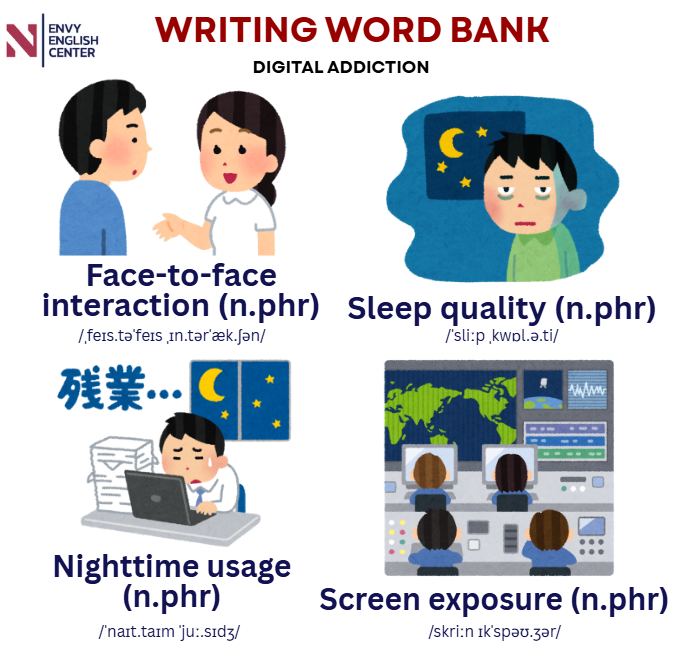
Face-to-face interaction (n.phr): tương tác trực tiếp
e.g: Technology reduces face-to-face interaction.
Digitalized activity (n.phr): hoạt động được số hóa
e.g: Education includes digitalized activities.
Increase efficiency (v.phr): tăng hiệu quả
e.g: Technology increases efficiency.
Integrated into (v.phr): tích hợp vào
e.g: Phones are integrated into modern life.
Question 6: Do you usually use your phone before sleeping?
Yes, unfortunately, I often use my phone before going to sleep, especially for social media, reading messages, or watching videos. I know this habit is not very healthy because screen exposure before sleeping can affect sleep quality and concentration the next day. I am trying to reduce nighttime phone usage gradually. Developing healthier sleep habits is important.
Sleep quality (n.phr): chất lượng giấc ngủ
e.g: Phones affect sleep quality.
Nighttime usage (n.phr): việc sử dụng ban đêm
e.g: Excessive nighttime usage is unhealthy.
Screen exposure (n.phr): tiếp xúc màn hình
e.g: Screen exposure affects sleep.
Healthy habit (n.phr): thói quen lành mạnh
e.g: Exercise creates healthy habits.
Question 7: Do you think young people are too dependent on technology?
Yes, to some extent, because technology now influences education, communication, entertainment, and even relationships. Many young people spend more time online than interacting directly with others. While technology provides many advantages, excessive dependence may reduce concentration, physical activity, and social skills. I think balance is extremely important.
Excessive dependence (n.phr): sự phụ thuộc quá mức
e.g: Society faces excessive dependence on phones.
Physical activity (n.phr): hoạt động thể chất
e.g: Exercise improves physical activity.
Social skill (n.phr): kỹ năng xã hội
e.g: Sports improve social skills.
Direct interaction (n.phr): tương tác trực tiếp
e.g: Families need direct interaction.
Question 8: Have you ever tried reducing your screen time?
Yes, I have tried reducing my screen time by limiting social media use and focusing more on offline activities such as reading, exercising, or spending time with friends. At first, it was slightly difficult because digital habits are deeply connected to daily routines. However, reducing screen time helped me concentrate better and feel less mentally exhausted. I think digital balance improves well-being.
Offline activity (n.phr): hoạt động ngoài mạng
e.g: Sports are healthy offline activities.
Mental exhaustion (n.phr): sự kiệt sức tinh thần
e.g: Stress causes mental exhaustion.
Digital balance (n.phr): cân bằng kỹ thuật số
e.g: Teenagers need digital balance.
Concentrate better (v.phr): tập trung tốt hơn
e.g: Sleep helps students concentrate better.
Question 9: What do people usually do online in your country?
People usually use the internet for social media, entertainment, studying, shopping, communication, and online business activities. Younger generations especially spend a lot of time watching videos, chatting, and following trends online. In addition, online learning and digital work have become increasingly common. Technology now affects nearly every aspect of daily life.
Online learning (n.phr): học trực tuyến
e.g: Universities support online learning.
Digital work (n.phr): công việc kỹ thuật số
e.g: Many jobs involve digital work.
Follow trend (v.phr): theo xu hướng
e.g: Teenagers follow online trends.
Aspect of life (n.phr): khía cạnh cuộc sống
e.g: Technology affects every aspect of life.
Question 10: Do you think digital addiction is a serious problem?
Yes, I think digital addiction is becoming a serious issue because excessive technology use can negatively affect mental health, productivity, relationships, and physical well-being. Many people struggle to disconnect from social media or digital entertainment for long periods. In addition, digital addiction may reduce attention span and increase stress or anxiety. I think society needs more awareness about healthy technology use.
Attention span (n.phr): khả năng tập trung
e.g: Phones reduce attention span.
Mental health (n.phr): sức khỏe tinh thần
e.g: Exercise improves mental health.
Physical well-being (n.phr): sức khỏe thể chất
e.g: Sleep improves physical well-being.
Technology awareness (n.phr): nhận thức về công nghệ
e.g: Schools teach technology awareness.
Part 2: Describe a time when you spent too much time using digital devices.
One time when I spent far too much time using a digital device was during an exam period at university when I became heavily dependent on my laptop and smartphone for both studying and entertainment. Since I had multiple assignments, online materials, and deadlines at the same time, I spent almost the entire day in front of screens. Although part of that time was necessary for academic purposes, I also wasted many hours scrolling through social media and watching short videos whenever I felt stressed or mentally tired.
During that period, my typical routine involved studying online, researching information, typing assignments, and communicating with classmates through messaging platforms. However, instead of taking proper breaks, I usually stayed on my phone continuously even after finishing academic tasks. I often told myself that I would only watch videos for a few minutes, but it easily turned into hours without me realizing it. Social media algorithms and constant notifications made it difficult to stop checking my phone repeatedly.
The main reason I spent so much time using digital devices was probably stress and mental exhaustion. When people feel overwhelmed, entertainment on social media can become an easy form of escape because it provides quick distraction and temporary relaxation. In addition, many educational activities today are already digitalized, so separating productive screen time from unnecessary usage became increasingly difficult for me. Since everything from studying to communication depended on technology, I was almost constantly connected online.
After several days of this routine, I started noticing negative effects on both my physical and mental health. My eyes felt tired, my sleep quality became worse, and I found it harder to concentrate for long periods. I also felt mentally exhausted because my brain never truly rested from digital stimulation. Even when I stopped studying, I was still consuming online content continuously instead of relaxing properly. As a result, I became less productive and more emotionally drained overall.
Eventually, I realized that I needed healthier digital habits and better self-discipline. I started setting limits on social media usage, turning off unnecessary notifications, and taking breaks away from screens whenever possible. I also tried replacing some online entertainment with offline activities such as exercising, reading, or simply resting without using my phone. Although reducing screen time was difficult at first, I gradually felt more focused and emotionally balanced afterward.
Overall, this experience taught me that technology itself is not necessarily harmful, but excessive and uncontrolled usage can negatively affect health, concentration, and emotional well-being. Digital devices are extremely useful for education and communication, but maintaining balance is essential. I think learning how to manage technology responsibly is becoming one of the most important skills in modern life.
Mental exhaustion (n.phr): sự kiệt sức tinh thần
e.g: Stress causes mental exhaustion.
Digital stimulation (n.phr): kích thích kỹ thuật số
e.g: Phones create constant digital stimulation.
Self-discipline (n): tính tự kỷ luật
e.g: Students need self-discipline.
Screen addiction (n.phr): nghiện màn hình
e.g: Teenagers face screen addiction.
Emotionally drained (adj.phr): kiệt quệ cảm xúc
e.g: Overwork makes people emotionally drained.
Social media algorithm (n.phr): thuật toán mạng xã hội
e.g: Algorithms influence online behavior.
Offline activity (n.phr): hoạt động ngoài mạng
e.g: Sports are healthy offline activities.
Emotional well-being (n.phr): sức khỏe tinh thần
e.g: Sleep improves emotional well-being.
Part 3: Discussion
Question: Why are people becoming addicted to digital devices?
People are becoming addicted to digital devices because modern technology is designed to attract and maintain attention continuously. Social media platforms, games, and online entertainment provide instant satisfaction and constant stimulation, which can easily create addictive behavior. In addition, many people rely on technology for communication, education, and work, so digital devices become deeply integrated into daily life. I think convenience and psychological dependence are major reasons.
Instant satisfaction (n.phr): sự thỏa mãn tức thời
e.g: Social media provides instant satisfaction.
Addictive behavior (n.phr): hành vi gây nghiện
e.g: Games may encourage addictive behavior.
Psychological dependence (n.phr): sự phụ thuộc tâm lý
e.g: Phones create psychological dependence.
Constant stimulation (n.phr): kích thích liên tục
e.g: Digital apps provide constant stimulation.
Question: What are the negative effects of digital addiction?
Digital addiction can negatively affect mental health, physical health, productivity, and relationships. Excessive screen time may reduce sleep quality, concentration, and physical activity while increasing stress and anxiety. In addition, people who spend too much time online may experience social isolation and reduced face-to-face communication. I think balance is extremely important in technology use.
Social isolation (n.phr): sự cô lập xã hội
e.g: Excessive gaming may cause social isolation.
Face-to-face communication (n.phr): giao tiếp trực tiếp
e.g: Families need face-to-face communication.
Physical health (n.phr): sức khỏe thể chất
e.g: Exercise improves physical health.
Excessive screen time (n.phr): thời gian màn hình quá mức
e.g: Excessive screen time affects sleep.
Question: Do social media platforms encourage addictive behavior?
Yes, definitely. Many social media platforms are intentionally designed to keep users online as long as possible through notifications, personalized content, and endless scrolling systems. These features stimulate curiosity and emotional reactions continuously, making it difficult for users to stop using apps. I think social media companies benefit financially from user attention.
Personalized content (n.phr): nội dung cá nhân hóa
e.g: Apps provide personalized content.
Endless scrolling (n.phr): cuộn vô tận
e.g: Endless scrolling wastes time.
User attention (n.phr): sự chú ý của người dùng
e.g: Companies compete for user attention.
Emotional reaction (n.phr): phản ứng cảm xúc
e.g: Media influences emotional reactions.
Question: How can people reduce screen time?
People can reduce screen time by setting usage limits, turning off unnecessary notifications, and spending more time on offline activities such as sports, reading, or socializing directly with others. Creating fixed study or rest schedules may also help improve self-discipline. In addition, people should become more aware of how digital habits affect mental health and productivity.
Usage limit (n.phr): giới hạn sử dụng
e.g: Apps allow usage limits.
Self-discipline (n): tính tự kỷ luật
e.g: Students need self-discipline.
Offline lifestyle (n.phr): lối sống ít trực tuyến
e.g: Exercise supports offline lifestyles.
Digital awareness (n.phr): nhận thức kỹ thuật số
e.g: Schools teach digital awareness.
Question: Should parents limit children’s use of technology?
Yes, I think parents should guide and limit children’s technology use reasonably because excessive screen exposure may affect child development, concentration, and social skills. However, completely banning technology is unrealistic because digital skills are essential in modern life. The most important thing is teaching children healthy and balanced technology habits. I think parental guidance is extremely important.
Parental guidance (n.phr): sự hướng dẫn của phụ huynh
e.g: Children need parental guidance.
Screen exposure (n.phr): tiếp xúc màn hình
e.g: Excessive screen exposure is unhealthy.
Child development (n.phr): sự phát triển trẻ em
e.g: Education supports child development.
Balanced habit (n.phr): thói quen cân bằng
e.g: Families encourage balanced habits.
Question: Is technology making communication better or worse?
I think technology has improved communication in many ways because people can connect instantly regardless of distance. Messaging apps and video calls make communication faster and more convenient. However, excessive dependence on digital communication may weaken face-to-face interaction and emotional connection in some situations. Overall, technology is useful, but balance remains important.
Emotional connection (n.phr): kết nối cảm xúc
e.g: Families need emotional connection.
Digital communication (n.phr): giao tiếp kỹ thuật số
e.g: Technology improves digital communication.
Instant connection (n.phr): kết nối tức thời
e.g: Phones provide instant connection.
Face-to-face interaction (n.phr): tương tác trực tiếp
e.g: Offices encourage face-to-face interaction.
Question: Why do young people spend so much time online?
Young people spend a lot of time online because the internet is connected to entertainment, education, communication, and social trends. Social media platforms are especially attractive because they provide fast information, interaction, and entertainment continuously. In addition, many young people fear missing out on trends or online conversations. I think online culture strongly influences younger generations.
Fear of missing out (n.phr): hội chứng sợ bị bỏ lỡ
e.g: Social media creates fear of missing out.
Online culture (n.phr): văn hóa trực tuyến
e.g: Teenagers are influenced by online culture.
Social trend (n.phr): xu hướng xã hội
e.g: Young people follow social trends.
Continuous entertainment (n.phr): giải trí liên tục
e.g: Apps provide continuous entertainment.
Question: Should schools teach digital responsibility?
Yes, definitely. Schools should teach students how to use technology responsibly because digital devices now affect nearly every aspect of life. Students should learn about online safety, privacy protection, screen-time management, and critical thinking online. Digital education is becoming just as important as traditional academic subjects. I think responsible technology use should be taught early.
Privacy protection (n.phr): bảo vệ quyền riêng tư
e.g: Apps require privacy protection.
Critical thinking (n.phr): tư duy phản biện
e.g: Schools teach critical thinking.
Online safety (n.phr): an toàn trực tuyến
e.g: Parents teach online safety.
Screen-time management (n.phr): quản lý thời gian màn hình
e.g: Teenagers need screen-time management.
Question: How has technology changed human relationships?
Technology has changed relationships by making communication faster and more convenient, especially for people living far apart. However, digital communication sometimes feels less personal and emotionally deep compared to direct interaction. Social media may also create comparison, misunderstandings, or emotional pressure. I think technology improves connection but can weaken relationship quality if overused.
Relationship quality (n.phr): chất lượng mối quan hệ
e.g: Communication affects relationship quality.
Emotional pressure (n.phr): áp lực cảm xúc
e.g: Social media creates emotional pressure.
Digital interaction (n.phr): tương tác kỹ thuật số
e.g: Teenagers prefer digital interaction.
Personal connection (n.phr): kết nối cá nhân
e.g: Families need personal connection.
Question: Do you think digital addiction will become more serious in the future?
Yes, probably, because technology is becoming increasingly integrated into work, education, entertainment, and daily life. Artificial intelligence, virtual reality, and social media algorithms may make digital experiences even more immersive and addictive. Unless people develop stronger self-control and digital awareness, excessive technology dependence could become a major social issue. I think society will need healthier digital habits in the future.
Virtual reality (n.phr): thực tế ảo
e.g: Companies develop virtual reality.
Immersive experience (n.phr): trải nghiệm nhập vai
e.g: Games provide immersive experiences.
Technology dependence (n.phr): sự phụ thuộc công nghệ
e.g: Society faces technology dependence.
Major social issue (n.phr): vấn đề xã hội lớn
e.g: Pollution is a major social issue.
Nếu bạn đang bắt đầu từ con số 0 hoặc đã học nhưng “dậm chân tại chỗ”, Envy English Center có thể đồng hành cùng bạn:
Test trình độ miễn phí theo format IELTS để biết chính xác điểm mạnh – điểm yếu.
Nhận lộ trình học cá nhân hóa từ 0 → 6.5+, phù hợp tốc độ và mục tiêu.
Trực tiếp học với giáo viên IELTS 8.0+, chuyên “gỡ rối” Speaking & Writing – hai kỹ năng khó nâng band nhất.
Đặc biệt, khi đăng ký trong tuần này, bạn được tặng bộ từ vựng chuẩn IELTS band 7+.
📞 Hotline: 028 7300 9677 / 0948 197 270 (Zalo)
🌐 Website: envyenglish.vn
📍 Địa chỉ: 46/5 Tân Cảng, Phường Thạnh Mỹ Tây, Quận Bình Thạnh, TP.HCM


Thông tin gửi đi không thành công, vui lòng thử lại sau.
Nếu bạn cần liên hệ gấp, vui lòng gọi hotline
02873009677

Cảm ơn bạn đã gửi thông tin đến Envy English Center.
Chúng tôi sẽ liên hệ với bạn sớm nhất khi có thể.
Nếu bạn cần liên hệ gấp, vui lòng gọi hotline
02873009677
Thông tin gửi đi không thành công, vui lòng thử lại sau.
Nếu bạn cần liên hệ gấp, vui lòng gọi hotline
02873009677
Bạn đang có một bài test chưa hoàn thành.
Bạn có muốn tiếp tục bài test đó không?
Bạn có chắc là muốn gửi bài test này không?

Số câu trả lời đúng/40

Số câu trả lời đúng/40
Thông tin gửi đi không thành công, vui lòng thử lại sau.
Nếu bạn cần liên hệ gấp, vui lòng gọi hotline
02873009677
Thời gian làm bài kiểm tra đã hết.
Cảm ơn bạn đã cố gắng.
