 02873009677
 contact@envyenglish.vn

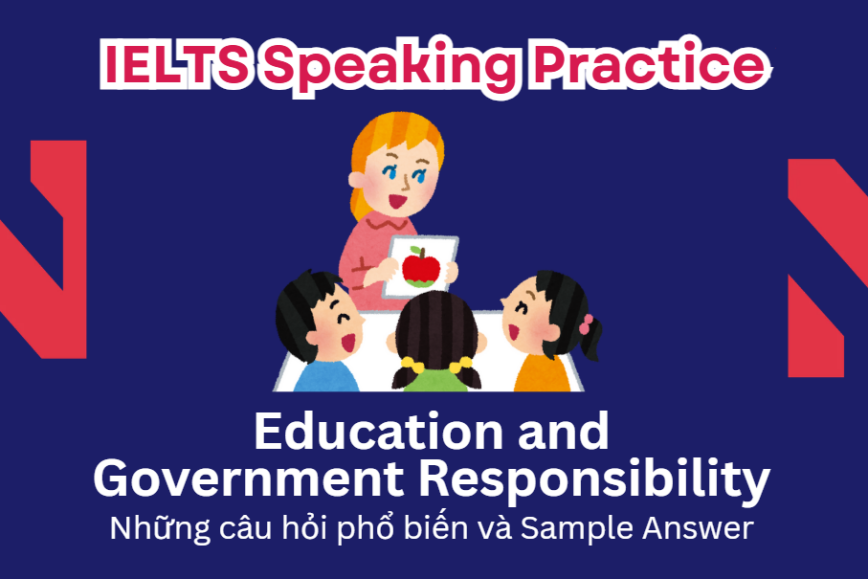
1. Questions
Part 1: Education (10 Questions)
Do you enjoy studying?
What subject did you like most at school?
Do you think education is important?
Would you like to continue studying in the future?
What makes a good teacher?
Do you prefer studying alone or in groups?
Has technology changed the way people learn?
What skills should schools teach students?
Is higher education popular in your country?
How can students become more effective learners?
Part 2: Cue Card (1 Question)
Describe a teacher or educator who had a positive influence on you.
You should say:
who this person was
when you knew them
what they taught you
and explain why they influenced you.
Part 3: Education and Government Responsibility Discussion (10 Questions)
Should education be free for everyone?
What responsibilities do governments have regarding education?
Is it better to invest in primary education or higher education?
Should governments spend more money on education?
How can governments improve educational quality?
Should private schools receive government support?
Is education the best way to reduce social inequality?
What role does technology play in public education?
Should governments control school curricula?
How might education systems change in the future?
2. Questions & Answers
Question 1: Do you enjoy studying?
Yes, I do. I enjoy learning new things, especially subjects that help me understand society, language, and the world around me. Studying also allows me to develop useful skills and achieve my academic goals.
Lifelong learning (n.phr): học tập suốt đời
e.g: Lifelong learning is important.
Academic goal (n.phr): mục tiêu học tập
e.g: Students should have academic goals.
Knowledge acquisition (n.phr): tiếp thu kiến thức
e.g: Education promotes knowledge acquisition.
Intellectual growth (n.phr): phát triển trí tuệ
e.g: Reading supports intellectual growth.
Question 2: What subject did you like most at school?
My favorite subject was English because it allowed me to communicate with people from different countries and access a wide range of information. I also enjoyed learning about different cultures through the language.
Language proficiency (n.phr): trình độ ngôn ngữ
e.g: English improves language proficiency.
Cross-cultural communication (n.phr): giao tiếp liên văn hóa
e.g: English supports cross-cultural communication.
Global perspective (n.phr): góc nhìn toàn cầu
e.g: Languages provide a global perspective.
Communication skill (n.phr): kỹ năng giao tiếp
e.g: English develops communication skills.
Question 3: Do you think education is important?
Absolutely. Education helps individuals acquire knowledge, develop critical thinking skills, and improve their future opportunities. It also contributes to economic and social development.
Critical thinking (n.phr): tư duy phản biện
e.g: Education develops critical thinking.
Future opportunity (n.phr): cơ hội tương lai
e.g: Education creates future opportunities.
Social development (n.phr): phát triển xã hội
e.g: Education supports social development.
Human capital (n.phr): nguồn nhân lực chất lượng cao
e.g: Education strengthens human capital.
Question 4: Would you like to continue studying in the future?
Yes, definitely. I believe continuous learning is essential in today's rapidly changing world. I would like to pursue further education and professional qualifications throughout my career.
Further education (n.phr): học vấn cao hơn
e.g: Many professionals pursue further education.
Professional qualification (n.phr): chứng chỉ chuyên môn
e.g: Qualifications improve employability.
Continuous improvement (n.phr): cải thiện liên tục
e.g: Learning supports continuous improvement.
Career development (n.phr): phát triển nghề nghiệp
e.g: Education aids career development.
Question 5: What makes a good teacher?
A good teacher should be knowledgeable, patient, supportive, and able to explain complex ideas clearly. They should also inspire students to become curious and independent learners.
Teaching method (n.phr): phương pháp giảng dạy
e.g: Effective teaching methods matter.
Student engagement (n.phr): sự tham gia của học sinh
e.g: Good teachers increase student engagement.
Learning motivation (n.phr): động lực học tập
e.g: Teachers encourage learning motivation.
Educational guidance (n.phr): định hướng giáo dục
e.g: Teachers provide educational guidance.
Question 6: Do you prefer studying alone or in groups?
I prefer a combination of both. Studying alone helps me concentrate, while group study sessions allow me to exchange ideas and learn from others.
Independent study (n.phr): tự học
e.g: Independent study improves concentration.
Collaborative learning (n.phr): học tập hợp tác
e.g: Collaborative learning encourages discussion.
Knowledge sharing (n.phr): chia sẻ kiến thức
e.g: Group work promotes knowledge sharing.
Study efficiency (n.phr): hiệu quả học tập
e.g: Students seek study efficiency.
Question 7: Has technology changed the way people learn?
Yes, significantly. Technology provides access to online courses, educational resources, and interactive learning platforms, making education more flexible and accessible.
Online learning (n.phr): học trực tuyến
e.g: Online learning is increasingly popular.
Educational resource (n.phr): tài nguyên giáo dục
e.g: Students use educational resources.
Digital platform (n.phr): nền tảng số
e.g: Digital platforms support learning.
Learning accessibility (n.phr): khả năng tiếp cận giáo dục
e.g: Technology improves learning accessibility.
Question 8: What skills should schools teach students?
Schools should teach both academic knowledge and practical life skills, including communication, critical thinking, financial literacy, teamwork, and problem-solving.
Financial literacy (n.phr): hiểu biết tài chính
e.g: Schools should teach financial literacy.
Problem-solving skill (n.phr): kỹ năng giải quyết vấn đề
e.g: Students need problem-solving skills.
Practical skill (n.phr): kỹ năng thực tiễn
e.g: Education should include practical skills.
Workplace readiness (n.phr): sự sẵn sàng cho công việc
e.g: Schools prepare students for workplace readiness.
Question 9: Is higher education popular in your country?
Yes, higher education is highly valued because many people view it as a pathway to better career opportunities and social mobility. As a result, university enrollment rates have increased over time.
Higher education (n.phr): giáo dục đại học
e.g: Higher education is widely valued.
University enrollment (n.phr): tuyển sinh đại học
e.g: University enrollment is increasing.
Career opportunity (n.phr): cơ hội nghề nghiệp
e.g: Degrees improve career opportunities.
Social mobility (n.phr): khả năng thăng tiến xã hội
e.g: Education supports social mobility.
Question 10: How can students become more effective learners?
Students can improve by setting clear goals, managing their time effectively, practicing consistently, and developing active learning strategies such as note-taking and self-testing.
Time management (n.phr): quản lý thời gian
e.g: Time management improves performance.
Active learning (n.phr): học tập chủ động
e.g: Active learning increases retention.
Study habit (n.phr): thói quen học tập
e.g: Good study habits are essential.
Goal setting (n.phr): đặt mục tiêu
e.g: Goal setting improves motivation.
Nếu bạn đang bắt đầu từ con số 0 hoặc đã học nhưng “dậm chân tại chỗ”, Envy English Center có thể đồng hành cùng bạn:
Test trình độ miễn phí theo format IELTS để biết chính xác điểm mạnh – điểm yếu.
Nhận lộ trình học cá nhân hóa từ 0 → 6.5+, phù hợp tốc độ và mục tiêu.
Trực tiếp học với giáo viên IELTS 8.0+, chuyên “gỡ rối” Speaking & Writing – hai kỹ năng khó nâng band nhất.
Đặc biệt, khi đăng ký trong tuần này, bạn được tặng bộ từ vựng chuẩn IELTS band 7+.
📞 Hotline: 028 7300 9677 / 0948 197 270 (Zalo)
🌐 Website: envyenglish.vn
📍 Địa chỉ: 46/5 Tân Cảng, Phường Thạnh Mỹ Tây, Quận Bình Thạnh, TP.HCM

Thông tin gửi đi không thành công, vui lòng thử lại sau.
Nếu bạn cần liên hệ gấp, vui lòng gọi hotline
02873009677

Cảm ơn bạn đã gửi thông tin đến Envy English Center.
Chúng tôi sẽ liên hệ với bạn sớm nhất khi có thể.
Nếu bạn cần liên hệ gấp, vui lòng gọi hotline
02873009677
Thông tin gửi đi không thành công, vui lòng thử lại sau.
Nếu bạn cần liên hệ gấp, vui lòng gọi hotline
02873009677
Bạn đang có một bài test chưa hoàn thành.
Bạn có muốn tiếp tục bài test đó không?
Bạn có chắc là muốn gửi bài test này không?

Số câu trả lời đúng/40

Số câu trả lời đúng/40
Thông tin gửi đi không thành công, vui lòng thử lại sau.
Nếu bạn cần liên hệ gấp, vui lòng gọi hotline
02873009677
Thời gian làm bài kiểm tra đã hết.
Cảm ơn bạn đã cố gắng.
