 02873009677
 contact@envyenglish.vn


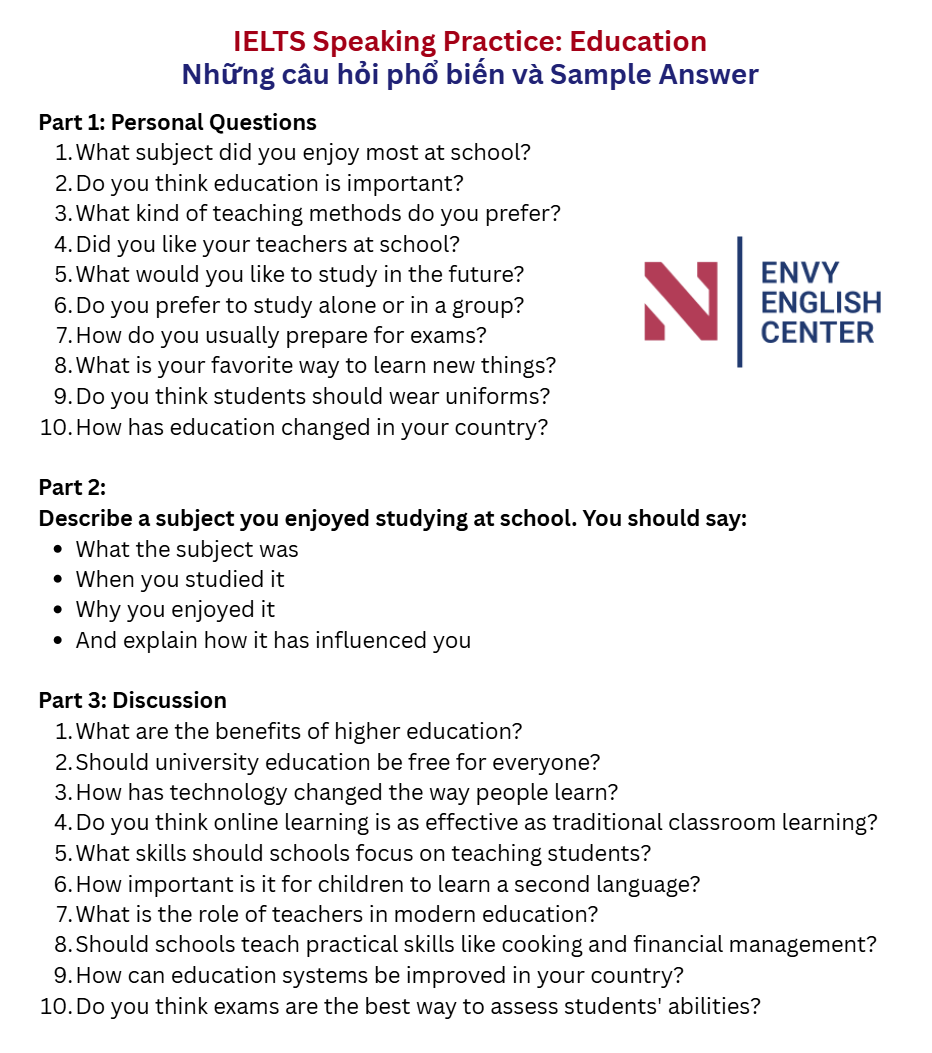
What subject did you enjoy most at school?
Do you think education is important?
What kind of teaching methods do you prefer?
Did you like your teachers at school?
What would you like to study in the future?
Do you prefer to study alone or in a group?
How do you usually prepare for exams?
What is your favorite way to learn new things?
Do you think students should wear uniforms?
How has education changed in your country?
Describe a subject you enjoyed studying at school.
You should say:
What the subject was
When you studied it
Why you enjoyed it
And explain how it has influenced you
What are the benefits of higher education?
Should university education be free for everyone?
How has technology changed the way people learn?
Do you think online learning is as effective as traditional classroom learning?
What skills should schools focus on teaching students?
How important is it for children to learn a second language?
What is the role of teachers in modern education?
Should schools teach practical skills like cooking and financial management?
How can education systems be improved in your country?
Do you think exams are the best way to assess students' abilities?
Question 1: What subject did you enjoy most at school?
Sample Answer:
I was particularly fond of literature during my secondary school years. I found it fascinating how authors could convey complex emotions and social commentary through their writing. The discussions we had in class about symbolism and character development really stimulated my critical thinking abilities. Moreover, analyzing different literary works helped me develop a deeper appreciation for language and storytelling, which has proven invaluable in my communication skills today.
Vocabulary & Collocations:
Particularly Fond Of (phrase): đặc biệt yêu thích
E.g: I am particularly fond of classical music because it helps me concentrate.
Convey (verb): truyền tải, diễn đạt
E.g: The speaker conveyed her message with clarity and passion.
Social Commentary (noun phrase): bình luận xã hội
E.g: Many films serve as social commentary on contemporary issues.
Stimulated (verb): kích thích, khuyến khích
E.g: The documentary stimulated an interesting debate among viewers.
Critical Thinking Abilities (noun phrase): khả năng tư duy phản biện
E.g: Universities aim to develop students' critical thinking abilities through research projects.
Invaluable (adjective): vô cùng quý giá, vô giá
E.g: Her mentor's guidance proved invaluable during her career transition.
Question 2: Do you think education is important?
Sample Answer:
Absolutely, I believe education is fundamental to both personal and societal development. It equips individuals with the knowledge and skills necessary to navigate an increasingly complex world. Beyond academic learning, education fosters critical thinking, creativity, and social awareness. From a broader perspective, well-educated populations tend to drive economic growth and innovation, while also being better equipped to address global challenges such as climate change and inequality.
Fundamental To (phrase): nền tảng cho, thiết yếu cho
E.g: Trust is fundamental to any successful relationship.
Equips (verb): trang bị
E.g: The training program equips employees with essential digital skills.
Navigate (verb): điều hướng, vượt qua
E.g: Young professionals must navigate a competitive job market.
Fosters (verb): nuôi dưỡng, thúc đẩy
E.g: A supportive environment fosters creativity and innovation.
Social Awareness (noun phrase): nhận thức xã hội
E.g: Schools should develop students' social awareness through community projects.
Drive Economic Growth (verb phrase): thúc đẩy tăng trưởng kinh tế
E.g: Investment in infrastructure can drive economic growth in developing regions.
Question 3: What kind of teaching methods do you prefer?
Sample Answer:
I'm drawn to interactive and student-centered approaches rather than traditional lecture-based methods. I find that hands-on activities and collaborative projects enhance understanding and retention significantly. For instance, when teachers incorporate real-world examples and case studies, the material becomes more relevant and engaging. Additionally, I appreciate when educators encourage open discussion and debate, as this allows students to develop their own perspectives while learning from their peers.
Vocabulary & Collocations:
Drawn To (phrase): bị thu hút bởi
E.g: Many young people are drawn to careers in technology and innovation.
Student-Centered Approaches (noun phrase): phương pháp lấy học sinh làm trung tâm
E.g: Student-centered approaches promote active learning and engagement.
Hands-On Activities (noun phrase): hoạt động thực hành
E.g: Science classes benefit greatly from hands-on activities and experiments.
Retention (noun): khả năng ghi nhớ, duy trì
E.g: Visual aids can improve information retention among students.
Incorporate (verb): kết hợp, tích hợp
E.g: Modern curricula incorporate technology into daily lessons.
Perspectives (noun): quan điểm, góc nhìn
E.g: Traveling abroad broadens one's perspectives on different cultures.
Question 4: Did you like your teachers at school?
Sample Answer:
Generally speaking, I had positive experiences with most of my teachers. What I valued most was their dedication and genuine interest in our academic progress. Some teachers went above and beyond their job descriptions, offering extra tutoring sessions and mentorship. However, I did encounter a few who seemed disengaged and relied heavily on rote learning methods. Looking back, the teachers who made the most impact were those who treated us as individuals and adapted their teaching styles to suit different learning needs.
Vocabulary & Collocations:
Generally Speaking (phrase): nói chung
E.g: Generally speaking, people prefer face-to-face communication over emails.
Dedication (noun): sự tận tâm, cống hiến
E.g: The team's dedication to the project was evident in their results.
Went Above And Beyond (phrase): làm vượt mức mong đợi
E.g: The customer service representative went above and beyond to resolve my issue.
Disengaged (adjective): thờ ơ, không quan tâm
E.g: Disengaged employees often produce lower quality work.
Rote Learning (noun phrase): học vẹt, học thuộc lòng
E.g: Rote learning may help with memorization but limits critical thinking.
Adapted (verb): điều chỉnh, thích nghi
E.g: Successful teachers adapted their methods during the pandemic.
Question 5: What would you like to study in the future?
Sample Answer:
I'm contemplating pursuing postgraduate studies in sustainable development or environmental policy. Given the escalating climate crisis, I believe these fields offer opportunities to make meaningful contributions to society. I'm particularly interested in exploring how policy frameworks can incentivize businesses to adopt more environmentally responsible practices. Additionally, I'd like to gain expertise in data analysis and research methodologies, as these skills are crucial for evidence-based policy making.
Vocabulary & Collocations:
Contemplating (verb): cân nhắc, suy ngẫm
E.g: She is contemplating a career change after ten years in finance.
Postgraduate Studies (noun phrase): học sau đại học
E.g: Postgraduate studies require significant commitment and self-discipline.
Escalating (adjective): leo thang, gia tăng
E.g: The escalating costs of healthcare are a major concern for governments.
Meaningful Contributions (noun phrase): đóng góp có ý nghĩa
E.g: Volunteers make meaningful contributions to their communities.
Policy Frameworks (noun phrase): khung chính sách
E.g: Effective policy frameworks balance economic growth with environmental protection.
Evidence-Based (adjective): dựa trên bằng chứng
E.g: Medical professionals rely on evidence-based practices for patient care.
Question 6: Do you prefer to study alone or in a group?
Sample Answer:
It largely depends on the nature of the task at hand. For intensive reading and initial comprehension of complex material, I prefer solitary study as it allows me to work at my own pace without distractions. However, when it comes to reviewing concepts or preparing for exams, I find group study sessions incredibly beneficial. Discussing topics with peers helps identify gaps in my understanding and exposes me to different interpretations and problem-solving approaches. The key is striking the right balance between independent and collaborative learning.
Vocabulary & Collocations:
Nature Of The Task (phrase): bản chất của nhiệm vụ
E.g: The nature of the task determines which tools we should use.
Solitary Study (noun phrase): học một mình
E.g: Some students achieve better results through solitary study.
At My Own Pace (phrase): theo nhịp độ của riêng tôi
E.g: Online courses allow learners to progress at their own pace.
Incredibly Beneficial (phrase): cực kỳ có lợi
E.g: Regular exercise is incredibly beneficial for mental health.
Gaps In Understanding (phrase): khoảng trống trong hiểu biết
E.g: Practice tests help identify gaps in understanding before final exams.
Striking The Right Balance (phrase): tìm được sự cân bằng phù hợp
E.g: Striking the right balance between work and leisure is essential for wellbeing.
Question 7: How do you usually prepare for exams?
Sample Answer:
My exam preparation typically follows a structured approach. I begin by creating a comprehensive revision schedule several weeks in advance, allocating specific time blocks for each subject area. I prioritize understanding core concepts rather than mere memorization, often using techniques like mind mapping and summarizing key points in my own words. Additionally, I make extensive use of past papers to familiarize myself with the exam format and identify recurring themes. In the final days before the exam, I focus on consolidating my knowledge and ensuring adequate rest rather than cramming.
Vocabulary & Collocations:
Structured Approach (noun phrase): phương pháp có cấu trúc
E.g: A structured approach to project management improves efficiency.
Comprehensive Revision Schedule (noun phrase): lịch ôn tập toàn diện
E.g: Creating a comprehensive revision schedule helps students manage their time effectively.
Allocating (verb): phân bổ
E.g: The government is allocating more funds to public education.
Mere Memorization (noun phrase): chỉ ghi nhớ đơn thuần
E.g: Mere memorization without understanding leads to poor long-term retention.
Familiarize Myself With (phrase): làm quen với
E.g: I need to familiarize myself with the new software before the presentation.
Consolidating (verb): củng cố
E.g: The final review session focuses on consolidating previously learned material.
Question 8: What is your favorite way to learn new things?
Sample Answer:
I'm a strong advocate of experiential learning through practical application. I find that actually doing something, rather than just reading about it, leads to much deeper understanding and longer retention. For instance, when learning a new language, I prefer immersing myself in authentic materials like films and podcasts rather than solely relying on textbooks. I also value learning from mentors and experts in the field, as their insights and real-world experiences provide context that theoretical knowledge alone cannot offer.
Vocabulary & Collocations:
Strong Advocate Of (phrase): người ủng hộ mạnh mẽ
E.g: She is a strong advocate of renewable energy initiatives.
Experiential Learning (noun phrase): học tập trải nghiệm
E.g: Experiential learning opportunities include internships and field trips.
Practical Application (noun phrase): ứng dụng thực tế
E.g: The course emphasizes practical application of theoretical concepts.
Immersing Myself In (phrase): đắm mình vào
E.g: Immersing myself in local culture enhanced my travel experience.
Authentic Materials (noun phrase): tài liệu thực tế
E.g: Language teachers should use authentic materials to expose students to natural language use.
Theoretical Knowledge (noun phrase): kiến thức lý thuyết
E.g: Theoretical knowledge must be complemented with practical skills.
Question 9: Do you think students should wear uniforms?
Sample Answer:
This is quite a contentious issue with valid arguments on both sides. Personally, I lean towards supporting school uniforms, primarily because they promote equality and reduce socioeconomic distinctions among students. Uniforms can also foster a sense of belonging and school identity, which may positively impact student behavior and academic focus. However, I acknowledge that uniforms can limit self-expression, which is an important aspect of adolescent development. Perhaps a compromise would be having uniforms with some flexibility for personal touches.
Vocabulary & Collocations:
Contentious Issue (noun phrase): vấn đề gây tranh cãi
E.g: Climate change policy remains a contentious issue in many countries.
Lean Towards (phrase): nghiêng về, có xu hướng
E.g: Most experts lean towards supporting stricter regulations.
Socioeconomic Distinctions (noun phrase): sự phân biệt kinh tế xã hội
E.g: Education should minimize socioeconomic distinctions among students.
Foster A Sense Of Belonging (phrase): nuôi dưỡng cảm giác thuộc về
E.g: Team-building activities foster a sense of belonging among employees.
Self-Expression (noun): sự thể hiện bản thân
E.g: Art classes provide opportunities for self-expression and creativity.
Adolescent Development (noun phrase): sự phát triển của thanh thiếu niên
E.g: Social interaction is crucial for healthy adolescent development.
Question 10: How has education changed in your country?
Sample Answer:
Education in Vietnam has undergone substantial transformation over the past few decades. There's been a notable shift from teacher-centered, examination-oriented approaches towards more progressive, competency-based methods. Technology integration has become increasingly prevalent, with digital learning platforms and interactive tools now commonplace in many schools. Additionally, there's growing emphasis on developing soft skills, critical thinking, and creativity rather than focusing exclusively on rote memorization. However, challenges remain, particularly regarding educational equity between urban and rural areas, and the pressure of high-stakes examinations still persists.
Vocabulary & Collocations:
Undergone Substantial Transformation (phrase): trải qua sự chuyển đổi đáng kể
E.g: The healthcare system has undergone substantial transformation in recent years.
Notable Shift (noun phrase): sự chuyển dịch đáng chú ý
E.g: There has been a notable shift in consumer preferences towards sustainable products.
Examination-Oriented (adjective): định hướng thi cử
E.g: Examination-oriented education systems may neglect holistic student development.
Competency-Based Methods (noun phrase): phương pháp dựa trên năng lực
E.g: Competency-based methods assess what students can actually do with their knowledge.
Increasingly Prevalent (phrase): ngày càng phổ biến
E.g: Remote working has become increasingly prevalent since the pandemic.
Educational Equity (noun phrase): công bằng giáo dục
E.g: Governments must address educational equity to ensure equal opportunities for all children.
Describe a subject you enjoyed studying at school.
Sample Answer:
I'd like to talk about history, which was undoubtedly my favorite subject throughout secondary school. I studied it intensively during my final three years, preparing for the national examination.
What captivated me most about history was its narrative quality and the way it illuminated the present through understanding the past. Unlike subjects that focused purely on formulas or grammar rules, history allowed me to explore the complexity of human nature, political systems, and social evolution. I was particularly fascinated by modern Vietnamese history and the various factors that shaped our nation's development.
My enthusiasm for the subject was largely due to my exceptional teacher, Mr. Thanh, who brought historical events to life through vivid storytelling and thought-provoking discussions. Rather than having us memorize dates and names, he encouraged us to analyze causes and consequences, to consider multiple perspectives, and to draw connections between historical events and contemporary issues. His classes often felt more like intellectual debates than traditional lessons.
The influence of studying history has been profound and lasting. It developed my analytical skills and taught me to question assumptions and examine evidence critically. This historical perspective has proven invaluable in understanding current affairs and making informed decisions. Moreover, it cultivated my interest in reading and research, habits that continue to enrich my life. Perhaps most importantly, studying history instilled in me a deep appreciation for the sacrifices of previous generations and a sense of responsibility towards shaping a better future.
Vocabulary & Collocations:
Undoubtedly (adverb): không nghi ngờ gì, chắc chắn
E.g: She is undoubtedly one of the most talented musicians of her generation.
Intensively (adverb): một cách chuyên sâu
E.g: Athletes train intensively before major competitions.
Captivated (verb): mê hoặc, quyến rũ
E.g: The audience was captivated by the speaker's compelling presentation.
Narrative Quality (noun phrase): tính chất tường thuật
E.g: Good documentaries combine factual accuracy with strong narrative quality.
Illuminated (verb): làm sáng tỏ, làm rõ
E.g: The research illuminated previously unknown aspects of the disease.
Complexity Of Human Nature (phrase): sự phức tạp của bản chất con người
E.g: Great literature explores the complexity of human nature.
Social Evolution (noun phrase): sự tiến hóa xã hội
E.g: Technology has accelerated social evolution in recent decades.
Exceptional Teacher (noun phrase): giáo viên xuất sắc
E.g: An exceptional teacher can inspire lifelong learning in students.
Brought To Life (phrase): làm sinh động
E.g: The museum's interactive exhibits brought history to life for visitors.
Thought-Provoking Discussions (noun phrase): các cuộc thảo luận kích thích tư duy
E.g: University seminars should facilitate thought-provoking discussions.
Analyze Causes And Consequences (phrase): phân tích nguyên nhân và hậu quả
E.g: Critical thinking requires the ability to analyze causes and consequences.
Multiple Perspectives (noun phrase): nhiều quan điểm
E.g: Considering multiple perspectives leads to more balanced judgments.
Contemporary Issues (noun phrase): các vấn đề đương đại
E.g: The curriculum addresses contemporary issues such as climate change and inequality.
Intellectual Debates (noun phrase): các cuộc tranh luận trí tuệ
E.g: Academic conferences provide forums for intellectual debates.
Profound And Lasting (phrase): sâu sắc và lâu dài
E.g: Travel experiences can have a profound and lasting impact on personal development.
Question Assumptions (phrase): đặt câu hỏi về các giả định
E.g: Scientists must constantly question assumptions to advance knowledge.
Examine Evidence Critically (phrase): xem xét bằng chứng một cách phê phán
E.g: Journalists should examine evidence critically before publishing stories.
Historical Perspective (noun phrase): góc nhìn lịch sử
E.g: A historical perspective helps us understand the roots of current conflicts.
Current Affairs (noun phrase): thời sự
E.g: Staying informed about current affairs is essential for engaged citizenship.
Cultivated (verb): trau dồi, nuôi dưỡng
E.g: Reading widely cultivated her appreciation for different writing styles.
Instilled In (phrase): thấm nhuần vào
E.g: Good parenting instills values of honesty and respect in children.
Sense Of Responsibility (phrase): ý thức trách nhiệm
E.g: Volunteering develops a sense of responsibility towards the community.
Nếu bạn đang bắt đầu từ con số 0 hoặc đã học nhưng “dậm chân tại chỗ”, Envy English Center có thể đồng hành cùng bạn:
Test trình độ miễn phí theo format IELTS để biết chính xác điểm mạnh – điểm yếu.
Nhận lộ trình học cá nhân hóa từ 0 → 6.5+, phù hợp tốc độ và mục tiêu.
Trực tiếp học với giáo viên IELTS 8.0+, chuyên “gỡ rối” Speaking & Writing – hai kỹ năng khó nâng band nhất.
Đặc biệt, khi đăng ký trong tuần này, bạn được tặng bộ từ vựng chuẩn IELTS band 7+.
📞 Hotline: 028 7300 9677 / 0948 197 270 (Zalo)
🌐 Website: envyenglish.vn
📍 Địa chỉ: 46/5 Tân Cảng, Phường Thạnh Mỹ Tây, Quận Bình Thạnh, TP.HCM


Thông tin gửi đi không thành công, vui lòng thử lại sau.
Nếu bạn cần liên hệ gấp, vui lòng gọi hotline
02873009677

Cảm ơn bạn đã gửi thông tin đến Envy English Center.
Chúng tôi sẽ liên hệ với bạn sớm nhất khi có thể.
Nếu bạn cần liên hệ gấp, vui lòng gọi hotline
02873009677
Thông tin gửi đi không thành công, vui lòng thử lại sau.
Nếu bạn cần liên hệ gấp, vui lòng gọi hotline
02873009677
Bạn đang có một bài test chưa hoàn thành.
Bạn có muốn tiếp tục bài test đó không?
Bạn có chắc là muốn gửi bài test này không?

Số câu trả lời đúng/40

Số câu trả lời đúng/40
Thông tin gửi đi không thành công, vui lòng thử lại sau.
Nếu bạn cần liên hệ gấp, vui lòng gọi hotline
02873009677
Thời gian làm bài kiểm tra đã hết.
Cảm ơn bạn đã cố gắng.
