 02873009677
 contact@envyenglish.vn

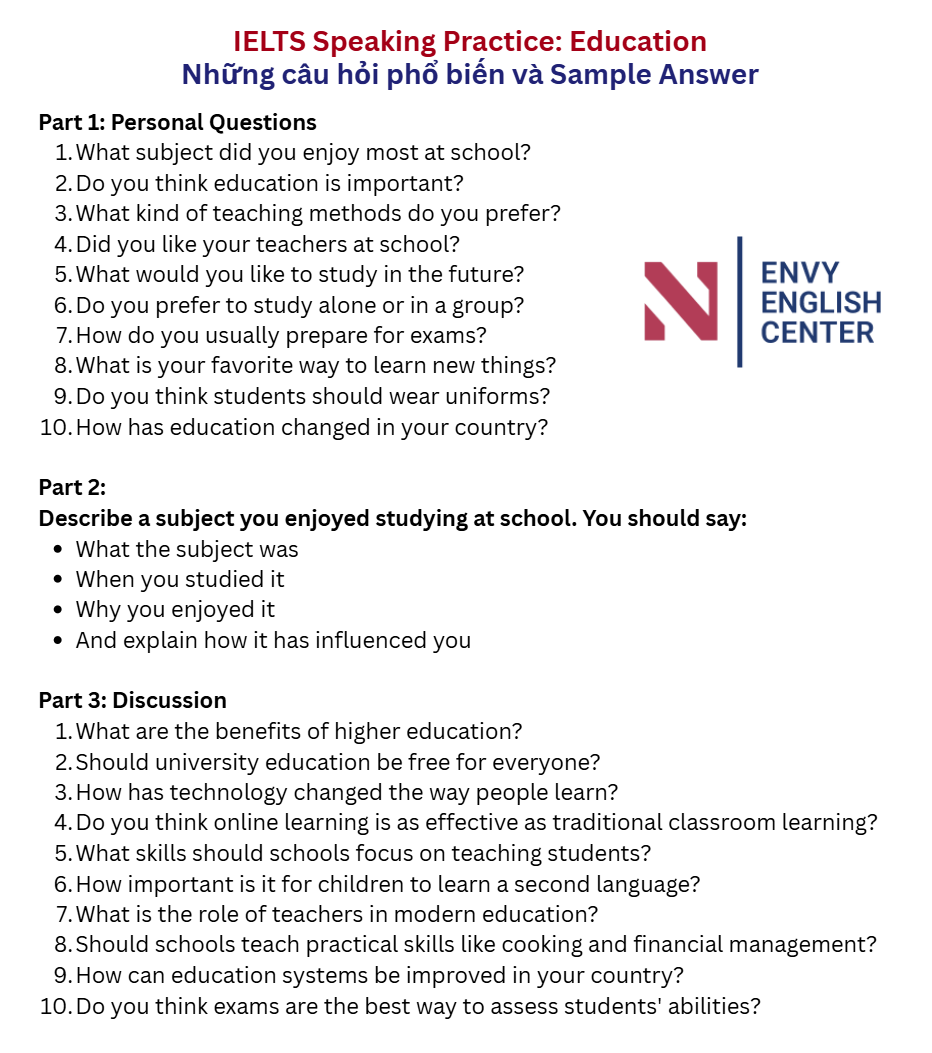
Question 1: What are the benefits of higher education?
Sample Answer:
Higher education offers multifaceted advantages that extend far beyond mere career preparation. Firstly, it provides specialized knowledge and advanced skills that are increasingly essential in our knowledge-based economy. Universities expose students to cutting-edge research and innovative thinking, fostering intellectual growth and analytical capabilities. Additionally, the higher education experience facilitates personal development through exposure to diverse perspectives and cultures, helping students become more well-rounded individuals. From an economic standpoint, degree holders typically enjoy enhanced employment prospects and higher earning potential throughout their careers. Furthermore, universities serve as hubs of innovation and research, contributing significantly to societal advancement and addressing complex global challenges.
Vocabulary & Collocations:
Multifaceted Advantages (noun phrase): lợi ích đa chiều
E.g: Learning a foreign language offers multifaceted advantages in today's globalized world.
Mere Career Preparation (phrase): chỉ chuẩn bị nghề nghiệp đơn thuần
E.g: Education should be more than mere career preparation.
Specialized Knowledge (noun phrase): kiến thức chuyên môn
E.g: Medical professionals require specialized knowledge in their respective fields.
Knowledge-Based Economy (noun phrase): nền kinh tế tri thức
E.g: Success in a knowledge-based economy depends on continuous learning.
Cutting-Edge Research (noun phrase): nghiên cứu tiên tiến
E.g: Universities conduct cutting-edge research in fields like biotechnology and artificial intelligence.
Analytical Capabilities (noun phrase): khả năng phân tích
E.g: Data science programs develop students' analytical capabilities.
Well-Rounded Individuals (noun phrase): cá nhân toàn diện
E.g: Liberal arts education aims to produce well-rounded individuals.
Enhanced Employment Prospects (noun phrase): triển vọng việc làm được cải thiện
E.g: Internship experience provides enhanced employment prospects for graduates.
Earning Potential (noun phrase): tiềm năng thu nhập
E.g: Advanced degrees often increase one's earning potential significantly.
Hubs Of Innovation (phrase): trung tâm đổi mới
E.g: Silicon Valley companies are recognized as hubs of innovation.
Societal Advancement (noun phrase): sự tiến bộ xã hội
E.g: Scientific breakthroughs contribute to societal advancement.
Question 2: Should university education be free for everyone?
Sample Answer:
This is a complex policy question with compelling arguments on both sides. Proponents of free university education argue that it promotes social mobility and ensures that talent, rather than financial circumstances, determines access to higher learning. Countries with tuition-free systems often demonstrate higher enrollment rates and reduced student debt burdens. However, implementing such policies requires substantial public funding, which may necessitate higher taxation or reallocation of resources from other critical areas. A potential middle ground could involve means-tested support systems where students from disadvantaged backgrounds receive full funding, while those from affluent families contribute proportionally. Ultimately, the feasibility depends on a nation's economic capacity and its prioritization of education as a public good.
Vocabulary & Collocations:
Complex Policy Question (noun phrase): câu hỏi chính sách phức tạp
E.g: Healthcare reform is a complex policy question with no simple solutions.
Compelling Arguments (noun phrase): lập luận thuyết phục
E.g: Both sides presented compelling arguments during the debate.
Proponents (noun): người ủng hộ
E.g: Proponents of renewable energy emphasize its environmental benefits.
Social Mobility (noun phrase): tính di động xã hội
E.g: Quality education is key to improving social mobility.
Financial Circumstances (noun phrase): hoàn cảnh tài chính
E.g: Scholarships help students whose financial circumstances would otherwise prevent university attendance.
Tuition-Free Systems (noun phrase): hệ thống miễn học phí
E.g: Several European countries operate tuition-free systems for higher education.
Enrollment Rates (noun phrase): tỷ lệ ghi danh
E.g: Enrollment rates in tertiary education have increased dramatically over the past decade.
Student Debt Burdens (noun phrase): gánh nặng nợ sinh viên
E.g: Rising student debt burdens are a major concern in many developed countries.
Substantial Public Funding (noun phrase): nguồn tài trợ công đáng kể
E.g: Infrastructure projects require substantial public funding.
Necessitate (verb): đòi hỏi, cần thiết phải có
E.g: Climate change will necessitate significant changes in agricultural practices.
Reallocation Of Resources (phrase): sự phân bổ lại nguồn lực
E.g: Budget cuts may require reallocation of resources across departments.
Means-Tested Support Systems (noun phrase): hệ thống hỗ trợ dựa trên thu nhập
E.g: Means-tested support systems ensure aid reaches those most in need.
Disadvantaged Backgrounds (noun phrase): xuất thân khó khăn
E.g: Affirmative action programs aim to help students from disadvantaged backgrounds.
Affluent Families (noun phrase): gia đình giàu có
E.g: Children from affluent families often have access to better educational resources.
Contribute Proportionally (phrase): đóng góp theo tỷ lệ
E.g: Progressive tax systems require higher earners to contribute proportionally more.
Economic Capacity (noun phrase): năng lực kinh tế
E.g: A nation's economic capacity determines its ability to fund social programs.
Public Good (noun phrase): lợi ích công
E.g: Clean air and water are essential public goods.
Question 3: How has technology changed the way people learn?
Sample Answer:
Technology has fundamentally revolutionized the educational landscape in numerous ways. Most notably, it has democratized access to information and learning resources through online platforms, making quality education available to people regardless of their geographical location. Digital tools enable personalized learning experiences, allowing students to progress at their own pace and focus on areas where they need improvement. Interactive technologies, such as virtual reality and simulation software, provide immersive learning experiences that were previously impossible. However, this digital transformation also presents challenges, including the digital divide that disadvantages those without reliable internet access, and concerns about reduced face-to-face interaction and its impact on developing social skills. Additionally, the abundance of information requires enhanced digital literacy to distinguish credible sources from misinformation.
Vocabulary & Collocations:
Fundamentally Revolutionized (phrase): cách mạng hóa về cơ bản
E.g: The internet has fundamentally revolutionized how businesses operate.
Educational Landscape (noun phrase): bối cảnh giáo dục
E.g: The educational landscape is constantly evolving with new pedagogical approaches.
Democratized Access (phrase): dân chủ hóa quyền truy cập
E.g: Open-source software has democratized access to powerful tools.
Geographical Location (noun phrase): vị trí địa lý
E.g: Online learning eliminates barriers related to geographical location.
Personalized Learning Experiences (noun phrase): trải nghiệm học tập cá nhân hóa
E.g: Adaptive software provides personalized learning experiences based on individual progress.
Progress At Their Own Pace (phrase): tiến bộ theo nhịp độ riêng
E.g: Self-paced courses allow learners to progress at their own pace.
Immersive Learning Experiences (noun phrase): trải nghiệm học tập nhập vai
E.g: Virtual field trips offer immersive learning experiences without leaving the classroom.
Digital Transformation (noun phrase): chuyển đổi số
E.g: Digital transformation requires significant investment in infrastructure and training.
Digital Divide (noun phrase): khoảng cách số
E.g: The digital divide exacerbates existing educational inequalities.
Reliable Internet Access (noun phrase): truy cập internet ổn định
E.g: Rural communities often lack reliable internet access.
Face-To-Face Interaction (noun phrase): tương tác trực tiếp
E.g: Face-to-face interaction remains important for developing communication skills.
Abundance Of Information (phrase): sự dồi dào thông tin
E.g: The abundance of information online can be overwhelming without proper filtering skills.
Digital Literacy (noun phrase): kiến thức số
E.g: Digital literacy is now as fundamental as reading and writing.
Credible Sources (noun phrase): nguồn đáng tin cậy
E.g: Academic research requires citing credible sources.
Misinformation (noun): thông tin sai lệch
E.g: Social media platforms struggle to combat the spread of misinformation.
Question 4: Do you think online learning is as effective as traditional classroom learning?
Sample Answer:
The effectiveness of online versus traditional learning is highly context-dependent and varies according to individual learning styles and subject matter. Online learning offers undeniable advantages in terms of flexibility, accessibility, and the ability to incorporate multimedia resources. It can be particularly effective for self-motivated learners and for subjects that lend themselves well to digital formats. However, traditional classroom settings provide irreplaceable benefits, particularly the spontaneous interaction between students and teachers, immediate feedback, and the structured environment that helps many students maintain discipline and focus. Practical subjects requiring hands-on experience, such as laboratory sciences or performing arts, are inherently more challenging to deliver online. Ultimately, a blended approach that combines the strengths of both modalities often yields optimal results, allowing for flexibility while maintaining essential interpersonal elements.
Vocabulary & Collocations:
Context-Dependent (adjective): phụ thuộc vào ngữ cảnh
E.g: The success of marketing strategies is often context-dependent.
Individual Learning Styles (noun phrase): phong cách học tập cá nhân
E.g: Effective teachers recognize and accommodate individual learning styles.
Undeniable Advantages (noun phrase): lợi thế không thể phủ nhận
E.g: Renewable energy has undeniable advantages over fossil fuels.
Incorporate Multimedia Resources (phrase): kết hợp các nguồn đa phương tiện
E.g: Modern textbooks incorporate multimedia resources to enhance engagement.
Self-Motivated Learners (noun phrase): người học tự thúc đẩy
E.g: Online courses are ideal for self-motivated learners who can manage their time effectively.
Lend Themselves Well To (phrase): phù hợp với
E.g: Mathematical concepts lend themselves well to visual representation.
Irreplaceable Benefits (noun phrase): lợi ích không thể thay thế
E.g: Mentorship provides irreplaceable benefits that cannot be replicated through books alone.
Spontaneous Interaction (noun phrase): tương tác tự phát
E.g: Spontaneous interaction in classrooms often leads to deeper understanding.
Immediate Feedback (noun phrase): phản hồi ngay lập tức
E.g: Immediate feedback helps students correct mistakes before they become habits.
Structured Environment (noun phrase): môi trường có cấu trúc
E.g: A structured environment helps children develop good study habits.
Maintain Discipline (phrase): duy trì kỷ luật
E.g: Remote workers must maintain discipline to stay productive.
Hands-On Experience (noun phrase): kinh nghiệm thực hành
E.g: Engineering students need hands-on experience with equipment and tools.
Inherently More Challenging (phrase): vốn dĩ khó khăn hơn
E.g: Teaching creative subjects online is inherently more challenging than theoretical ones.
Blended Approach (noun phrase): phương pháp kết hợp
E.g: A blended approach combines online and in-person instruction.
Optimal Results (noun phrase): kết quả tối ưu
E.g: Achieving optimal results requires careful planning and execution.
Interpersonal Elements (noun phrase): các yếu tố giữa các cá nhân
E.g: Leadership development programs emphasize interpersonal elements.
Question 5: What skills should schools focus on teaching students?
Sample Answer:
Contemporary education should prioritize a balanced combination of foundational academic skills and essential competencies for the 21st century. Critical thinking and problem-solving abilities are paramount, as they enable students to navigate complex situations and adapt to rapidly changing circumstances. Digital literacy has become non-negotiable in our technology-driven world, encompassing not just technical proficiency but also the ability to evaluate online information critically. Equally important are soft skills such as communication, collaboration, and emotional intelligence, which are crucial for success in virtually any career path. Furthermore, schools should cultivate creativity and innovation, encouraging students to think divergently and challenge conventional approaches. Financial literacy and basic life skills, often overlooked in traditional curricula, deserve greater attention to prepare students for independent adult life. Finally, fostering global awareness and intercultural competence is essential in our increasingly interconnected world.
Vocabulary & Collocations:
Contemporary Education (noun phrase): giáo dục đương đại
E.g: Contemporary education must prepare students for jobs that don't yet exist.
Foundational Academic Skills (noun phrase): kỹ năng học thuật nền tảng
E.g: Reading and mathematics are foundational academic skills.
Essential Competencies (noun phrase): năng lực thiết yếu
E.g: The curriculum identifies essential competencies for graduates.
Paramount (adjective): tối quan trọng
E.g: Safety is paramount in laboratory settings.
Navigate Complex Situations (phrase): vượt qua các tình huống phức tạp
E.g: Leaders must navigate complex situations with limited information.
Rapidly Changing Circumstances (phrase): hoàn cảnh thay đổi nhanh chóng
E.g: Businesses must adapt to rapidly changing circumstances in the market.
Non-Negotiable (adjective): không thể thương lượng, bắt buộc
E.g: Ethical behavior is non-negotiable in professional settings.
Technology-Driven World (noun phrase): thế giới được thúc đẩy bởi công nghệ
E.g: Success in our technology-driven world requires continuous skill updating.
Technical Proficiency (noun phrase): thành thạo kỹ thuật
E.g: The job requires technical proficiency in several software programs.
Evaluate Online Information Critically (phrase): đánh giá thông tin trực tuyến một cách phê phán
E.g: Students must learn to evaluate online information critically.
Soft Skills (noun phrase): kỹ năng mềm
E.g: Employers increasingly value soft skills alongside technical qualifications.
Emotional Intelligence (noun phrase): trí tuệ cảm xúc
E.g: Emotional intelligence is a key predictor of leadership success.
Virtually Any Career Path (phrase): hầu như bất kỳ con đường sự nghiệp nào
E.g: Communication skills are valuable in virtually any career path.
Cultivate Creativity (phrase): trau dồi sự sáng tạo
E.g: Arts education helps cultivate creativity in young minds.
Think Divergently (phrase): tư duy phân kỳ
E.g: Innovation requires the ability to think divergently.
Challenge Conventional Approaches (phrase): thách thức các phương pháp thông thường
E.g: Successful entrepreneurs often challenge conventional approaches.
Financial Literacy (noun phrase): kiến thức tài chính
E.g: Financial literacy should be taught in secondary schools.
Traditional Curricula (noun phrase): chương trình giảng dạy truyền thống
E.g: Traditional curricula often neglect practical life skills.
Independent Adult Life (noun phrase): cuộc sống trưởng thành độc lập
E.g: Schools should prepare students for independent adult life.
Global Awareness (noun phrase): nhận thức toàn cầu
E.g: Study abroad programs enhance students' global awareness.
Intercultural Competence (noun phrase): năng lực liên văn hóa
E.g: Intercultural competence is essential for international business.
Interconnected World (noun phrase): thế giới kết nối với nhau
E.g: Our interconnected world requires understanding of diverse perspectives.
Question 6: How important is it for children to learn a second language?
Sample Answer:
Learning a second language in childhood offers profound cognitive, academic, and social advantages. Research consistently demonstrates that bilingualism enhances cognitive flexibility, improves problem-solving abilities, and even delays cognitive decline in later life. From an academic perspective, language learning strengthens metalinguistic awareness, which positively impacts literacy development in the first language as well. In our globalized world, multilingualism opens doors to broader career opportunities and facilitates cross-cultural communication and understanding. The critical period hypothesis suggests that children possess enhanced language acquisition capabilities, making early exposure particularly advantageous. Beyond practical benefits, learning another language fosters cultural appreciation and empathy by providing insights into different worldviews. However, the approach matters significantly; immersive, communicative methods prove far more effective than rote memorization of vocabulary and grammar rules. Ideally, language learning should be integrated naturally into children's education rather than treated as an isolated academic subject.
Vocabulary & Collocations:
Profound Cognitive Advantages (noun phrase): lợi thế nhận thức sâu sắc
E.g: Reading literature provides profound cognitive advantages beyond entertainment.
Bilingualism (noun): song ngữ
E.g: Bilingualism is increasingly common in multicultural societies.
Cognitive Flexibility (noun phrase): sự linh hoạt nhận thức
E.g: Cognitive flexibility helps people adapt to new situations.
Cognitive Decline (noun phrase): suy giảm nhận thức
E.g: Mental stimulation may slow cognitive decline in elderly populations.
Metalinguistic Awareness (noun phrase): nhận thức siêu ngôn ngữ
E.g: Metalinguistic awareness involves thinking about language as a system.
Literacy Development (noun phrase): phát triển đọc viết
E.g: Early childhood programs focus on literacy development.
Globalized World (noun phrase): thế giới toàn cầu hóa
E.g: Success in our globalized world often requires international experience.
Multilingualism (noun): đa ngôn ngữ
E.g: Multilingualism is valued in international organizations.
Cross-Cultural Communication (noun phrase): giao tiếp liên văn hóa
E.g: Effective cross-cultural communication requires cultural sensitivity.
Critical Period Hypothesis (noun phrase): giả thuyết giai đoạn quan trọng
E.g: The critical period hypothesis suggests optimal ages for language acquisition.
Enhanced Language Acquisition Capabilities (phrase): khả năng tiếp thu ngôn ngữ được nâng cao
E.g: Young children demonstrate enhanced language acquisition capabilities.
Early Exposure (noun phrase): tiếp xúc sớm
E.g: Early exposure to music can influence lifelong appreciation.
Cultural Appreciation (noun phrase): sự trân trọng văn hóa
E.g: Travel fosters cultural appreciation and tolerance.
Empathy (noun): sự đồng cảm
E.g: Literature develops empathy by allowing readers to experience different perspectives.
Worldviews (noun): thế giới quan
E.g: Education should expose students to diverse worldviews.
Immersive Methods (noun phrase): phương pháp nhập vai
E.g: Immersive methods accelerate language learning.
Communicative Methods (noun phrase): phương pháp giao tiếp
E.g: Communicative methods emphasize practical language use over grammar rules.
Integrated Naturally (phrase): tích hợp một cách tự nhiên
E.g: Technology should be integrated naturally into lessons rather than used superficially.
Isolated Academic Subject (noun phrase): môn học riêng biệt
E.g: Physical education should not be treated as an isolated academic subject.
Question 7: What is the role of teachers in modern education?
Sample Answer:
The role of teachers has evolved considerably from traditional knowledge transmitters to multifaceted facilitators of learning. In contemporary classrooms, teachers serve as guides who scaffold students' learning journeys, helping them develop critical thinking skills and learn how to learn independently. They must be adept at differentiating instruction to meet diverse learning needs and creating inclusive environments where all students can thrive. Beyond academic instruction, teachers play crucial roles as mentors and role models, influencing students' social-emotional development and character formation. In the digital age, teachers must curate and contextualize the overwhelming amount of information available, teaching students to discern quality sources and think critically about content. They also serve as bridges between technology and pedagogy, leveraging digital tools meaningfully rather than using them superficially. Perhaps most importantly, teachers inspire curiosity and foster a love of learning that extends beyond the classroom, cultivating lifelong learners who can adapt to our rapidly changing world.
Vocabulary & Collocations:
Evolved Considerably (phrase): tiến hóa đáng kể
E.g: Communication technology has evolved considerably over the past two decades.
Knowledge Transmitters (noun phrase): người truyền tải kiến thức
E.g: Teachers are no longer merely knowledge transmitters but learning facilitators.
Multifaceted Facilitators (noun phrase): người hỗ trợ đa chiều
E.g: Modern teachers are multifaceted facilitators of student development.
Scaffold Students' Learning Journeys (phrase): hỗ trợ hành trình học tập của học sinh
E.g: Effective teachers scaffold students' learning journeys with appropriate support.
Learn Independently (phrase): học độc lập
E.g: University students must learn independently with minimal supervision.
Adept At (phrase): thành thạo trong
E.g: Successful managers are adept at conflict resolution.
Differentiating Instruction (noun phrase): phân hóa giảng dạy
E.g: Differentiating instruction ensures all students are appropriately challenged.
Diverse Learning Needs (noun phrase): nhu cầu học tập đa dạng
E.g: Inclusive classrooms accommodate diverse learning needs.
Inclusive Environments (noun phrase): môi trường hòa nhập
E.g: Schools should create inclusive environments for students with disabilities.
Social-Emotional Development (noun phrase): phát triển xã hội-cảm xúc
E.g: Social-emotional development is as important as academic achievement.
Character Formation (noun phrase): hình thành nhân cách
E.g: Education plays a vital role in character formation.
Curate And Contextualize (phrase): tuyển chọn và đặt trong ngữ cảnh
E.g: Educators must curate and contextualize information for students.
Overwhelming Amount Of Information (phrase): lượng thông tin quá tải
E.g: The internet provides an overwhelming amount of information.
Discern Quality Sources (phrase): phân biệt các nguồn chất lượng
E.g: Critical readers can discern quality sources from unreliable ones.
Bridges Between Technology And Pedagogy (phrase): cầu nối giữa công nghệ và sư phạm
E.g: Instructional designers serve as bridges between technology and pedagogy.
Leveraging Digital Tools Meaningfully (phrase): tận dụng các công cụ kỹ thuật số một cách có ý nghĩa
E.g: Effective teaching involves leveraging digital tools meaningfully.
Inspire Curiosity (phrase): truyền cảm hứng tò mò
E.g: Great teachers inspire curiosity about the world.
Foster A Love Of Learning (phrase): nuôi dưỡng tình yêu học tập
E.g: Early positive experiences foster a love of learning.
Cultivating Lifelong Learners (phrase): trau dồi người học suốt đời
E.g: Education systems should focus on cultivating lifelong learners.
Question 8: Should schools teach practical skills like cooking and financial management?
Sample Answer:
Absolutely, I believe integrating practical life skills into curricula is essential for holistic student development. Traditional academic subjects, while important, often leave graduates ill-equipped for fundamental aspects of adult life. Teaching financial literacy, for instance, would address the widespread problem of debt and poor money management that affects countless young adults. Similarly, basic cooking skills promote healthier eating habits and self-sufficiency, potentially addressing public health issues related to diet. These practical subjects also provide valuable learning opportunities for students who may not excel in conventional academic areas, potentially increasing engagement and reducing dropout rates. Critics argue that such skills should be taught at home, but this perspective overlooks the reality that not all families possess the knowledge, time, or resources to provide this education. However, implementation requires careful consideration of already-crowded curricula. A balanced approach might involve integrating these skills into existing subjects or offering them as elective options rather than mandating them for all students.
Vocabulary & Collocations:
Integrating Practical Life Skills (phrase): tích hợp các kỹ năng sống thực tế
E.g: Integrating practical life skills into education prepares students for independence.
Holistic Student Development (noun phrase): phát triển toàn diện học sinh
E.g: Schools should prioritize holistic student development over test scores.
Ill-Equipped For (phrase): không được trang bị tốt cho
E.g: Many graduates feel ill-equipped for the job market.
Fundamental Aspects (noun phrase): các khía cạnh cơ bản
E.g: Communication is one of the fundamental aspects of successful relationships.
Financial Literacy (noun phrase): kiến thức tài chính
E.g: Financial literacy programs teach budgeting and investment basics.
Widespread Problem (noun phrase): vấn đề phổ biến
E.g: Obesity has become a widespread problem in developed nations.
Poor Money Management (noun phrase): quản lý tiền bạc kém
E.g: Poor money management leads to financial stress.
Self-Sufficiency (noun): sự tự cung tự cấp
E.g: Learning basic repairs promotes self-sufficiency.
Public Health Issues (noun phrase): các vấn đề sức khỏe cộng đồng
E.g: Smoking remains one of the major public health issues.
Conventional Academic Areas (noun phrase): các lĩnh vực học thuật thông thường
E.g: Vocational education serves students who struggle in conventional academic areas.
Increasing Engagement (phrase): tăng sự tham gia
E.g: Interactive lessons are effective in increasing engagement.
Dropout Rates (noun phrase): tỷ lệ bỏ học
E.g: Schools with strong support systems have lower dropout rates.
Overlooks The Reality (phrase): bỏ qua thực tế
E.g: This argument overlooks the reality of economic inequality.
Already-Crowded Curricula (noun phrase): chương trình giảng dạy đã quá tải
E.g: Adding new subjects to already-crowded curricula presents challenges.
Balanced Approach (noun phrase): phương pháp cân bằng
E.g: A balanced approach considers multiple perspectives.
Elective Options (noun phrase): các lựa chọn tự chọn
E.g: High schools should offer diverse elective options to match student interests.
Mandating (verb): bắt buộc
E.g: Mandating vaccinations raises ethical questions about personal freedom.
Question 9: How can education systems be improved in your country?
Sample Answer:
Vietnam's education system, while showing considerable progress, requires reforms in several key areas. Firstly, there needs to be a fundamental shift away from examination-centric approaches toward more comprehensive assessment methods that evaluate critical thinking, creativity, and practical application of knowledge. The current emphasis on rote learning and high-stakes testing creates tremendous pressure on students while potentially stifling innovation and genuine understanding. Secondly, addressing educational inequality between urban and rural regions is imperative; this requires substantial investment in infrastructure, teacher training, and resource allocation for disadvantaged areas. Teacher development programs need enhancement to equip educators with modern pedagogical approaches and technology integration skills. Additionally, curricula should be updated to reflect contemporary needs, incorporating more emphasis on soft skills, digital literacy, and global competencies. Finally, reducing class sizes would enable more personalized attention and interactive learning. These improvements require not only financial investment but also political will and societal recognition that education quality matters more than examination results.
Vocabulary & Collocations:
Considerable Progress (noun phrase): tiến bộ đáng kể
E.g: The country has made considerable progress in poverty reduction.
Fundamental Shift (noun phrase): sự thay đổi cơ bản
E.g: Climate action requires a fundamental shift in energy consumption.
Examination-Centric Approaches (noun phrase): phương pháp lấy thi cử làm trung tâm
E.g: Examination-centric approaches may not accurately measure student learning.
Comprehensive Assessment Methods (noun phrase): phương pháp đánh giá toàn diện
E.g: Comprehensive assessment methods include portfolios, presentations, and projects.
Practical Application Of Knowledge (phrase): ứng dụng thực tế của kiến thức
E.g: Internships provide opportunities for practical application of knowledge.
High-Stakes Testing (noun phrase): kiểm tra có tính quyết định cao
E.g: High-stakes testing can create anxiety and narrow the curriculum.
Tremendous Pressure (noun phrase): áp lực to lớn
E.g: Students face tremendous pressure to perform well academically.
Stifling Innovation (phrase): kìm hãm sự đổi mới
E.g: Overly rigid regulations risk stifling innovation.
Genuine Understanding (noun phrase): sự hiểu biết thực sự
E.g: Memorization does not guarantee genuine understanding.
Educational Inequality (noun phrase): bất bình đẳng giáo dục
E.g: Educational inequality perpetuates cycles of poverty.
Imperative (adjective): bắt buộc, cấp thiết
E.g: Addressing climate change is imperative for future generations.
Resource Allocation (noun phrase): phân bổ nguồn lực
E.g: Efficient resource allocation maximizes impact.
Teacher Development Programs (noun phrase): chương trình phát triển giáo viên
E.g: Teacher development programs should include ongoing professional learning.
Modern Pedagogical Approaches (noun phrase): phương pháp sư phạm hiện đại
E.g: Modern pedagogical approaches emphasize student-centered learning.
Technology Integration Skills (noun phrase): kỹ năng tích hợp công nghệ
E.g: Teachers need technology integration skills to effectively use digital tools.
Reflect Contemporary Needs (phrase): phản ánh nhu cầu đương đại
E.g: Curricula should reflect contemporary needs of the workforce.
Global Competencies (noun phrase): năng lực toàn cầu
E.g: Global competencies include intercultural understanding and collaboration.
Personalized Attention (noun phrase): sự chú ý cá nhân hóa
E.g: Smaller classes allow for more personalized attention.
Political Will (noun phrase): ý chí chính trị
E.g: Meaningful reform requires political will and public support.
Societal Recognition (noun phrase): sự công nhận của xã hội
E.g: There is growing societal recognition of mental health importance.
Question 10: Do you think exams are the best way to assess students' abilities?
Sample Answer:
While examinations serve certain purposes, I believe they represent a limited and often problematic method of assessing student capabilities. Exams typically measure memorization and recall under pressure rather than deeper understanding, critical analysis, or creative application of knowledge. They favor certain learning styles while disadvantaging others, potentially overlooking students who possess valuable skills not easily measured through written tests. Furthermore, the emphasis on examinations can lead to teaching to the test, narrowing curricula and prioritizing test-taking strategies over genuine learning. That said, exams do offer some advantages: they provide standardized benchmarks for comparison, are relatively efficient to administer, and can motivate students to consolidate their knowledge. However, a more robust assessment framework should incorporate diverse evaluation methods, including project-based assessments, presentations, portfolios, and practical demonstrations. Such varied approaches provide a more comprehensive picture of student abilities and better prepare them for real-world challenges that rarely resemble examination conditions. The ideal system would use examinations as one component within a broader, more holistic assessment strategy.
Vocabulary & Collocations:
Serve Certain Purposes (phrase): phục vụ một số mục đích nhất định
E.g: Social media platforms serve certain purposes but have limitations.
Limited And Problematic Method (phrase): phương pháp hạn chế và có vấn đề
E.g: Relying solely on GDP is a limited and problematic method of measuring progress.
Memorization And Recall (noun phrase): ghi nhớ và nhớ lại
E.g: Traditional tests emphasize memorization and recall over application.
Deeper Understanding (noun phrase): sự hiểu biết sâu sắc hơn
E.g: Discussion-based learning promotes deeper understanding of concepts.
Creative Application Of Knowledge (phrase): ứng dụng sáng tạo kiến thức
E.g: Innovation requires creative application of knowledge to new problems.
Favor Certain Learning Styles (phrase): ưu ái một số phong cách học nhất định
E.g: Lecture-based teaching may favor certain learning styles over others.
Disadvantaging Others (phrase): gây bất lợi cho những người khác
E.g: Standardized testing risks disadvantaging students from diverse backgrounds.
Valuable Skills (noun phrase): kỹ năng có giá trị
E.g: Collaboration and communication are valuable skills in any profession.
Teaching To The Test (phrase): dạy để thi
E.g: Teaching to the test narrows educational experiences.
Narrowing Curricula (phrase): thu hẹp chương trình giảng dạy
E.g: Excessive focus on tested subjects results in narrowing curricula.
Test-Taking Strategies (noun phrase): chiến lược làm bài thi
E.g: Coaching centers teach test-taking strategies rather than subject mastery.
Genuine Learning (noun phrase): học tập thực sự
E.g: Genuine learning involves curiosity and exploration, not just memorization.
Standardized Benchmarks (noun phrase): các tiêu chuẩn chuẩn hóa
E.g: Standardized benchmarks allow comparison across different schools.
Efficient To Administer (phrase): hiệu quả để quản lý
E.g: Multiple-choice tests are efficient to administer and grade.
Consolidate Their Knowledge (phrase): củng cố kiến thức của họ
E.g: Revision periods help students consolidate their knowledge.
Robust Assessment Framework (noun phrase): khung đánh giá vững chắc
E.g: A robust assessment framework includes multiple evaluation methods.
Diverse Evaluation Methods (noun phrase): phương pháp đánh giá đa dạng
E.g: Diverse evaluation methods provide a fuller picture of student achievement.
Project-Based Assessments (noun phrase): đánh giá dựa trên dự án
E.g: Project-based assessments develop research and collaboration skills.
Practical Demonstrations (noun phrase): trình diễn thực hành
E.g: Practical demonstrations assess hands-on competencies.
Comprehensive Picture (noun phrase): bức tranh toàn diện
E.g: Multiple data sources provide a comprehensive picture of the situation.
Real-World Challenges (noun phrase): thách thức thế giới thực
E.g: Education should prepare students for real-world challenges.
Examination Conditions (noun phrase): điều kiện thi cử
E.g: Few professional situations resemble examination conditions.
Holistic Assessment Strategy (noun phrase): chiến lược đánh giá toàn diện
E.g: Universities are adopting more holistic assessment strategies.
Nếu bạn đang bắt đầu từ con số 0 hoặc đã học nhưng “dậm chân tại chỗ”, Envy English Center có thể đồng hành cùng bạn:
Test trình độ miễn phí theo format IELTS để biết chính xác điểm mạnh – điểm yếu.
Nhận lộ trình học cá nhân hóa từ 0 → 6.5+, phù hợp tốc độ và mục tiêu.
Trực tiếp học với giáo viên IELTS 8.0+, chuyên “gỡ rối” Speaking & Writing – hai kỹ năng khó nâng band nhất.
Đặc biệt, khi đăng ký trong tuần này, bạn được tặng bộ từ vựng chuẩn IELTS band 7+.
📞 Hotline: 028 7300 9677 / 0948 197 270 (Zalo)
🌐 Website: envyenglish.vn
📍 Địa chỉ: 46/5 Tân Cảng, Phường Thạnh Mỹ Tây, Quận Bình Thạnh, TP.HCM


Thông tin gửi đi không thành công, vui lòng thử lại sau.
Nếu bạn cần liên hệ gấp, vui lòng gọi hotline
02873009677

Cảm ơn bạn đã gửi thông tin đến Envy English Center.
Chúng tôi sẽ liên hệ với bạn sớm nhất khi có thể.
Nếu bạn cần liên hệ gấp, vui lòng gọi hotline
02873009677
Thông tin gửi đi không thành công, vui lòng thử lại sau.
Nếu bạn cần liên hệ gấp, vui lòng gọi hotline
02873009677
Bạn đang có một bài test chưa hoàn thành.
Bạn có muốn tiếp tục bài test đó không?
Bạn có chắc là muốn gửi bài test này không?

Số câu trả lời đúng/40

Số câu trả lời đúng/40
Thông tin gửi đi không thành công, vui lòng thử lại sau.
Nếu bạn cần liên hệ gấp, vui lòng gọi hotline
02873009677
Thời gian làm bài kiểm tra đã hết.
Cảm ơn bạn đã cố gắng.
