 02873009677
 contact@envyenglish.vn

1. Questions
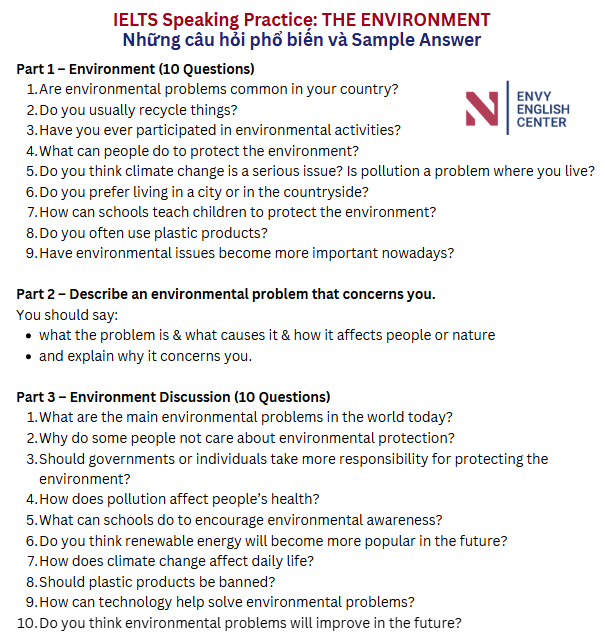
Part 1 – Environment (10 Questions)
Are environmental problems common in your country?
Do you usually recycle things?
Have you ever participated in environmental activities?
What can people do to protect the environment?
Do you think climate change is a serious issue?
Is pollution a problem where you live?
Do you prefer living in a city or in the countryside?
How can schools teach children to protect the environment?
Do you often use plastic products?
Have environmental issues become more important nowadays?
Part 2 – Cue Card (1 Question)
Describe an environmental problem that concerns you.
You should say:
what the problem is
what causes it
how it affects people or nature
and explain why it concerns you.
Part 3 – Environment Discussion (10 Questions)
What are the main environmental problems in the world today?
Why do some people not care about environmental protection?
Should governments or individuals take more responsibility for protecting the environment?
How does pollution affect people’s health?
What can schools do to encourage environmental awareness?
Do you think renewable energy will become more popular in the future?
How does climate change affect daily life?
Should plastic products be banned?
How can technology help solve environmental problems?
Do you think environmental problems will improve in the future?
2. Questions & Answers
Question 1: Are environmental problems common in your country?
Yes, environmental problems are becoming increasingly serious in my country, especially in large urban areas. Air pollution, water contamination, and excessive waste are common issues caused by industrial activities and rapid population growth. In addition, traffic congestion in major cities contributes significantly to poor air quality. I think environmental protection should become a higher priority for both governments and individuals.
Urban area (n.phr): khu vực đô thị
e.g: Urban areas face serious pollution problems.
Water contamination (n.phr): ô nhiễm nguồn nước
e.g: Factories contribute to water contamination.
Traffic congestion (n.phr): tắc nghẽn giao thông
e.g: Traffic congestion increases air pollution.
Environmental protection (n.phr): bảo vệ môi trường
e.g: Schools should teach environmental protection.
Question 2: Do you usually recycle things?
Yes, I try to recycle whenever possible because I believe small actions can contribute to environmental protection. For example, I often separate plastic bottles, paper, and cans from regular household waste. In addition, I try to reuse certain items instead of throwing them away immediately. Although recycling systems in some areas are still limited, I think public awareness about recycling is gradually improving.
Household waste (n.phr): rác thải sinh hoạt
e.g: Recycling reduces household waste.
Reuse item (v.phr): tái sử dụng đồ vật
e.g: People should reuse items more often.
Public awareness (n.phr): nhận thức cộng đồng
e.g: Campaigns increase public awareness.
Gradually improve (v.phr): dần cải thiện
e.g: Environmental conditions are gradually improving.
Question 3: Have you ever participated in environmental activities?
Yes, I have participated in several environmental activities organized by schools and local communities. For example, I joined tree-planting campaigns and neighborhood clean-up events aimed at reducing litter and improving public spaces. These activities helped me understand the importance of environmental responsibility and collective action. I think community participation plays a crucial role in protecting the environment.
Tree-planting campaign (n.phr): chiến dịch trồng cây
e.g: Students joined tree-planting campaigns.
Clean-up event (n.phr): hoạt động dọn dẹp
e.g: Volunteers organized a beach clean-up event.
Environmental responsibility (n.phr): trách nhiệm môi trường
e.g: Companies should promote environmental responsibility.
Collective action (n.phr): hành động tập thể
e.g: Climate change requires collective action.
Question 4: What can people do to protect the environment?
There are many practical actions people can take to protect the environment in daily life. Firstly, individuals should reduce waste by recycling, reusing products, and avoiding excessive plastic consumption. Secondly, people can save energy and water by using resources more efficiently. In addition, using public transportation or environmentally friendly alternatives such as bicycles can help reduce pollution. I believe even small lifestyle changes can have a positive environmental impact.
Reduce waste (v.phr): giảm rác thải
e.g: Recycling helps reduce waste.
Plastic consumption (n.phr): việc tiêu thụ nhựa
e.g: Governments should reduce plastic consumption.
Environmentally friendly (adj.phr): thân thiện với môi trường
e.g: Electric vehicles are environmentally friendly.
Positive impact (n.phr): tác động tích cực
e.g: Small actions create positive impacts.
Question 5: Do you think climate change is a serious issue?
Yes, I think climate change is one of the most serious global challenges today. Rising temperatures, extreme weather conditions, and natural disasters are becoming increasingly common in many parts of the world. In addition, climate change threatens ecosystems, food security, and human health on a large scale. I believe governments and international organizations must cooperate to address this issue effectively.
Global challenge (n.phr): thách thức toàn cầu
e.g: Climate change is a major global challenge.
Extreme weather condition (n.phr): điều kiện thời tiết cực đoan
e.g: Floods are caused by extreme weather conditions.
Food security (n.phr): an ninh lương thực
e.g: Climate change threatens food security.
International organization (n.phr): tổ chức quốc tế
e.g: International organizations support climate policies.
Question 6: Is pollution a problem where you live?
Yes, pollution is a noticeable problem in many urban areas where I live. Air pollution caused by traffic and industrial activities is especially concerning because it can negatively affect people’s health. In addition, littering and plastic waste sometimes pollute rivers and public spaces. Although environmental awareness is increasing, I think stronger regulations and public action are still necessary.
Industrial activity (n.phr): hoạt động công nghiệp
e.g: Industrial activities increase pollution.
Plastic waste (n.phr): rác thải nhựa
e.g: Oceans contain large amounts of plastic waste.
Public space (n.phr): không gian công cộng
e.g: Citizens should keep public spaces clean.
Environmental awareness (n.phr): nhận thức môi trường
e.g: Schools improve environmental awareness.
Question 7: Do you prefer living in a city or in the countryside?
I personally prefer living in a city because urban areas provide better educational, professional, and entertainment opportunities. Cities also offer more convenient transportation systems and access to modern services. However, I think the countryside has cleaner air, less noise pollution, and a more peaceful lifestyle. Ideally, I would like to live in a place that combines urban convenience with a healthy natural environment.
Urban area (n.phr): khu vực đô thị
e.g: Urban areas develop rapidly.
Entertainment opportunity (n.phr): cơ hội giải trí
e.g: Cities offer many entertainment opportunities.
Noise pollution (n.phr): ô nhiễm tiếng ồn
e.g: Noise pollution affects mental health.
Natural environment (n.phr): môi trường tự nhiên
e.g: People should protect the natural environment.
Question 8: How can schools teach children to protect the environment?
Schools can teach children environmental protection through both education and practical activities. For example, teachers can include topics such as recycling, climate change, and sustainable lifestyles in the curriculum. In addition, schools can organize environmental campaigns, clean-up events, and tree-planting activities to encourage student participation. I think teaching environmental awareness from a young age can create long-term positive habits.
Sustainable lifestyle (n.phr): lối sống bền vững
e.g: Schools promote sustainable lifestyles.
Environmental campaign (n.phr): chiến dịch môi trường
e.g: Students joined environmental campaigns.
Student participation (n.phr): sự tham gia của học sinh
e.g: Clubs encourage student participation.
Long-term habit (n.phr): thói quen lâu dài
e.g: Recycling should become a long-term habit.
Question 9: Do you often use plastic products?
Yes, I still use plastic products in daily life because they are convenient and widely available. However, I try to reduce single-use plastics by bringing reusable bags and water bottles whenever possible. I also think businesses and governments should encourage more environmentally friendly alternatives. Although avoiding plastic completely is difficult, reducing unnecessary plastic consumption is definitely important.
Single-use plastic (n.phr): nhựa dùng một lần
e.g: Many countries ban single-use plastics.
Reusable bag (n.phr): túi tái sử dụng
e.g: Consumers should use reusable bags.
Environmentally friendly alternative (n.phr): giải pháp thay thế thân thiện môi trường
e.g: Paper straws are environmentally friendly alternatives.
Plastic consumption (n.phr): việc tiêu thụ nhựa
e.g: Society should reduce plastic consumption.
Question 10: Have environmental issues become more important nowadays?
Yes, environmental issues have become far more important nowadays because people are increasingly aware of climate change and pollution. Governments, businesses, and individuals now recognize that environmental problems can seriously affect public health, economies, and future generations. In addition, social media and international campaigns have helped spread environmental awareness more effectively. I believe environmental protection will remain a major global priority in the future.
Future generation (n.phr): thế hệ tương lai
e.g: Environmental protection benefits future generations.
Public health (n.phr): sức khỏe cộng đồng
e.g: Pollution affects public health.
Environmental awareness (n.phr): nhận thức môi trường
e.g: Campaigns improve environmental awareness.
Global priority (n.phr): ưu tiên toàn cầu
e.g: Climate action is a global priority.
Part 2 – Cue Card
Describe an environmental problem that concerns you.
One environmental problem that concerns me greatly is plastic pollution because it affects both human life and natural ecosystems on a global scale. Nowadays, enormous amounts of plastic waste are produced every day, especially from single-use products such as plastic bags, bottles, and food packaging. Although plastic is convenient and inexpensive, excessive consumption has created serious environmental consequences that are becoming increasingly difficult to control.
One major cause of plastic pollution is irresponsible waste disposal and overconsumption. Many people throw plastic waste into rivers, streets, or public areas without considering the long-term effects on the environment. In addition, some countries still lack effective recycling systems and waste management infrastructure, which makes the problem even worse. As a result, large quantities of plastic eventually end up in oceans and natural habitats, where they remain for hundreds of years before decomposing.
Plastic pollution has severe impacts on both wildlife and human health. Marine animals often mistake plastic waste for food, which can lead to injury, starvation, or death. Furthermore, microplastics have been found in water supplies and food chains, raising concerns about long-term health risks for humans. I think this issue is particularly alarming because environmental damage on such a large scale may become irreversible in the future if people fail to take action quickly.
Another reason why this problem worries me is that plastic pollution reflects unsustainable lifestyles and irresponsible consumer behavior. Modern societies often prioritize convenience over environmental protection, which leads to excessive waste generation. Although many environmental campaigns encourage recycling and reusable products, public awareness and participation are still inconsistent in many places. Therefore, stronger government policies and global cooperation are necessary to address this issue effectively.
I believe individuals can also contribute by reducing single-use plastics, recycling responsibly, and supporting environmentally friendly alternatives. Even small lifestyle changes can collectively create positive environmental impacts over time. Overall, plastic pollution concerns me because it threatens ecosystems, public health, and the future sustainability of our planet.
Plastic pollution (n.phr): ô nhiễm nhựa
e.g: Plastic pollution damages marine ecosystems.
Single-use product (n.phr): sản phẩm dùng một lần
e.g: Governments should reduce single-use products.
Waste management infrastructure (n.phr): cơ sở hạ tầng quản lý rác thải
e.g: Cities need better waste management infrastructure.
Natural habitat (n.phr): môi trường sống tự nhiên
e.g: Pollution destroys natural habitats.
Marine animal (n.phr): động vật biển
e.g: Marine animals are threatened by plastic waste.
Microplastic (n): vi nhựa
e.g: Scientists found microplastics in seafood.
Unsustainable lifestyle (n.phr): lối sống không bền vững
e.g: Excessive consumption creates unsustainable lifestyles.
Environmentally friendly alternative (n.phr): giải pháp thay thế thân thiện môi trường
e.g: Paper packaging is an environmentally friendly alternative.
Part 3 – Discussion
Question: What are the main environmental problems in the world today?
There are several major environmental problems affecting the world today, including climate change, air pollution, deforestation, and plastic waste. Climate change is particularly serious because it contributes to rising sea levels, extreme weather conditions, and damage to ecosystems. In addition, pollution from industries and transportation negatively affects both public health and natural environments. I think environmental degradation has become a global issue that requires international cooperation and long-term solutions.
Deforestation (n): nạn phá rừng
e.g: Deforestation threatens biodiversity.
Rising sea level (n.phr): mực nước biển dâng
e.g: Rising sea levels affect coastal cities.
Environmental degradation (n.phr): suy thoái môi trường
e.g: Industrialization causes environmental degradation.
Long-term solution (n.phr): giải pháp dài hạn
e.g: Governments should invest in long-term solutions.
Question: Why do some people not care about environmental protection?
Some people may not care about environmental protection because they prioritize convenience and economic benefits over long-term environmental consequences. In addition, a lack of environmental education and public awareness can prevent individuals from fully understanding the seriousness of environmental issues. Some people also believe their personal actions are too small to make a difference. However, I think collective action is extremely important because environmental problems affect everyone globally.
Environmental consequence (n.phr): hậu quả môi trường
e.g: Factories should consider environmental consequences.
Environmental education (n.phr): giáo dục môi trường
e.g: Schools should improve environmental education.
Public awareness (n.phr): nhận thức cộng đồng
e.g: Campaigns increase public awareness.
Collective action (n.phr): hành động tập thể
e.g: Climate change requires collective action.
Question: Should governments or individuals take more responsibility for protecting the environment?
I think both governments and individuals should share responsibility for environmental protection because environmental problems are too large for one group to solve alone. Governments play an important role by creating environmental laws, investing in renewable energy, and regulating industrial pollution. On the other hand, individuals can contribute by reducing waste, recycling, and adopting sustainable lifestyles. Therefore, cooperation between governments, businesses, and citizens is essential for achieving meaningful environmental progress.
Renewable energy (n.phr): năng lượng tái tạo
e.g: Countries invest heavily in renewable energy.
Industrial pollution (n.phr): ô nhiễm công nghiệp
e.g: Governments regulate industrial pollution.
Sustainable lifestyle (n.phr): lối sống bền vững
e.g: Young people promote sustainable lifestyles.
Meaningful progress (n.phr): tiến bộ đáng kể
e.g: International cooperation creates meaningful progress.
Question: How does pollution affect people’s health?
Pollution can seriously damage people’s physical and mental health in many ways. Air pollution increases the risk of respiratory diseases, heart problems, and other long-term medical conditions. In addition, contaminated water and food sources may spread harmful chemicals and diseases to communities. Noise pollution can also negatively affect sleep quality and mental well-being. Therefore, reducing pollution is extremely important for protecting public health.
Respiratory disease (n.phr): bệnh hô hấp
e.g: Air pollution causes respiratory diseases.
Medical condition (n.phr): tình trạng bệnh lý
e.g: Pollution worsens medical conditions.
Contaminated water source (n.phr): nguồn nước ô nhiễm
e.g: Contaminated water sources threaten communities.
Mental well-being (n.phr): sức khỏe tinh thần
e.g: Green spaces improve mental well-being.
Question: What can schools do to encourage environmental awareness?
Schools can encourage environmental awareness by combining education with practical environmental activities. For example, students can learn about climate change, recycling, and conservation through classroom lessons and group projects. Schools can also organize tree-planting campaigns, recycling competitions, and environmental clubs to encourage active participation. I believe teaching environmental responsibility at a young age can create positive lifelong habits.
Conservation (n): bảo tồn
e.g: Students learn about wildlife conservation.
Group project (n.phr): dự án nhóm
e.g: Schools assign environmental group projects.
Environmental club (n.phr): câu lạc bộ môi trường
e.g: Many schools have environmental clubs.
Lifelong habit (n.phr): thói quen suốt đời
e.g: Recycling should become a lifelong habit.
Question: Do you think renewable energy will become more popular in the future?
Yes, I strongly believe renewable energy will become much more popular in the future because fossil fuels are limited and environmentally harmful. Many governments and companies are already investing heavily in solar, wind, and hydroelectric energy to reduce carbon emissions. In addition, technological advancements are gradually making renewable energy more efficient and affordable. I think the transition to cleaner energy sources is necessary for sustainable development.
Fossil fuel (n.phr): nhiên liệu hóa thạch
e.g: Fossil fuels contribute to climate change.
Carbon emission (n.phr): khí thải carbon
e.g: Countries aim to reduce carbon emissions.
Technological advancement (n.phr): tiến bộ công nghệ
e.g: Technological advancements improve energy efficiency.
Sustainable development (n.phr): phát triển bền vững
e.g: Renewable energy supports sustainable development.
Question: How does climate change affect daily life?
Climate change affects daily life in many noticeable ways. Rising temperatures and extreme weather conditions can damage homes, transportation systems, and agricultural production. In addition, natural disasters such as floods, droughts, and storms are becoming more frequent and severe in many regions. Climate change also affects food prices, water supplies, and public health. Therefore, its impact is becoming increasingly difficult for societies to ignore.
Agricultural production (n.phr): sản xuất nông nghiệp
e.g: Droughts damage agricultural production.
Natural disaster (n.phr): thiên tai
e.g: Climate change increases natural disasters.
Water supply (n.phr): nguồn cung cấp nước
e.g: Some cities face water supply shortages.
Public health (n.phr): sức khỏe cộng đồng
e.g: Heatwaves affect public health.
Question: Should plastic products be banned?
I think some single-use plastic products should definitely be restricted or banned because they create enormous amounts of long-lasting waste. Items such as plastic bags, straws, and disposable packaging are often used briefly but remain in the environment for many years. However, completely banning all plastic products may not be realistic because plastic still has important industrial and medical applications. Therefore, governments should encourage environmentally friendly alternatives while reducing unnecessary plastic consumption.
Single-use plastic (n.phr): nhựa dùng một lần
e.g: Many countries ban single-use plastics.
Disposable packaging (n.phr): bao bì dùng một lần
e.g: Restaurants use too much disposable packaging.
Industrial application (n.phr): ứng dụng công nghiệp
e.g: Plastic has many industrial applications.
Environmentally friendly alternative (n.phr): giải pháp thay thế thân thiện môi trường
e.g: Bamboo products are environmentally friendly alternatives.
Question: How can technology help solve environmental problems?
Technology can help solve environmental problems in several important ways. Firstly, renewable energy technologies reduce dependence on fossil fuels and lower carbon emissions. Secondly, scientific innovations improve waste management systems, water purification, and energy efficiency. In addition, digital technologies such as artificial intelligence and environmental monitoring systems can help governments track pollution and manage resources more effectively. I believe technological progress will play a crucial role in environmental protection in the future.
Energy efficiency (n.phr): hiệu quả năng lượng
e.g: Modern buildings improve energy efficiency.
Water purification (n.phr): lọc nước
e.g: Technology improves water purification systems.
Environmental monitoring system (n.phr): hệ thống giám sát môi trường
e.g: Cities install environmental monitoring systems.
Technological progress (n.phr): tiến bộ công nghệ
e.g: Technological progress improves sustainability.
Question: Do you think environmental problems will improve in the future?
I think environmental problems may improve gradually in the future, but only if governments, businesses, and individuals take stronger action. Public awareness about climate change and sustainability has increased significantly in recent years, which is a positive sign. In addition, technological advancements and international cooperation may help reduce pollution and promote cleaner energy sources. However, environmental challenges are still extremely serious, so long-term commitment and global cooperation will remain essential.
Sustainability (n): tính bền vững
e.g: Companies focus more on sustainability.
Cleaner energy source (n.phr): nguồn năng lượng sạch hơn
e.g: Solar power is a cleaner energy source.
Long-term commitment (n.phr): cam kết dài hạn
e.g: Environmental protection requires long-term commitment.
Global cooperation (n.phr): hợp tác toàn cầu
e.g: Climate change requires global cooperation.
Nếu bạn đang bắt đầu từ con số 0 hoặc đã học nhưng “dậm chân tại chỗ”, Envy English Center có thể đồng hành cùng bạn:
Test trình độ miễn phí theo format IELTS để biết chính xác điểm mạnh – điểm yếu.
Nhận lộ trình học cá nhân hóa từ 0 → 6.5+, phù hợp tốc độ và mục tiêu.
Trực tiếp học với giáo viên IELTS 8.0+, chuyên “gỡ rối” Speaking & Writing – hai kỹ năng khó nâng band nhất.
Đặc biệt, khi đăng ký trong tuần này, bạn được tặng bộ từ vựng chuẩn IELTS band 7+.
📞 Hotline: 028 7300 9677 / 0948 197 270 (Zalo)
🌐 Website: envyenglish.vn
📍 Địa chỉ: 46/5 Tân Cảng, Phường Thạnh Mỹ Tây, Quận Bình Thạnh, TP.HCM


Thông tin gửi đi không thành công, vui lòng thử lại sau.
Nếu bạn cần liên hệ gấp, vui lòng gọi hotline
02873009677

Cảm ơn bạn đã gửi thông tin đến Envy English Center.
Chúng tôi sẽ liên hệ với bạn sớm nhất khi có thể.
Nếu bạn cần liên hệ gấp, vui lòng gọi hotline
02873009677
Thông tin gửi đi không thành công, vui lòng thử lại sau.
Nếu bạn cần liên hệ gấp, vui lòng gọi hotline
02873009677
Bạn đang có một bài test chưa hoàn thành.
Bạn có muốn tiếp tục bài test đó không?
Bạn có chắc là muốn gửi bài test này không?

Số câu trả lời đúng/40

Số câu trả lời đúng/40
Thông tin gửi đi không thành công, vui lòng thử lại sau.
Nếu bạn cần liên hệ gấp, vui lòng gọi hotline
02873009677
Thời gian làm bài kiểm tra đã hết.
Cảm ơn bạn đã cố gắng.
