 02873009677
 contact@envyenglish.vn

1. Questions
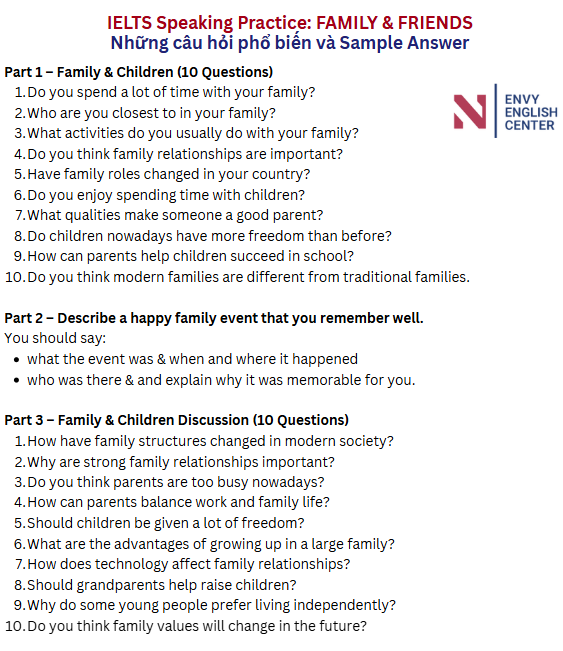
Part 1 – Family & Children (10 Questions)
Do you spend a lot of time with your family?
Who are you closest to in your family?
What activities do you usually do with your family?
Do you think family relationships are important?
Have family roles changed in your country?
Do you enjoy spending time with children?
What qualities make someone a good parent?
Do children nowadays have more freedom than before?
How can parents help children succeed in school?
Do you think modern families are different from traditional families?
Part 2 – Cue Card (1 Question)
Describe a happy family event that you remember well.
You should say:
what the event was
when and where it happened
who was there
and explain why it was memorable for you.
Part 3 – Family & Children Discussion (10 Questions)
How have family structures changed in modern society?
Why are strong family relationships important?
Do you think parents are too busy nowadays?
How can parents balance work and family life?
Should children be given a lot of freedom?
What are the advantages of growing up in a large family?
How does technology affect family relationships?
Should grandparents help raise children?
Why do some young people prefer living independently?
Do you think family values will change in the future?
2. Questions & Answers
Question 1: Do you spend a lot of time with your family?
Yes, I try to spend as much time with my family as possible despite having a busy academic schedule. We usually have meals together, talk about our daily experiences, and occasionally go out on weekends. I believe spending time with family helps strengthen emotional connections and reduce stress after long working or studying hours. In addition, family support is extremely important during difficult periods in life.
Academic schedule (n.phr): lịch học tập
e.g: Students often have busy academic schedules.
Emotional connection (n.phr): kết nối cảm xúc
e.g: Family activities strengthen emotional connections.
Reduce stress (v.phr): giảm căng thẳng
e.g: Spending time with loved ones reduces stress.
Family support (n.phr): sự hỗ trợ từ gia đình
e.g: Family support helps students overcome difficulties.
Question 2: Who are you closest to in your family?
I am probably closest to my mother because she is the person I talk to most frequently about personal matters and future plans. She is very supportive, understanding, and patient whenever I experience stress or uncertainty. In addition, she often gives me practical advice and emotional encouragement during important situations. I think strong communication is one of the main reasons why our relationship is so close.
Personal matter (n.phr): chuyện cá nhân
e.g: Teenagers often discuss personal matters with parents.
Practical advice (n.phr): lời khuyên thực tế
e.g: Parents give practical advice to children.
Emotional encouragement (n.phr): sự động viên tinh thần
e.g: Students need emotional encouragement before exams.
Strong communication (n.phr): giao tiếp tốt
e.g: Strong communication improves relationships.
Question 3: What activities do you usually do with your family?
My family usually spends time together through simple daily activities rather than large events. For example, we often have meals together, watch movies, or discuss work and study experiences in the evening. Occasionally, we also travel or visit relatives during holidays and special occasions. I think these activities help family members maintain close relationships despite busy schedules.
Daily activity (n.phr): hoạt động hằng ngày
e.g: Family meals are important daily activities.
Special occasion (n.phr): dịp đặc biệt
e.g: Families gather during special occasions.
Maintain close relationship (v.phr): duy trì mối quan hệ thân thiết
e.g: Communication helps maintain close relationships.
Busy schedule (n.phr): lịch trình bận rộn
e.g: Modern workers often have busy schedules.
Question 4: Do you think family relationships are important?
Yes, I believe family relationships are extremely important because families provide emotional support, guidance, and a sense of belonging. Strong family bonds can help people feel more confident and emotionally stable during difficult times. In addition, family members often influence a person’s values, personality, and behavior from an early age. I think healthy family relationships contribute significantly to overall happiness and mental well-being.
Sense of belonging (n.phr): cảm giác thuộc về
e.g: Families provide a sense of belonging.
Family bond (n.phr): gắn kết gia đình
e.g: Holidays strengthen family bonds.
Emotionally stable (adj.phr): ổn định cảm xúc
e.g: Supportive families help children become emotionally stable.
Mental well-being (n.phr): sức khỏe tinh thần
e.g: Good relationships improve mental well-being.
Question 5: Have family roles changed in your country?
Yes, family roles have changed significantly in recent decades due to social and economic development. In the past, men were often expected to be the primary breadwinners while women mainly focused on household responsibilities. However, nowadays both men and women usually contribute financially and share domestic duties more equally. I think modern families are becoming more flexible and balanced compared to traditional family structures.
Primary breadwinner (n.phr): trụ cột tài chính chính
e.g: Fathers were traditionally primary breadwinners.
Household responsibility (n.phr): trách nhiệm gia đình
e.g: Couples should share household responsibilities.
Contribute financially (v.phr): đóng góp tài chính
e.g: Both parents contribute financially nowadays.
Traditional family structure (n.phr): cấu trúc gia đình truyền thống
e.g: Traditional family structures are changing.
Question 6: Do you enjoy spending time with children?
Yes, I generally enjoy spending time with children because they are energetic, curious, and often very honest in their behavior. Interacting with children can be entertaining and emotionally refreshing after stressful periods of study or work. In addition, children sometimes have creative perspectives that adults may overlook. However, taking care of children also requires patience and responsibility.
Energetic (adj): năng động
e.g: Young children are extremely energetic.
Emotionally refreshing (adj.phr): giúp thư giãn tinh thần
e.g: Playing with children feels emotionally refreshing.
Creative perspective (n.phr): góc nhìn sáng tạo
e.g: Children often have creative perspectives.
Patience and responsibility (n.phr): sự kiên nhẫn và trách nhiệm
e.g: Teaching requires patience and responsibility.
Question 7: What qualities make someone a good parent?
I think good parents should possess qualities such as patience, responsibility, and emotional understanding. Firstly, parents need to support and guide children rather than simply controlling them. Secondly, effective communication is important because children should feel comfortable sharing their thoughts and problems. In addition, good parents should set positive examples through their own behavior and values.
Emotional understanding (n.phr): sự thấu hiểu cảm xúc
e.g: Parents need emotional understanding.
Effective communication (n.phr): giao tiếp hiệu quả
e.g: Effective communication strengthens families.
Set positive example (v.phr): làm gương tốt
e.g: Adults should set positive examples for children.
Guide children (v.phr): hướng dẫn con cái
e.g: Parents should guide children patiently.
Question 8: Do children nowadays have more freedom than before?
Yes, I think children nowadays generally have more freedom than previous generations. Modern parents are often more open-minded and willing to allow children to express their opinions and make personal choices. In addition, access to technology and social media exposes children to a wider range of information and lifestyles. However, I believe children still need guidance and appropriate boundaries to develop responsibly.
Open-minded (adj): cởi mở
e.g: Modern parents are more open-minded.
Personal choice (n.phr): lựa chọn cá nhân
e.g: Teenagers want more personal choices.
Appropriate boundary (n.phr): giới hạn phù hợp
e.g: Children need appropriate boundaries.
Develop responsibly (v.phr): phát triển có trách nhiệm
e.g: Parents help children develop responsibly.
Question 9: How can parents help children succeed in school?
Parents can support children’s academic success in several important ways. Firstly, they should encourage positive study habits and provide a supportive learning environment at home. Secondly, emotional encouragement and constructive feedback can increase children’s confidence and motivation. In addition, parents should communicate regularly with teachers and pay attention to children’s emotional well-being rather than focusing only on grades.
Study habit (n.phr): thói quen học tập
e.g: Good study habits improve academic performance.
Supportive learning environment (n.phr): môi trường học tập hỗ trợ
e.g: Children need supportive learning environments.
Constructive feedback (n.phr): phản hồi mang tính xây dựng
e.g: Teachers should provide constructive feedback.
Academic performance (n.phr): kết quả học tập
e.g: Sleep affects academic performance.
Question 10: Do you think modern families are different from traditional families?
Yes, modern families are quite different from traditional families in several ways. Nowadays, family structures are generally smaller, and relationships between parents and children tend to be more equal and open. In addition, both parents often work outside the home, which changes household responsibilities and daily routines. However, despite these social changes, I think values such as love, support, and mutual respect remain important in both modern and traditional families.
Family structure (n.phr): cấu trúc gia đình
e.g: Family structures have changed over time.
Household responsibility (n.phr): trách nhiệm gia đình
e.g: Couples share household responsibilities.
Mutual respect (n.phr): sự tôn trọng lẫn nhau
e.g: Healthy relationships require mutual respect.
Social change (n.phr): thay đổi xã hội
e.g: Technology contributes to social changes.
Part 2 – Cue Card
Describe a happy family event that you remember well.
One happy family event that I remember very clearly was a large family gathering that took place during Lunar New Year a few years ago. The celebration was held at my grandparents’ house in my hometown, and many relatives from different cities came back to reunite with the family. Since everyone had busy schedules throughout the year, it was a rare opportunity for all of us to spend meaningful time together.
The event lasted for several days, and the atmosphere was extremely warm and joyful. My family prepared traditional dishes, decorated the house, and participated in cultural customs associated with the holiday. During the reunion, adults talked about work and family life while younger family members played games, watched movies, and exchanged gifts. In addition, we visited relatives and wished one another good health, happiness, and success for the new year.
What made the event especially memorable for me was the strong emotional connection among family members. Although people in my family have different personalities and lifestyles, everyone became closer and more relaxed during the celebration. I particularly enjoyed listening to my grandparents share stories about the past because it helped me appreciate family traditions and cultural values more deeply. Furthermore, seeing multiple generations gathering together created a strong sense of belonging and emotional comfort.
Another reason why I remember this event so fondly is that it reminded me of the importance of maintaining family relationships despite modern busy lifestyles. Nowadays, many people spend most of their time studying or working, so opportunities for large family reunions are becoming less common. Therefore, moments like this feel much more valuable and emotionally meaningful.
Overall, this family gathering remains one of my happiest memories because it brought relatives together, strengthened family bonds, and created a joyful atmosphere filled with love and support. I believe family celebrations play an important role in preserving emotional connections and cultural traditions across generations.
Family gathering (n.phr): buổi họp mặt gia đình
e.g: Lunar New Year is an important family gathering.
Meaningful time (n.phr): khoảng thời gian ý nghĩa
e.g: Families should spend meaningful time together.
Cultural custom (n.phr): phong tục văn hóa
e.g: Traditional festivals include cultural customs.
Emotional connection (n.phr): kết nối cảm xúc
e.g: Family meals strengthen emotional connections.
Sense of belonging (n.phr): cảm giác thuộc về
e.g: Families provide a sense of belonging.
Family bond (n.phr): sự gắn kết gia đình
e.g: Holidays strengthen family bonds.
Busy lifestyle (n.phr): lối sống bận rộn
e.g: Modern busy lifestyles reduce family interaction.
Preserve tradition (v.phr): gìn giữ truyền thống
e.g: Festivals help preserve traditions.
Part 3 – Discussion
Question: How have family structures changed in modern society?
Family structures have changed significantly in modern society due to economic development and changing social values. Nowadays, nuclear families are becoming more common, while extended families living together are less popular than in the past. In addition, both parents often work full-time jobs, which changes traditional household roles and responsibilities. I think modern families are generally more independent and flexible compared to previous generations.
Nuclear family (n.phr): gia đình hạt nhân
e.g: Nuclear families are common in cities.
Extended family (n.phr): đại gia đình
e.g: Extended families were more common in the past.
Household role (n.phr): vai trò trong gia đình
e.g: Household roles have changed significantly.
Previous generation (n.phr): thế hệ trước
e.g: Previous generations had stricter family rules.
Question: Why are strong family relationships important?
Strong family relationships are important because they provide emotional support, stability, and guidance throughout life. Family members often help one another during difficult situations and contribute to emotional well-being. In addition, healthy family relationships can positively influence children’s personality development and social behavior. I believe strong family bonds help people feel more secure, confident, and emotionally connected.
Emotional support (n.phr): hỗ trợ tinh thần
e.g: Families provide emotional support during difficult times.
Emotional well-being (n.phr): sức khỏe tinh thần
e.g: Positive relationships improve emotional well-being.
Personality development (n.phr): sự phát triển tính cách
e.g: Parents influence children’s personality development.
Family bond (n.phr): sự gắn kết gia đình
e.g: Shared activities strengthen family bonds.
Question: Do you think parents are too busy nowadays?
Yes, I think many parents are extremely busy nowadays because modern lifestyles involve heavy workloads and financial pressure. In many families, both parents work full-time jobs in order to support household expenses and children’s education. As a result, some parents may have limited time to communicate with their children regularly. However, I believe maintaining quality family time is still very important despite busy schedules.
Financial pressure (n.phr): áp lực tài chính
e.g: Financial pressure affects modern families.
Household expense (n.phr): chi phí sinh hoạt
e.g: Parents work hard to cover household expenses.
Quality family time (n.phr): thời gian chất lượng bên gia đình
e.g: Families need quality family time.
Busy schedule (n.phr): lịch trình bận rộn
e.g: Workers often have busy schedules.
Question: How can parents balance work and family life?
Parents can balance work and family life by managing their time effectively and prioritizing important responsibilities. For example, they can create schedules that allow more opportunities for family meals, conversations, and shared activities. In addition, workplaces should provide flexible working arrangements to support employees with family responsibilities. I think maintaining open communication within families is also essential for reducing stress and strengthening relationships.
Manage time effectively (v.phr): quản lý thời gian hiệu quả
e.g: Parents should manage time effectively.
Flexible working arrangement (n.phr): hình thức làm việc linh hoạt
e.g: Companies offer flexible working arrangements.
Family responsibility (n.phr): trách nhiệm gia đình
e.g: Employees balance work and family responsibilities.
Open communication (n.phr): giao tiếp cởi mở
e.g: Open communication strengthens relationships.
Question: Should children be given a lot of freedom?
I think children should be given a reasonable amount of freedom because independence helps them develop confidence and decision-making skills. However, children still need guidance and appropriate boundaries to ensure healthy personal development. If parents are too strict, children may become less confident or emotionally distant. On the other hand, excessive freedom without supervision may lead to irresponsible behavior. Therefore, a balanced parenting approach is probably the most effective.
Decision-making skill (n.phr): kỹ năng ra quyết định
e.g: Teenagers need decision-making skills.
Appropriate boundary (n.phr): giới hạn phù hợp
e.g: Children require appropriate boundaries.
Emotionally distant (adj.phr): xa cách cảm xúc
e.g: Strict parenting can make children emotionally distant.
Balanced parenting approach (n.phr): cách nuôi dạy cân bằng
e.g: Experts recommend balanced parenting approaches.
Question: What are the advantages of growing up in a large family?
Growing up in a large family offers several important advantages. Firstly, children usually develop stronger social and communication skills because they interact with many family members regularly. Secondly, large families often provide emotional support and companionship, which can reduce loneliness. In addition, children may learn responsibility, cooperation, and conflict-resolution skills through daily family interactions. I think large families can create warm and lively home environments.
Companionship (n): sự đồng hành
e.g: Siblings provide companionship for children.
Conflict-resolution skill (n.phr): kỹ năng giải quyết xung đột
e.g: Family discussions improve conflict-resolution skills.
Daily interaction (n.phr): tương tác hằng ngày
e.g: Daily interactions strengthen relationships.
Lively environment (n.phr): môi trường sôi động
e.g: Large families create lively environments.
Question: How does technology affect family relationships?
Technology affects family relationships in both positive and negative ways. On the positive side, digital communication allows family members to stay connected even when they live far apart. Video calls and messaging apps are especially useful for maintaining long-distance relationships. However, excessive screen time and smartphone use may reduce face-to-face interaction within families. Therefore, I think technology should be used in moderation to maintain healthy family communication.
Digital communication (n.phr): giao tiếp kỹ thuật số
e.g: Digital communication connects families globally.
Long-distance relationship (n.phr): mối quan hệ xa cách địa lý
e.g: Video calls support long-distance relationships.
Excessive screen time (n.phr): thời gian màn hình quá mức
e.g: Excessive screen time affects communication.
In moderation (adv.phr): có chừng mực
e.g: Technology should be used in moderation.
Question: Should grandparents help raise children?
Yes, I think grandparents can play a very important role in raising children because they often provide emotional support, practical experience, and family traditions. In many families, grandparents help take care of children when parents are busy working. In addition, close relationships between grandparents and grandchildren can strengthen family bonds across generations. However, parents should still remain primarily responsible for major educational and parenting decisions.
Practical experience (n.phr): kinh nghiệm thực tế
e.g: Grandparents share practical experience with families.
Family tradition (n.phr): truyền thống gia đình
e.g: Grandparents preserve family traditions.
Across generations (adv.phr): xuyên thế hệ
e.g: Stories connect families across generations.
Parenting decision (n.phr): quyết định nuôi dạy con
e.g: Parents should make final parenting decisions.
Question: Why do some young people prefer living independently?
Many young people prefer living independently because they want greater freedom and personal responsibility. Living alone allows individuals to make their own decisions, manage finances, and develop important life skills. In addition, some young adults move out for educational or career opportunities in different cities. Although independent living can sometimes feel stressful or lonely, it often encourages personal growth and maturity.
Personal responsibility (n.phr): trách nhiệm cá nhân
e.g: Independent living teaches personal responsibility.
Manage finances (v.phr): quản lý tài chính
e.g: Young adults learn to manage finances.
Personal growth (n.phr): sự phát triển cá nhân
e.g: Traveling encourages personal growth.
Maturity (n): sự trưởng thành
e.g: Work experience develops maturity.
Question: Do you think family values will change in the future?
Yes, I think family values may continue changing as society becomes more modern and globally connected. For example, younger generations may place greater importance on independence, equality, and personal freedom within family relationships. In addition, technology and changing lifestyles may influence communication patterns and household structures. However, I believe core values such as love, support, and mutual respect will remain essential in families regardless of social changes.
Personal freedom (n.phr): tự do cá nhân
e.g: Modern societies value personal freedom.
Communication pattern (n.phr): hình thức giao tiếp
e.g: Technology changes communication patterns.
Household structure (n.phr): cấu trúc gia đình
e.g: Household structures evolve over time.
Mutual respect (n.phr): sự tôn trọng lẫn nhau
e.g: Healthy families require mutual respect.
Nếu bạn đang bắt đầu từ con số 0 hoặc đã học nhưng “dậm chân tại chỗ”, Envy English Center có thể đồng hành cùng bạn:
Test trình độ miễn phí theo format IELTS để biết chính xác điểm mạnh – điểm yếu.
Nhận lộ trình học cá nhân hóa từ 0 → 6.5+, phù hợp tốc độ và mục tiêu.
Trực tiếp học với giáo viên IELTS 8.0+, chuyên “gỡ rối” Speaking & Writing – hai kỹ năng khó nâng band nhất.
Đặc biệt, khi đăng ký trong tuần này, bạn được tặng bộ từ vựng chuẩn IELTS band 7+.
📞 Hotline: 028 7300 9677 / 0948 197 270 (Zalo)
🌐 Website: envyenglish.vn
📍 Địa chỉ: 46/5 Tân Cảng, Phường Thạnh Mỹ Tây, Quận Bình Thạnh, TP.HCM


Thông tin gửi đi không thành công, vui lòng thử lại sau.
Nếu bạn cần liên hệ gấp, vui lòng gọi hotline
02873009677

Cảm ơn bạn đã gửi thông tin đến Envy English Center.
Chúng tôi sẽ liên hệ với bạn sớm nhất khi có thể.
Nếu bạn cần liên hệ gấp, vui lòng gọi hotline
02873009677
Thông tin gửi đi không thành công, vui lòng thử lại sau.
Nếu bạn cần liên hệ gấp, vui lòng gọi hotline
02873009677
Bạn đang có một bài test chưa hoàn thành.
Bạn có muốn tiếp tục bài test đó không?
Bạn có chắc là muốn gửi bài test này không?

Số câu trả lời đúng/40

Số câu trả lời đúng/40
Thông tin gửi đi không thành công, vui lòng thử lại sau.
Nếu bạn cần liên hệ gấp, vui lòng gọi hotline
02873009677
Thời gian làm bài kiểm tra đã hết.
Cảm ơn bạn đã cố gắng.
