 02873009677
 contact@envyenglish.vn

1. Questions
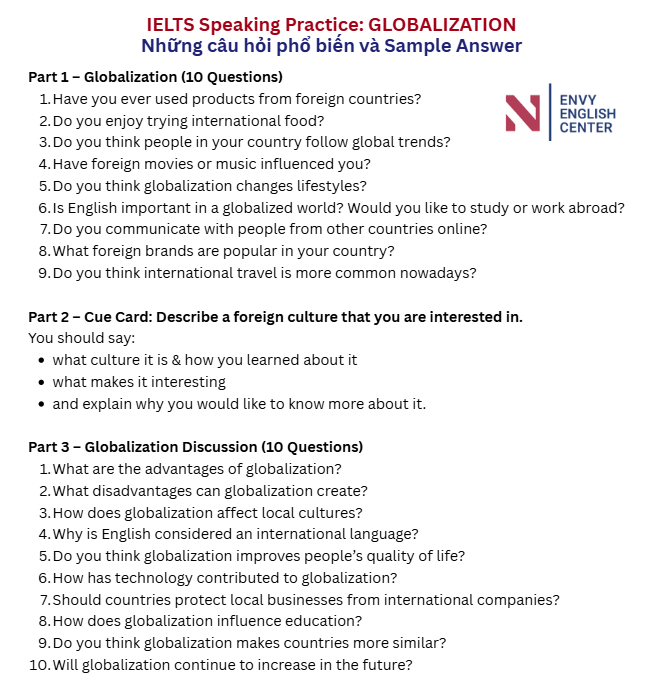
Part 1 – Globalization (10 Questions)
Have you ever used products from foreign countries?
Do you enjoy trying international food?
Do you think people in your country follow global trends?
Have foreign movies or music influenced you?
Do you think globalization changes lifestyles?
Is English important in a globalized world?
Would you like to study or work abroad?
Do you communicate with people from other countries online?
What foreign brands are popular in your country?
Do you think international travel is more common nowadays?
Part 2 – Cue Card: Describe a foreign culture that you are interested in.
You should say:
what culture it is
how you learned about it
what makes it interesting
and explain why you would like to know more about it.
Part 3 – Globalization Discussion (10 Questions)
What are the advantages of globalization?
What disadvantages can globalization create?
How does globalization affect local cultures?
Why is English considered an international language?
Do you think globalization improves people’s quality of life?
How has technology contributed to globalization?
Should countries protect local businesses from international companies?
How does globalization influence education?
Do you think globalization makes countries more similar?
Will globalization continue to increase in the future?
2. Questions & Answers
Question 1: Have you ever used products from foreign countries?
Yes, I use foreign products quite frequently in my daily life, especially electronic devices, cosmetics, and clothing brands. Many international products are popular in my country because people often associate them with high quality and advanced technology. In addition, globalization has made imported goods much more accessible and affordable than before. I think using foreign products also exposes consumers to different lifestyles and international trends.
Electronic devices (n.phr): thiết bị điện tử
e.g: Students rely heavily on electronic devices nowadays.
Advanced technology (n.phr): công nghệ tiên tiến
e.g: Modern hospitals use advanced technology.
Imported goods (n.phr): hàng nhập khẩu
e.g: Imported goods are widely available in supermarkets.
International trends (n.phr): xu hướng quốc tế
e.g: Teenagers often follow international trends online.
Question 2: Do you enjoy trying international food?
Yes, I absolutely enjoy trying food from different countries because it allows me to experience diverse flavors and cooking styles. For example, I particularly like Japanese, Korean, and Italian cuisine because each has unique ingredients and cultural characteristics. In addition, trying international dishes helps me learn more about different cultures and traditions. I think food is one of the most interesting ways to connect people globally.
Diverse flavors (n.phr): hương vị đa dạng
e.g: Asian cuisine offers diverse flavors.
Cooking style (n.phr): phong cách nấu ăn
e.g: French cooking styles are famous worldwide.
Unique ingredients (n.phr): nguyên liệu độc đáo
e.g: Traditional dishes often use unique ingredients.
Connect people globally (v.phr): kết nối con người toàn cầu
e.g: Music and food connect people globally.
Question 3: Do you think people in your country follow global trends?
Yes, I think many people in my country are strongly influenced by global trends, especially younger generations. Social media platforms and international entertainment expose people to foreign fashion, music, and lifestyles very quickly. As a result, trends from countries such as the United States or South Korea often become popular in Vietnam within a short period of time. However, I believe people should still preserve important aspects of their local culture despite international influences.
Younger generation (n.phr): thế hệ trẻ
e.g: Younger generations adapt quickly to change.
International entertainment (n.phr): giải trí quốc tế
e.g: International entertainment influences teenagers.
Local culture (n.phr): văn hóa địa phương
e.g: Tourism can help promote local culture.
International influence (n.phr): ảnh hưởng quốc tế
e.g: Global brands have strong international influence.
Question 4: Have foreign movies or music influenced you?
Yes, foreign movies and music have influenced me in several positive ways. Watching English-language films has improved my listening skills and helped me become more familiar with different accents and communication styles. In addition, international music allows me to explore various cultures and artistic perspectives. I think foreign media can broaden people’s understanding of the world if consumed thoughtfully.
Communication style (n.phr): phong cách giao tiếp
e.g: Communication styles vary between cultures.
Artistic perspective (n.phr): góc nhìn nghệ thuật
e.g: Films reflect different artistic perspectives.
Broaden understanding (v.phr): mở rộng hiểu biết
e.g: Traveling broadens people’s understanding.
Consumed thoughtfully (v.phr): tiếp cận một cách chọn lọc
e.g: Social media should be consumed thoughtfully.
Question 5: Do you think globalization changes lifestyles?
Yes, globalization has significantly changed modern lifestyles in many countries. Nowadays, people have easier access to international products, entertainment, education, and communication technologies than ever before. As a result, lifestyles around the world are becoming increasingly modernized and interconnected. However, some people worry that globalization may reduce cultural uniqueness and encourage excessive consumerism.
Communication technology (n.phr): công nghệ giao tiếp
e.g: Communication technology develops rapidly.
Interconnected (adj): kết nối với nhau
e.g: The modern world is highly interconnected.
Cultural uniqueness (n.phr): sự độc đáo văn hóa
e.g: Countries should preserve cultural uniqueness.
Consumerism (n): chủ nghĩa tiêu dùng
e.g: Advertising encourages consumerism.
Question 6: Is English important in a globalized world?
Yes, English is extremely important in today’s globalized world because it is widely used in international communication, business, and education. Many multinational companies require employees to have strong English skills in order to work effectively with international partners. Furthermore, English allows people to access a large amount of academic knowledge and online information. I think learning English creates more educational and professional opportunities for individuals.
International communication (n.phr): giao tiếp quốc tế
e.g: English is essential for international communication.
Multinational company (n.phr): công ty đa quốc gia
e.g: Multinational companies hire international employees.
Academic knowledge (n.phr): kiến thức học thuật
e.g: Students use English to access academic knowledge.
Professional opportunity (n.phr): cơ hội nghề nghiệp
e.g: Language skills increase professional opportunities.
Question 7: Would you like to study or work abroad?
Yes, I would definitely like to study or work abroad in the future because it would provide valuable personal and professional experiences. Living in another country could help me become more independent, adaptable, and culturally aware. In addition, international education or work experience may improve my career prospects significantly. However, I would still want to maintain strong connections with my family and home country.
Career prospect (n.phr): triển vọng nghề nghiệp
e.g: International experience improves career prospects.
Culturally aware (adj.phr): có nhận thức văn hóa
e.g: Travelers become more culturally aware.
Adaptable (adj): dễ thích nghi
e.g: Employees should be adaptable in modern workplaces.
Maintain strong connections (v.phr): duy trì kết nối bền chặt
e.g: Technology helps migrants maintain strong connections with family.
Question 8: Do you communicate with people from other countries online?
Yes, I occasionally communicate with people from other countries through social media and language-learning platforms. These interactions allow me to practice English and learn more about different cultures and perspectives. In addition, online communication makes international friendships much easier to develop than in the past. I believe digital platforms have greatly increased global connectivity among young people.
Language-learning platform (n.phr): nền tảng học ngôn ngữ
e.g: Many students use language-learning platforms.
Global connectivity (n.phr): kết nối toàn cầu
e.g: The Internet improves global connectivity.
International friendship (n.phr): tình bạn quốc tế
e.g: Exchange programs encourage international friendships.
Different perspectives (n.phr): góc nhìn khác nhau
e.g: Reading helps people understand different perspectives.
Question 9: What foreign brands are popular in your country?
Many foreign brands are extremely popular in Vietnam, especially in areas such as technology, fashion, and food. International companies like Apple, Samsung, Nike, and McDonald’s are widely recognized by consumers of different age groups. People often choose these brands because they are associated with quality, innovation, and modern lifestyles. However, domestic brands are also becoming increasingly competitive in recent years.
Recognized by consumers (v.phr): được người tiêu dùng biết đến
e.g: Luxury brands are recognized by consumers worldwide.
Modern lifestyle (n.phr): lối sống hiện đại
e.g: Advertising promotes modern lifestyles.
Domestic brand (n.phr): thương hiệu nội địa
e.g: Domestic brands are improving rapidly.
Competitive (adj): có tính cạnh tranh
e.g: Local businesses are becoming more competitive.
Question 10: Do you think international travel is more common nowadays?
Yes, international travel has become much more common nowadays due to technological and economic development. Air travel is generally more affordable and accessible than it was in the past, which encourages more people to travel abroad for tourism, study, or work. In addition, social media inspires many individuals to explore different countries and cultures. I think globalization has made international travel an important part of modern life.
Economic development (n.phr): phát triển kinh tế
e.g: Economic development increases living standards.
Affordable (adj): giá cả phải chăng
e.g: Budget airlines make travel more affordable.
Accessible (adj): dễ tiếp cận
e.g: Online education is more accessible nowadays.
Explore different cultures (v.phr): khám phá các nền văn hóa khác nhau
e.g: Traveling helps people explore different cultures.
Part 2 – Cue Card
Describe a foreign culture that you are interested in.
One foreign culture that I am particularly interested in is Japanese culture because it combines modern innovation with strong traditional values. I first became interested in Japan through anime, movies, and documentaries, and later I learned more about the country through books and social media content. Over time, I realized that Japanese culture is much deeper and more fascinating than I had initially thought.
One aspect that I find especially interesting is the Japanese sense of discipline and respect in daily life. For example, people in Japan are generally known for being punctual, polite, and highly responsible in both professional and social situations. In addition, the country places great importance on cleanliness and public manners, which contributes to a well-organized society. I admire these qualities because they reflect strong social awareness and mutual respect among citizens.
Another reason why I am attracted to Japanese culture is its rich traditions and unique art forms. Traditional festivals, tea ceremonies, kimono clothing, and historical architecture all represent important aspects of Japanese cultural identity. At the same time, Japan is also famous for technological innovation, modern entertainment, and creative industries such as anime and video games. I find this balance between tradition and modernization extremely impressive.
Furthermore, Japanese cuisine is another cultural feature that interests me greatly. Dishes such as sushi, ramen, and tempura are popular worldwide because they are both flavorful and visually appealing. I also appreciate the attention to detail and presentation in Japanese cooking, which reflects the country’s artistic mindset.
I would like to know more about Japanese culture because I believe it could broaden my understanding of global perspectives and different ways of life. If possible, I would love to visit Japan in the future in order to experience the culture directly, communicate with local people, and explore historical places. Overall, Japanese culture fascinates me because it successfully preserves traditional values while continuously adapting to the modern world.
Traditional values (n.phr): giá trị truyền thống
e.g: Japanese society strongly respects traditional values.
Social awareness (n.phr): ý thức xã hội
e.g: Public campaigns improve social awareness.
Cultural identity (n.phr): bản sắc văn hóa
e.g: Traditional clothing reflects cultural identity.
Technological innovation (n.phr): đổi mới công nghệ
e.g: Japan is famous for technological innovation.
Attention to detail (n.phr): sự chú ý đến chi tiết
e.g: Good designers pay attention to detail.
Broaden understanding (v.phr): mở rộng hiểu biết
e.g: Traveling broadens people’s understanding of the world.
Global perspective (n.phr): góc nhìn toàn cầu
e.g: International education develops a global perspective.
Adapt to the modern world (v.phr): thích nghi với thế giới hiện đại
e.g: Traditional businesses must adapt to the modern world.
Part 3 – Discussion
Question: What are the advantages of globalization?
Globalization offers numerous advantages for both individuals and societies. Firstly, it promotes international trade and economic growth by allowing countries to exchange goods, services, and technology more efficiently. Secondly, globalization encourages cultural exchange, which helps people become more open-minded and globally aware. In addition, technological development and international cooperation have improved communication and access to information worldwide. I believe globalization creates more educational and professional opportunities for people in many countries.
International trade (n.phr): thương mại quốc tế
e.g: International trade supports economic growth.
Economic growth (n.phr): tăng trưởng kinh tế
e.g: Technology contributes to economic growth.
Cultural exchange (n.phr): giao lưu văn hóa
e.g: Tourism promotes cultural exchange.
Globally aware (adj.phr): có nhận thức toàn cầu
e.g: Young people are becoming more globally aware.
Question: What disadvantages can globalization create?
Although globalization has many benefits, it can also create several negative consequences. One major disadvantage is that local cultures and traditions may gradually disappear due to the strong influence of global media and foreign lifestyles. In addition, international competition can make it difficult for small local businesses to survive against multinational corporations. Another issue is that globalization may increase economic inequality because not everyone benefits equally from global development. Therefore, governments should carefully manage globalization to minimize its negative impacts.
Multinational corporation (n.phr): tập đoàn đa quốc gia
e.g: Multinational corporations dominate global markets.
Economic inequality (n.phr): bất bình đẳng kinh tế
e.g: Economic inequality remains a global issue.
Local business (n.phr): doanh nghiệp địa phương
e.g: Governments should support local businesses.
Negative impact (n.phr): tác động tiêu cực
e.g: Social media can have negative impacts on teenagers.
Question: How does globalization affect local cultures?
Globalization affects local cultures in both positive and negative ways. On the positive side, it allows cultures to spread internationally and encourages people to learn more about traditions from other countries. However, globalization can also weaken cultural identity because younger generations are increasingly influenced by foreign entertainment and lifestyles. As a result, some traditional customs may become less common over time. I think societies should preserve their cultural heritage while still embracing international development.
Cultural identity (n.phr): bản sắc văn hóa
e.g: Language shapes cultural identity.
Foreign entertainment (n.phr): giải trí nước ngoài
e.g: Teenagers consume a lot of foreign entertainment.
Traditional custom (n.phr): phong tục truyền thống
e.g: Rural communities preserve traditional customs.
Cultural heritage (n.phr): di sản văn hóa
e.g: Museums help protect cultural heritage.
Question: Why is English considered an international language?
English is considered an international language because it is widely used in global communication, business, education, and technology. Many international organizations and multinational companies use English as their primary working language. In addition, a large amount of academic research, online content, and international media is produced in English. As a result, people who speak English often have greater access to educational and professional opportunities worldwide.
Global communication (n.phr): giao tiếp toàn cầu
e.g: English is essential for global communication.
Primary working language (n.phr): ngôn ngữ làm việc chính
e.g: English is the primary working language in many companies.
Academic research (n.phr): nghiên cứu học thuật
e.g: Most academic research is published in English.
Professional opportunity (n.phr): cơ hội nghề nghiệp
e.g: English skills improve professional opportunities.
Question: Do you think globalization improves people’s quality of life?
Yes, I believe globalization has improved people’s quality of life in many important ways. For example, globalization has increased access to technology, education, healthcare, and international products that make daily life more convenient. In addition, people can now communicate and share information across countries much more easily than before. However, the benefits of globalization are not distributed equally, so some communities may still face economic difficulties. Overall, I think globalization has had a mostly positive impact on modern society.
Quality of life (n.phr): chất lượng cuộc sống
e.g: Technology improves quality of life.
Access to technology (n.phr): khả năng tiếp cận công nghệ
e.g: Rural areas need better access to technology.
Distributed equally (v.phr): phân bổ đồng đều
e.g: Wealth is not distributed equally in society.
Positive impact (n.phr): tác động tích cực
e.g: Education has a positive impact on communities.
Question: How has technology contributed to globalization?
Technology has played a crucial role in accelerating globalization around the world. The Internet and digital communication platforms allow people to exchange information instantly regardless of geographical distance. In addition, transportation technology has made international travel and global trade much faster and more affordable. Social media also enables cultural trends and global news to spread rapidly across different countries. Consequently, technology has created a highly interconnected global society.
Digital communication platform (n.phr): nền tảng giao tiếp số
e.g: Businesses rely on digital communication platforms.
Geographical distance (n.phr): khoảng cách địa lý
e.g: Technology reduces the effect of geographical distance.
Global trade (n.phr): thương mại toàn cầu
e.g: Shipping technology supports global trade.
Interconnected society (n.phr): xã hội kết nối
e.g: We live in an interconnected society.
Question: Should countries protect local businesses from international companies?
Yes, I think governments should provide reasonable support for local businesses because they contribute significantly to the national economy and create employment opportunities. Without protection or financial assistance, many small businesses may struggle to compete with large multinational corporations. However, I also believe international competition can encourage local companies to improve their products and services. Therefore, governments should maintain a balance between protecting domestic industries and encouraging healthy competition.
Employment opportunity (n.phr): cơ hội việc làm
e.g: Small businesses create employment opportunities.
Financial assistance (n.phr): hỗ trợ tài chính
e.g: Governments offer financial assistance to farmers.
Domestic industry (n.phr): ngành công nghiệp trong nước
e.g: Countries should support domestic industries.
Healthy competition (n.phr): cạnh tranh lành mạnh
e.g: Healthy competition improves product quality.
Question: How does globalization influence education?
Globalization has greatly influenced education by increasing access to international knowledge and learning opportunities. Students can now study online courses from foreign universities and communicate with teachers or classmates from different countries. In addition, English-language education has become increasingly important because it helps students participate in the global workforce. I think globalization encourages educational systems to become more modern and internationally connected.
Learning opportunity (n.phr): cơ hội học tập
e.g: Scholarships provide learning opportunities for students.
Global workforce (n.phr): lực lượng lao động toàn cầu
e.g: English helps people join the global workforce.
Educational system (n.phr): hệ thống giáo dục
e.g: Technology changes educational systems rapidly.
Internationally connected (adj.phr): kết nối quốc tế
e.g: Universities are becoming more internationally connected.
Question: Do you think globalization makes countries more similar?
Yes, to some extent, globalization makes countries more similar because people around the world are increasingly exposed to the same products, entertainment, and lifestyles. For example, international fashion brands, social media platforms, and fast-food chains are popular in many countries. However, I believe cultural differences still remain important because traditions, languages, and historical backgrounds vary greatly between societies. Therefore, globalization may increase similarities while cultural diversity continues to exist.
Fast-food chain (n.phr): chuỗi thức ăn nhanh
e.g: Fast-food chains are common worldwide.
Cultural diversity (n.phr): sự đa dạng văn hóa
e.g: Cultural diversity enriches society.
Historical background (n.phr): bối cảnh lịch sử
e.g: Countries have different historical backgrounds.
To some extent (adv.phr): ở một mức độ nào đó
e.g: Technology changes communication to some extent.
Question: Will globalization continue to increase in the future?
Yes, I believe globalization will continue to increase in the future because technology and international cooperation are developing rapidly. The growth of digital communication, global trade, and international travel makes countries more interconnected than ever before. In addition, multinational companies and online platforms continue expanding their influence across different regions of the world. Although some countries may attempt to protect local industries or reduce dependence on globalization, I think global integration will still remain a long-term trend.
International cooperation (n.phr): hợp tác quốc tế
e.g: Climate change requires international cooperation.
Global integration (n.phr): hội nhập toàn cầu
e.g: Technology accelerates global integration.
Reduce dependence on (v.phr): giảm phụ thuộc vào
e.g: Countries want to reduce dependence on imported energy.
Long-term trend (n.phr): xu hướng dài hạn
e.g: Remote work may become a long-term trend.
Nếu bạn đang bắt đầu từ con số 0 hoặc đã học nhưng “dậm chân tại chỗ”, Envy English Center có thể đồng hành cùng bạn:
Test trình độ miễn phí theo format IELTS để biết chính xác điểm mạnh – điểm yếu.
Nhận lộ trình học cá nhân hóa từ 0 → 6.5+, phù hợp tốc độ và mục tiêu.
Trực tiếp học với giáo viên IELTS 8.0+, chuyên “gỡ rối” Speaking & Writing – hai kỹ năng khó nâng band nhất.
Đặc biệt, khi đăng ký trong tuần này, bạn được tặng bộ từ vựng chuẩn IELTS band 7+.
📞 Hotline: 028 7300 9677 / 0948 197 270 (Zalo)
🌐 Website: envyenglish.vn
📍 Địa chỉ: 46/5 Tân Cảng, Phường Thạnh Mỹ Tây, Quận Bình Thạnh, TP.HCM


Thông tin gửi đi không thành công, vui lòng thử lại sau.
Nếu bạn cần liên hệ gấp, vui lòng gọi hotline
02873009677

Cảm ơn bạn đã gửi thông tin đến Envy English Center.
Chúng tôi sẽ liên hệ với bạn sớm nhất khi có thể.
Nếu bạn cần liên hệ gấp, vui lòng gọi hotline
02873009677
Thông tin gửi đi không thành công, vui lòng thử lại sau.
Nếu bạn cần liên hệ gấp, vui lòng gọi hotline
02873009677
Bạn đang có một bài test chưa hoàn thành.
Bạn có muốn tiếp tục bài test đó không?
Bạn có chắc là muốn gửi bài test này không?

Số câu trả lời đúng/40

Số câu trả lời đúng/40
Thông tin gửi đi không thành công, vui lòng thử lại sau.
Nếu bạn cần liên hệ gấp, vui lòng gọi hotline
02873009677
Thời gian làm bài kiểm tra đã hết.
Cảm ơn bạn đã cố gắng.
