 02873009677
 contact@envyenglish.vn

1. Questions
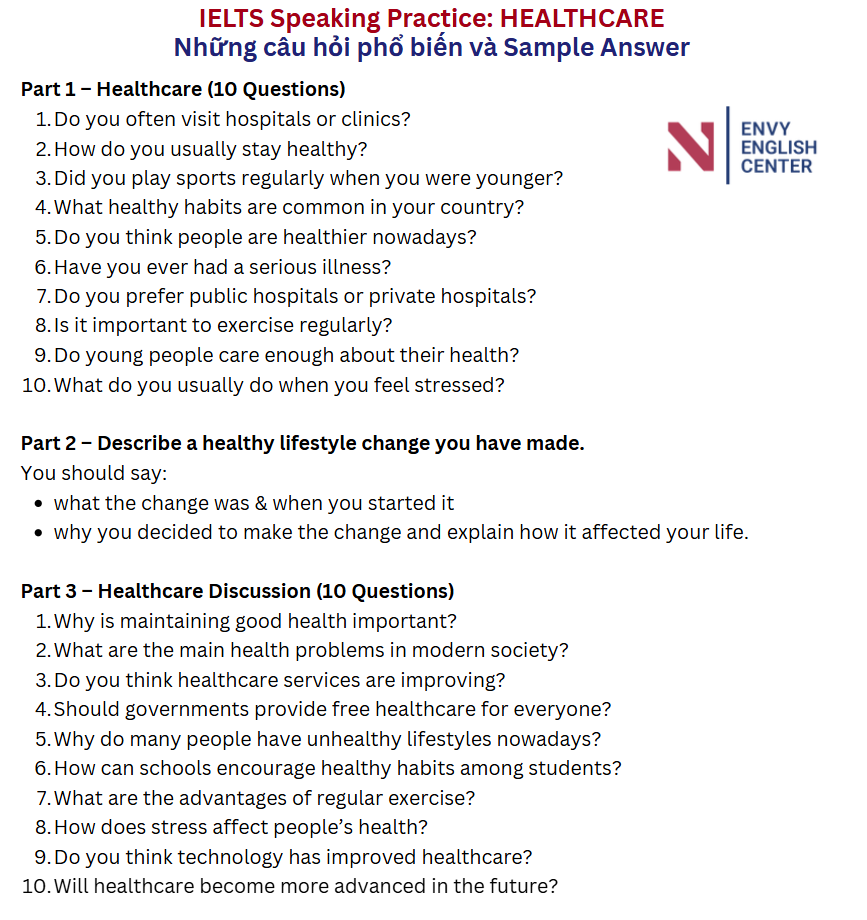
Part 1 – Healthcare (10 Questions)
Do you often visit hospitals or clinics?
How do you usually stay healthy?
Did you play sports regularly when you were younger?
What healthy habits are common in your country?
Do you think people are healthier nowadays?
Have you ever had a serious illness?
Do you prefer public hospitals or private hospitals?
Is it important to exercise regularly?
Do young people care enough about their health?
What do you usually do when you feel stressed?
Part 2 – Cue Card (1 Question)
Describe a healthy lifestyle change you have made.
You should say:
what the change was
when you started it
why you decided to make the change
and explain how it affected your life.
Part 3 – Healthcare Discussion (10 Questions)
Why is maintaining good health important?
What are the main health problems in modern society?
Do you think healthcare services are improving?
Should governments provide free healthcare for everyone?
Why do many people have unhealthy lifestyles nowadays?
How can schools encourage healthy habits among students?
What are the advantages of regular exercise?
How does stress affect people’s health?
Do you think technology has improved healthcare?
Will healthcare become more advanced in the future?
2. Questions & Answers
Question 1: Do you often visit hospitals or clinics?
No, I do not visit hospitals or clinics very often because I am generally in good health. I usually only go for regular medical check-ups or minor illnesses such as colds or headaches. However, I think routine health examinations are important because they help detect potential health problems at an early stage. In addition, regular healthcare visits can encourage people to maintain healthier lifestyles.
Medical check-up (n.phr): kiểm tra sức khỏe
e.g: People should have regular medical check-ups.
Minor illness (n.phr): bệnh nhẹ
e.g: Most minor illnesses can be treated easily.
Routine examination (n.phr): kiểm tra định kỳ
e.g: Routine examinations improve public health.
Healthy lifestyle (n.phr): lối sống lành mạnh
e.g: Exercise supports a healthy lifestyle.
Question 2: How do you usually stay healthy?
I try to stay healthy by maintaining balanced daily habits and managing stress effectively. For example, I exercise regularly, drink enough water, and try to get sufficient sleep despite my busy schedule. In addition, I attempt to maintain a relatively balanced diet by reducing unhealthy fast food and sugary drinks. I believe consistency is extremely important when it comes to maintaining good physical and mental health.
Balanced daily habit (n.phr): thói quen hằng ngày cân bằng
e.g: Balanced daily habits improve health.
Sufficient sleep (n.phr): giấc ngủ đầy đủ
e.g: Teenagers need sufficient sleep.
Balanced diet (n.phr): chế độ ăn cân bằng
e.g: Doctors recommend balanced diets.
Mental health (n.phr): sức khỏe tinh thần
e.g: Exercise improves mental health.
Question 3: Did you play sports regularly when you were younger?
Yes, I played sports more frequently when I was younger, especially during my school years. I often participated in activities such as badminton, running, and volleyball with friends after class. Playing sports not only improved my physical fitness but also helped me develop teamwork and communication skills. However, as academic responsibilities increased, I gradually had less free time for sports activities.
Physical fitness (n.phr): thể lực
e.g: Sports improve physical fitness.
Teamwork skill (n.phr): kỹ năng làm việc nhóm
e.g: Students develop teamwork skills through sports.
Academic responsibility (n.phr): trách nhiệm học tập
e.g: Academic responsibilities create stress.
Sports activity (n.phr): hoạt động thể thao
e.g: Schools encourage sports activities.
Question 4: What healthy habits are common in your country?
Several healthy habits are becoming increasingly popular in my country, particularly among younger generations. Many people now pay more attention to exercising regularly, eating healthier foods, and reducing sugary drinks. In addition, outdoor activities such as jogging, cycling, and going to the gym are becoming more common. However, unhealthy lifestyles still exist due to stress, fast food consumption, and busy working schedules.
Younger generation (n.phr): thế hệ trẻ
e.g: Younger generations care more about fitness.
Healthy food (n.phr): thực phẩm lành mạnh
e.g: People buy more healthy foods nowadays.
Outdoor activity (n.phr): hoạt động ngoài trời
e.g: Outdoor activities improve physical health.
Fast food consumption (n.phr): việc tiêu thụ đồ ăn nhanh
e.g: Fast food consumption contributes to obesity.
Question 5: Do you think people are healthier nowadays?
I think healthcare and medical knowledge have improved significantly, but modern lifestyles also create new health problems. On the positive side, people have better access to healthcare services, nutrition, and fitness information than previous generations. However, stress, lack of exercise, unhealthy diets, and excessive screen time negatively affect many people’s health. Therefore, I believe modern society offers both advantages and challenges regarding health.
Medical knowledge (n.phr): kiến thức y khoa
e.g: Medical knowledge improves healthcare quality.
Healthcare service (n.phr): dịch vụ chăm sóc sức khỏe
e.g: Governments invest in healthcare services.
Unhealthy diet (n.phr): chế độ ăn không lành mạnh
e.g: Unhealthy diets increase health risks.
Excessive screen time (n.phr): thời gian màn hình quá mức
e.g: Excessive screen time affects sleep quality.
Question 6: Have you ever had a serious illness?
Fortunately, I have never experienced a very serious illness, although I have occasionally suffered from common health problems such as flu or stress-related fatigue. During particularly stressful academic periods, I sometimes experienced sleep deprivation and exhaustion due to heavy workloads. Those experiences made me realize the importance of maintaining both physical and mental health. Since then, I have tried to manage stress more effectively and maintain healthier routines.
Stress-related fatigue (n.phr): mệt mỏi do căng thẳng
e.g: Students often experience stress-related fatigue.
Sleep deprivation (n.phr): thiếu ngủ
e.g: Sleep deprivation affects concentration.
Heavy workload (n.phr): khối lượng công việc lớn
e.g: Employees suffer from heavy workloads.
Healthy routine (n.phr): thói quen lành mạnh
e.g: Exercise becomes part of a healthy routine.
Question 7: Do you prefer public hospitals or private hospitals?
I think both public and private hospitals have their own advantages and disadvantages. Public hospitals are generally more affordable and accessible for a larger number of people, although they are often overcrowded. On the other hand, private hospitals usually provide faster services, shorter waiting times, and more comfortable facilities. Personally, I would probably choose depending on the seriousness of the medical situation and financial considerations.
Affordable (adj): giá phải chăng
e.g: Public healthcare is more affordable.
Overcrowded (adj): quá tải
e.g: Urban hospitals are often overcrowded.
Waiting time (n.phr): thời gian chờ
e.g: Patients dislike long waiting times.
Financial consideration (n.phr): cân nhắc tài chính
e.g: Families make financial considerations carefully.
Question 8: Is it important to exercise regularly?
Yes, regular exercise is extremely important for maintaining both physical and mental health. Physical activity helps improve cardiovascular health, strengthen muscles, and reduce the risk of many diseases. In addition, exercise can reduce stress levels and improve mood by increasing energy and relaxation. I believe regular physical activity should become a normal part of daily life.
Physical activity (n.phr): hoạt động thể chất
e.g: Physical activity improves health.
Cardiovascular health (n.phr): sức khỏe tim mạch
e.g: Running improves cardiovascular health.
Reduce stress level (v.phr): giảm mức độ căng thẳng
e.g: Exercise reduces stress levels.
Daily life (n.phr): cuộc sống hằng ngày
e.g: Healthy habits should be part of daily life.
Question 9: Do young people care enough about their health?
I think awareness about health among young people has improved compared to the past, especially because information is widely available online. Many young people now exercise regularly, follow fitness trends, and pay attention to mental health. However, unhealthy habits such as excessive screen time, poor diets, and lack of sleep are still common among students and young workers. Therefore, I think health awareness exists, but consistent healthy behavior is still a challenge.
Fitness trend (n.phr): xu hướng thể hình
e.g: Social media promotes fitness trends.
Mental health awareness (n.phr): nhận thức về sức khỏe tinh thần
e.g: Mental health awareness is increasing.
Poor diet (n.phr): chế độ ăn kém lành mạnh
e.g: Poor diets cause obesity.
Consistent behavior (n.phr): hành vi duy trì ổn định
e.g: Healthy lifestyles require consistent behavior.
Question 10: What do you usually do when you feel stressed?
When I feel stressed, I usually try to relax through activities such as listening to music, exercising, or spending time alone quietly. Sometimes I also talk to close friends or family members because emotional support helps reduce pressure and anxiety. In addition, I try to organize my schedule more effectively whenever stress comes from academic or work-related responsibilities. I think managing stress properly is very important for maintaining long-term mental health.
Emotional support (n.phr): hỗ trợ tinh thần
e.g: Friends provide emotional support.
Reduce pressure (v.phr): giảm áp lực
e.g: Exercise helps reduce pressure.
Work-related responsibility (n.phr): trách nhiệm liên quan công việc
e.g: Adults face work-related responsibilities.
Long-term mental health (n.phr): sức khỏe tinh thần lâu dài
e.g: Rest is important for long-term mental health.
Part 2 – Cue Card
Describe a healthy lifestyle change you have made.
One healthy lifestyle change that I made recently was starting a regular exercise routine combined with healthier eating habits. I began making this change about a year ago after realizing that my academic schedule and daily stress were negatively affecting both my physical and mental health. At that time, I often felt tired, lacked energy, and experienced difficulty concentrating because my lifestyle was becoming increasingly unhealthy.
Before making this change, I had several bad habits such as sleeping late, skipping meals, and spending excessive amounts of time sitting in front of screens while studying. In addition, I rarely exercised regularly because I believed I was too busy with school responsibilities. However, after experiencing stress-related fatigue and reduced productivity, I realized that maintaining good health should become a priority rather than an afterthought.
To improve my lifestyle, I started exercising several times a week, especially through jogging, gym workouts, and light home exercises. I also tried to maintain a more balanced diet by reducing fast food, sugary drinks, and unhealthy snacks while eating more vegetables, fruits, and protein-rich foods. Furthermore, I attempted to improve my sleep schedule by sleeping earlier and limiting screen time before bedtime. Although these changes were difficult at first, they gradually became part of my daily routine.
This lifestyle change had many positive effects on my life. Physically, I became more energetic, healthier, and less exhausted during busy periods of study. Mentally, regular exercise and better sleep helped reduce stress levels and improve concentration, which also increased my academic productivity. In addition, I became more disciplined and aware of the importance of maintaining long-term health.
Another important benefit was the improvement in my emotional well-being and self-confidence. When people feel physically healthy, they often become more motivated and emotionally stable as well. I also learned that small but consistent habits can create significant long-term improvements over time.
Overall, this healthy lifestyle change positively transformed both my physical condition and mental health. Although maintaining healthy habits requires discipline and consistency, I believe the long-term benefits are definitely worth the effort.
Regular exercise routine (n.phr): thói quen tập thể dục đều đặn
e.g: A regular exercise routine improves fitness.
Balanced diet (n.phr): chế độ ăn cân bằng
e.g: Doctors recommend balanced diets.
Stress-related fatigue (n.phr): mệt mỏi do căng thẳng
e.g: Students often experience stress-related fatigue.
Reduce productivity (v.phr): giảm năng suất
e.g: Poor sleep reduces productivity.
Protein-rich food (n.phr): thực phẩm giàu protein
e.g: Athletes eat protein-rich foods.
Sleep schedule (n.phr): lịch ngủ
e.g: Teenagers should maintain healthy sleep schedules.
Emotional well-being (n.phr): sức khỏe tinh thần
e.g: Exercise improves emotional well-being.
Long-term benefit (n.phr): lợi ích lâu dài
e.g: Healthy habits create long-term benefits.
Part 3 – Discussion
Question: Why is maintaining good health important?
Maintaining good health is extremely important because health affects nearly every aspect of life, including productivity, emotional well-being, and overall quality of life. People who are physically healthy generally have more energy, stronger immune systems, and lower risks of serious diseases. In addition, good mental health allows individuals to manage stress and maintain positive relationships more effectively. I believe health should be considered one of the most valuable long-term investments a person can make.
Quality of life (n.phr): chất lượng cuộc sống
e.g: Exercise improves quality of life.
Immune system (n.phr): hệ miễn dịch
e.g: Sleep strengthens the immune system.
Mental health (n.phr): sức khỏe tinh thần
e.g: Stress affects mental health.
Long-term investment (n.phr): khoản đầu tư dài hạn
e.g: Education is a long-term investment.
Question: What are the main health problems in modern society?
Modern society faces several major health problems, including obesity, stress-related illnesses, mental health disorders, and heart disease. Many of these issues are caused by unhealthy lifestyles involving poor diets, lack of exercise, and excessive screen time. In addition, modern working environments and academic pressure contribute significantly to stress and anxiety. I think maintaining work-life balance has become increasingly difficult in fast-paced societies.
Stress-related illness (n.phr): bệnh liên quan căng thẳng
e.g: Employees suffer from stress-related illnesses.
Mental health disorder (n.phr): rối loạn sức khỏe tinh thần
e.g: Anxiety is a common mental health disorder.
Fast-paced society (n.phr): xã hội nhịp sống nhanh
e.g: Fast-paced societies create pressure.
Work-life balance (n.phr): cân bằng công việc-cuộc sống
e.g: Workers need better work-life balance.
Question: Do you think healthcare services are improving?
Yes, I think healthcare services have improved significantly due to medical advancements and technological development. Nowadays, hospitals have access to better equipment, more effective treatments, and improved diagnostic methods compared to the past. In addition, online healthcare services and digital medical records have made healthcare more convenient and efficient in many countries. However, access to high-quality healthcare is still unequal in some regions.
Medical advancement (n.phr): tiến bộ y học
e.g: Medical advancements save millions of lives.
Diagnostic method (n.phr): phương pháp chẩn đoán
e.g: Modern diagnostic methods are highly accurate.
Digital medical record (n.phr): hồ sơ y tế điện tử
e.g: Hospitals use digital medical records.
High-quality healthcare (n.phr): chăm sóc sức khỏe chất lượng cao
e.g: Rural areas need high-quality healthcare.
Question: Should governments provide free healthcare for everyone?
I believe governments should provide basic healthcare services for everyone because healthcare is a fundamental human need. Free or affordable healthcare systems can improve public health and reduce inequality within society. In addition, access to medical treatment should not depend entirely on a person’s financial situation. However, governments must also manage healthcare funding efficiently to ensure long-term sustainability.
Fundamental human need (n.phr): nhu cầu cơ bản của con người
e.g: Healthcare is a fundamental human need.
Public health (n.phr): sức khỏe cộng đồng
e.g: Vaccination improves public health.
Medical treatment (n.phr): điều trị y tế
e.g: Patients need affordable medical treatment.
Long-term sustainability (n.phr): tính bền vững lâu dài
e.g: Governments plan for long-term sustainability.
Question: Why do many people have unhealthy lifestyles nowadays?
Many people have unhealthy lifestyles because modern society often encourages convenience and fast-paced routines. Busy schedules make it difficult for individuals to cook healthy meals, exercise regularly, or get sufficient sleep. In addition, technology and entertainment platforms encourage sedentary behavior and excessive screen time. I also think stress and financial pressure contribute to unhealthy habits such as poor diets and sleep deprivation.
Fast-paced routine (n.phr): nhịp sống nhanh
e.g: Fast-paced routines increase stress.
Sedentary behavior (n.phr): lối sống ít vận động
e.g: Office workers often have sedentary behavior.
Sleep deprivation (n.phr): thiếu ngủ
e.g: Sleep deprivation affects concentration.
Financial pressure (n.phr): áp lực tài chính
e.g: Financial pressure affects mental health.
Question: How can schools encourage healthy habits among students?
Schools can encourage healthy habits by combining education with practical activities and supportive environments. For example, schools can teach students about nutrition, mental health, and the importance of physical activity through health education programs. In addition, schools should organize sports activities, provide healthy meals, and encourage balanced study schedules. I think creating healthy routines from a young age can positively influence long-term behavior.
Health education program (n.phr): chương trình giáo dục sức khỏe
e.g: Schools need better health education programs.
Physical activity (n.phr): hoạt động thể chất
e.g: Physical activity improves concentration.
Balanced schedule (n.phr): lịch trình cân bằng
e.g: Students need balanced schedules.
Long-term behavior (n.phr): hành vi lâu dài
e.g: Childhood habits influence long-term behavior.
Question: What are the advantages of regular exercise?
Regular exercise offers many physical and psychological benefits. Physically, it strengthens muscles, improves cardiovascular health, and reduces the risk of diseases such as obesity and diabetes. Mentally, exercise helps reduce stress, improve mood, and increase self-confidence. In addition, people who exercise regularly often have higher energy levels and better overall productivity in daily life.
Psychological benefit (n.phr): lợi ích tâm lý
e.g: Exercise provides psychological benefits.
Cardiovascular health (n.phr): sức khỏe tim mạch
e.g: Running improves cardiovascular health.
Energy level (n.phr): mức năng lượng
e.g: Sleep affects energy levels.
Overall productivity (n.phr): năng suất tổng thể
e.g: Healthy employees have better overall productivity.
Question: How does stress affect people’s health?
Stress can negatively affect both physical and mental health if it becomes excessive or long-lasting. Physically, chronic stress may contribute to sleep problems, headaches, weakened immune systems, and heart disease. Mentally, stress can increase anxiety, emotional exhaustion, and difficulty concentrating. Therefore, stress management is extremely important for maintaining overall well-being and healthy daily functioning.
Chronic stress (n.phr): căng thẳng mãn tính
e.g: Chronic stress affects mental health.
Weakened immune system (n.phr): hệ miễn dịch suy yếu
e.g: Stress weakens the immune system.
Emotional exhaustion (n.phr): kiệt sức tinh thần
e.g: Employees experience emotional exhaustion.
Overall well-being (n.phr): sức khỏe tổng thể
e.g: Exercise improves overall well-being.
Question: Do you think technology has improved healthcare?
Yes, technology has improved healthcare dramatically in many ways. Medical technology allows doctors to diagnose diseases more accurately and provide more effective treatments than before. In addition, telemedicine and online healthcare platforms make medical services more accessible for people living in remote areas. I also think artificial intelligence and medical research will continue transforming healthcare in the future.
Medical technology (n.phr): công nghệ y tế
e.g: Medical technology improves treatment quality.
Diagnose disease (v.phr): chẩn đoán bệnh
e.g: Doctors diagnose diseases earlier nowadays.
Telemedicine (n): khám chữa bệnh từ xa
e.g: Telemedicine supports rural communities.
Remote area (n.phr): khu vực xa xôi
e.g: Technology improves healthcare in remote areas.
Question: Will healthcare become more advanced in the future?
Yes, I strongly believe healthcare will become far more advanced in the future due to scientific research and technological innovation. Future medical systems may use artificial intelligence, robotics, and genetic technology to improve diagnosis and treatment efficiency. In addition, personalized medicine could allow doctors to provide treatments specifically designed for individual patients. However, governments will still need to ensure equal access to advanced healthcare services.
Technological innovation (n.phr): đổi mới công nghệ
e.g: Technological innovation improves healthcare.
Genetic technology (n.phr): công nghệ di truyền
e.g: Scientists study genetic technology carefully.
Personalized medicine (n.phr): y học cá nhân hóa
e.g: Personalized medicine may improve treatment results.
Equal access (n.phr): quyền tiếp cận bình đẳng
e.g: Citizens deserve equal access to healthcare.
Nếu bạn đang bắt đầu từ con số 0 hoặc đã học nhưng “dậm chân tại chỗ”, Envy English Center có thể đồng hành cùng bạn:
Test trình độ miễn phí theo format IELTS để biết chính xác điểm mạnh – điểm yếu.
Nhận lộ trình học cá nhân hóa từ 0 → 6.5+, phù hợp tốc độ và mục tiêu.
Trực tiếp học với giáo viên IELTS 8.0+, chuyên “gỡ rối” Speaking & Writing – hai kỹ năng khó nâng band nhất.
Đặc biệt, khi đăng ký trong tuần này, bạn được tặng bộ từ vựng chuẩn IELTS band 7+.
📞 Hotline: 028 7300 9677 / 0948 197 270 (Zalo)
🌐 Website: envyenglish.vn
📍 Địa chỉ: 46/5 Tân Cảng, Phường Thạnh Mỹ Tây, Quận Bình Thạnh, TP.HCM


Thông tin gửi đi không thành công, vui lòng thử lại sau.
Nếu bạn cần liên hệ gấp, vui lòng gọi hotline
02873009677

Cảm ơn bạn đã gửi thông tin đến Envy English Center.
Chúng tôi sẽ liên hệ với bạn sớm nhất khi có thể.
Nếu bạn cần liên hệ gấp, vui lòng gọi hotline
02873009677
Thông tin gửi đi không thành công, vui lòng thử lại sau.
Nếu bạn cần liên hệ gấp, vui lòng gọi hotline
02873009677
Bạn đang có một bài test chưa hoàn thành.
Bạn có muốn tiếp tục bài test đó không?
Bạn có chắc là muốn gửi bài test này không?

Số câu trả lời đúng/40

Số câu trả lời đúng/40
Thông tin gửi đi không thành công, vui lòng thử lại sau.
Nếu bạn cần liên hệ gấp, vui lòng gọi hotline
02873009677
Thời gian làm bài kiểm tra đã hết.
Cảm ơn bạn đã cố gắng.
