 02873009677
 contact@envyenglish.vn

1. Questions
Part 1: Languages & Communication (10 Questions)
What languages can you speak?
Which language would you like to learn in the future?
Why are foreign languages important?
Do you enjoy learning languages?
How do people usually communicate nowadays?
Do you prefer texting or face-to-face communication?
Is communication different online and offline?
Did you enjoy language classes at school?
Do you think body language is important?
Has technology changed communication?
Part 2: Cue Card
Describe a time when communication was difficult for you.
You should say:
when it happened
who you were communicating with
why communication was difficult
and explain how the situation was solved.
Part 3: Languages & Communication Discussion (10 Questions)
Why is learning foreign languages important nowadays?
What difficulties do people face when learning languages?
How has technology changed communication?
Is face-to-face communication better than online communication?
Why do some people communicate more effectively than others?
Should children learn foreign languages at an early age?
How does body language affect communication?
Do social media platforms improve communication?
Why do misunderstandings happen in communication?
Do you think communication will change more in the future?
2. Questions & Answers
Question 1: What languages can you speak?
I can speak Vietnamese and English relatively fluently. Vietnamese is my native language, while English is the foreign language I use most frequently for studying and communication. I am also interested in learning additional languages in the future because language skills can create more educational and professional opportunities. I think multilingual ability is becoming increasingly valuable in a globalized world.
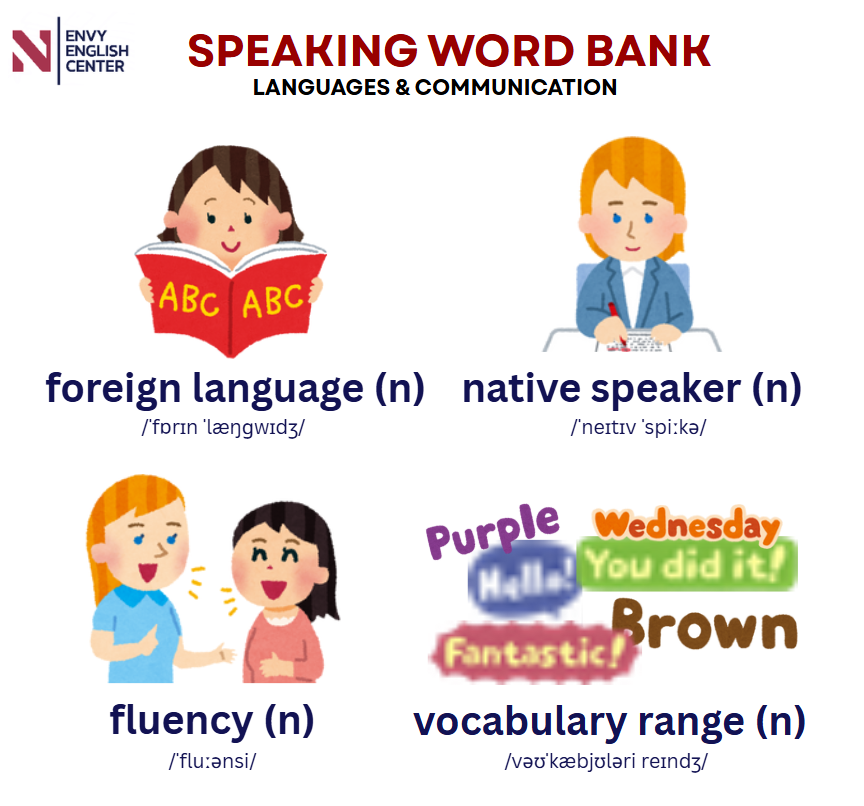
Native language (n.phr): tiếng mẹ đẻ
e.g: Vietnamese is my native language.
Foreign language (n.phr): ngoại ngữ
e.g: English is an important foreign language.
Multilingual ability (n.phr): khả năng đa ngôn ngữ
e.g: Multilingual ability improves communication.
Professional opportunity (n.phr): cơ hội nghề nghiệp
e.g: Languages create professional opportunities.
Question 2: Which language would you like to learn in the future?
I would like to learn French in the future because I find the language elegant and culturally interesting. In addition, French is widely used internationally in diplomacy, law, business, and education, which could be useful for my future career goals. Learning another language would also allow me to understand different cultures more deeply. I think language learning broadens people’s perspectives significantly.
Diplomacy (n): ngoại giao
e.g: French is used in diplomacy.
Career goal (n.phr): mục tiêu nghề nghiệp
e.g: Students should plan career goals.
Cultural understanding (n.phr): hiểu biết văn hóa
e.g: Travel improves cultural understanding.
Broaden perspective (v.phr): mở rộng góc nhìn
e.g: Reading broadens perspectives.
Question 3: Why are foreign languages important?
Foreign languages are important because they improve communication, education, travel, and international cooperation. In today’s globalized world, language skills help people access information and connect with individuals from different cultural backgrounds. In addition, speaking multiple languages can improve career opportunities significantly. I think language learning encourages both intellectual and cultural development.
International cooperation (n.phr): hợp tác quốc tế
e.g: English supports international cooperation.
Cultural background (n.phr): nền tảng văn hóa
e.g: Students learn cultural backgrounds.
Intellectual development (n.phr): phát triển trí tuệ
e.g: Reading supports intellectual development.
Globalized world (n.phr): thế giới toàn cầu hóa
e.g: Languages are important in a globalized world.
Question 4: Do you enjoy learning languages?
Yes, I enjoy learning languages because the process feels intellectually stimulating and culturally interesting. Language learning improves communication skills and allows people to understand different ways of thinking and expressing ideas. Although learning grammar and pronunciation can sometimes be challenging, I think the experience is very rewarding. I especially enjoy improving vocabulary and speaking ability.
Intellectually stimulating (adj.phr): kích thích trí tuệ
e.g: Reading is intellectually stimulating.
Pronunciation (n): phát âm
e.g: Students practice pronunciation.
Speaking ability (n.phr): khả năng nói
e.g: Practice improves speaking ability.
Rewarding experience (n.phr): trải nghiệm đáng giá
e.g: Studying abroad is rewarding.
Question 5: How do people usually communicate nowadays?
Nowadays, people communicate through many methods including face-to-face conversation, phone calls, messaging applications, social media, and video calls. Technology has made communication much faster and more convenient than before. However, some people believe digital communication reduces emotional connection and direct interaction. I think both online and offline communication are important in different situations.
Messaging application (n.phr): ứng dụng nhắn tin
e.g: Students use messaging applications.
Video call (n.phr): cuộc gọi video
e.g: Families communicate through video calls.
Direct interaction (n.phr): tương tác trực tiếp
e.g: Offices encourage direct interaction.
Emotional connection (n.phr): kết nối cảm xúc
e.g: Families provide emotional connection.
Question 6: Do you prefer texting or face-to-face communication?
I generally prefer face-to-face communication because it feels more natural, emotional, and effective. Direct conversations allow people to understand facial expressions, body language, and tone of voice more clearly. However, texting is still very convenient for quick communication and busy schedules. I think the best communication method depends on the situation.
Facial expression (n.phr): biểu cảm khuôn mặt
e.g: Actors use facial expressions.
Body language (n.phr): ngôn ngữ cơ thể
e.g: Body language affects communication.
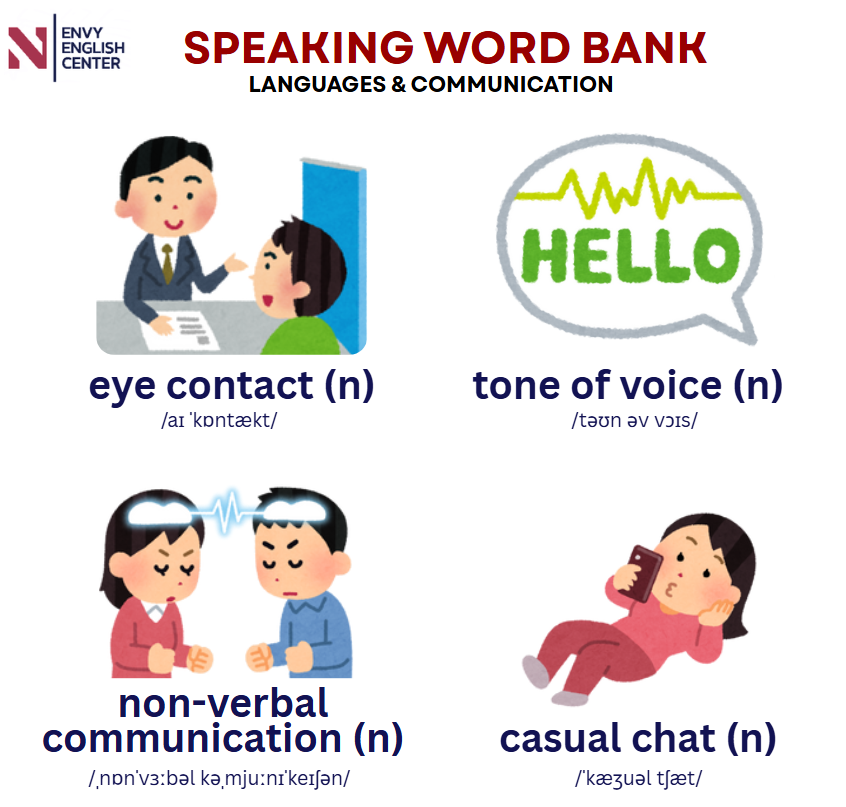
Tone of voice (n.phr): giọng điệu
e.g: Tone of voice changes meaning.
Convenient communication (n.phr): giao tiếp tiện lợi
e.g: Phones provide convenient communication.
Question 7: Is communication different online and offline?
Yes, communication is quite different online and offline. Online communication is usually faster and more convenient, but it may feel less personal and emotionally expressive. Offline communication allows better emotional understanding because people can observe body language and facial expressions directly. I think face-to-face interaction often creates stronger social connections.
Emotionally expressive (adj.phr): giàu biểu cảm cảm xúc
e.g: Live conversations are emotionally expressive.
Social connection (n.phr): kết nối xã hội
e.g: Sports improve social connections.
Personal interaction (n.phr): tương tác cá nhân
e.g: Offices encourage personal interaction.
Emotional understanding (n.phr): sự thấu hiểu cảm xúc
e.g: Families need emotional understanding.
Question 8: Did you enjoy language classes at school?
Yes, I generally enjoyed language classes, especially English lessons, because they improved my communication skills and cultural understanding. I particularly enjoyed speaking activities and discussions because they made classes more interactive and practical. However, some grammar-focused lessons could feel repetitive at times. I think effective language learning should balance theory and communication practice.
Interactive activity (n.phr): hoạt động tương tác
e.g: Teachers organize interactive activities.
Communication skill (n.phr): kỹ năng giao tiếp
e.g: Languages improve communication skills.
Grammar-focused (adj): tập trung vào ngữ pháp
e.g: Some classes are grammar-focused.
Practical learning (n.phr): học thực tế
e.g: Schools encourage practical learning.
Question 9: Do you think body language is important?
Yes, body language is extremely important because it affects emotional expression and communication effectiveness. Facial expressions, gestures, posture, and eye contact can communicate feelings and attitudes even without words. In some situations, body language may express emotions more clearly than spoken language. I think good communication depends heavily on nonverbal signals.
Gesture (n): cử chỉ
e.g: Speakers use gestures naturally.
Eye contact (n.phr): giao tiếp bằng mắt
e.g: Eye contact shows confidence.
Nonverbal signal (n.phr): tín hiệu phi ngôn ngữ
e.g: Smiling is a nonverbal signal.
Communication effectiveness (n.phr): hiệu quả giao tiếp
e.g: Listening improves communication effectiveness.
Question 10: Has technology changed communication?
Yes, technology has changed communication dramatically by making it faster, easier, and more globalized. People can now communicate instantly across long distances through messaging apps and video calls. However, excessive reliance on technology may reduce face-to-face interaction and emotional connection. I think technology has both improved and complicated modern communication.
Long distance (n.phr): khoảng cách xa
e.g: Technology connects long distances.
Instant communication (n.phr): giao tiếp tức thời
e.g: Phones allow instant communication.
Excessive reliance (n.phr): sự phụ thuộc quá mức
e.g: Students have excessive reliance on phones.
Globalized communication (n.phr): giao tiếp toàn cầu hóa
e.g: English supports globalized communication.
Part 2: Describe a time when communication was difficult for you.
One time when communication was particularly difficult for me was during an English-speaking discussion with several people from different cultural and linguistic backgrounds in an online academic environment. It happened during a group discussion activity where participants had different accents, communication styles, and levels of speaking speed. Although everyone was using English, I realized that effective communication involves much more than simply understanding vocabulary and grammar.
At the beginning of the conversation, I found it challenging to follow the discussion because some participants spoke extremely quickly and used unfamiliar expressions or idioms. In addition, differences in pronunciation and accent made certain parts of the conversation difficult to understand clearly. Since I did not want to interrupt too often, I sometimes became nervous about asking people to repeat themselves. As a result, I occasionally misunderstood ideas or responded less confidently than usual.
Another difficulty was the pressure of expressing complex thoughts clearly in a second language. Sometimes I understood the topic internally but struggled to organize my ideas naturally and communicate them fluently. I was worried that grammatical mistakes or unclear explanations might affect other people’s impressions of my communication ability. I think many language learners experience this kind of anxiety when speaking in unfamiliar environments.
To solve the situation, I gradually became more proactive and patient during the discussion. Instead of pretending to understand everything immediately, I politely asked for clarification whenever necessary. I also tried to speak more slowly and organize my ideas into simpler, clearer sentences. Fortunately, the other participants were understanding and supportive, which made the communication atmosphere more comfortable and less stressful. Over time, the conversation became smoother and more natural.
That experience taught me several important lessons about communication. First, effective communication depends not only on language ability but also on confidence, listening skills, patience, and adaptability. Second, misunderstandings are normal in multilingual conversations, especially when people come from different cultural backgrounds. Finally, I realized that asking questions and seeking clarification are actually signs of good communication rather than weakness.
Overall, although the situation initially felt stressful and uncomfortable, it eventually became a valuable learning experience. It improved my confidence in communicating internationally and helped me understand the importance of active listening and open-minded communication. I believe communication skills develop gradually through real experiences and continuous practice.
Cultural background (n.phr): nền tảng văn hóa
e.g: Students have different cultural backgrounds.
Pronunciation (n): phát âm
e.g: Practice improves pronunciation.
Seek clarification (v.phr): tìm sự làm rõ
e.g: Employees should seek clarification.
Communication anxiety (n.phr): lo âu giao tiếp
e.g: Many students experience communication anxiety.
Active listening (n.phr): lắng nghe chủ động
e.g: Managers need active listening skills.
Multilingual conversation (n.phr): cuộc trò chuyện đa ngôn ngữ
e.g: Conferences involve multilingual conversations.
Communication atmosphere (n.phr): bầu không khí giao tiếp
e.g: Teachers create positive communication atmospheres.
Open-minded communication (n.phr): giao tiếp cởi mở
e.g: Teams need open-minded communication.
Part 3: Discussion
Question: Why is learning foreign languages important nowadays?
Learning foreign languages is important because modern societies are increasingly globalized and internationally connected. Language skills improve communication, education, travel, and professional opportunities significantly. In addition, learning languages allows people to understand different cultures and perspectives more deeply. I think multilingual ability has become a major advantage in today’s world.
Professional opportunity (n.phr): cơ hội nghề nghiệp
e.g: Languages create professional opportunities.
Multilingual ability (n.phr): khả năng đa ngôn ngữ
e.g: Multilingual ability improves communication.
Globalized society (n.phr): xã hội toàn cầu hóa
e.g: Languages are important in globalized societies.
Cultural perspective (n.phr): góc nhìn văn hóa
e.g: Travel broadens cultural perspectives.
Question: What difficulties do people face when learning languages?
People often face difficulties related to grammar, pronunciation, vocabulary, listening comprehension, and speaking confidence. In addition, fear of making mistakes may create communication anxiety and reduce motivation. Some learners also struggle because they lack regular practice or exposure to native speakers. I think consistency and confidence are extremely important in language learning.
Listening comprehension (n.phr): khả năng nghe hiểu
e.g: Podcasts improve listening comprehension.
Speaking confidence (n.phr): sự tự tin khi nói
e.g: Practice improves speaking confidence.
Communication anxiety (n.phr): lo âu giao tiếp
e.g: Students experience communication anxiety.
Regular exposure (n.phr): tiếp xúc thường xuyên
e.g: Movies provide regular exposure.
Question: How has technology changed communication?
Technology has transformed communication by making it faster, more convenient, and more global. People can now communicate instantly through messaging apps, social media, and video calls regardless of geographical distance. However, excessive dependence on digital communication may reduce face-to-face interaction and emotional connection. I think technology has both positive and negative effects on communication.
Geographical distance (n.phr): khoảng cách địa lý
e.g: Technology reduces geographical distance.
Digital communication (n.phr): giao tiếp kỹ thuật số
e.g: Students use digital communication daily.
Emotional connection (n.phr): kết nối cảm xúc
e.g: Families need emotional connections.
Instant interaction (n.phr): tương tác tức thời
e.g: Phones allow instant interaction.
Question: Is face-to-face communication better than online communication?
I think face-to-face communication is generally more effective because people can observe body language, facial expressions, and tone of voice directly. These nonverbal signals improve emotional understanding and reduce misunderstandings. However, online communication is still extremely convenient for long-distance interaction and busy schedules. I believe both forms of communication are valuable depending on the context.
Nonverbal signal (n.phr): tín hiệu phi ngôn ngữ
e.g: Smiling is a nonverbal signal.
Emotional understanding (n.phr): sự thấu hiểu cảm xúc
e.g: Families need emotional understanding.
Long-distance interaction (n.phr): tương tác khoảng cách xa
e.g: Video calls support long-distance interaction.
Communication context (n.phr): bối cảnh giao tiếp
e.g: Formal situations require different communication contexts.
Question: Why do some people communicate more effectively than others?
Some people communicate more effectively because they have stronger listening skills, emotional intelligence, confidence, and social experience. Effective communicators also know how to organize ideas clearly and adapt their communication style depending on the audience. In addition, empathy and patience are important qualities in successful communication. I think communication skills can improve through practice and experience.
Emotional intelligence (n.phr): trí tuệ cảm xúc
e.g: Leaders need emotional intelligence.
Communication style (n.phr): phong cách giao tiếp
e.g: Teachers use different communication styles.
Social experience (n.phr): trải nghiệm xã hội
e.g: Work provides social experience.
Organize ideas (v.phr): sắp xếp ý tưởng
e.g: Writers organize ideas carefully.
Question: Should children learn foreign languages at an early age?
Yes, children should learn foreign languages early because younger learners often develop pronunciation and listening skills more naturally. Early language exposure can also improve cognitive development and cultural understanding. In addition, children usually learn languages faster because they are less afraid of making mistakes. I think early language education provides long-term advantages.
Cognitive development (n.phr): phát triển nhận thức
e.g: Reading improves cognitive development.
Language exposure (n.phr): tiếp xúc ngôn ngữ
e.g: Travel increases language exposure.
Long-term advantage (n.phr): lợi thế dài hạn
e.g: Education provides long-term advantages.
Listening skill (n.phr): kỹ năng nghe
e.g: Podcasts improve listening skills.
Question: How does body language affect communication?
Body language strongly affects communication because gestures, facial expressions, posture, and eye contact help express emotions and attitudes. Positive body language can improve confidence, trust, and communication effectiveness, while negative body language may create misunderstandings or discomfort. In some situations, body language communicates more clearly than words. I think nonverbal communication is extremely important.
Facial expression (n.phr): biểu cảm khuôn mặt
e.g: Actors use facial expressions.
Eye contact (n.phr): giao tiếp bằng mắt
e.g: Eye contact shows confidence.
Communication effectiveness (n.phr): hiệu quả giao tiếp
e.g: Listening improves communication effectiveness.
Nonverbal communication (n.phr): giao tiếp phi ngôn ngữ
e.g: Interviews require nonverbal communication.
Question: Do social media platforms improve communication?
Social media platforms improve communication by allowing people to connect quickly and share information globally. They are especially useful for maintaining long-distance relationships and spreading ideas rapidly. However, social media can also create misunderstandings, misinformation, and reduced face-to-face interaction. I think social media is beneficial when used responsibly and in moderation.
Long-distance relationship (n.phr): mối quan hệ xa
e.g: Video calls support long-distance relationships.
Spread information (v.phr): lan truyền thông tin
e.g: Social media spreads information quickly.
Misinformation (n): thông tin sai lệch
e.g: The internet spreads misinformation.
In moderation (adv.phr): điều độ
e.g: Technology should be used in moderation.
Question: Why do misunderstandings happen in communication?
Misunderstandings happen because people may interpret words, tone, or body language differently depending on culture, personality, or emotional state. Poor listening skills, unclear explanations, and assumptions can also create communication problems. In multilingual conversations, language barriers and pronunciation differences increase misunderstanding risks further. I think patience and clarification are essential for effective communication.
Language barrier (n.phr): rào cản ngôn ngữ
e.g: Tourists experience language barriers.
Emotional state (n.phr): trạng thái cảm xúc
e.g: Stress affects emotional states.
Poor listening skill (n.phr): kỹ năng nghe kém
e.g: Poor listening skills create misunderstandings.
Seek clarification (v.phr): tìm sự làm rõ
e.g: Employees should seek clarification.
Question: Do you think communication will change more in the future?
Yes, I think communication will continue changing because technology and artificial intelligence are developing rapidly. Future communication may become even faster, more globalized, and more dependent on digital platforms. Translation technology and virtual communication tools could also reduce language barriers significantly. However, maintaining genuine emotional connection may become more challenging in highly digital societies.
Artificial intelligence (n.phr): trí tuệ nhân tạo
e.g: Artificial intelligence changes communication.
Translation technology (n.phr): công nghệ dịch thuật
e.g: Translation technology improves travel.
Virtual communication (n.phr): giao tiếp ảo
e.g: Companies use virtual communication.
Genuine connection (n.phr): kết nối chân thật
e.g: Families need genuine connections.
Nếu bạn đang bắt đầu từ con số 0 hoặc đã học nhưng “dậm chân tại chỗ”, Envy English Center có thể đồng hành cùng bạn:
Test trình độ miễn phí theo format IELTS để biết chính xác điểm mạnh – điểm yếu.
Nhận lộ trình học cá nhân hóa từ 0 → 6.5+, phù hợp tốc độ và mục tiêu.
Trực tiếp học với giáo viên IELTS 8.0+, chuyên “gỡ rối” Speaking & Writing – hai kỹ năng khó nâng band nhất.
Đặc biệt, khi đăng ký trong tuần này, bạn được tặng bộ từ vựng chuẩn IELTS band 7+.
📞 Hotline: 028 7300 9677 / 0948 197 270 (Zalo)
🌐 Website: envyenglish.vn
📍 Địa chỉ: 46/5 Tân Cảng, Phường Thạnh Mỹ Tây, Quận Bình Thạnh, TP.HCM


Thông tin gửi đi không thành công, vui lòng thử lại sau.
Nếu bạn cần liên hệ gấp, vui lòng gọi hotline
02873009677

Cảm ơn bạn đã gửi thông tin đến Envy English Center.
Chúng tôi sẽ liên hệ với bạn sớm nhất khi có thể.
Nếu bạn cần liên hệ gấp, vui lòng gọi hotline
02873009677
Thông tin gửi đi không thành công, vui lòng thử lại sau.
Nếu bạn cần liên hệ gấp, vui lòng gọi hotline
02873009677
Bạn đang có một bài test chưa hoàn thành.
Bạn có muốn tiếp tục bài test đó không?
Bạn có chắc là muốn gửi bài test này không?

Số câu trả lời đúng/40

Số câu trả lời đúng/40
Thông tin gửi đi không thành công, vui lòng thử lại sau.
Nếu bạn cần liên hệ gấp, vui lòng gọi hotline
02873009677
Thời gian làm bài kiểm tra đã hết.
Cảm ơn bạn đã cố gắng.
