 02873009677
 contact@envyenglish.vn

1. Questions
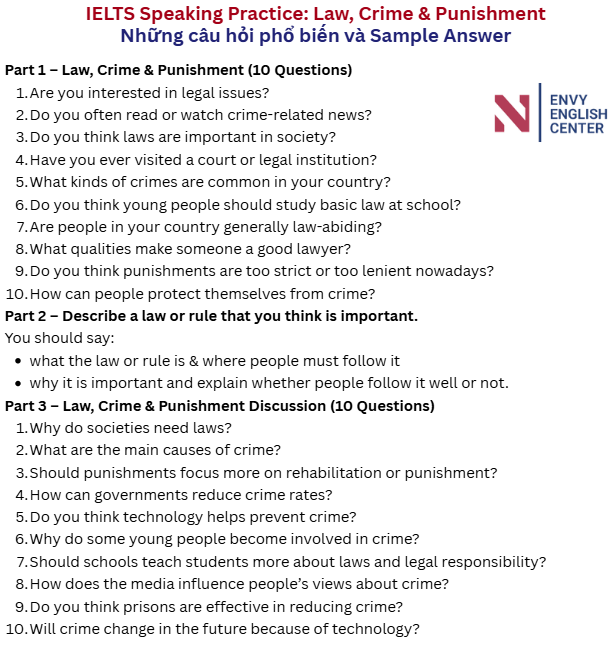
Part 1 – Law, Crime & Punishment (10 Questions)
Are you interested in legal issues?
Do you often read or watch crime-related news?
Do you think laws are important in society?
Have you ever visited a court or legal institution?
What kinds of crimes are common in your country?
Do you think young people should study basic law at school?
Are people in your country generally law-abiding?
What qualities make someone a good lawyer?
Do you think punishments are too strict or too lenient nowadays?
How can people protect themselves from crime?
Part 2 – Cue Card (1 Question)
Describe a law or rule that you think is important.
You should say:
what the law or rule is
where people must follow it
why it is important
and explain whether people follow it well or not.
Part 3 – Law, Crime & Punishment Discussion (10 Questions)
Why do societies need laws?
What are the main causes of crime?
Should punishments focus more on rehabilitation or punishment?
How can governments reduce crime rates?
Do you think technology helps prevent crime?
Why do some young people become involved in crime?
Should schools teach students more about laws and legal responsibility?
How does the media influence people’s views about crime?
Do you think prisons are effective in reducing crime?
Will crime change in the future because of technology?
2. Questions & Answers
Question 1: Are you interested in legal issues?
Yes, I am very interested in legal issues because law affects nearly every aspect of society, including business, education, human rights, and social order. I enjoy learning about how legal systems operate and how laws influence people’s behavior and responsibilities. In addition, legal knowledge is extremely important for protecting individual rights and maintaining fairness within society. I think understanding basic legal concepts is beneficial for everyone, not only legal professionals.
Legal system (n.phr): hệ thống pháp luật
e.g: Every country has its own legal system.
Human right (n.phr): quyền con người
e.g: Laws protect human rights.
Individual right (n.phr): quyền cá nhân
e.g: Citizens should understand individual rights.
Legal concept (n.phr): khái niệm pháp lý
e.g: Students study legal concepts at university.
Question 2: Do you often read or watch crime-related news?
Yes, I occasionally follow crime-related news because it helps me understand social issues and public safety concerns. News reports about crimes can also increase public awareness about legal responsibilities and personal security. However, I try not to consume excessive negative news because constant exposure to violent content can become emotionally exhausting. I prefer reliable and professional news sources when learning about legal or criminal issues.
Public safety (n.phr): an toàn công cộng
e.g: Governments prioritize public safety.
Public awareness (n.phr): nhận thức cộng đồng
e.g: Media increases public awareness.
Personal security (n.phr): an toàn cá nhân
e.g: People care about personal security.
Reliable source (n.phr): nguồn đáng tin cậy
e.g: Students should use reliable sources.
Question 3: Do you think laws are important in society?
Yes, laws are essential because they help maintain social order, protect citizens’ rights, and regulate behavior within society. Without laws, communities would probably experience more conflict, injustice, and instability. In addition, laws create standards of responsibility and fairness that people are expected to follow. I believe legal systems are fundamental for creating stable and organized societies.
Social order (n.phr): trật tự xã hội
e.g: Laws maintain social order.
Regulate behavior (v.phr): điều chỉnh hành vi
e.g: Governments regulate behavior through laws.
Legal system (n.phr): hệ thống pháp luật
e.g: Legal systems protect citizens.
Organized society (n.phr): xã hội có tổ chức
e.g: Laws create organized societies.
Question 4: Have you ever visited a court or legal institution?
No, I have never officially visited a court for legal proceedings, but I have learned about courts and legal institutions through academic research and educational activities. I find courtroom procedures and legal processes very interesting because they demonstrate how justice is applied in real situations. In addition, observing legal systems can help people better understand rights, responsibilities, and judicial procedures. I would like to visit a court in the future for educational purposes.
Legal proceeding (n.phr): thủ tục tố tụng
e.g: Courts handle legal proceedings daily.
Courtroom procedure (n.phr): thủ tục tại tòa
e.g: Students study courtroom procedures.
Judicial procedure (n.phr): thủ tục tư pháp
e.g: Judicial procedures vary between countries.
Educational purpose (n.phr): mục đích giáo dục
e.g: Museums serve educational purposes.
Question 5: What kinds of crimes are common in your country?
Like many countries, common crimes in my country include theft, fraud, cybercrime, and traffic-related offenses. In recent years, online scams and technology-related crimes have become increasingly serious due to widespread internet use. In addition, financial crimes and illegal activities on social media platforms are receiving more public attention. I think governments must continuously improve law enforcement strategies to address modern criminal activities effectively.
Cybercrime (n): tội phạm mạng
e.g: Cybercrime is increasing globally.
Online scam (n.phr): lừa đảo trực tuyến
e.g: People should avoid online scams.
Law enforcement (n.phr): thực thi pháp luật
e.g: Governments strengthen law enforcement.
Criminal activity (n.phr): hoạt động tội phạm
e.g: Police investigate criminal activities.
Question 6: Do you think young people should study basic law at school?
Yes, I strongly believe schools should teach students basic legal knowledge because it helps young people understand their rights and responsibilities as citizens. Legal education can also increase awareness about social issues, public behavior, and the consequences of illegal actions. In addition, understanding laws may help students avoid risky or irresponsible behavior in the future. I think legal literacy is becoming increasingly important in modern society.
Legal knowledge (n.phr): kiến thức pháp luật
e.g: Citizens need basic legal knowledge.
Legal literacy (n.phr): hiểu biết pháp luật
e.g: Schools should improve legal literacy.
Irresponsible behavior (n.phr): hành vi thiếu trách nhiệm
e.g: Education reduces irresponsible behavior.
Social issue (n.phr): vấn đề xã hội
e.g: Students discuss social issues in class.
Question 7: Are people in your country generally law-abiding?
Yes, I think most people in my country generally try to follow the law and maintain social order. However, like in many societies, there are still individuals who violate regulations, especially in areas such as traffic rules or online behavior. Public awareness about legal responsibility has improved over time, particularly among younger generations. Nevertheless, stronger law enforcement and legal education are still necessary in some situations.
Law-abiding (adj): tuân thủ pháp luật
e.g: Citizens should be law-abiding.
Violate regulation (v.phr): vi phạm quy định
e.g: Drivers sometimes violate regulations.
Legal responsibility (n.phr): trách nhiệm pháp lý
e.g: Adults have legal responsibilities.
Legal education (n.phr): giáo dục pháp luật
e.g: Schools promote legal education.
Question 8: What qualities make someone a good lawyer?
A good lawyer should possess strong analytical skills, communication abilities, and a deep understanding of legal systems. In addition, lawyers must be responsible, ethical, and capable of defending clients professionally under pressure. Effective research and persuasive speaking skills are also extremely important in legal practice. I think integrity and fairness are essential qualities for anyone working in the legal profession.
Analytical skill (n.phr): kỹ năng phân tích
e.g: Lawyers require analytical skills.
Persuasive speaking (n.phr): khả năng nói thuyết phục
e.g: Debate improves persuasive speaking.
Legal practice (n.phr): hành nghề luật
e.g: Students prepare for legal practice.
Integrity (n): sự chính trực
e.g: Judges must demonstrate integrity.
Question 9: Do you think punishments are too strict or too lenient nowadays?
I think the effectiveness of punishment depends on the seriousness of the crime and the goals of the legal system. Some punishments may appear too lenient for serious offenses, while others may be excessively harsh for minor violations. In my opinion, punishments should balance justice, public safety, and opportunities for rehabilitation. A fair legal system should aim not only to punish offenders but also to reduce future criminal behavior.
Serious offense (n.phr): tội nghiêm trọng
e.g: Serious offenses receive severe punishments.
Minor violation (n.phr): vi phạm nhỏ
e.g: Drivers commit minor violations daily.
Public safety (n.phr): an toàn công cộng
e.g: Laws protect public safety.
Reduce criminal behavior (v.phr): giảm hành vi phạm tội
e.g: Education helps reduce criminal behavior.
Question 10: How can people protect themselves from crime?
People can protect themselves from crime by remaining cautious, staying informed, and following basic safety measures. For example, individuals should protect personal information online, avoid dangerous areas at night, and report suspicious activities to authorities. In addition, public education and community awareness programs can improve overall safety within society. I think prevention and awareness are extremely important in reducing crime risks.
Safety measure (n.phr): biện pháp an toàn
e.g: Travelers should follow safety measures.
Personal information (n.phr): thông tin cá nhân
e.g: People should protect personal information.
Suspicious activity (n.phr): hoạt động đáng ngờ
e.g: Citizens report suspicious activities.
Community awareness (n.phr): nhận thức cộng đồng
e.g: Campaigns improve community awareness.
Part 2 – Cue Card
Describe a law or rule that you think is important.
One law that I believe is extremely important is the law requiring people to obey traffic regulations, especially rules related to wearing helmets while riding motorcycles. In my country, motorcycles are one of the most common forms of transportation, so traffic safety laws play a very important role in protecting public safety and reducing accidents. This law applies to all road users and is enforced nationwide by traffic authorities.
I think this law is particularly important because traffic accidents can cause serious injuries, disabilities, or even death. Wearing helmets significantly reduces the risk of severe head injuries during accidents, which can save many lives every year. In addition, traffic regulations help maintain order on the roads and reduce dangerous behavior such as speeding or reckless driving. Without clear traffic laws, transportation systems would probably become much more chaotic and unsafe.
Another reason why this law matters is that it encourages people to become more responsible citizens. When individuals follow traffic regulations, they not only protect themselves but also contribute to the safety of other people in society. Furthermore, respecting traffic laws reflects social responsibility and public awareness, both of which are essential for maintaining an organized society. I believe laws are most effective when citizens understand their importance rather than simply obeying them because of punishment.
In my opinion, most people nowadays follow helmet regulations relatively well because public awareness has improved significantly over time. Government campaigns, educational programs, and stricter law enforcement have helped increase compliance among citizens. However, there are still some individuals who ignore traffic rules, especially younger people who may underestimate the risks of dangerous driving behavior.
Personally, I strongly support strict enforcement of traffic laws because public safety should always be a priority. Although some people complain that traffic fines are inconvenient or expensive, I think these penalties are necessary to discourage irresponsible behavior and prevent accidents. In addition, stricter regulations can create safer environments for both drivers and pedestrians.
Overall, I believe traffic safety laws are extremely important because they save lives, maintain public order, and encourage responsible behavior within society. Following traffic regulations may seem like a simple responsibility, but it can have a significant impact on community safety and social stability.
Traffic regulation (n.phr): quy định giao thông
e.g: Drivers must follow traffic regulations.
Public safety (n.phr): an toàn công cộng
e.g: Governments prioritize public safety.
Severe head injury (n.phr): chấn thương đầu nghiêm trọng
e.g: Helmets reduce severe head injuries.
Reckless driving (n.phr): lái xe liều lĩnh
e.g: Reckless driving causes accidents.
Social responsibility (n.phr): trách nhiệm xã hội
e.g: Citizens have social responsibilities.
Law enforcement (n.phr): thực thi pháp luật
e.g: Strong law enforcement improves safety.
Compliance (n): sự tuân thủ
e.g: Authorities encourage legal compliance.
Social stability (n.phr): ổn định xã hội
e.g: Laws contribute to social stability.
Part 3 – Discussion
Question: Why do societies need laws?
Societies need laws because laws maintain order, protect citizens’ rights, and regulate human behavior within communities. Without laws, societies would probably experience more violence, conflict, and instability because people would act without clear limits or responsibilities. In addition, laws help create fairness by establishing rules that apply equally to everyone. I believe legal systems are essential for maintaining peaceful and organized societies.
Regulate human behavior (v.phr): điều chỉnh hành vi con người
e.g: Laws regulate human behavior.
Citizens’ rights (n.phr): quyền công dân
e.g: Governments protect citizens’ rights.
Legal system (n.phr): hệ thống pháp luật
e.g: Every country has a legal system.
Organized society (n.phr): xã hội có tổ chức
e.g: Laws create organized societies.
Question: What are the main causes of crime?
There are many factors that can contribute to criminal behavior, including poverty, unemployment, lack of education, and social inequality. In some cases, individuals may become involved in crime because they experience financial pressure or negative social environments. In addition, poor parenting and limited access to opportunities may increase the likelihood of criminal activity among young people. I think crime is often influenced by both personal choices and broader social conditions.
Social inequality (n.phr): bất bình đẳng xã hội
e.g: Social inequality may increase crime.
Financial pressure (n.phr): áp lực tài chính
e.g: Financial pressure affects families.
Negative environment (n.phr): môi trường tiêu cực
e.g: Teenagers are influenced by negative environments.
Criminal activity (n.phr): hoạt động phạm tội
e.g: Governments reduce criminal activity through education.
Question: Should punishments focus more on rehabilitation or punishment?
I think legal systems should balance punishment and rehabilitation rather than focusing entirely on one approach. Serious crimes obviously require strict punishment to protect society and discourage criminal behavior. However, rehabilitation programs can help offenders improve themselves and successfully return to society after serving their sentences. I believe rehabilitation is especially important for young offenders because people should have opportunities to change and become productive citizens.
Rehabilitation program (n.phr): chương trình cải tạo
e.g: Prisons offer rehabilitation programs.
Serve sentence (v.phr): chấp hành án
e.g: Criminals serve prison sentences.
Discourage criminal behavior (v.phr): ngăn chặn hành vi phạm tội
e.g: Strict laws discourage criminal behavior.
Productive citizen (n.phr): công dân có ích
e.g: Education helps offenders become productive citizens.
Question: How can governments reduce crime rates?
Governments can reduce crime rates through education, employment opportunities, strong law enforcement, and social support programs. Improving education and job access may reduce poverty-related crimes by providing individuals with better opportunities for success. In addition, police systems and judicial institutions should operate fairly and efficiently to maintain public trust. I also think community awareness campaigns can help prevent crime by educating people about legal responsibilities and public safety.
Employment opportunity (n.phr): cơ hội việc làm
e.g: Employment opportunities reduce poverty.
Judicial institution (n.phr): cơ quan tư pháp
e.g: Judicial institutions protect justice.
Public trust (n.phr): niềm tin công chúng
e.g: Fair courts maintain public trust.
Community awareness campaign (n.phr): chiến dịch nâng cao nhận thức cộng đồng
e.g: Governments organize awareness campaigns.
Question: Do you think technology helps prevent crime?
Yes, technology has become extremely useful in crime prevention and law enforcement. Surveillance cameras, digital security systems, and online monitoring tools help authorities detect suspicious activities and identify criminals more efficiently. In addition, technology improves communication between citizens and law enforcement agencies during emergencies. However, criminals can also misuse technology for cybercrime and online fraud, so governments must continuously improve cybersecurity measures.
Surveillance camera (n.phr): camera giám sát
e.g: Cities install surveillance cameras.
Digital security system (n.phr): hệ thống an ninh kỹ thuật số
e.g: Businesses use digital security systems.
Cybersecurity measure (n.phr): biện pháp an ninh mạng
e.g: Companies strengthen cybersecurity measures.
Online fraud (n.phr): lừa đảo trực tuyến
e.g: Online fraud affects many victims.
Question: Why do some young people become involved in crime?
Some young people become involved in crime because of negative social influences, financial difficulties, or lack of guidance from family and schools. Peer pressure can also encourage risky or illegal behavior, especially among teenagers seeking social acceptance. In addition, limited education and unemployment may reduce future opportunities and increase frustration among young individuals. I think early education and supportive environments are very important in preventing youth crime.
Peer pressure (n.phr): áp lực bạn bè
e.g: Teenagers experience peer pressure.
Social acceptance (n.phr): sự chấp nhận xã hội
e.g: Young people seek social acceptance.
Supportive environment (n.phr): môi trường hỗ trợ
e.g: Children need supportive environments.
Youth crime (n.phr): tội phạm vị thành niên
e.g: Governments try to reduce youth crime.
Question: Should schools teach students more about laws and legal responsibility?
Yes, I strongly believe schools should provide more legal education because students need to understand their rights and responsibilities from a young age. Teaching basic laws can increase awareness about public behavior, online safety, and social responsibility. In addition, legal education may help young people avoid illegal activities and make more responsible decisions in daily life. I think legal literacy is becoming increasingly important in modern society.
Legal education (n.phr): giáo dục pháp luật
e.g: Schools should improve legal education.
Social responsibility (n.phr): trách nhiệm xã hội
e.g: Students learn social responsibility.
Online safety (n.phr): an toàn trực tuyến
e.g: Teenagers should learn online safety.
Legal literacy (n.phr): hiểu biết pháp luật
e.g: Citizens need legal literacy.
Question: How does the media influence people’s views about crime?
The media strongly influences public opinion about crime by determining which stories receive the most attention and how they are presented. Crime-related news can increase public awareness about safety issues and legal problems within society. However, excessive or sensationalized reporting may also create fear, stereotypes, or negative perceptions about certain groups of people. Therefore, responsible journalism is extremely important when reporting criminal cases.
Public opinion (n.phr): dư luận xã hội
e.g: Media influences public opinion.
Sensationalized reporting (n.phr): đưa tin giật gân
e.g: Sensationalized reporting creates fear.
Negative perception (n.phr): nhận thức tiêu cực
e.g: Media affects negative perceptions.
Responsible journalism (n.phr): báo chí có trách nhiệm
e.g: Society needs responsible journalism.
Question: Do you think prisons are effective in reducing crime?
I think prisons can reduce crime to some extent because they separate dangerous offenders from society and discourage illegal behavior through punishment. However, prisons are not always completely effective if they focus only on punishment without rehabilitation or education programs. Some offenders may continue criminal behavior after release if they do not receive proper support or opportunities for reintegration. Therefore, prison systems should combine punishment, rehabilitation, and social support.
Dangerous offender (n.phr): tội phạm nguy hiểm
e.g: Prisons isolate dangerous offenders.
Reintegration (n): tái hòa nhập
e.g: Governments support prisoner reintegration.
Illegal behavior (n.phr): hành vi bất hợp pháp
e.g: Strict laws discourage illegal behavior.
Social support (n.phr): hỗ trợ xã hội
e.g: Former prisoners need social support.
Question: Will crime change in the future because of technology?
Yes, I believe crime will continue changing because technology is developing very rapidly. Traditional crimes may decrease in some areas, while cybercrime, online fraud, identity theft, and digital financial crimes will probably become more common. In addition, artificial intelligence and advanced technologies may create entirely new legal challenges in the future. Therefore, governments and legal systems must continuously adapt to technological changes.
Identity theft (n.phr): đánh cắp danh tính
e.g: Identity theft affects online users.
Digital financial crime (n.phr): tội phạm tài chính kỹ thuật số
e.g: Banks fight digital financial crimes.
Legal challenge (n.phr): thách thức pháp lý
e.g: Technology creates legal challenges.
Adapt to change (v.phr): thích nghi với thay đổi
e.g: Legal systems adapt to technological change.
Nếu bạn đang bắt đầu từ con số 0 hoặc đã học nhưng “dậm chân tại chỗ”, Envy English Center có thể đồng hành cùng bạn:
Test trình độ miễn phí theo format IELTS để biết chính xác điểm mạnh – điểm yếu.
Nhận lộ trình học cá nhân hóa từ 0 → 6.5+, phù hợp tốc độ và mục tiêu.
Trực tiếp học với giáo viên IELTS 8.0+, chuyên “gỡ rối” Speaking & Writing – hai kỹ năng khó nâng band nhất.
Đặc biệt, khi đăng ký trong tuần này, bạn được tặng bộ từ vựng chuẩn IELTS band 7+.
📞 Hotline: 028 7300 9677 / 0948 197 270 (Zalo)
🌐 Website: envyenglish.vn
📍 Địa chỉ: 46/5 Tân Cảng, Phường Thạnh Mỹ Tây, Quận Bình Thạnh, TP.HCM


Thông tin gửi đi không thành công, vui lòng thử lại sau.
Nếu bạn cần liên hệ gấp, vui lòng gọi hotline
02873009677

Cảm ơn bạn đã gửi thông tin đến Envy English Center.
Chúng tôi sẽ liên hệ với bạn sớm nhất khi có thể.
Nếu bạn cần liên hệ gấp, vui lòng gọi hotline
02873009677
Thông tin gửi đi không thành công, vui lòng thử lại sau.
Nếu bạn cần liên hệ gấp, vui lòng gọi hotline
02873009677
Bạn đang có một bài test chưa hoàn thành.
Bạn có muốn tiếp tục bài test đó không?
Bạn có chắc là muốn gửi bài test này không?

Số câu trả lời đúng/40

Số câu trả lời đúng/40
Thông tin gửi đi không thành công, vui lòng thử lại sau.
Nếu bạn cần liên hệ gấp, vui lòng gọi hotline
02873009677
Thời gian làm bài kiểm tra đã hết.
Cảm ơn bạn đã cố gắng.
