 02873009677
 contact@envyenglish.vn

1. Questions
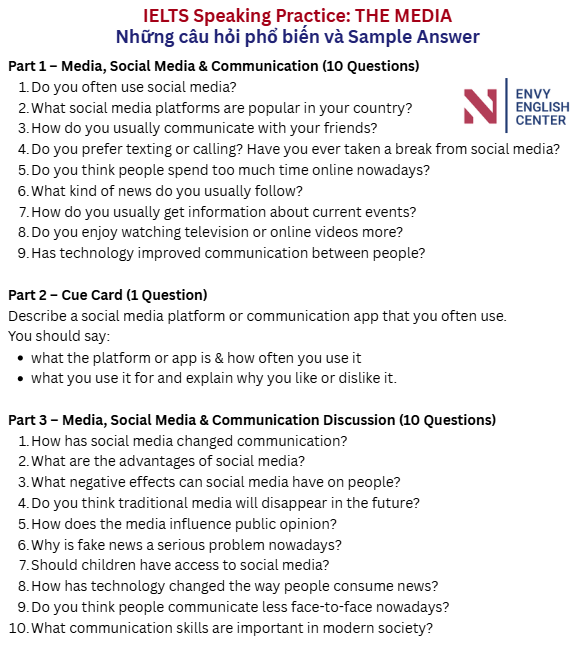
Part 1 – Media, Social Media & Communication (10 Questions)
Do you often use social media?
What social media platforms are popular in your country?
How do you usually communicate with your friends?
Do you prefer texting or calling?
Have you ever taken a break from social media?
Do you think people spend too much time online nowadays?
What kind of news do you usually follow?
How do you usually get information about current events?
Do you enjoy watching television or online videos more?
Has technology improved communication between people?
Part 2 – Cue Card (1 Question)
Describe a social media platform or communication app that you often use.
You should say:
what the platform or app is
how often you use it
what you use it for
and explain why you like or dislike it.
Part 3 – Media, Social Media & Communication Discussion (10 Questions)
How has social media changed communication?
What are the advantages of social media?
What negative effects can social media have on people?
Do you think traditional media will disappear in the future?
How does the media influence public opinion?
Why is fake news a serious problem nowadays?
Should children have access to social media?
How has technology changed the way people consume news?
Do you think people communicate less face-to-face nowadays?
What communication skills are important in modern society?
2. Questions & Answers
Question 1: Do you often use social media?
Yes, I use social media on a daily basis because it helps me stay connected with friends, family, and current events. Platforms such as Facebook, Instagram, and TikTok are very convenient for communication and entertainment. In addition, social media allows me to access educational content and follow topics that interest me. However, I also try to limit my screen time because excessive social media use can negatively affect productivity and concentration.
Stay connected (v.phr): giữ kết nối
e.g: Social media helps families stay connected.
Educational content (n.phr): nội dung giáo dục
e.g: Students often watch educational content online.
Screen time (n.phr): thời gian sử dụng màn hình
e.g: Parents should control children’s screen time.
Excessive use (n.phr): sử dụng quá mức
e.g: Excessive smartphone use affects sleep quality.
Question 2: What social media platforms are popular in your country?
Several social media platforms are extremely popular in Vietnam, especially among younger generations. Facebook remains widely used for communication and sharing information, while TikTok has become very influential for entertainment and short-form content. In addition, Instagram is popular for photography and lifestyle-related posts. I think social media trends change quickly because technology and online culture develop rapidly.
Younger generation (n.phr): thế hệ trẻ
e.g: Younger generations spend more time online.
Short-form content (n.phr): nội dung ngắn
e.g: TikTok specializes in short-form content.
Lifestyle-related post (n.phr): bài đăng liên quan lối sống
e.g: Influencers upload lifestyle-related posts daily.
Online culture (n.phr): văn hóa trực tuyến
e.g: Social media strongly influences online culture.
Question 3: How do you usually communicate with your friends?
I usually communicate with my friends through messaging applications and social media platforms because they are fast and convenient. We often send text messages, voice recordings, or memes throughout the day to stay in touch. In addition, video calls are useful when we want to discuss something more personally or spend time together online. Although digital communication is convenient, I still think face-to-face conversations are more meaningful.
Messaging application (n.phr): ứng dụng nhắn tin
e.g: Teenagers rely heavily on messaging applications.
Stay in touch (v.phr): giữ liên lạc
e.g: Social media helps friends stay in touch.
Video call (n.phr): cuộc gọi video
e.g: Families use video calls to communicate internationally.
Face-to-face conversation (n.phr): trò chuyện trực tiếp
e.g: Face-to-face conversations build stronger relationships.
Question 4: Do you prefer texting or calling?
I generally prefer texting because it is more convenient and less disruptive during busy schedules. Text messages also give people more time to think carefully before responding, which can improve communication in some situations. However, I still prefer phone calls when discussing important matters or emotional topics because they feel more personal and direct. Therefore, I think both forms of communication have their own advantages depending on the situation.
Busy schedule (n.phr): lịch trình bận rộn
e.g: Students often have busy schedules.
Respond carefully (v.phr): phản hồi cẩn thận
e.g: Texting allows people to respond carefully.
Emotional topic (n.phr): chủ đề cảm xúc
e.g: Emotional topics are better discussed in person.
Personal and direct (adj.phr): cá nhân và trực tiếp
e.g: Phone calls feel more personal and direct.
Question 5: Have you ever taken a break from social media?
Yes, I have taken short breaks from social media before, especially during stressful academic periods. I realized that spending too much time online could distract me from studying and reduce my productivity. During these breaks, I usually focused more on reading, exercising, and spending time with family or friends. I think temporary breaks from social media can improve mental well-being and help people manage their time more effectively.
Stressful academic period (n.phr): giai đoạn học tập căng thẳng
e.g: Students experience stressful academic periods before exams.
Reduce productivity (v.phr): giảm năng suất
e.g: Social media distractions reduce productivity.
Mental well-being (n.phr): sức khỏe tinh thần
e.g: Exercise improves mental well-being.
Manage time effectively (v.phr): quản lý thời gian hiệu quả
e.g: Good planning helps students manage time effectively.
Question 6: Do you think people spend too much time online nowadays?
Yes, I believe many people spend excessive amounts of time online nowadays, particularly on social media and entertainment platforms. Constant Internet access makes it easy for individuals to become distracted and dependent on digital devices. In addition, excessive online activity may negatively affect physical health, sleep quality, and face-to-face social interaction. Therefore, I think maintaining a healthy balance between online and offline life is extremely important.
Excessive amount of time (n.phr): lượng thời gian quá mức
e.g: Teenagers spend excessive amounts of time online.
Digital device (n.phr): thiết bị số
e.g: Children use digital devices from a young age.
Sleep quality (n.phr): chất lượng giấc ngủ
e.g: Screen time affects sleep quality.
Healthy balance (n.phr): sự cân bằng lành mạnh
e.g: People need a healthy balance between work and rest.
Question 7: What kind of news do you usually follow?
I usually follow news related to education, technology, international affairs, and social issues because I find these topics both informative and relevant to modern society. Most of the time, I read news articles online or watch short news summaries on social media platforms. In addition, I occasionally follow economic and legal news because I am interested in those fields academically. I think staying informed about current events helps people become more socially aware and knowledgeable.
International affairs (n.phr): vấn đề quốc tế
e.g: International affairs influence global politics.
Social issue (n.phr): vấn đề xã hội
e.g: Social issues are widely discussed online.
Current event (n.phr): sự kiện hiện tại
e.g: Students should follow current events regularly.
Socially aware (adj.phr): có nhận thức xã hội
e.g: Reading news helps people become socially aware.
Question 8: How do you usually get information about current events?
I usually get information about current events through online newspapers, social media platforms, and video content. Digital media allows people to access information quickly and conveniently from almost anywhere. However, I try to follow reliable news sources because misinformation and fake news are becoming increasingly common online. I believe critical thinking is extremely important when consuming digital information.
Online newspaper (n.phr): báo điện tử
e.g: Many people read online newspapers daily.
Reliable source (n.phr): nguồn đáng tin cậy
e.g: Students should use reliable sources for research.
Misinformation (n): thông tin sai lệch
e.g: Social media spreads misinformation rapidly.
Critical thinking (n.phr): tư duy phản biện
e.g: Critical thinking helps people evaluate information.
Question 9: Do you enjoy watching television or online videos more?
I personally prefer watching online videos because they are more flexible and personalized than traditional television programs. Online platforms allow users to choose content based on their interests and watch videos at any convenient time. In addition, educational videos, documentaries, and podcasts are widely available online, which makes learning more accessible. However, television can still be useful for live events and professionally produced programs.
Personalized content (n.phr): nội dung cá nhân hóa
e.g: Algorithms recommend personalized content online.
Educational video (n.phr): video giáo dục
e.g: Students watch educational videos for revision.
Accessible (adj): dễ tiếp cận
e.g: Online learning is accessible to many people.
Professionally produced (adj.phr): được sản xuất chuyên nghiệp
e.g: Television programs are professionally produced.
Question 10: Has technology improved communication between people?
Yes, technology has significantly improved communication in many positive ways. People can now communicate instantly through messaging apps, video calls, and social media regardless of geographical distance. In addition, technology allows individuals to maintain international relationships and share information more efficiently. However, some people argue that excessive dependence on digital communication may weaken face-to-face interaction and emotional connection.
Geographical distance (n.phr): khoảng cách địa lý
e.g: Technology reduces geographical distance.
Maintain international relationship (v.phr): duy trì mối quan hệ quốc tế
e.g: Social media helps people maintain international relationships.
Digital communication (n.phr): giao tiếp kỹ thuật số
e.g: Businesses rely heavily on digital communication.
Emotional connection (n.phr): kết nối cảm xúc
e.g: Face-to-face conversations create stronger emotional connections.
Part 2 – Cue Card
Describe a social media platform or communication app that you often use.
One social media platform that I use very frequently is Instagram because it is both entertaining and visually appealing. I started using it several years ago mainly to stay connected with friends, but over time it also became a source of information, inspiration, and communication for me. Nowadays, I use Instagram almost every day, although I try to manage my screen time carefully to avoid becoming too dependent on social media.
One reason why I use Instagram so often is that it allows me to communicate conveniently with friends and classmates through direct messages, group chats, and story replies. In addition, I enjoy following educational pages, language-learning accounts, and content creators who share useful information about topics such as productivity, fashion, technology, and current events. The platform also provides short-form videos and visual content, which makes information more engaging and easier to consume.
Another feature that I appreciate is Instagram’s ability to help people express themselves creatively. Users can upload photos, videos, and stories to share personal experiences, opinions, and artistic ideas. I think this creates opportunities for self-expression and social interaction, especially among younger generations. Furthermore, Instagram allows people to connect with international communities and stay updated on global trends and cultural developments.
However, despite these advantages, I think Instagram also has several negative aspects. For example, excessive use of social media can distract people from studying or working and reduce productivity. In addition, some users may compare themselves to unrealistic online lifestyles, which can negatively affect mental health and self-esteem. I believe it is important for people to use social media responsibly and maintain a healthy balance between online and offline life.
Overall, I enjoy using Instagram because it combines communication, entertainment, and educational content in a convenient and modern way. Although social media has certain disadvantages, I think it can still be extremely beneficial if people use it wisely and in moderation.
Visually appealing (adj.phr): hấp dẫn về mặt hình ảnh
e.g: Instagram is visually appealing to young users.
Manage screen time (v.phr): quản lý thời gian dùng màn hình
e.g: Teenagers should manage screen time carefully.
Direct message (n.phr): tin nhắn riêng
e.g: Students often communicate through direct messages.
Short-form video (n.phr): video ngắn
e.g: TikTok popularized short-form videos.
Self-expression (n): sự thể hiện bản thân
e.g: Art allows self-expression.
Global trend (n.phr): xu hướng toàn cầu
e.g: Social media spreads global trends quickly.
Mental health (n.phr): sức khỏe tinh thần
e.g: Excessive social media use affects mental health.
In moderation (adv.phr): có chừng mực
e.g: Social media should be used in moderation.
Part 3 – Discussion
Question: How has social media changed communication?
Social media has transformed communication by making it much faster, easier, and more accessible than before. People can now communicate instantly through messages, video calls, and online platforms regardless of geographical distance. In addition, social media allows individuals to share information, opinions, and experiences with large audiences within seconds. However, some people argue that online communication may reduce the quality of face-to-face interaction and emotional connection between individuals.
Geographical distance (n.phr): khoảng cách địa lý
e.g: Technology reduces geographical distance.
Large audience (n.phr): lượng lớn khán giả
e.g: Influencers communicate with large audiences online.
Face-to-face interaction (n.phr): tương tác trực tiếp
e.g: Face-to-face interaction strengthens relationships.
Emotional connection (n.phr): kết nối cảm xúc
e.g: Families need emotional connection.
Question: What are the advantages of social media?
Social media offers several important advantages for individuals and society. Firstly, it allows people to stay connected with friends and family regardless of physical distance. Secondly, social media provides quick access to news, educational content, and global information. In addition, businesses and organizations can use social media for marketing, communication, and customer interaction. I also think social media creates opportunities for creativity, self-expression, and international cultural exchange.
Physical distance (n.phr): khoảng cách địa lý
e.g: Technology reduces physical distance.
Educational content (n.phr): nội dung giáo dục
e.g: Students learn through educational content online.
Customer interaction (n.phr): tương tác khách hàng
e.g: Companies improve customer interaction through social media.
Cultural exchange (n.phr): giao lưu văn hóa
e.g: Social media encourages cultural exchange.
Question: What negative effects can social media have on people?
Although social media has many benefits, it can also create several negative effects. Excessive social media use may reduce productivity and distract people from important responsibilities such as studying or working. In addition, unrealistic online content can negatively affect self-esteem and mental health, especially among teenagers. Another serious issue is the spread of misinformation and online harassment, which can create social and psychological problems. Therefore, people should use social media responsibly and critically.
Reduce productivity (v.phr): làm giảm năng suất
e.g: Social media distractions reduce productivity.
Self-esteem (n): lòng tự trọng
e.g: Online comparisons damage self-esteem.
Online harassment (n.phr): quấy rối trực tuyến
e.g: Many teenagers experience online harassment.
Psychological problem (n.phr): vấn đề tâm lý
e.g: Stress can cause psychological problems.
Question: Do you think traditional media will disappear in the future?
No, I do not think traditional media will disappear completely, although its influence may decline over time. Many people still watch television, read newspapers, and listen to radio programs because they consider them more reliable than social media sources. In addition, traditional media organizations often provide professionally verified information and higher journalistic standards. However, digital media will probably continue growing because it is faster and more convenient for modern audiences.
Reliable source (n.phr): nguồn đáng tin cậy
e.g: Newspapers are considered reliable sources.
Journalistic standard (n.phr): tiêu chuẩn báo chí
e.g: Professional media follows journalistic standards.
Digital media (n.phr): truyền thông kỹ thuật số
e.g: Young people prefer digital media.
Modern audience (n.phr): khán giả hiện đại
e.g: Modern audiences consume online content daily.
Question: How does the media influence public opinion?
The media strongly influences public opinion by shaping the way people understand social, political, and economic issues. News organizations and online platforms decide which topics receive public attention and how information is presented to audiences. In addition, repeated exposure to certain opinions or perspectives can affect people’s beliefs and attitudes over time. Therefore, responsible journalism and critical thinking are extremely important in modern society.
Public attention (n.phr): sự chú ý của công chúng
e.g: Major events receive public attention quickly.
Repeated exposure (n.phr): tiếp xúc lặp lại
e.g: Repeated exposure affects consumer behavior.
Responsible journalism (n.phr): báo chí có trách nhiệm
e.g: Democracies require responsible journalism.
Critical thinking (n.phr): tư duy phản biện
e.g: Critical thinking helps people analyze information.
Question: Why is fake news a serious problem nowadays?
Fake news is a serious problem because misinformation can spread extremely quickly through social media and online platforms. False information may confuse the public, damage reputations, and even influence political or social decisions. In addition, many people do not verify information carefully before sharing it online, which makes the problem even worse. I think improving media literacy and critical thinking skills is essential for reducing the spread of fake news.
Misinformation (n): thông tin sai lệch
e.g: Social media spreads misinformation rapidly.
Damage reputation (v.phr): làm tổn hại danh tiếng
e.g: False rumors can damage reputations.
Media literacy (n.phr): hiểu biết truyền thông
e.g: Schools should teach media literacy.
Verify information (v.phr): xác minh thông tin
e.g: Journalists must verify information carefully.
Question: Should children have access to social media?
I think children should have limited and supervised access to social media rather than unlimited freedom online. Social media can provide educational content and communication opportunities, but it also exposes children to inappropriate content, online harassment, and privacy risks. In addition, excessive screen time may negatively affect children’s mental health and academic performance. Therefore, parents should monitor online activity and teach children how to use digital platforms responsibly.
Supervised access (n.phr): quyền truy cập có giám sát
e.g: Children need supervised access to the Internet.
Inappropriate content (n.phr): nội dung không phù hợp
e.g: Parents should block inappropriate content.
Privacy risk (n.phr): rủi ro quyền riêng tư
e.g: Social media creates privacy risks.
Academic performance (n.phr): kết quả học tập
e.g: Excessive gaming affects academic performance.
Question: How has technology changed the way people consume news?
Technology has changed news consumption dramatically by making information faster and more accessible. Nowadays, people can receive breaking news instantly through smartphones, websites, and social media platforms. In addition, online news allows users to personalize the type of content they want to follow. However, the speed of digital media also increases the risk of misinformation because information is sometimes shared before being properly verified.
Breaking news (n.phr): tin nóng
e.g: Smartphones deliver breaking news instantly.
Personalize content (v.phr): cá nhân hóa nội dung
e.g: Algorithms personalize online content.
Digital media (n.phr): truyền thông số
e.g: Digital media dominates modern communication.
Properly verified (adj.phr): được xác minh đúng cách
e.g: Journalists should publish properly verified information.
Question: Do you think people communicate less face-to-face nowadays?
Yes, I think face-to-face communication has decreased to some extent because people increasingly rely on digital devices and online platforms. Messaging apps and social media are often more convenient, especially for busy individuals. However, excessive dependence on online communication may weaken interpersonal relationships and emotional connections in real life. I believe maintaining direct human interaction is still extremely important for healthy social relationships.
To some extent (adv.phr): ở một mức độ nào đó
e.g: Technology changes lifestyles to some extent.
Digital device (n.phr): thiết bị số
e.g: Teenagers spend too much time on digital devices.
Interpersonal relationship (n.phr): mối quan hệ giữa người với người
e.g: Communication strengthens interpersonal relationships.
Human interaction (n.phr): tương tác con người
e.g: Human interaction is essential for mental health.
Question: What communication skills are important in modern society?
Several communication skills are extremely important in modern society. Firstly, active listening and clear speaking skills help people understand others and express their ideas effectively. Secondly, digital communication skills are increasingly necessary because many interactions now take place online. In addition, emotional intelligence and cross-cultural communication are important in globalized workplaces and multicultural environments. I believe strong communication skills contribute significantly to both professional success and personal relationships.
Active listening (n.phr): lắng nghe chủ động
e.g: Managers need active listening skills.
Digital communication skill (n.phr): kỹ năng giao tiếp số
e.g: Employees require digital communication skills.
Cross-cultural communication (n.phr): giao tiếp đa văn hóa
e.g: International companies value cross-cultural communication.
Professional success (n.phr): thành công nghề nghiệp
e.g: Communication skills support professional success.
Nếu bạn đang bắt đầu từ con số 0 hoặc đã học nhưng “dậm chân tại chỗ”, Envy English Center có thể đồng hành cùng bạn:
Test trình độ miễn phí theo format IELTS để biết chính xác điểm mạnh – điểm yếu.
Nhận lộ trình học cá nhân hóa từ 0 → 6.5+, phù hợp tốc độ và mục tiêu.
Trực tiếp học với giáo viên IELTS 8.0+, chuyên “gỡ rối” Speaking & Writing – hai kỹ năng khó nâng band nhất.
Đặc biệt, khi đăng ký trong tuần này, bạn được tặng bộ từ vựng chuẩn IELTS band 7+.
📞 Hotline: 028 7300 9677 / 0948 197 270 (Zalo)
🌐 Website: envyenglish.vn
📍 Địa chỉ: 46/5 Tân Cảng, Phường Thạnh Mỹ Tây, Quận Bình Thạnh, TP.HCM


Thông tin gửi đi không thành công, vui lòng thử lại sau.
Nếu bạn cần liên hệ gấp, vui lòng gọi hotline
02873009677

Cảm ơn bạn đã gửi thông tin đến Envy English Center.
Chúng tôi sẽ liên hệ với bạn sớm nhất khi có thể.
Nếu bạn cần liên hệ gấp, vui lòng gọi hotline
02873009677
Thông tin gửi đi không thành công, vui lòng thử lại sau.
Nếu bạn cần liên hệ gấp, vui lòng gọi hotline
02873009677
Bạn đang có một bài test chưa hoàn thành.
Bạn có muốn tiếp tục bài test đó không?
Bạn có chắc là muốn gửi bài test này không?

Số câu trả lời đúng/40

Số câu trả lời đúng/40
Thông tin gửi đi không thành công, vui lòng thử lại sau.
Nếu bạn cần liên hệ gấp, vui lòng gọi hotline
02873009677
Thời gian làm bài kiểm tra đã hết.
Cảm ơn bạn đã cố gắng.
