 02873009677
 contact@envyenglish.vn

1. Questions
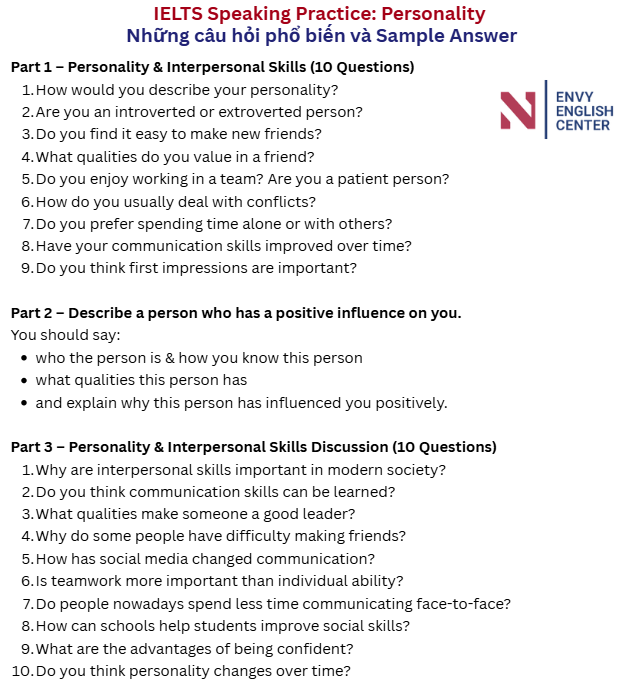
Part 1 – Personality & Interpersonal Skills (10 Questions)
How would you describe your personality?
Are you an introverted or extroverted person?
Do you find it easy to make new friends?
What qualities do you value in a friend?
Do you enjoy working in a team?
Are you a patient person?
How do you usually deal with conflicts?
Do you prefer spending time alone or with others?
Have your communication skills improved over time?
Do you think first impressions are important?
Part 2 – Cue Card (1 Question)
Describe a person who has a positive influence on you.
You should say:
who the person is
how you know this person
what qualities this person has
and explain why this person has influenced you positively.
Part 3 – Personality & Interpersonal Skills Discussion (10 Questions)
Why are interpersonal skills important in modern society?
Do you think communication skills can be learned?
What qualities make someone a good leader?
Why do some people have difficulty making friends?
How has social media changed communication?
Is teamwork more important than individual ability?
Do people nowadays spend less time communicating face-to-face?
How can schools help students improve social skills?
What are the advantages of being confident?
Do you think personality changes over time?
2. Questions & Answers
Question 1: How would you describe your personality?
I would describe my personality as ambitious, responsible, and relatively open-minded. I usually set clear goals for myself and try to work consistently toward achieving them. At the same time, I enjoy learning from different perspectives and interacting with people who have diverse backgrounds and experiences. Although I can sometimes become stressed due to high expectations, I generally try to remain calm and adaptable in difficult situations.
Open-minded (adj): cởi mở
e.g: Open-minded people accept different opinions.
Diverse background (n.phr): nền tảng đa dạng
e.g: Universities attract students from diverse backgrounds.
High expectation (n.phr): kỳ vọng cao
e.g: Students face high expectations from society.
Adaptable (adj): dễ thích nghi
e.g: Adaptable employees perform well in changing environments.
Question 2: Are you an introverted or extroverted person?
I would say I am somewhere between introverted and extroverted, depending on the situation. I enjoy social interaction and communicating with people, especially in academic or professional environments. However, I also value personal space and occasionally need quiet time to relax and recharge mentally. Therefore, I think my personality is relatively balanced rather than completely extroverted or introverted.
Social interaction (n.phr): tương tác xã hội
e.g: Social interaction improves communication skills.
Professional environment (n.phr): môi trường chuyên nghiệp
e.g: Communication is important in professional environments.
Personal space (n.phr): không gian riêng
e.g: Everyone needs personal space sometimes.
Recharge mentally (v.phr): phục hồi tinh thần
e.g: Reading helps me recharge mentally.
Question 3: Do you find it easy to make new friends?
Yes, I generally find it relatively easy to make new friends because I enjoy conversations and meeting people with different personalities. I usually try to be friendly, respectful, and open during social interactions, which helps create positive first impressions. In addition, shared interests and similar goals often make communication more natural and comfortable. However, building close friendships still requires time and trust.
Positive first impression (n.phr): ấn tượng đầu tốt
e.g: Smiling creates positive first impressions.
Shared interest (n.phr): sở thích chung
e.g: Shared interests strengthen friendships.
Social interaction (n.phr): tương tác xã hội
e.g: Students need social interaction.
Build trust (v.phr): xây dựng lòng tin
e.g: Good communication helps build trust.
Question 4: What qualities do you value in a friend?
I highly value honesty, loyalty, and emotional support in a friendship. I believe trustworthy friends are important because they provide support during both positive and difficult situations. In addition, I appreciate people who communicate openly and respect different opinions rather than judging others unfairly. I think healthy friendships should be based on mutual respect and understanding.
Emotional support (n.phr): hỗ trợ tinh thần
e.g: Friends provide emotional support.
Communicate openly (v.phr): giao tiếp cởi mở
e.g: Good friends communicate openly.
Mutual respect (n.phr): sự tôn trọng lẫn nhau
e.g: Relationships require mutual respect.
Trustworthy (adj): đáng tin cậy
e.g: Trustworthy friends are valuable.
Question 5: Do you enjoy working in a team?
Yes, I generally enjoy teamwork because collaborative environments allow people to exchange ideas and solve problems more effectively. Working in a team also helps individuals develop communication, leadership, and conflict-resolution skills. In addition, teamwork can reduce pressure because responsibilities are shared among multiple members. However, successful teamwork requires strong communication and equal participation from everyone involved.
Collaborative environment (n.phr): môi trường hợp tác
e.g: Offices encourage collaborative environments.
Conflict-resolution skill (n.phr): kỹ năng giải quyết xung đột
e.g: Team projects improve conflict-resolution skills.
Equal participation (n.phr): sự tham gia công bằng
e.g: Teamwork requires equal participation.
Shared responsibility (n.phr): trách nhiệm chung
e.g: Group projects involve shared responsibility.
Question 6: Are you a patient person?
I think I am relatively patient in most situations, especially when dealing with long-term goals or academic responsibilities. I usually try to remain calm and think carefully before reacting emotionally to problems or disagreements. However, I can occasionally become impatient when situations involve unnecessary delays or poor communication. Overall, I believe patience is an important skill for maintaining healthy relationships and effective decision-making.
Long-term goal (n.phr): mục tiêu dài hạn
e.g: Success requires commitment to long-term goals.
Academic responsibility (n.phr): trách nhiệm học tập
e.g: Students manage academic responsibilities daily.
Poor communication (n.phr): giao tiếp kém
e.g: Poor communication creates misunderstandings.
Effective decision-making (n.phr): ra quyết định hiệu quả
e.g: Leaders need effective decision-making skills.
Question 7: How do you usually deal with conflicts?
When dealing with conflicts, I usually try to remain calm and communicate respectfully rather than reacting emotionally. I believe listening carefully to other perspectives is important because misunderstandings often cause unnecessary disagreements. In addition, I prefer finding practical solutions that benefit both sides instead of focusing only on winning an argument. I think effective communication is the key to resolving most interpersonal conflicts.
React emotionally (v.phr): phản ứng cảm tính
e.g: People should avoid reacting emotionally.
Different perspective (n.phr): góc nhìn khác nhau
e.g: Discussions involve different perspectives.
Practical solution (n.phr): giải pháp thực tế
e.g: Teams need practical solutions.
Interpersonal conflict (n.phr): xung đột giữa cá nhân
e.g: Communication reduces interpersonal conflicts.
Question 8: Do you prefer spending time alone or with others?
I think I enjoy both situations depending on my mood and responsibilities. Spending time with others allows me to socialize, exchange ideas, and maintain strong relationships with friends or family members. On the other hand, spending time alone helps me relax, focus on personal goals, and recharge mentally after stressful periods. Therefore, I believe maintaining a balance between social interaction and personal time is important.
Socialize (v): giao lưu
e.g: Students socialize through clubs and events.
Personal goal (n.phr): mục tiêu cá nhân
e.g: Individuals should focus on personal goals.
Recharge mentally (v.phr): phục hồi tinh thần
e.g: Quiet environments help people recharge mentally.
Maintain balance (v.phr): duy trì cân bằng
e.g: Adults must maintain work-life balance.
Question 9: Have your communication skills improved over time?
Yes, I think my communication skills have improved significantly over time through academic activities and social experiences. Participating in presentations, group discussions, and public speaking opportunities has helped me become more confident and organized when expressing ideas. In addition, interacting with different types of people has improved my listening and interpersonal skills. However, I still believe communication is a skill that requires continuous improvement.
Public speaking (n.phr): nói trước công chúng
e.g: Public speaking builds confidence.
Express idea (v.phr): diễn đạt ý tưởng
e.g: Students should express ideas clearly.
Interpersonal skill (n.phr): kỹ năng giao tiếp xã hội
e.g: Employers value interpersonal skills.
Continuous improvement (n.phr): sự cải thiện liên tục
e.g: Communication requires continuous improvement.
Question 10: Do you think first impressions are important?
Yes, I think first impressions are important because they often influence how people initially evaluate someone’s personality or professionalism. Factors such as body language, communication style, and appearance can strongly affect first impressions during social or professional interactions. However, I also believe first impressions are not always completely accurate because people may behave differently after becoming more comfortable. Therefore, long-term behavior is still more important than initial impressions.
Professionalism (n): tính chuyên nghiệp
e.g: Employers value professionalism.
Body language (n.phr): ngôn ngữ cơ thể
e.g: Body language affects communication.
Initial impression (n.phr): ấn tượng ban đầu
e.g: Smiling improves initial impressions.
Long-term behavior (n.phr): hành vi lâu dài
e.g: Long-term behavior matters more than first impressions.
Part 2 – Cue Card
Describe a person who has a positive influence on you.
One person who has had a very positive influence on me is my mother. She has always been one of the most supportive and inspiring people in my life, especially during difficult academic and personal situations. Since I spend a great deal of time with her, I have learned many valuable lessons from both her advice and her behavior.
My mother is an extremely responsible, hardworking, and emotionally supportive person. Despite having many responsibilities related to work and family life, she always remains patient and calm when dealing with problems. In addition, she communicates very thoughtfully and encourages me to approach challenges with confidence rather than fear. I particularly admire her ability to stay emotionally stable even during stressful situations because I think that quality requires significant maturity and self-control.
One of the reasons why she influences me so positively is her strong work ethic. She consistently works hard to support the family while also encouraging me to pursue my academic and personal goals seriously. Whenever I experience stress or self-doubt, she often reminds me that success requires discipline, persistence, and continuous self-improvement. As a result, I have gradually become more ambitious and responsible in many aspects of my life.
Another quality that I deeply respect is her emotional intelligence and communication ability. She is usually willing to listen carefully before giving advice, which makes conversations with her feel comfortable and meaningful. Furthermore, she treats people respectfully and tries to understand different perspectives instead of judging others too quickly. Observing her behavior has taught me the importance of empathy, patience, and effective interpersonal communication.
In addition, my mother has influenced the way I approach relationships and personal development. She believes that maintaining honesty, kindness, and emotional balance is just as important as achieving academic or professional success. Because of her influence, I now place greater importance on emotional well-being and healthy relationships rather than focusing only on achievement.
Overall, my mother has positively influenced me through her personality, values, and life experiences. She has taught me the importance of responsibility, resilience, and emotional maturity, all of which continue shaping the person I want to become in the future.
Emotionally supportive (adj.phr): hỗ trợ tinh thần
e.g: Parents should be emotionally supportive.
Emotional stability (n.phr): sự ổn định cảm xúc
e.g: Emotional stability is important in stressful situations.
Work ethic (n.phr): đạo đức làm việc
e.g: Successful people usually have strong work ethics.
Self-improvement (n.phr): sự phát triển bản thân
e.g: Reading encourages self-improvement.
Emotional intelligence (n.phr): trí tuệ cảm xúc
e.g: Leaders need emotional intelligence.
Interpersonal communication (n.phr): giao tiếp giữa người với người
e.g: Jobs require interpersonal communication skills.
Emotional well-being (n.phr): sức khỏe tinh thần
e.g: Exercise improves emotional well-being.
Emotional maturity (n.phr): sự trưởng thành cảm xúc
e.g: Experience develops emotional maturity.
Part 3 – Discussion
Question: Why are interpersonal skills important in modern society?
Interpersonal skills are extremely important in modern society because people constantly interact in academic, professional, and social environments. Strong communication and relationship-building abilities help individuals cooperate effectively, solve problems, and avoid misunderstandings. In addition, many employers value interpersonal skills as highly as technical knowledge because teamwork and communication are essential in most workplaces. I believe these skills strongly influence both personal success and professional development.
Relationship-building ability (n.phr): khả năng xây dựng mối quan hệ
e.g: Managers need relationship-building abilities.
Avoid misunderstanding (v.phr): tránh hiểu lầm
e.g: Clear communication avoids misunderstandings.
Technical knowledge (n.phr): kiến thức chuyên môn
e.g: Engineers require technical knowledge.
Professional development (n.phr): phát triển nghề nghiệp
e.g: Communication supports professional development.
Question: Do you think communication skills can be learned?
Yes, I strongly believe communication skills can be learned and improved through practice and experience. Activities such as presentations, teamwork, public speaking, and daily social interactions help people become more confident communicators. In addition, individuals can improve listening skills, emotional intelligence, and conflict management through education and self-awareness. Although some people may naturally communicate more easily than others, effective communication is definitely a skill that can be developed over time.
Public speaking (n.phr): nói trước công chúng
e.g: Public speaking improves confidence.
Social interaction (n.phr): tương tác xã hội
e.g: Students need social interaction.
Self-awareness (n.phr): sự tự nhận thức
e.g: Self-awareness improves communication.
Conflict management (n.phr): quản lý xung đột
e.g: Leaders require conflict management skills.
Question: What qualities make someone a good leader?
A good leader should possess qualities such as responsibility, confidence, emotional intelligence, and strong decision-making abilities. Effective leaders must communicate clearly, motivate others, and remain calm under pressure. In addition, good leaders should be open-minded and willing to listen to different perspectives before making important decisions. I think trust and respect are essential because people are more willing to follow leaders whom they genuinely admire.
Decision-making ability (n.phr): khả năng ra quyết định
e.g: Managers need decision-making abilities.
Remain calm under pressure (v.phr): giữ bình tĩnh dưới áp lực
e.g: Doctors remain calm under pressure.
Open-minded (adj): cởi mở
e.g: Good leaders are open-minded.
Gain respect (v.phr): nhận được sự tôn trọng
e.g: Honest behavior helps leaders gain respect.
Question: Why do some people have difficulty making friends?
Some people may have difficulty making friends because of shyness, lack of confidence, or limited social opportunities. In some cases, individuals may fear rejection or feel uncomfortable starting conversations with unfamiliar people. In addition, modern lifestyles and excessive online communication sometimes reduce face-to-face social interaction. I think building friendships requires both communication skills and emotional openness.
Lack of confidence (n.phr): thiếu tự tin
e.g: Lack of confidence affects communication.
Fear rejection (v.phr): sợ bị từ chối
e.g: Teenagers often fear rejection.
Face-to-face interaction (n.phr): tương tác trực tiếp
e.g: Technology reduces face-to-face interaction.
Emotional openness (n.phr): sự cởi mở cảm xúc
e.g: Friendships require emotional openness.
Question: How has social media changed communication?
Social media has transformed communication dramatically by making interaction faster and more convenient. People can now communicate instantly regardless of geographical distance through messaging platforms and video calls. In addition, social media allows individuals to share ideas, opinions, and experiences with large audiences very easily. However, excessive dependence on digital communication may reduce face-to-face interaction and negatively affect interpersonal relationships.
Geographical distance (n.phr): khoảng cách địa lý
e.g: Technology reduces geographical distance.
Messaging platform (n.phr): nền tảng nhắn tin
e.g: Teenagers use messaging platforms daily.
Digital communication (n.phr): giao tiếp kỹ thuật số
e.g: Digital communication is increasingly common.
Interpersonal relationship (n.phr): mối quan hệ cá nhân
e.g: Phones affect interpersonal relationships.
Question: Is teamwork more important than individual ability?
I think both teamwork and individual ability are important because they complement each other in different situations. Individual skills are necessary for personal responsibility, creativity, and specialized tasks, while teamwork allows people to combine strengths and solve complex problems more effectively. In modern workplaces, employees are usually expected to work independently while also cooperating successfully with others. Therefore, maintaining a balance between both abilities is probably the most beneficial approach.
Specialized task (n.phr): nhiệm vụ chuyên môn
e.g: Engineers perform specialized tasks.
Combine strengths (v.phr): kết hợp điểm mạnh
e.g: Teams combine individual strengths.
Complex problem (n.phr): vấn đề phức tạp
e.g: Teams solve complex problems faster.
Work independently (v.phr): làm việc độc lập
e.g: Employees should work independently.
Question: Do people nowadays spend less time communicating face-to-face?
Yes, I think modern technology has reduced face-to-face communication to some extent. Many people now prefer texting or communicating online because it is faster and more convenient than meeting in person. In addition, busy lifestyles and work schedules often limit opportunities for direct social interaction. However, I believe face-to-face communication remains extremely important for building trust and emotional connection.
Direct social interaction (n.phr): tương tác xã hội trực tiếp
e.g: Technology reduces direct social interaction.
Emotional connection (n.phr): kết nối cảm xúc
e.g: Face-to-face conversations improve emotional connections.
Busy lifestyle (n.phr): lối sống bận rộn
e.g: Busy lifestyles reduce communication time.
Build trust (v.phr): xây dựng lòng tin
e.g: Honest communication builds trust.
Question: How can schools help students improve social skills?
Schools can improve students’ social skills by encouraging teamwork, discussions, presentations, and extracurricular activities. These activities allow students to practice communication, leadership, and problem-solving abilities in real social situations. In addition, teachers should create supportive learning environments where students feel comfortable expressing opinions and interacting with classmates. I think social development is just as important as academic achievement.
Extracurricular activity (n.phr): hoạt động ngoại khóa
e.g: Schools organize extracurricular activities.
Supportive environment (n.phr): môi trường hỗ trợ
e.g: Students need supportive environments.
Express opinion (v.phr): bày tỏ ý kiến
e.g: Students should express opinions confidently.
Academic achievement (n.phr): thành tích học tập
e.g: Schools value academic achievement.
Question: What are the advantages of being confident?
Confidence offers many advantages in both personal and professional life. Confident individuals usually communicate more effectively, make decisions more easily, and feel more comfortable facing challenges. In addition, confidence can positively influence leadership ability and interpersonal relationships because people often trust confident individuals more. However, confidence should remain balanced because excessive confidence may appear arrogant.
Leadership ability (n.phr): khả năng lãnh đạo
e.g: Confidence improves leadership ability.
Interpersonal relationship (n.phr): mối quan hệ cá nhân
e.g: Communication affects interpersonal relationships.
Face challenge (v.phr): đối mặt thử thách
e.g: Confident people face challenges positively.
Appear arrogant (v.phr): trông kiêu ngạo
e.g: Excessive confidence may appear arrogant.
Question: Do you think personality changes over time?
Yes, I believe personality can gradually change over time due to life experiences, education, and social environments. As people mature, they often become more emotionally stable, responsible, and self-aware compared to when they were younger. In addition, major experiences such as work, relationships, or personal challenges can strongly influence attitudes and behavior. However, I think some core personality traits usually remain relatively stable throughout life.
Emotionally stable (adj.phr): ổn định cảm xúc
e.g: Adults become more emotionally stable.
Self-aware (adj): tự nhận thức
e.g: Self-aware people understand emotions better.
Core personality trait (n.phr): đặc điểm tính cách cốt lõi
e.g: Some core personality traits remain stable.
Life experience (n.phr): trải nghiệm sống
e.g: Life experiences shape personality.
Nếu bạn đang bắt đầu từ con số 0 hoặc đã học nhưng “dậm chân tại chỗ”, Envy English Center có thể đồng hành cùng bạn:
Test trình độ miễn phí theo format IELTS để biết chính xác điểm mạnh – điểm yếu.
Nhận lộ trình học cá nhân hóa từ 0 → 6.5+, phù hợp tốc độ và mục tiêu.
Trực tiếp học với giáo viên IELTS 8.0+, chuyên “gỡ rối” Speaking & Writing – hai kỹ năng khó nâng band nhất.
Đặc biệt, khi đăng ký trong tuần này, bạn được tặng bộ từ vựng chuẩn IELTS band 7+.
📞 Hotline: 028 7300 9677 / 0948 197 270 (Zalo)
🌐 Website: envyenglish.vn
📍 Địa chỉ: 46/5 Tân Cảng, Phường Thạnh Mỹ Tây, Quận Bình Thạnh, TP.HCM


Thông tin gửi đi không thành công, vui lòng thử lại sau.
Nếu bạn cần liên hệ gấp, vui lòng gọi hotline
02873009677

Cảm ơn bạn đã gửi thông tin đến Envy English Center.
Chúng tôi sẽ liên hệ với bạn sớm nhất khi có thể.
Nếu bạn cần liên hệ gấp, vui lòng gọi hotline
02873009677
Thông tin gửi đi không thành công, vui lòng thử lại sau.
Nếu bạn cần liên hệ gấp, vui lòng gọi hotline
02873009677
Bạn đang có một bài test chưa hoàn thành.
Bạn có muốn tiếp tục bài test đó không?
Bạn có chắc là muốn gửi bài test này không?

Số câu trả lời đúng/40

Số câu trả lời đúng/40
Thông tin gửi đi không thành công, vui lòng thử lại sau.
Nếu bạn cần liên hệ gấp, vui lòng gọi hotline
02873009677
Thời gian làm bài kiểm tra đã hết.
Cảm ơn bạn đã cố gắng.
