 02873009677
 contact@envyenglish.vn

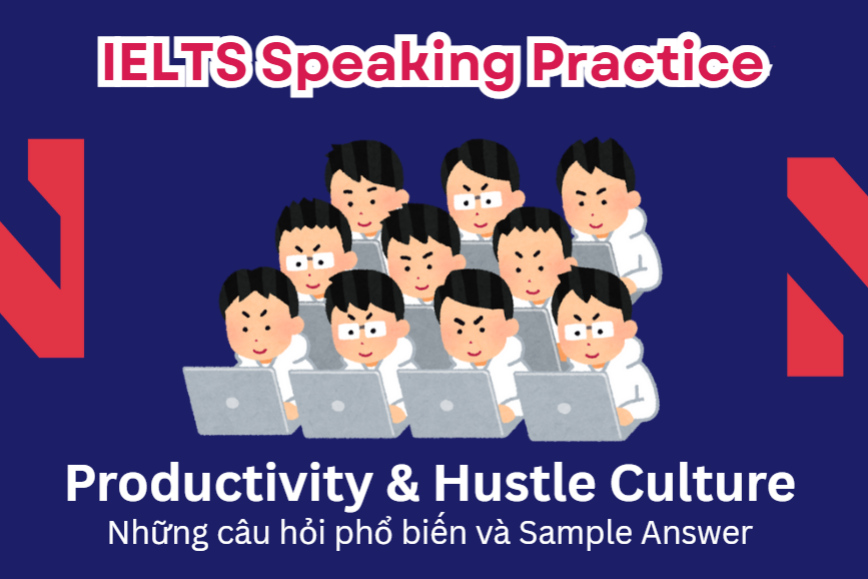
1. Questions
Part 1: Productivity & Hustle Culture (10 Questions)
Do you consider yourself a productive person?
How do you usually organize your daily schedule?
What helps you stay focused while working or studying?
Do you often make to-do lists?
Have you ever felt too busy?
Do you prefer working alone or with others?
How do you deal with distractions?
Do you think people are busier nowadays?
How important is time management?
Do you think resting is important for productivity?
Part 2: Cue Card
Describe a time when you were very productive.
You should say:
what you were doing
when it happened
why you were productive
and explain how you felt afterwards
Part 3: Productivity & Hustle Culture Discussion (10 Questions)
Why are people so focused on productivity today?
What is hustle culture?
Is hustle culture beneficial or harmful?
Why do some people work excessively?
How can people maintain a healthy work-life balance?
Does technology improve productivity?
How has remote work affected productivity?
Should people always try to be productive?
What are the consequences of burnout?
How might attitudes toward work change in the future?
2. Questions & Answers
Question 1: Do you consider yourself a productive person?
I would say that I am reasonably productive, especially when I have clear goals and a structured schedule. However, like most people, there are times when I struggle with distractions or procrastination. Overall, I try to manage my time effectively and focus on completing important tasks.
Structured schedule (n.phr): lịch trình có tổ chức
e.g: A structured schedule improves productivity.
Clear goal (n.phr): mục tiêu rõ ràng
e.g: Clear goals increase motivation.
Procrastination (n): sự trì hoãn
e.g: Procrastination reduces efficiency.
Time management (n.phr): quản lý thời gian
e.g: Good time management improves results.
Question 2: How do you usually organize your daily schedule?
I usually organize my day by prioritizing important tasks and allocating specific time blocks for studying, work, exercise, and relaxation. Having a plan helps me stay focused and reduces the likelihood of wasting time.
Prioritize task (v.phr): ưu tiên nhiệm vụ
e.g: Successful people prioritize tasks.
Time block (n.phr): khung thời gian cố định
e.g: Students use time blocks for studying.
Daily routine (n.phr): thói quen hằng ngày
e.g: A good daily routine improves efficiency.
Stay focused (v.phr): duy trì sự tập trung
e.g: Planning helps people stay focused.
Question 3: What helps you stay focused while working or studying?
A quiet environment, clear objectives, and minimizing distractions help me stay focused. I also find it useful to break large tasks into smaller steps because this makes progress easier to track and less overwhelming.
Quiet environment (n.phr): môi trường yên tĩnh
e.g: Libraries provide quiet environments.
Minimize distraction (v.phr): giảm thiểu xao nhãng
e.g: Students should minimize distractions.
Manageable step (n.phr): bước thực hiện vừa sức
e.g: Large projects require manageable steps.
Track progress (v.phr): theo dõi tiến độ
e.g: Apps help users track progress.
Question 4: Do you often make to-do lists?
Yes, I do. To-do lists help me organize tasks, remember deadlines, and prioritize responsibilities. They also provide a sense of accomplishment when I complete items on the list.
To-do list (n.phr): danh sách việc cần làm
e.g: Many professionals use to-do lists.
Meet deadline (v.phr): hoàn thành đúng hạn
e.g: Planning helps people meet deadlines.
Sense of accomplishment (n.phr): cảm giác thành tựu
e.g: Finishing tasks creates a sense of accomplishment.
Task organization (n.phr): sắp xếp công việc
e.g: Task organization improves productivity.
Question 5: Have you ever felt too busy?
Yes, especially during periods of examinations or major projects. Sometimes I have multiple responsibilities competing for my attention, which can feel overwhelming. During such times, effective planning becomes even more important.
Competing responsibility (n.phr): trách nhiệm chồng chéo
e.g: Adults manage competing responsibilities.
Overwhelming workload (n.phr): khối lượng công việc quá lớn
e.g: Students sometimes face overwhelming workloads.
Busy period (n.phr): giai đoạn bận rộn
e.g: The end of the semester is a busy period.
Effective planning (n.phr): lập kế hoạch hiệu quả
e.g: Effective planning reduces stress.
Question 6: Do you prefer working alone or with others?
It depends on the task. For activities that require deep concentration, I often prefer working alone. However, for projects involving creativity or problem-solving, collaboration can be extremely valuable because different people contribute different perspectives.
Deep concentration (n.phr): sự tập trung sâu
e.g: Writing requires deep concentration.
Collaborative work (n.phr): công việc hợp tác
e.g: Businesses encourage collaborative work.
Problem-solving (n): giải quyết vấn đề
e.g: Teams improve problem-solving.
Different perspective (n.phr): góc nhìn khác nhau
e.g: Collaboration provides different perspectives.
Question 7: How do you deal with distractions?
I try to identify the source of distractions and eliminate them whenever possible. For example, I often silence unnecessary notifications and create a dedicated study environment. Maintaining clear priorities also helps me stay on track.
Silence notification (v.phr): tắt thông báo
e.g: Students silence notifications while studying.
Dedicated workspace (n.phr): không gian làm việc riêng
e.g: A dedicated workspace improves focus.
Stay on track (v.phr): đi đúng hướng
e.g: Goals help people stay on track.
Source of distraction (n.phr): nguồn gây xao nhãng
e.g: Smartphones are a source of distraction.
Question 8: Do you think people are busier nowadays?
Yes, I think many people feel busier due to work demands, technological connectivity, and social expectations. Technology allows people to work from almost anywhere, but it can also make it difficult to completely disconnect from work.
Work demand (n.phr): yêu cầu công việc
e.g: Modern work demands are increasing.
Technological connectivity (n.phr): kết nối công nghệ
e.g: Technological connectivity changes lifestyles.
Social expectation (n.phr): kỳ vọng xã hội
e.g: Social expectations create pressure.
Work-life boundary (n.phr): ranh giới công việc-cuộc sống
e.g: Technology blurs work-life boundaries.
Question 9: How important is time management?
Time management is extremely important because time is a limited resource. Effective time management allows people to achieve goals, reduce stress, and maintain balance between different aspects of life.
Limited resource (n.phr): nguồn lực hữu hạn
e.g: Time is a limited resource.
Goal achievement (n.phr): đạt được mục tiêu
e.g: Planning supports goal achievement.
Reduce stress (v.phr): giảm căng thẳng
e.g: Organization helps reduce stress.
Personal balance (n.phr): sự cân bằng cá nhân
e.g: Time management improves personal balance.
Question 10: Do you think resting is important for productivity?
Absolutely. Rest is essential because it allows the mind and body to recover. Without adequate rest, people may experience fatigue, reduced concentration, and lower performance. Sustainable productivity requires a balance between effort and recovery.
Adequate rest (n.phr): nghỉ ngơi đầy đủ
e.g: Adequate rest improves performance.
Mental recovery (n.phr): phục hồi tinh thần
e.g: Sleep supports mental recovery.
Sustainable productivity (n.phr): năng suất bền vững
e.g: Companies value sustainable productivity.
Work-life balance (n.phr): cân bằng công việc-cuộc sống
e.g: Employees seek work-life balance.
Part 2: Describe a time when you were very productive.
You should say:
what you were doing
when it happened
why you were productive
and explain how you felt afterwards.
Sample Answer
I'd like to talk about a period during my final year of high school when I was preparing for both my graduation examinations and university entrance exams.
This happened a few months before the exams, which was one of the busiest periods of my academic life. At that time, I had a large amount of material to review and several subjects to prepare for simultaneously. Because the exams would have a significant impact on my future education, I was highly motivated to perform well.
What made me particularly productive was that I had a very structured study plan. I divided my day into specific time blocks for different subjects and set clear goals for each study session. Instead of trying to study everything at once, I focused on one task at a time and tracked my progress regularly. I also minimized distractions by limiting my use of social media and keeping my phone away while studying.
Another reason for my productivity was that I maintained a balanced routine. I made sure to get enough sleep, exercise regularly, and take short breaks between study sessions. These habits helped me maintain my concentration and avoid mental exhaustion.
As a result, I was able to complete most of my revision goals ahead of schedule and felt much more confident about the upcoming exams. The sense of progress motivated me to continue working hard throughout the preparation period.
Afterwards, I felt extremely satisfied and proud of myself. Not only did I achieve good academic results, but I also learned valuable lessons about discipline, time management, and self-control. The experience showed me that productivity is not about working constantly; rather, it is about working efficiently and consistently toward meaningful goals.
Looking back, it remains one of the most productive periods of my life because it demonstrated how proper planning and sustained effort can lead to impressive results.
Structured study plan (n.phr): kế hoạch học tập có tổ chức
e.g: A structured study plan improves efficiency.
Time block (n.phr): khung thời gian cố định
e.g: Students often use time blocks.
Track progress (v.phr): theo dõi tiến độ
e.g: Tracking progress increases motivation.
Mental exhaustion (n.phr): kiệt sức tinh thần
e.g: Breaks prevent mental exhaustion.
Sustained effort (n.phr): nỗ lực bền bỉ
e.g: Success requires sustained effort.
Self-discipline (n): tính kỷ luật bản thân
e.g: Self-discipline improves performance.
Meaningful goal (n.phr): mục tiêu có ý nghĩa
e.g: People work harder for meaningful goals.
Efficient work (n.phr): làm việc hiệu quả
e.g: Efficient work is better than long hours.
Part 3: Discussion
Question: Why are people so focused on productivity today?
People are increasingly focused on productivity because modern society is highly competitive. Many individuals want to achieve career success, financial stability, and personal development. In addition, technology allows people to track performance and optimize their time more easily than ever before.
Competitive environment (n.phr): môi trường cạnh tranh
e.g: Students face a competitive environment.
Career success (n.phr): thành công nghề nghiệp
e.g: Productivity contributes to career success.
Personal development (n.phr): phát triển bản thân
e.g: Many people pursue personal development.
Performance optimization (n.phr): tối ưu hiệu suất
e.g: Technology enables performance optimization.
Question: What is hustle culture?
Hustle culture is a mindset that promotes constant work, high achievement, and continuous productivity. It often encourages people to view busyness as a sign of success and to prioritize work above many other aspects of life.
Constant productivity (n.phr): năng suất liên tục
e.g: Hustle culture promotes constant productivity.
Achievement-oriented (adj): định hướng thành tích
e.g: Some societies are highly achievement-oriented.
Work-centered lifestyle (n.phr): lối sống xoay quanh công việc
e.g: Hustle culture encourages a work-centered lifestyle.
Success indicator (n.phr): dấu hiệu thành công
e.g: Many people see busyness as a success indicator.
Question: Is hustle culture beneficial or harmful?
I think it has both advantages and disadvantages. On the positive side, it can encourage ambition, discipline, and hard work. However, when taken to extremes, it may lead to stress, burnout, and poor work-life balance. Therefore, moderation is essential.
Personal ambition (n.phr): tham vọng cá nhân
e.g: Ambition drives achievement.
Work-life balance (n.phr): cân bằng công việc-cuộc sống
e.g: Employees value work-life balance.
Burnout risk (n.phr): nguy cơ kiệt sức
e.g: Long hours increase burnout risk.
Moderation (n): sự điều độ
e.g: Moderation is important in all areas of life.
Question: Why do some people work excessively?
People may work excessively because of financial pressure, career ambitions, social expectations, or personal goals. Some individuals also associate their self-worth with their achievements, which can motivate them to work more than is healthy.
Financial pressure (n.phr): áp lực tài chính
e.g: Financial pressure affects behavior.
Career ambition (n.phr): tham vọng nghề nghiệp
e.g: Career ambition motivates professionals.
Self-worth (n): giá trị bản thân
e.g: Self-worth should not depend entirely on success.
External pressure (n.phr): áp lực từ bên ngoài
e.g: External pressure affects decision-making.
Question: How can people maintain a healthy work-life balance?
People can maintain balance by setting boundaries, managing their time effectively, taking regular breaks, and making time for family, hobbies, and rest. It is also important to recognize that productivity and well-being should complement each other rather than compete.
Set boundaries (v.phr): thiết lập ranh giới
e.g: Employees should set boundaries.
Personal well-being (n.phr): sức khỏe cá nhân
e.g: Work should not harm personal well-being.
Leisure activity (n.phr): hoạt động giải trí
e.g: Leisure activities reduce stress.
Healthy balance (n.phr): sự cân bằng lành mạnh
e.g: Healthy balance improves quality of life.
Question: Does technology improve productivity?
Yes, in many ways. Technology automates repetitive tasks, improves communication, and provides access to information instantly. However, it can also create distractions if people spend excessive time on social media or entertainment platforms.
Task automation (n.phr): tự động hóa công việc
e.g: Software supports task automation.
Instant access (n.phr): truy cập tức thời
e.g: Technology provides instant access to information.
Digital distraction (n.phr): xao nhãng kỹ thuật số
e.g: Smartphones create digital distractions.
Efficiency improvement (n.phr): cải thiện hiệu quả
e.g: Technology drives efficiency improvement.
Question: How has remote work affected productivity?
Remote work has increased flexibility and reduced commuting time, which can improve productivity for many people. However, it also presents challenges such as isolation, communication difficulties, and blurred boundaries between work and personal life.
Flexible schedule (n.phr): lịch trình linh hoạt
e.g: Remote work offers flexible schedules.
Commuting time (n.phr): thời gian đi lại
e.g: Remote work reduces commuting time.
Virtual communication (n.phr): giao tiếp trực tuyến
e.g: Teams rely on virtual communication.
Work-life boundary (n.phr): ranh giới công việc-cuộc sống
e.g: Remote work can blur work-life boundaries.
Question: Should people always try to be productive?
No, I do not think so. Productivity is important, but people also need time for rest, relationships, hobbies, and personal reflection. Constantly striving to be productive can become unhealthy and may reduce overall well-being.
Personal reflection (n.phr): suy ngẫm cá nhân
e.g: Reflection promotes self-awareness.
Overall well-being (n.phr): sức khỏe tổng thể
e.g: Productivity should support overall well-being.
Meaningful rest (n.phr): nghỉ ngơi có ý nghĩa
e.g: Meaningful rest improves performance.
Life satisfaction (n.phr): sự hài lòng với cuộc sống
e.g: Balance increases life satisfaction.
Question: What are the consequences of burnout?
Burnout can lead to physical fatigue, emotional exhaustion, reduced motivation, lower productivity, and mental health problems. In severe cases, it can affect personal relationships, job performance, and overall quality of life.
Emotional exhaustion (n.phr): kiệt quệ cảm xúc
e.g: Burnout causes emotional exhaustion.
Physical fatigue (n.phr): mệt mỏi thể chất
e.g: Overwork causes physical fatigue.
Mental health issue (n.phr): vấn đề sức khỏe tinh thần
e.g: Burnout contributes to mental health issues.
Reduced performance (n.phr): giảm hiệu suất
e.g: Exhaustion causes reduced performance.
Question: How might attitudes toward work change in the future?
I think future generations may place greater emphasis on flexibility, well-being, and work-life balance. While productivity will remain important, people may increasingly value meaningful work, mental health, and personal fulfillment alongside professional success.
Meaningful work (n.phr): công việc có ý nghĩa
e.g: Young people seek meaningful work.
Personal fulfillment (n.phr): sự thỏa mãn cá nhân
e.g: Careers should provide personal fulfillment.
Flexible working arrangement (n.phr): hình thức làm việc linh hoạt
e.g: Companies offer flexible working arrangements.
Quality of life (n.phr): chất lượng cuộc sống
e.g: Employees value quality of life.
Nếu bạn đang bắt đầu từ con số 0 hoặc đã học nhưng “dậm chân tại chỗ”, Envy English Center có thể đồng hành cùng bạn:
Test trình độ miễn phí theo format IELTS để biết chính xác điểm mạnh – điểm yếu.
Nhận lộ trình học cá nhân hóa từ 0 → 6.5+, phù hợp tốc độ và mục tiêu.
Trực tiếp học với giáo viên IELTS 8.0+, chuyên “gỡ rối” Speaking & Writing – hai kỹ năng khó nâng band nhất.
Đặc biệt, khi đăng ký trong tuần này, bạn được tặng bộ từ vựng chuẩn IELTS band 7+.
📞 Hotline: 028 7300 9677 / 0948 197 270 (Zalo)
🌐 Website: envyenglish.vn
📍 Địa chỉ: 46/5 Tân Cảng, Phường Thạnh Mỹ Tây, Quận Bình Thạnh, TP.HCM


Thông tin gửi đi không thành công, vui lòng thử lại sau.
Nếu bạn cần liên hệ gấp, vui lòng gọi hotline
02873009677

Cảm ơn bạn đã gửi thông tin đến Envy English Center.
Chúng tôi sẽ liên hệ với bạn sớm nhất khi có thể.
Nếu bạn cần liên hệ gấp, vui lòng gọi hotline
02873009677
Thông tin gửi đi không thành công, vui lòng thử lại sau.
Nếu bạn cần liên hệ gấp, vui lòng gọi hotline
02873009677
Bạn đang có một bài test chưa hoàn thành.
Bạn có muốn tiếp tục bài test đó không?
Bạn có chắc là muốn gửi bài test này không?

Số câu trả lời đúng/40

Số câu trả lời đúng/40
Thông tin gửi đi không thành công, vui lòng thử lại sau.
Nếu bạn cần liên hệ gấp, vui lòng gọi hotline
02873009677
Thời gian làm bài kiểm tra đã hết.
Cảm ơn bạn đã cố gắng.
