 02873009677
 contact@envyenglish.vn

1. Questions
Part 1 – Science (10 Questions)
Did you enjoy studying science at school?
Which science subject did you like the most?
Do you think science is important in daily life?
Are you interested in scientific discoveries?
Do you often read or watch science-related content?
What scientific development has impressed you the most?
Do you think science makes life better?
Would you like to work in a scientific field?
Do young people today show interest in science?
Has technology changed scientific research?
Part 2: Cue Card
Describe a scientific discovery or invention that you find interesting.
You should say:
what it is
when you learned about it
how it works or why it is important
and explain why you find it interesting.
Part 3: Science Discussion (10 Questions)
Why is science important for society?
How does science improve people’s lives?
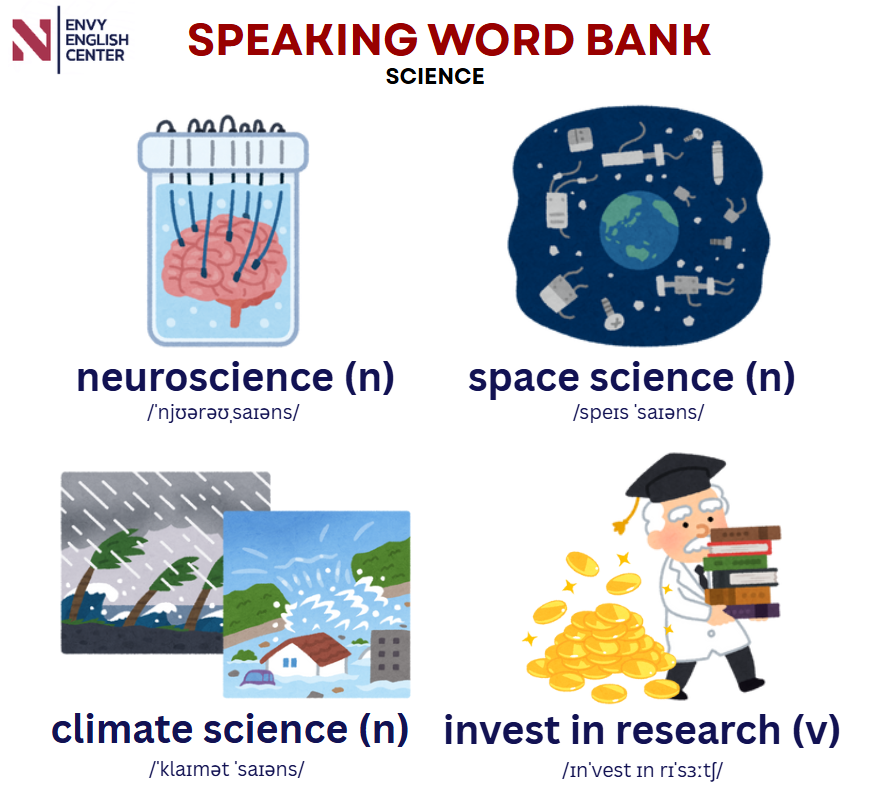
Should governments invest more in scientific research?
Why are some people more interested in science than others?
How has technology changed scientific development?
Should science education be improved in schools?
What are the disadvantages of scientific advancement?
Do you think artificial intelligence will change society?
How can science help solve environmental problems?
Do you think scientific progress will continue rapidly in the future?
2. Questions & Answers
Question 1: Did you enjoy studying science at school?
Yes, I generally enjoyed studying science at school because it helped me understand how the world works from a logical and practical perspective. I found scientific experiments and real-life applications especially interesting because they made lessons more interactive and engaging. Although some topics could be quite challenging, I think science develops analytical thinking and problem-solving skills effectively.
Scientific experiment (n.phr): thí nghiệm khoa học
e.g: Students conduct scientific experiments.
Real-life application (n.phr): ứng dụng thực tế
e.g: Mathematics has real-life applications.
Analytical thinking (n.phr): tư duy phân tích
e.g: Science improves analytical thinking.
Problem-solving skill (n.phr): kỹ năng giải quyết vấn đề
e.g: Education develops problem-solving skills.
Question 2: Which science subject did you like the most?
I probably liked biology and physics the most because both subjects explain important natural processes and scientific principles. Biology helped me understand living organisms and human health, while physics explained energy, motion, and technology in daily life. I especially enjoyed topics that connected theory with practical situations. I think science becomes more interesting when students can see its real-world relevance.
Scientific principle (n.phr): nguyên lý khoa học
e.g: Physics explains scientific principles.
Living organism (n.phr): sinh vật sống
e.g: Biology studies living organisms.
Real-world relevance (n.phr): tính liên hệ thực tế
e.g: Teachers should show real-world relevance.
Natural process (n.phr): quá trình tự nhiên
e.g: Biology explains natural processes.
Question 3: Do you think science is important in daily life?
Yes, science is extremely important because modern society depends heavily on scientific knowledge and technological development. Science improves healthcare, transportation, communication, education, and environmental protection. Many everyday technologies that people use regularly exist because of scientific research and innovation. I think science has transformed human life significantly.
Technological development (n.phr): phát triển công nghệ
e.g: Science supports technological development.
Scientific knowledge (n.phr): kiến thức khoa học
e.g: Schools teach scientific knowledge.
Environmental protection (n.phr): bảo vệ môi trường
e.g: Science improves environmental protection.
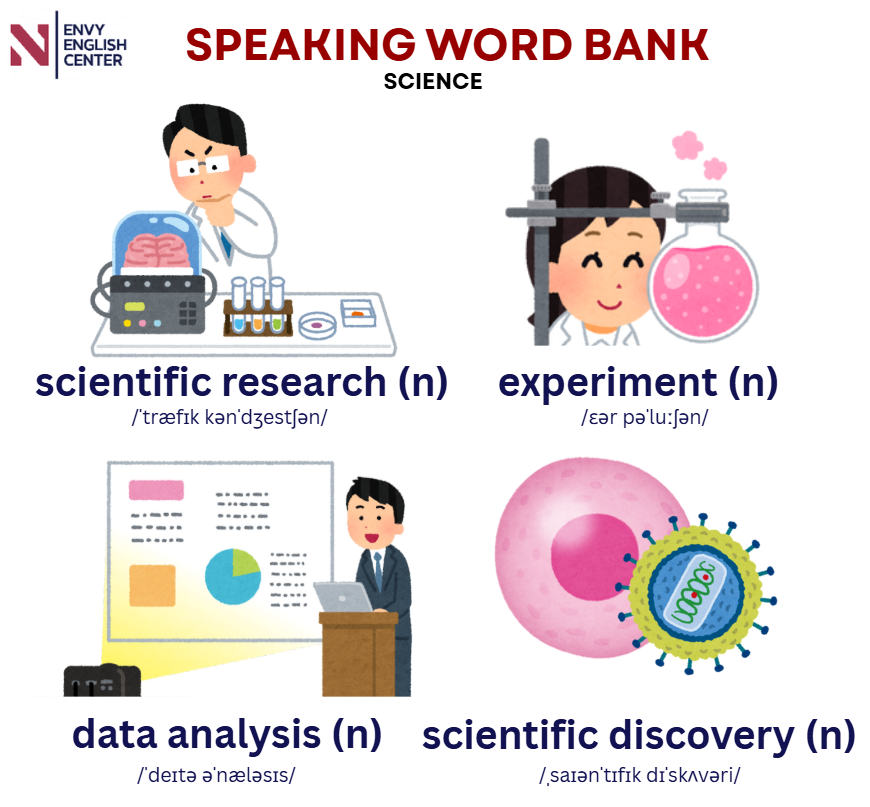
Scientific research (n.phr): nghiên cứu khoa học
e.g: Universities conduct scientific research.
Question 4: Are you interested in scientific discoveries?
Yes, I am interested in scientific discoveries, especially those related to medicine, artificial intelligence, and space exploration. Scientific discoveries often change society and improve people’s understanding of the world. I enjoy learning about innovations that solve practical problems or improve quality of life. I think scientific progress is one of the driving forces behind human development.
Artificial intelligence (n.phr): trí tuệ nhân tạo
e.g: Artificial intelligence changes industries.
Space exploration (n.phr): khám phá không gian
e.g: Countries invest in space exploration.
Driving force (n.phr): động lực thúc đẩy
e.g: Education is a driving force of development.
Quality of life (n.phr): chất lượng cuộc sống
e.g: Healthcare improves quality of life.
Question 5: Do you often read or watch science-related content?
Yes, occasionally I watch documentaries or online videos related to science and technology because they are both educational and interesting. I especially enjoy content about space, human psychology, medicine, and technological innovation. Scientific content can make complicated ideas easier to understand through visuals and explanations. I think online platforms have made scientific knowledge much more accessible.
Documentary (n): phim tài liệu
e.g: I watch documentaries online.
Technological innovation (n.phr): đổi mới công nghệ
e.g: Companies encourage technological innovation.
Accessible knowledge (n.phr): kiến thức dễ tiếp cận
e.g: The internet provides accessible knowledge.
Scientific content (n.phr): nội dung khoa học
e.g: Students enjoy scientific content.
Question 6: What scientific development has impressed you the most?
One scientific development that impresses me greatly is artificial intelligence because it is transforming communication, education, healthcare, and many other industries rapidly. AI systems can process information efficiently and perform tasks that previously required human effort. Although AI creates ethical and social concerns, its potential benefits are enormous. I think it will continue changing society significantly in the future.
Ethical concern (n.phr): vấn đề đạo đức
e.g: AI creates ethical concerns.
Human effort (n.phr): nỗ lực con người
e.g: Machines reduce human effort.
Process information (v.phr): xử lý thông tin
e.g: Computers process information quickly.
Potential benefit (n.phr): lợi ích tiềm năng
e.g: Technology has potential benefits.
Question 7: Do you think science makes life better?
Yes, definitely, because science improves healthcare, transportation, communication, and living standards overall. Scientific advancements help people solve problems more efficiently and increase life expectancy significantly. However, scientific progress should still be managed responsibly because some technologies may create environmental or ethical problems. Overall, I believe science has improved human life enormously.
Living standard (n.phr): mức sống
e.g: Technology improves living standards.
Life expectancy (n.phr): tuổi thọ
e.g: Medicine increases life expectancy.
Scientific advancement (n.phr): tiến bộ khoa học
e.g: Scientific advancements improve healthcare.
Responsibly (adv): một cách có trách nhiệm
e.g: Technology should be used responsibly.
Question 8: Would you like to work in a scientific field?
Although I respect scientific careers greatly, I personally prefer fields more related to law and communication. However, I would still enjoy working in areas connected to technology, research, or innovation indirectly. I think scientific knowledge is valuable in many professions, not only in laboratories or research institutions. Modern careers are becoming increasingly interdisciplinary.
Research institution (n.phr): viện nghiên cứu
e.g: Scientists work in research institutions.
Interdisciplinary (adj): liên ngành
e.g: Modern education is interdisciplinary.
Scientific career (n.phr): nghề nghiệp khoa học
e.g: Students pursue scientific careers.
Innovation (n): đổi mới
e.g: Technology encourages innovation.
Question 9: Do young people today show interest in science?
Yes, many young people are interested in science, especially topics related to technology, medicine, artificial intelligence, and environmental protection. Social media and online educational platforms have made scientific knowledge more accessible and engaging for younger generations. However, some students may still consider science difficult or stressful because of its complexity. I think effective teaching methods are extremely important.
Educational platform (n.phr): nền tảng giáo dục
e.g: Students use educational platforms.
Younger generation (n.phr): thế hệ trẻ
e.g: Younger generations enjoy technology.
Environmental protection (n.phr): bảo vệ môi trường
e.g: Students support environmental protection.
Teaching method (n.phr): phương pháp giảng dạy
e.g: Schools improve teaching methods.
Question 10: Has technology changed scientific research?
Yes, technology has changed scientific research dramatically by improving speed, accuracy, and global collaboration. Scientists can now analyze massive amounts of data, communicate internationally, and conduct simulations using advanced technology. In addition, the internet allows researchers to share information more efficiently. I think technology has accelerated scientific progress significantly.
Global collaboration (n.phr): hợp tác toàn cầu
e.g: Technology supports global collaboration.
Analyze data (v.phr): phân tích dữ liệu
e.g: Scientists analyze data carefully.
Scientific simulation (n.phr): mô phỏng khoa học
e.g: Computers create scientific simulations.
Accelerate progress (v.phr): thúc đẩy tiến bộ
e.g: Innovation accelerates progress.
Part 2: Describe a scientific discovery or invention that you find interesting.
One scientific invention that I find extremely interesting is the Internet. Although many people see it mainly as a technological system, I think it is also one of the most important scientific and communication-related inventions in human history because it has completely transformed the way people access information, communicate, work, and study. I first learned about the Internet seriously when I was a child using computers and online platforms for both entertainment and education. Over time, I gradually realized how deeply it influences modern society.
The Internet works by connecting millions of computers and digital devices globally through communication networks and data systems. It allows information to travel almost instantly between different locations around the world. Through the Internet, people can communicate through social media, video calls, emails, and messaging applications regardless of geographical distance. In addition, online platforms provide access to education, news, scientific research, entertainment, and business opportunities on a massive scale.
One reason why I find the Internet particularly fascinating is because of its impact on education and knowledge accessibility. In the past, people depended heavily on physical libraries or traditional classrooms to access information. Today, students can learn languages, study academic subjects, watch educational videos, and access international resources within seconds. I think the Internet has made learning more flexible, globalized, and accessible for millions of people.
Another reason why I admire this invention is its influence on communication and globalization. The Internet allows people from different countries and cultural backgrounds to connect easily and exchange ideas quickly. It has created opportunities for international cooperation, online business, remote working, and cultural exchange. Especially after global events like pandemics, the importance of digital communication became even more obvious.
However, I also recognize that the Internet has certain disadvantages and risks. Problems such as misinformation, cybercrime, digital addiction, and privacy concerns have become increasingly serious in modern society. Excessive dependence on online platforms may also negatively affect mental health and face-to-face communication. Therefore, I believe people should use the Internet responsibly and critically rather than depending on it completely.
Overall, I think the Internet is one of the most revolutionary inventions in modern history because it has transformed education, communication, business, and daily life globally. Although it creates some challenges, its positive contributions to human development are enormous. I believe future technological progress will continue improving the Internet and making global communication even more advanced.
Knowledge accessibility (n.phr): khả năng tiếp cận tri thức
e.g: Technology improves knowledge accessibility.
Communication network (n.phr): mạng lưới giao tiếp
e.g: Phones use communication networks.
International cooperation (n.phr): hợp tác quốc tế
e.g: Technology supports international cooperation.
Digital addiction (n.phr): nghiện kỹ thuật số
e.g: Teenagers face digital addiction.
Privacy concern (n.phr): vấn đề quyền riêng tư
e.g: Social media creates privacy concerns.
Remote working (n.phr): làm việc từ xa
e.g: Companies support remote working.
Global communication (n.phr): giao tiếp toàn cầu
e.g: The internet improves global communication.
Technological progress (n.phr): tiến bộ công nghệ
e.g: Scientific research drives technological progress.
Part 3: Discussion
Question: Why is science important for society?
Science is important because it improves healthcare, technology, education, transportation, and overall quality of life. Scientific research helps societies solve practical problems and understand the world more accurately. In addition, science contributes significantly to economic development and innovation. I think modern society could not function effectively without scientific advancement.
Scientific advancement (n.phr): tiến bộ khoa học
e.g: Scientific advancements improve healthcare.
Economic development (n.phr): phát triển kinh tế
e.g: Technology supports economic development.
Practical problem (n.phr): vấn đề thực tế
e.g: Science solves practical problems.
Quality of life (n.phr): chất lượng cuộc sống
e.g: Medicine improves quality of life.
Question: How does science improve people’s lives?
Science improves people’s lives through medical treatment, technological innovation, environmental protection, and improved living standards. Scientific discoveries make transportation faster, communication easier, and education more accessible. In addition, modern medicine has increased life expectancy and reduced many diseases significantly. I think science affects almost every aspect of human life.
Medical treatment (n.phr): điều trị y tế
e.g: Hospitals provide medical treatment.
Living standard (n.phr): mức sống
e.g: Technology improves living standards.
Life expectancy (n.phr): tuổi thọ
e.g: Healthcare increases life expectancy.
Technological innovation (n.phr): đổi mới công nghệ
e.g: Companies encourage technological innovation.
Question: Should governments invest more in scientific research?
Yes, definitely, because scientific research contributes to healthcare, environmental protection, economic growth, and national development. Government investment can support universities, laboratories, and technological innovation projects that benefit society long-term. In addition, some scientific research requires large financial resources that private companies may not provide adequately. I think science investment is extremely important for future progress.
Financial resource (n.phr): nguồn tài chính
e.g: Research requires financial resources.
Technological innovation (n.phr): đổi mới công nghệ
e.g: Governments support technological innovation.
National development (n.phr): phát triển quốc gia
e.g: Education supports national development.
Long-term benefit (n.phr): lợi ích dài hạn
e.g: Science creates long-term benefits.
Question: Why are some people more interested in science than others?
Some people are more interested in science because of personal curiosity, educational experiences, personality differences, or career goals. Individuals who enjoy logical thinking, experimentation, and problem-solving may naturally prefer scientific subjects. In addition, inspiring teachers and engaging educational environments can increase students’ interest in science. I think motivation and exposure play important roles.
Logical thinking (n.phr): tư duy logic
e.g: Mathematics improves logical thinking.
Problem-solving (n): giải quyết vấn đề
e.g: Science develops problem-solving.
Educational environment (n.phr): môi trường giáo dục
e.g: Schools need positive educational environments.
Personal curiosity (n.phr): sự tò mò cá nhân
e.g: Curiosity encourages learning.
Question: How has technology changed scientific development?
Technology has accelerated scientific development by improving research speed, accuracy, communication, and global collaboration. Scientists can now analyze massive amounts of data and conduct advanced simulations using powerful computers and artificial intelligence. In addition, digital communication allows researchers worldwide to share discoveries more efficiently. I think modern technology has transformed scientific research completely.
Global collaboration (n.phr): hợp tác toàn cầu
e.g: Technology supports global collaboration.
Artificial intelligence (n.phr): trí tuệ nhân tạo
e.g: Artificial intelligence improves research.
Analyze data (v.phr): phân tích dữ liệu
e.g: Scientists analyze data carefully.
Advanced simulation (n.phr): mô phỏng tiên tiến
e.g: Computers create advanced simulations.
Question: Should science education be improved in schools?
Yes, I think science education should become more practical, interactive, and connected to real-life applications. Many students lose interest because lessons sometimes focus too heavily on memorization rather than experimentation and critical thinking. Schools should encourage curiosity and hands-on learning experiences more actively. I believe effective science education can inspire future innovation.
Hands-on learning (n.phr): học thực hành
e.g: Science requires hands-on learning.
Critical thinking (n.phr): tư duy phản biện
e.g: Schools teach critical thinking.
Real-life application (n.phr): ứng dụng thực tế
e.g: Teachers explain real-life applications.
Memorization (n): học thuộc lòng
e.g: Memorization alone is ineffective.
Question: What are the disadvantages of scientific advancement?
Although science creates many benefits, it can also create ethical, environmental, and social problems. Advanced technologies may increase unemployment through automation or create dangerous inventions such as weapons. In addition, industrial development sometimes damages the environment significantly. I think scientific progress should always be balanced with ethical responsibility.
Automation (n): tự động hóa
e.g: Automation changes industries.
Ethical responsibility (n.phr): trách nhiệm đạo đức
e.g: Scientists need ethical responsibility.
Industrial development (n.phr): phát triển công nghiệp
e.g: Industrial development affects nature.
Dangerous invention (n.phr): phát minh nguy hiểm
e.g: Governments regulate dangerous inventions.
Question: Do you think artificial intelligence will change society?
Yes, absolutely. Artificial intelligence is already transforming industries such as healthcare, education, business, transportation, and communication. AI can improve efficiency and reduce human workload significantly, but it also creates concerns about privacy, employment, and ethical decision-making. I think AI will become one of the most influential technologies in the future.
Human workload (n.phr): khối lượng công việc con người
e.g: Machines reduce human workload.
Ethical decision-making (n.phr): việc ra quyết định đạo đức
e.g: AI creates ethical decision-making issues.
Influential technology (n.phr): công nghệ có ảnh hưởng lớn
e.g: Smartphones are influential technologies.
Privacy concern (n.phr): vấn đề quyền riêng tư
e.g: Social media creates privacy concerns.
Question: How can science help solve environmental problems?
Science can help solve environmental problems by developing renewable energy, waste treatment systems, sustainable agriculture, and pollution-control technology. Scientific research also improves understanding of climate change and environmental protection strategies. In addition, innovation can help societies reduce carbon emissions and protect natural resources. I think science is essential for sustainable development.
Renewable energy (n.phr): năng lượng tái tạo
e.g: Solar power is renewable energy.
Climate change (n.phr): biến đổi khí hậu
e.g: Scientists study climate change.
Carbon emission (n.phr): khí thải carbon
e.g: Governments reduce carbon emissions.
Sustainable development (n.phr): phát triển bền vững
e.g: Countries support sustainable development.
Question: Do you think scientific progress will continue rapidly in the future?
Yes, I believe scientific progress will continue developing rapidly because technology, artificial intelligence, and global collaboration are advancing constantly. Future discoveries may transform healthcare, transportation, communication, and environmental protection even further. However, societies must also manage ethical and social challenges carefully. I think the future of science will be both exciting and complex.
Global collaboration (n.phr): hợp tác toàn cầu
e.g: Research requires global collaboration.
Future discovery (n.phr): khám phá tương lai
e.g: Scientists hope for future discoveries.
Environmental protection (n.phr): bảo vệ môi trường
e.g: Science improves environmental protection.
Ethical challenge (n.phr): thách thức đạo đức
e.g: AI creates ethical challenges.
Nếu bạn đang bắt đầu từ con số 0 hoặc đã học nhưng “dậm chân tại chỗ”, Envy English Center có thể đồng hành cùng bạn:
Test trình độ miễn phí theo format IELTS để biết chính xác điểm mạnh – điểm yếu.
Nhận lộ trình học cá nhân hóa từ 0 → 6.5+, phù hợp tốc độ và mục tiêu.
Trực tiếp học với giáo viên IELTS 8.0+, chuyên “gỡ rối” Speaking & Writing – hai kỹ năng khó nâng band nhất.
Đặc biệt, khi đăng ký trong tuần này, bạn được tặng bộ từ vựng chuẩn IELTS band 7+.
📞 Hotline: 028 7300 9677 / 0948 197 270 (Zalo)
🌐 Website: envyenglish.vn
📍 Địa chỉ: 46/5 Tân Cảng, Phường Thạnh Mỹ Tây, Quận Bình Thạnh, TP.HCM


Thông tin gửi đi không thành công, vui lòng thử lại sau.
Nếu bạn cần liên hệ gấp, vui lòng gọi hotline
02873009677

Cảm ơn bạn đã gửi thông tin đến Envy English Center.
Chúng tôi sẽ liên hệ với bạn sớm nhất khi có thể.
Nếu bạn cần liên hệ gấp, vui lòng gọi hotline
02873009677
Thông tin gửi đi không thành công, vui lòng thử lại sau.
Nếu bạn cần liên hệ gấp, vui lòng gọi hotline
02873009677
Bạn đang có một bài test chưa hoàn thành.
Bạn có muốn tiếp tục bài test đó không?
Bạn có chắc là muốn gửi bài test này không?

Số câu trả lời đúng/40

Số câu trả lời đúng/40
Thông tin gửi đi không thành công, vui lòng thử lại sau.
Nếu bạn cần liên hệ gấp, vui lòng gọi hotline
02873009677
Thời gian làm bài kiểm tra đã hết.
Cảm ơn bạn đã cố gắng.
