 02873009677
 contact@envyenglish.vn

1. Questions
Part 1: Shopping (10 Questions)
Do you enjoy shopping?
How often do you go shopping?
What kinds of things do you usually buy?
Do you prefer shopping online or in physical stores?
Have your shopping habits changed recently?
Do you like shopping for clothes?
Is shopping popular among young people in your country?
Do advertisements influence your shopping decisions?
Have you ever bought something you didn’t need?
Do you think shopping is a good way to relax?
Part 2: Cue Card
Describe a shopping experience that you enjoyed.
You should say:
what you bought
where you bought it
who you went with
and explain why you enjoyed the experience.
Part 3: Shopping Discussion (10 Questions)
Why do people enjoy shopping?
How has online shopping changed consumer behavior?
What are the advantages of shopping online?
What are the disadvantages of online shopping?
Do advertisements affect people’s shopping habits?
Why do some people buy expensive brands?
Should people spend less money on unnecessary things?
How does shopping influence the economy?
Do young people shop differently from older generations?
Do you think shopping habits will change in the future?
2. Questions & Answers
Question 1: Do you enjoy shopping?
Yes, I generally enjoy shopping because it can be both practical and relaxing. I especially enjoy shopping when I am looking for something meaningful or useful rather than buying things impulsively. Sometimes shopping also helps me reduce stress and improve my mood after studying or working for a long time. However, I try to maintain responsible spending habits.
Impulsive buying (n.phr): mua sắm bốc đồng
e.g: Advertisements encourage impulsive buying.
Responsible spending (n.phr): chi tiêu có trách nhiệm
e.g: Students should practice responsible spending.
Reduce stress (v.phr): giảm căng thẳng
e.g: Music helps reduce stress.
Shopping habit (n.phr): thói quen mua sắm
e.g: Online platforms change shopping habits.
Question 2: How often do you go shopping?
I usually go shopping once or twice a week depending on my needs and schedule. Most of the time, I buy daily necessities such as food, personal items, or study materials. Occasionally, I also shop for clothes or gifts during special occasions. Nowadays, online shopping has reduced the need to visit physical stores frequently.
Daily necessity (n.phr): nhu yếu phẩm hàng ngày
e.g: Supermarkets sell daily necessities.
Physical store (n.phr): cửa hàng vật lý
e.g: Some people prefer physical stores.
Special occasion (n.phr): dịp đặc biệt
e.g: Families shop during special occasions.
Study material (n.phr): tài liệu học tập
e.g: Students buy study materials.
Question 3: What kinds of things do you usually buy?
I usually buy practical items such as books, clothes, skincare products, food, and study-related materials. I prefer purchasing things that are useful and necessary rather than buying expensive products only for appearance. Occasionally, I also buy gifts for friends or family members during celebrations. I think practical shopping is more financially responsible.
Practical item (n.phr): vật dụng thực tế
e.g: Students buy practical items.
Financially responsible (adj.phr): có trách nhiệm tài chính
e.g: Adults should spend money responsibly.
Skincare product (n.phr): sản phẩm chăm sóc da
e.g: Many teenagers use skincare products.
Necessary purchase (n.phr): món đồ cần thiết
e.g: Food is a necessary purchase.
Question 4: Do you prefer shopping online or in physical stores?
I prefer a combination of both depending on the product. Online shopping is convenient because it saves time and offers more choices, while physical stores allow me to check product quality directly before purchasing. For clothes or expensive items, I usually prefer shopping in person. Overall, online shopping has become increasingly important in modern life.
Product quality (n.phr): chất lượng sản phẩm
e.g: Customers care about product quality.
Save time (v.phr): tiết kiệm thời gian
e.g: Technology helps save time.
Convenient option (n.phr): lựa chọn tiện lợi
e.g: Online shopping is convenient.
In person (adv.phr): trực tiếp
e.g: Customers try clothes in person.
Question 5: Have your shopping habits changed recently?
Yes, my shopping habits have changed because I now shop more carefully and thoughtfully than before. I pay more attention to product quality, usefulness, and price instead of buying things impulsively. In addition, I use online shopping platforms more frequently due to convenience and wider product choices. I think people become more financially conscious over time.
Financially conscious (adj.phr): có ý thức tài chính
e.g: Adults become financially conscious.
Thoughtful purchase (n.phr): mua sắm cân nhắc
e.g: Customers make thoughtful purchases.
Product usefulness (n.phr): tính hữu ích của sản phẩm
e.g: Students value product usefulness.
Wider choice (n.phr): nhiều lựa chọn hơn
e.g: Online stores provide wider choices.
Question 6: Do you like shopping for clothes?
Yes, I enjoy shopping for clothes because fashion allows people to express personality and confidence. I especially like finding outfits that are comfortable, practical, and suitable for different occasions. However, I usually avoid buying too many unnecessary clothes because I prefer quality over quantity. I think clothing style can influence first impressions significantly.
Express personality (v.phr): thể hiện cá tính
e.g: Fashion helps express personality.
First impression (n.phr): ấn tượng đầu tiên
e.g: Clothing affects first impressions.
Quality over quantity (n.phr): chất lượng hơn số lượng
e.g: Many people prefer quality over quantity.
Suitable outfit (n.phr): trang phục phù hợp
e.g: Students choose suitable outfits.
Question 7: Is shopping popular among young people in your country?
Yes, shopping is very popular among young people because it is connected to fashion, social trends, entertainment, and lifestyle. Many young people enjoy visiting shopping malls, cafes, and online platforms with friends. Social media and advertisements also strongly influence consumer behavior among younger generations. I think shopping has become both a practical activity and a social experience.
Consumer behavior (n.phr): hành vi tiêu dùng
e.g: Advertisements influence consumer behavior.
Social trend (n.phr): xu hướng xã hội
e.g: Young people follow social trends.
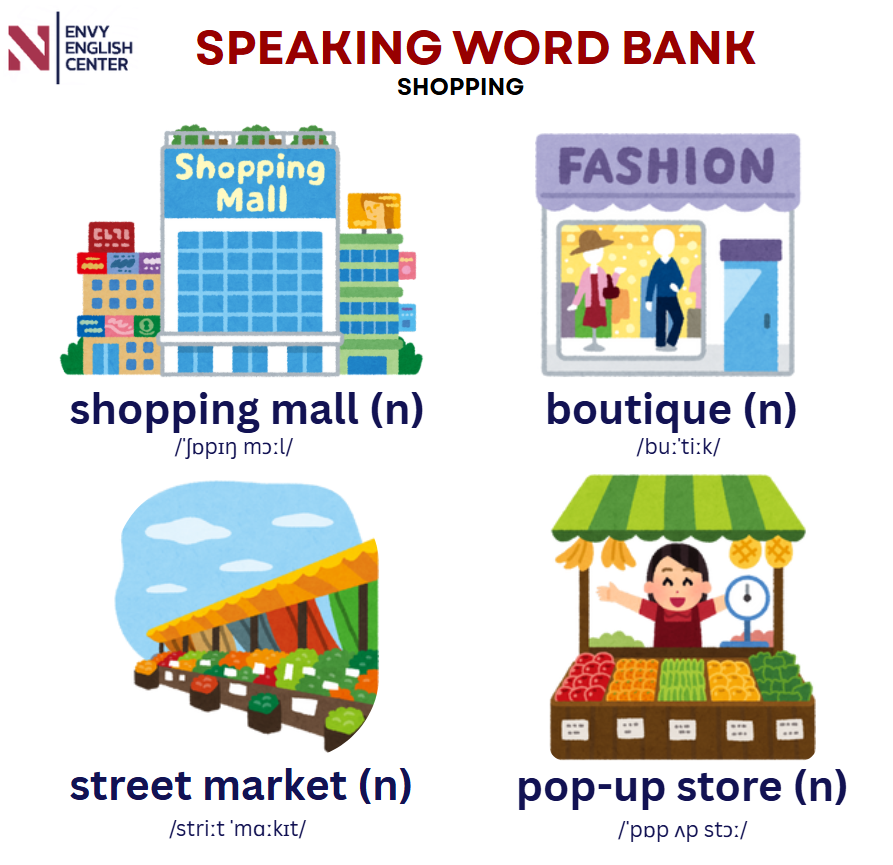
Shopping mall (n.phr): trung tâm thương mại
e.g: Teenagers visit shopping malls.
Social experience (n.phr): trải nghiệm xã hội
e.g: Shopping can be a social experience.
Question 8: Do advertisements influence your shopping decisions?
Yes, advertisements can influence my shopping decisions to some extent because they provide information about products and trends. However, I usually try to evaluate product quality and usefulness carefully before making purchases. Some advertisements can encourage unnecessary spending by creating artificial desires. I think consumers should remain critical and financially responsible.
Artificial desire (n.phr): nhu cầu nhân tạo
e.g: Ads create artificial desires.
Evaluate carefully (v.phr): đánh giá cẩn thận
e.g: Customers evaluate products carefully.
Financial responsibility (n.phr): trách nhiệm tài chính
e.g: Adults need financial responsibility.
Consumer awareness (n.phr): nhận thức người tiêu dùng
e.g: Education improves consumer awareness.
Question 9: Have you ever bought something you didn’t need?
Yes, like many people, I have occasionally bought unnecessary items impulsively, especially when products were heavily advertised or discounted. Afterward, I sometimes realized that the purchase was not actually useful or important. Experiences like that taught me to think more carefully before spending money. I now try to prioritize practical purchases instead.
Discounted product (n.phr): sản phẩm giảm giá
e.g: Customers buy discounted products.
Practical purchase (n.phr): món đồ thiết thực
e.g: Adults prioritize practical purchases.
Impulsive decision (n.phr): quyết định bốc đồng
e.g: Shopping can create impulsive decisions.
Spend money wisely (v.phr): tiêu tiền khôn ngoan
e.g: Students should spend money wisely.
Question 10: Do you think shopping is a good way to relax?
Yes, for some people shopping can be relaxing because it provides entertainment and emotional satisfaction. Visiting stores or browsing online platforms may help people reduce stress temporarily. However, excessive shopping can create financial problems and unhealthy spending habits. I think shopping is enjoyable when it is balanced and responsible.
Emotional satisfaction (n.phr): sự thỏa mãn cảm xúc
e.g: Shopping provides emotional satisfaction.
Unhealthy habit (n.phr): thói quen không lành mạnh
e.g: Overspending becomes an unhealthy habit.
Financial problem (n.phr): vấn đề tài chính
e.g: Debt creates financial problems.
Balanced lifestyle (n.phr): lối sống cân bằng
e.g: Exercise supports balanced lifestyles.
Part 2: Describe a shopping experience that you enjoyed.
One shopping experience that I really enjoyed was when I bought a formal outfit for an important academic event at university. Since the event was relatively formal and professional, I wanted to choose clothes that looked elegant, confident, and suitable for the occasion. It was not only about buying clothes but also about preparing myself mentally for an important milestone, so the experience felt much more meaningful than ordinary shopping.
I went shopping at a large shopping mall with one of my close friends who has a good sense of fashion. Before going there, I had already searched online for ideas and different clothing styles because I wanted something simple but professional-looking. However, choosing the right outfit turned out to be more difficult than I expected because there were so many options in terms of color, material, and design.
At the shopping mall, we visited several clothing stores and spent a few hours trying on different outfits. I especially enjoyed comparing styles and asking for opinions from my friend and the store assistants. The atmosphere was lively and enjoyable because there were many people shopping, listening to music, and spending time with friends or family members. Eventually, I chose a formal outfit that felt comfortable, elegant, and appropriate for the event. Even though it was slightly more expensive than I originally planned, I felt satisfied because the quality was very good.
What made the experience particularly enjoyable was the sense of confidence and excitement it gave me. After choosing the outfit, I felt more prepared and motivated for the academic event itself. Shopping sometimes has a psychological effect because buying something suitable for an important occasion can improve self-confidence and emotional readiness. In addition, spending time with my friend made the experience much more entertaining and relaxing.
Another reason why I enjoyed this shopping experience was because it taught me the importance of thoughtful spending. Instead of buying things impulsively, I carefully considered quality, practicality, and long-term usefulness before making the purchase. I realized that shopping becomes more meaningful when people focus on value and purpose rather than simply following trends or advertisements.
Overall, this was one of the most memorable shopping experiences I have had because it combined social interaction, personal preparation, and responsible decision-making. The outfit itself was useful, but the confidence and positive emotions connected to the experience were even more valuable. I think enjoyable shopping experiences are often connected to meaningful moments in people’s lives.
Formal outfit (n.phr): trang phục trang trọng
e.g: Students wear formal outfits at events.
Professional-looking (adj): trông chuyên nghiệp
e.g: She prefers professional-looking clothes.
Thoughtful spending (n.phr): chi tiêu cân nhắc
e.g: Adults practice thoughtful spending.
Long-term usefulness (n.phr): tính hữu ích lâu dài
e.g: Buyers value long-term usefulness.
Self-confidence (n): sự tự tin
e.g: Fashion can improve self-confidence.
Store assistant (n.phr): nhân viên cửa hàng
e.g: Store assistants help customers.
Psychological effect (n.phr): tác động tâm lý
e.g: Music has psychological effects.
Responsible decision-making (n.phr): đưa ra quyết định có trách nhiệm
e.g: Schools teach responsible decision-making.
Part 3: Discussion
Question: Why do people enjoy shopping?
People enjoy shopping because it provides entertainment, relaxation, and emotional satisfaction. For some individuals, shopping is also a social activity that allows them to spend time with friends or family members. In addition, buying new products may increase confidence and create excitement temporarily. I think shopping combines both practical and psychological benefits.
Emotional satisfaction (n.phr): sự thỏa mãn cảm xúc
e.g: Shopping creates emotional satisfaction.
Social activity (n.phr): hoạt động xã hội
e.g: Sports are social activities.
Psychological benefit (n.phr): lợi ích tâm lý
e.g: Exercise provides psychological benefits.
Practical benefit (n.phr): lợi ích thực tế
e.g: Technology offers practical benefits.
Question: How has online shopping changed consumer behavior?
Online shopping has changed consumer behavior significantly because it allows people to purchase products more quickly and conveniently. Consumers can now compare prices, read customer reviews, and access international products without leaving home. However, online shopping may also encourage impulsive purchases because products are always available. I think modern shopping habits are becoming increasingly digital.
Customer review (n.phr): đánh giá khách hàng
e.g: Buyers read customer reviews.
Impulsive purchase (n.phr): mua hàng bốc đồng
e.g: Online shopping encourages impulsive purchases.
Digital habit (n.phr): thói quen kỹ thuật số
e.g: Young people develop digital habits.
Convenient access (n.phr): khả năng tiếp cận tiện lợi
e.g: Technology provides convenient access.
Question: What are the disadvantages of online shopping?
One disadvantage is that customers cannot physically examine products before purchasing them. Sometimes products may arrive damaged or different from online descriptions and images. Online shopping can also increase unnecessary spending and reduce face-to-face interaction. In addition, privacy and cybersecurity issues are becoming increasingly concerning.
Cybersecurity issue (n.phr): vấn đề an ninh mạng
e.g: Companies face cybersecurity issues.
Online description (n.phr): mô tả trực tuyến
e.g: Buyers read online descriptions.
Face-to-face interaction (n.phr): tương tác trực tiếp
e.g: Offices encourage face-to-face interaction.
Unnecessary spending (n.phr): chi tiêu không cần thiết
e.g: Ads encourage unnecessary spending.
Question: Do advertisements affect people’s shopping habits?
Yes, advertisements strongly affect shopping habits because they influence people emotionally and psychologically. Companies often use attractive visuals, celebrities, and social trends to encourage consumers to purchase products. Social media advertisements are particularly effective because they appear constantly in daily life. I think consumers should remain critical instead of believing advertisements completely.
Attractive visual (n.phr): hình ảnh hấp dẫn
e.g: Companies use attractive visuals.
Social trend (n.phr): xu hướng xã hội
e.g: Teenagers follow social trends.
Consumer psychology (n.phr): tâm lý người tiêu dùng
e.g: Ads target consumer psychology.
Remain critical (v.phr): giữ tư duy phản biện
e.g: Students should remain critical online.
Question: Why do some people buy expensive brands?
Some people buy expensive brands because they associate them with higher quality, social status, and personal image. Luxury brands may also increase confidence and create a sense of prestige. However, some consumers purchase expensive products mainly because of social pressure or trends rather than actual necessity. I think spending choices depend on personal values and financial conditions.
Social status (n.phr): địa vị xã hội
e.g: Luxury products represent social status.
Sense of prestige (n.phr): cảm giác danh giá
e.g: Brands create a sense of prestige.
Financial condition (n.phr): điều kiện tài chính
e.g: Purchases depend on financial conditions.
Personal image (n.phr): hình ảnh cá nhân
e.g: Fashion affects personal image.
Question: Should people spend less money on unnecessary things?
Yes, I think people should spend more carefully because excessive consumption may create financial stress and waste resources. Although buying enjoyable things occasionally is normal, people should prioritize practical needs and long-term financial stability. Responsible spending habits are especially important for young adults. I believe balance is necessary.
Excessive consumption (n.phr): tiêu dùng quá mức
e.g: Society faces excessive consumption.
Financial stability (n.phr): ổn định tài chính
e.g: Savings improve financial stability.
Practical need (n.phr): nhu cầu thực tế
e.g: Adults prioritize practical needs.
Responsible habit (n.phr): thói quen có trách nhiệm
e.g: Families teach responsible habits.
Question: How does shopping influence the economy?
Shopping plays a major role in economic growth because consumer spending supports businesses, creates jobs, and increases production. Retail industries, transportation companies, and advertising businesses all depend heavily on consumer demand. In addition, shopping contributes to tax revenue and economic circulation. I think consumption is essential for modern economies.
Economic growth (n.phr): tăng trưởng kinh tế
e.g: Technology supports economic growth.
Consumer demand (n.phr): nhu cầu tiêu dùng
e.g: Companies study consumer demand.
Economic circulation (n.phr): lưu thông kinh tế
e.g: Shopping supports economic circulation.
Retail industry (n.phr): ngành bán lẻ
e.g: The retail industry creates jobs.
Question: Do young people shop differently from older generations?
Yes, younger people are generally more influenced by social media, digital trends, and online platforms. They often value convenience, fashion, and brand image strongly. Older generations, on the other hand, usually focus more on durability, practicality, and long-term value. I think technology has created significant generational differences in shopping behavior.
Brand image (n.phr): hình ảnh thương hiệu
e.g: Companies build strong brand images.
Long-term value (n.phr): giá trị lâu dài
e.g: Adults care about long-term value.
Generational difference (n.phr): khác biệt thế hệ
e.g: Technology creates generational differences.
Shopping behavior (n.phr): hành vi mua sắm
e.g: Ads influence shopping behavior.
Question: Do you think shopping habits will change in the future?
Yes, definitely. Future shopping will probably become even more digital, personalized, and technology-driven because artificial intelligence and online services are developing rapidly. People may also become more environmentally conscious and support sustainable consumption more actively. I think convenience and sustainability will strongly influence future shopping habits.
Technology-driven (adj): được thúc đẩy bởi công nghệ
e.g: Modern businesses are technology-driven.
Sustainable consumption (n.phr): tiêu dùng bền vững
e.g: Society encourages sustainable consumption.
Environmentally conscious (adj.phr): có ý thức môi trường
e.g: Young people are environmentally conscious.
Artificial intelligence (n.phr): trí tuệ nhân tạo
e.g: Artificial intelligence changes shopping.
Nếu bạn đang bắt đầu từ con số 0 hoặc đã học nhưng “dậm chân tại chỗ”, Envy English Center có thể đồng hành cùng bạn:
Test trình độ miễn phí theo format IELTS để biết chính xác điểm mạnh – điểm yếu.
Nhận lộ trình học cá nhân hóa từ 0 → 6.5+, phù hợp tốc độ và mục tiêu.
Trực tiếp học với giáo viên IELTS 8.0+, chuyên “gỡ rối” Speaking & Writing – hai kỹ năng khó nâng band nhất.
Đặc biệt, khi đăng ký trong tuần này, bạn được tặng bộ từ vựng chuẩn IELTS band 7+.
📞 Hotline: 028 7300 9677 / 0948 197 270 (Zalo)
🌐 Website: envyenglish.vn
📍 Địa chỉ: 46/5 Tân Cảng, Phường Thạnh Mỹ Tây, Quận Bình Thạnh, TP.HCM


Thông tin gửi đi không thành công, vui lòng thử lại sau.
Nếu bạn cần liên hệ gấp, vui lòng gọi hotline
02873009677

Cảm ơn bạn đã gửi thông tin đến Envy English Center.
Chúng tôi sẽ liên hệ với bạn sớm nhất khi có thể.
Nếu bạn cần liên hệ gấp, vui lòng gọi hotline
02873009677
Thông tin gửi đi không thành công, vui lòng thử lại sau.
Nếu bạn cần liên hệ gấp, vui lòng gọi hotline
02873009677
Bạn đang có một bài test chưa hoàn thành.
Bạn có muốn tiếp tục bài test đó không?
Bạn có chắc là muốn gửi bài test này không?

Số câu trả lời đúng/40

Số câu trả lời đúng/40
Thông tin gửi đi không thành công, vui lòng thử lại sau.
Nếu bạn cần liên hệ gấp, vui lòng gọi hotline
02873009677
Thời gian làm bài kiểm tra đã hết.
Cảm ơn bạn đã cố gắng.
