 02873009677
 contact@envyenglish.vn

Part 1
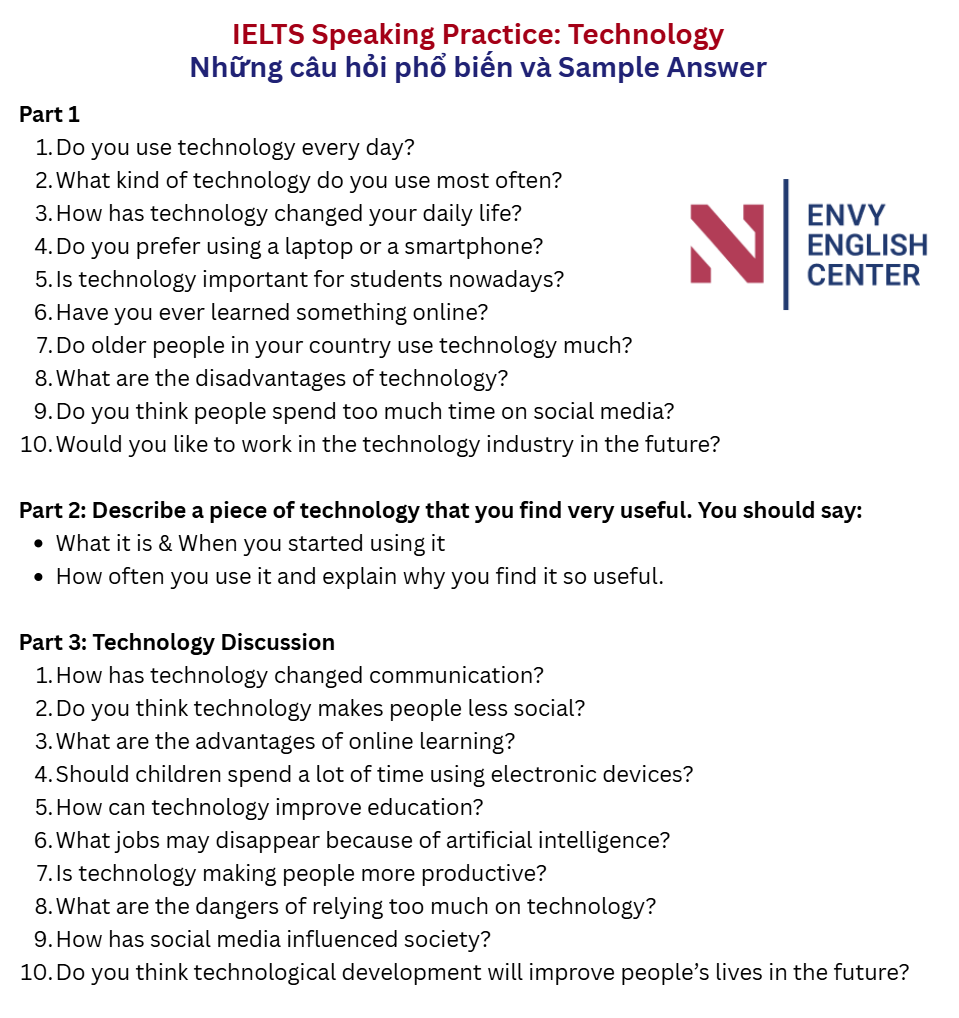
Do you use technology every day?
What kind of technology do you use most often?
How has technology changed your daily life?
Do you prefer using a laptop or a smartphone?
Is technology important for students nowadays?
Have you ever learned something online?
Do older people in your country use technology much?
What are the disadvantages of technology?
Do you think people spend too much time on social media?
Would you like to work in the technology industry in the future?
Part 2: Describe a piece of technology that you find very useful. You should say:
what it is
when you started using it
how often you use it
and explain why you find it so useful.
Part 3: Technology Discussion
How has technology changed communication?
Do you think technology makes people less social?
What are the advantages of online learning?
Should children spend a lot of time using electronic devices?
How can technology improve education?
What jobs may disappear because of artificial intelligence?
Is technology making people more productive?
What are the dangers of relying too much on technology?
How has social media influenced society?
Do you think technological development will improve people’s lives in the future?
Part 1: Personal questions
Question 1: Do you use technology every day?
Yes, I use technology on a daily basis for both academic and personal purposes. As a university student, I rely heavily on digital devices to attend online classes, conduct research, and communicate with classmates. In addition, technology allows me to manage my schedule more efficiently through productivity applications and online calendars. I honestly cannot imagine completing my daily tasks effectively without technological support.
On a daily basis (adv.phr): hàng ngày
e.g: Most office workers use computers on a daily basis.
Rely heavily on (v.phr): phụ thuộc nhiều vào
e.g: Students rely heavily on the Internet for information.
Conduct research (v.phr): nghiên cứu
e.g: Scientists conduct research to develop new technologies.
Productivity applications (n.phr): ứng dụng năng suất
e.g: Productivity applications help users organize their work.
Question 2: What kind of technology do you use most often?
The piece of technology I use most frequently is probably my smartphone because it is extremely convenient and multifunctional. I use it not only for communication but also for studying, entertainment, and accessing news updates. Furthermore, many applications on my phone help me improve my English skills through listening and vocabulary practice. Since smartphones combine so many functions in one device, they have become an essential part of modern life.
Multifunctional (adj): đa chức năng
e.g: Smartphones are highly multifunctional devices.
Access news updates (v.phr): cập nhật tin tức
e.g: Young people often access news updates through social media.
Improve language skills (v.phr): cải thiện kỹ năng ngôn ngữ
e.g: Watching movies can improve language skills.
Essential part of (n.phr): phần thiết yếu của
e.g: Technology is an essential part of education nowadays.
Question 3: How has technology changed your daily life?
Technology has transformed my daily routine in numerous ways over the past few years. Firstly, it has made communication significantly faster and more convenient through messaging platforms and video calls. Secondly, I can access educational materials instantly instead of spending hours searching for physical books. Moreover, technology has improved my productivity because many digital tools help me organize tasks and manage deadlines effectively. Overall, I believe technology has made my life more efficient and flexible.
Transform someone’s routine (v.phr): thay đổi thói quen hằng ngày
e.g: Technology has transformed people’s routines dramatically.
Messaging platform (n.phr): nền tảng nhắn tin
e.g: Messaging platforms are widely used among teenagers.
Educational materials (n.phr): tài liệu học tập
e.g: Students can download educational materials online.
Manage deadlines effectively (v.phr): quản lý hạn chót hiệu quả
e.g: Digital calendars help employees manage deadlines effectively.
Question 4: Do you prefer using a laptop or a smartphone?
Although smartphones are extremely convenient for daily communication, I personally prefer using a laptop for academic purposes. A laptop provides a larger screen and a more comfortable keyboard, which makes studying and writing assignments much easier. In addition, laptops usually support more advanced software for research, presentations, and document editing. Therefore, I think laptops are more suitable for serious academic work.
Academic purposes (n.phr): mục đích học tập
e.g: Tablets are commonly used for academic purposes.
Advanced software (n.phr): phần mềm nâng cao
e.g: Graphic designers require advanced software.
Document editing (n.phr): chỉnh sửa tài liệu
e.g: Laptops are ideal for document editing.
Serious academic work (n.phr): công việc học thuật nghiêm túc
e.g: Desktop computers are often preferred for serious academic work.
Question 5: What are the disadvantages of technology?
Despite its numerous benefits, technology also has several drawbacks that should not be ignored. One major issue is that excessive screen time can negatively affect both physical and mental health. In addition, many people have become overly dependent on digital devices, which may reduce face-to-face communication skills. Another concern is the spread of misinformation on social media platforms, where false information can circulate rapidly. Consequently, people should learn how to use technology responsibly and critically.
Numerous benefits (n.phr): nhiều lợi ích
e.g: Online learning offers numerous benefits for students.
Excessive screen time (n.phr): thời gian nhìn màn hình quá nhiều
e.g: Excessive screen time can cause eye strain.
Overly dependent on (adj.phr): quá phụ thuộc vào
e.g: Children should not become overly dependent on smartphones.
Spread of misinformation (n.phr): sự lan truyền thông tin sai lệch
e.g: Governments are concerned about the spread of misinformation online.
Part 2: Describe a piece of technology that you find very useful.
One piece of technology that I find extremely useful is my laptop, which I use almost every day for both studying and personal activities. I started using a laptop seriously when I entered high school because my academic workload became much heavier at that time. Since then, it has become one of the most important tools in my daily life.
The main reason I find it useful is that it allows me to complete a wide range of tasks efficiently. For example, I use it to attend online classes, conduct academic research, prepare presentations, and write assignments. Compared to smartphones, laptops provide a much larger screen and a more comfortable typing experience, which helps me work more productively for long periods of time.
In addition, my laptop enables me to access enormous amounts of information within seconds through the Internet. This is particularly beneficial for students because we often need to search for academic materials and reliable sources quickly. Furthermore, I use various productivity applications to organize my schedule, manage deadlines, and take notes during lectures. As a result, my study routine has become significantly more organized and efficient.
Another reason why I appreciate this technology is that it supports communication and collaboration. For instance, I frequently use video conferencing platforms and online group chats to discuss projects with classmates. Without a laptop, it would be much more difficult to participate in online learning environments effectively.
Besides academic purposes, I also use my laptop for entertainment and self-improvement. In my free time, I watch documentaries, read articles, and practice English listening skills online. Therefore, I believe my laptop not only supports my education but also contributes positively to my personal development.
Overall, I would say that my laptop is an indispensable piece of technology because it improves my productivity, communication, and access to knowledge in countless ways.
Academic workload (n.phr): khối lượng học tập
e.g: University students often struggle with a heavy academic workload.
Typing experience (n.phr): trải nghiệm gõ máy
e.g: Mechanical keyboards provide a better typing experience.
Productivity applications (n.phr): ứng dụng năng suất
e.g: Productivity applications help employees stay organized.
Reliable sources (n.phr): nguồn đáng tin cậy
e.g: Students should use reliable sources in academic writing.
Video conferencing platform (n.phr): nền tảng họp trực tuyến
e.g: Many companies use video conferencing platforms for meetings.
Online learning environment (n.phr): môi trường học trực tuyến
e.g: Teachers must adapt to online learning environments.
Self-improvement (n): sự phát triển bản thân
e.g: Reading books is important for self-improvement.
Indispensable (adj): không thể thiếu
e.g: Smartphones have become indispensable in modern society.
Part 3: Discussion
Question 1: How has technology changed communication?
Technology has revolutionized communication in many significant ways. In the past, people relied mainly on face-to-face conversations and traditional letters, whereas nowadays communication can occur instantly through messaging applications and video calls. This has made it much easier for individuals to maintain relationships despite geographical distance. Furthermore, businesses and educational institutions can now collaborate internationally more efficiently than ever before. However, some people argue that excessive online communication may weaken real-life social interaction skills.
Revolutionize communication (v.phr): cách mạng hóa giao tiếp
e.g: Social media has revolutionized communication worldwide.
Geographical distance (n.phr): khoảng cách địa lý
e.g: Technology helps people overcome geographical distance.
Collaborate internationally (v.phr): hợp tác quốc tế
e.g: Scientists frequently collaborate internationally on research projects.
Real-life social interaction (n.phr): tương tác xã hội ngoài đời thực
e.g: Teenagers should maintain real-life social interaction.
Question 2: Should children spend a lot of time using electronic devices?
In my opinion, children should not spend excessive amounts of time using electronic devices because it may negatively affect both their physical health and social development. Although technology can provide educational benefits and entertainment, overexposure to screens may reduce physical activity and contribute to problems such as poor eyesight and sleep disorders. Moreover, children who spend too much time online might become less interested in face-to-face interaction and outdoor activities. Therefore, parents should establish reasonable limits while still allowing children to benefit from technology in moderation.
Excessive amounts of time (n.phr): quá nhiều thời gian
e.g: Children should not spend excessive amounts of time gaming.
Overexposure to screens (n.phr): tiếp xúc màn hình quá mức
e.g: Overexposure to screens affects children’s eyesight.
Face-to-face interaction (n.phr): tương tác trực tiếp
e.g: Schools encourage face-to-face interaction among students.
In moderation (adv.phr): điều độ, vừa phải
e.g: Social media can be beneficial if used in moderation.
Question 3: What jobs may disappear because of artificial intelligence?
I believe artificial intelligence is likely to replace many repetitive and routine-based jobs in the future. For example, occupations involving data entry, basic customer service, or simple manufacturing tasks may become increasingly automated. This is because AI systems can often perform these tasks faster, more accurately, and at a lower cost than human workers. Nevertheless, jobs requiring creativity, emotional intelligence, and complex decision-making are less likely to disappear completely. Consequently, people may need to develop more advanced and adaptable skill sets in order to remain competitive in the job market.
Routine-based jobs (n.phr): công việc mang tính lặp lại
e.g: Automation threatens many routine-based jobs.
Become automated (v.phr): được tự động hóa
e.g: Factory processes are becoming increasingly automated.
Emotional intelligence (n.phr): trí tuệ cảm xúc
e.g: Leaders require strong emotional intelligence.
Remain competitive (v.phr): duy trì tính cạnh tranh
e.g: Employees must update their skills to remain competitive.
Nếu bạn đang bắt đầu từ con số 0 hoặc đã học nhưng “dậm chân tại chỗ”, Envy English Center có thể đồng hành cùng bạn:
Test trình độ miễn phí theo format IELTS để biết chính xác điểm mạnh – điểm yếu.
Nhận lộ trình học cá nhân hóa từ 0 → 6.5+, phù hợp tốc độ và mục tiêu.
Trực tiếp học với giáo viên IELTS 8.0+, chuyên “gỡ rối” Speaking & Writing – hai kỹ năng khó nâng band nhất.
Đặc biệt, khi đăng ký trong tuần này, bạn được tặng bộ từ vựng chuẩn IELTS band 7+.
📞 Hotline: 028 7300 9677 / 0948 197 270 (Zalo)
🌐 Website: envyenglish.vn
📍 Địa chỉ: 46/5 Tân Cảng, Phường Thạnh Mỹ Tây, Quận Bình Thạnh, TP.HCM


Thông tin gửi đi không thành công, vui lòng thử lại sau.
Nếu bạn cần liên hệ gấp, vui lòng gọi hotline
02873009677

Cảm ơn bạn đã gửi thông tin đến Envy English Center.
Chúng tôi sẽ liên hệ với bạn sớm nhất khi có thể.
Nếu bạn cần liên hệ gấp, vui lòng gọi hotline
02873009677
Thông tin gửi đi không thành công, vui lòng thử lại sau.
Nếu bạn cần liên hệ gấp, vui lòng gọi hotline
02873009677
Bạn đang có một bài test chưa hoàn thành.
Bạn có muốn tiếp tục bài test đó không?
Bạn có chắc là muốn gửi bài test này không?

Số câu trả lời đúng/40

Số câu trả lời đúng/40
Thông tin gửi đi không thành công, vui lòng thử lại sau.
Nếu bạn cần liên hệ gấp, vui lòng gọi hotline
02873009677
Thời gian làm bài kiểm tra đã hết.
Cảm ơn bạn đã cố gắng.
