 02873009677
 contact@envyenglish.vn

1. Questions
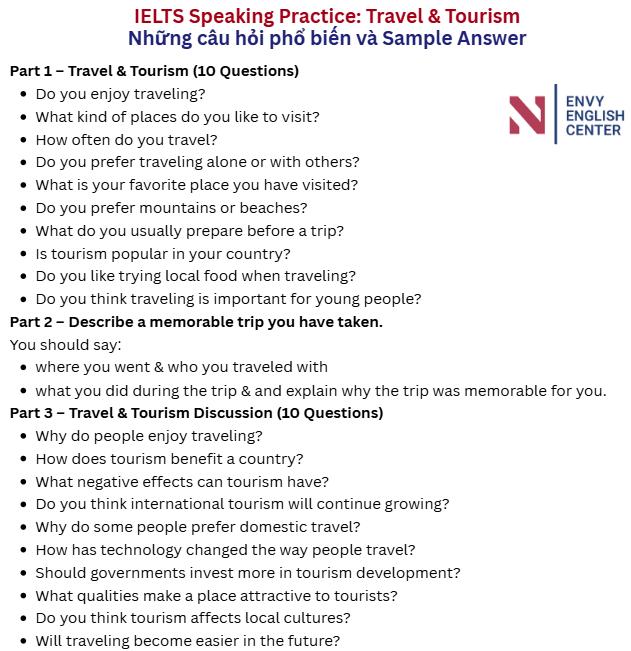
Part 1 – Travel & Tourism (10 Questions)
Do you enjoy traveling?
What kind of places do you like to visit?
How often do you travel?
Do you prefer traveling alone or with others?
What is your favorite place you have visited?
Do you prefer mountains or beaches?
What do you usually prepare before a trip?
Is tourism popular in your country?
Do you like trying local food when traveling?
Do you think traveling is important for young people?
Part 2 – Cue Card (1 Question)
Describe a memorable trip you have taken.
You should say:
where you went
who you traveled with
what you did during the trip
and explain why the trip was memorable for you.
Part 3 – Travel & Tourism Discussion (10 Questions)
Why do people enjoy traveling?
How does tourism benefit a country?
What negative effects can tourism have?
Do you think international tourism will continue growing?
Why do some people prefer domestic travel?
How has technology changed the way people travel?
Should governments invest more in tourism development?
What qualities make a place attractive to tourists?
Do you think tourism affects local cultures?
Will traveling become easier in the future?
2. Questions & Answers
Question 1: Do you enjoy traveling?
Yes, I enjoy traveling very much because it allows me to relax, explore new places, and experience different cultures. Traveling also helps me temporarily escape from academic pressure and daily routines. In addition, visiting unfamiliar places can broaden my perspective and improve my understanding of the world. I think traveling is both enjoyable and educational at the same time.
Academic pressure (n.phr): áp lực học tập
e.g: Students often experience academic pressure.
Daily routine (n.phr): thói quen hằng ngày
e.g: Traveling helps people escape daily routines.
Broaden perspective (v.phr): mở rộng góc nhìn
e.g: Traveling broadens people’s perspectives.
Cultural experience (n.phr): trải nghiệm văn hóa
e.g: Tourists enjoy cultural experiences abroad.
Question 2: What kind of places do you like to visit?
I enjoy visiting places that have beautiful natural scenery and interesting cultural attractions. For example, I like coastal cities, historical destinations, and places with peaceful environments because they help me relax mentally. In addition, I enjoy exploring local traditions, architecture, and food whenever I travel. I think combining nature and culture makes a trip much more meaningful.
Natural scenery (n.phr): phong cảnh thiên nhiên
e.g: Vietnam has beautiful natural scenery.
Cultural attraction (n.phr): điểm thu hút văn hóa
e.g: Museums are cultural attractions.
Historical destination (n.phr): điểm đến lịch sử
e.g: Hue is a famous historical destination.
Peaceful environment (n.phr): môi trường yên bình
e.g: Countryside areas provide peaceful environments.
Question 3: How often do you travel?
I do not travel very frequently because academic responsibilities and busy schedules often limit my free time. However, I usually take short trips during holidays or special occasions with friends or family members. Occasionally, I also participate in educational trips or local tourism activities. Although I cannot travel regularly, I always look forward to opportunities to explore new places.
Academic responsibility (n.phr): trách nhiệm học tập
e.g: Academic responsibilities reduce free time.
Special occasion (n.phr): dịp đặc biệt
e.g: Families travel during special occasions.
Educational trip (n.phr): chuyến đi học tập
e.g: Schools organize educational trips.
Local tourism activity (n.phr): hoạt động du lịch địa phương
e.g: Cities promote local tourism activities.
Question 4: Do you prefer traveling alone or with others?
I generally prefer traveling with friends or family because shared experiences often make trips more enjoyable and memorable. Traveling with others also provides emotional support and increases safety during the journey. In addition, group travel allows people to create stronger relationships through shared activities and conversations. However, solo travel can also be beneficial because it encourages independence and personal growth.
Shared experience (n.phr): trải nghiệm chung
e.g: Shared experiences strengthen friendships.
Emotional support (n.phr): hỗ trợ tinh thần
e.g: Friends provide emotional support during trips.
Solo travel (n.phr): du lịch một mình
e.g: Solo travel encourages independence.
Personal growth (n.phr): sự phát triển cá nhân
e.g: Traveling promotes personal growth.
Question 5: What is your favorite place you have visited?
One of my favorite places that I have visited is Da Lat because the city has a cool climate, beautiful scenery, and a peaceful atmosphere. I especially enjoyed the pine forests, flower gardens, and quiet cafés located around the city. In addition, the local food was delicious and relatively affordable compared to larger cities. I think Da Lat is an ideal destination for relaxation and escaping busy urban life.
Cool climate (n.phr): khí hậu mát mẻ
e.g: Da Lat is famous for its cool climate.
Peaceful atmosphere (n.phr): bầu không khí yên bình
e.g: Tourists enjoy peaceful atmospheres.
Urban life (n.phr): cuộc sống đô thị
e.g: Many people escape stressful urban life.
Ideal destination (n.phr): điểm đến lý tưởng
e.g: Da Nang is an ideal destination for tourists.
Question 6: Do you prefer mountains or beaches?
I personally prefer beaches because I find coastal environments relaxing and visually beautiful. I enjoy listening to the sound of waves, walking along the beach, and watching sunsets near the ocean. In addition, beaches often provide opportunities for outdoor activities such as swimming and water sports. However, mountains are also attractive because they offer fresh air and peaceful natural landscapes.
Coastal environment (n.phr): môi trường ven biển
e.g: Coastal environments attract tourists.
Outdoor activity (n.phr): hoạt động ngoài trời
e.g: Beaches offer outdoor activities.
Water sport (n.phr): thể thao dưới nước
e.g: Tourists enjoy water sports.
Natural landscape (n.phr): cảnh quan thiên nhiên
e.g: Vietnam has beautiful natural landscapes.
Question 7: What do you usually prepare before a trip?
Before a trip, I usually prepare transportation arrangements, accommodation bookings, and important personal belongings. I also research the destination carefully to learn about local attractions, weather conditions, and cultural customs. In addition, I create a basic travel schedule to organize activities more efficiently. Proper preparation helps reduce stress and makes traveling much more convenient.
Accommodation booking (n.phr): đặt chỗ ở
e.g: Tourists make accommodation bookings online.
Weather condition (n.phr): điều kiện thời tiết
e.g: Travelers check weather conditions beforehand.
Cultural custom (n.phr): phong tục văn hóa
e.g: Visitors should respect cultural customs.
Travel schedule (n.phr): lịch trình du lịch
e.g: Families plan travel schedules carefully.
Question 8: Is tourism popular in your country?
Yes, tourism is extremely popular in Vietnam because the country has diverse natural landscapes, historical sites, and cultural attractions. Both domestic and international tourists visit destinations such as beaches, mountains, ancient towns, and major cities throughout the year. In addition, Vietnamese cuisine and hospitality are also attractive to foreign visitors. I think tourism plays an important role in economic development and cultural exchange.
Natural landscape (n.phr): cảnh quan thiên nhiên
e.g: Vietnam has diverse natural landscapes.
Historical site (n.phr): di tích lịch sử
e.g: Hue contains many historical sites.
Cultural exchange (n.phr): giao lưu văn hóa
e.g: Tourism encourages cultural exchange.
Economic development (n.phr): phát triển kinh tế
e.g: Tourism contributes to economic development.
Question 9: Do you like trying local food when traveling?
Yes, I always enjoy trying local food whenever I travel because cuisine is an important part of cultural experience. Traditional dishes often reflect the history, lifestyle, and identity of a particular region. In addition, tasting local specialties makes traveling more interesting and memorable. I think food allows tourists to understand local culture in a more authentic way.
Cultural experience (n.phr): trải nghiệm văn hóa
e.g: Food is part of cultural experiences.
Traditional dish (n.phr): món ăn truyền thống
e.g: Pho is a traditional Vietnamese dish.
Local specialty (n.phr): đặc sản địa phương
e.g: Tourists buy local specialties as gifts.
Authentic (adj): chân thực
e.g: Travelers seek authentic cultural experiences.
Question 10: Do you think traveling is important for young people?
Yes, I believe traveling is extremely beneficial for young people because it broadens their knowledge and develops important life skills. Traveling allows young individuals to experience different cultures, improve communication abilities, and become more independent. In addition, exposure to new environments can increase adaptability and open-mindedness. I think travel contributes significantly to both personal growth and global understanding.
Communication ability (n.phr): khả năng giao tiếp
e.g: Traveling improves communication abilities.
Open-mindedness (n): tư duy cởi mở
e.g: International experiences encourage open-mindedness.
Adaptability (n): khả năng thích nghi
e.g: Traveling develops adaptability.
Global understanding (n.phr): hiểu biết toàn cầu
e.g: Students need greater global understanding.
Part 2 – Cue Card
Describe a memorable trip you have taken.
One of the most memorable trips I have ever taken was a vacation to Da Nang with my family a few years ago. We traveled there during the summer holiday because everyone wanted to relax after a long period of work and study. Since Da Nang is well known for its beautiful beaches, modern city atmosphere, and delicious local cuisine, we were all extremely excited about the trip before it even began.
We stayed in Da Nang for about five days and visited many famous tourist attractions during that time. One of the places I enjoyed the most was My Khe Beach because the scenery was incredibly beautiful and peaceful. We spent a lot of time swimming, walking along the coastline, and watching the sunset in the evening. In addition, we visited Ba Na Hills, where we experienced the cool mountain climate and saw the famous Golden Bridge, which attracted a large number of tourists.
Another memorable part of the trip was the local food. Da Nang is famous for many traditional dishes such as seafood, Mi Quang, and banh xeo, all of which I found extremely delicious and affordable. Trying local specialties allowed me to understand more about the culture and lifestyle of the region. Furthermore, visiting local markets and interacting with local residents made the trip feel more authentic and interesting.
What made the trip especially unforgettable was the quality time I spent with my family. Because everyone usually has busy schedules, we rarely have opportunities to travel together for several days. During the trip, we talked more, shared experiences, took photos together, and created many happy memories. I realized that traveling is not only about visiting new places but also about strengthening relationships with the people around us.
In addition, the trip helped me reduce stress and temporarily escape from academic pressure. The relaxing environment, beautiful natural scenery, and enjoyable activities made me feel mentally refreshed and more energetic afterward. It was one of the few times when I felt completely relaxed without constantly thinking about responsibilities or deadlines.
Overall, this trip to Da Nang remains one of the happiest and most memorable experiences of my life because it combined relaxation, cultural exploration, and meaningful family bonding. I believe memorable trips are valuable because they create lifelong memories and broaden people’s understanding of the world.
Tourist attraction (n.phr): địa điểm du lịch
e.g: Da Nang has many tourist attractions.
Coastline (n): đường bờ biển
e.g: Tourists walked along the coastline.
Local specialty (n.phr): đặc sản địa phương
e.g: Visitors enjoy local specialties.
Authentic experience (n.phr): trải nghiệm chân thực
e.g: Markets provide authentic experiences.
Quality time (n.phr): thời gian chất lượng
e.g: Families should spend quality time together.
Academic pressure (n.phr): áp lực học tập
e.g: Students experience academic pressure.
Mentally refreshed (adj.phr): tinh thần được làm mới
e.g: Vacations help people feel mentally refreshed.
Lifelong memory (n.phr): ký ức suốt đời
e.g: Childhood trips create lifelong memories.
Part 3 – Discussion
Question: Why do people enjoy traveling?
People enjoy traveling for many different reasons, including relaxation, entertainment, and cultural exploration. Traveling allows individuals to escape from stressful daily routines and experience new environments. In addition, visiting unfamiliar places can broaden people’s perspectives and increase their understanding of different cultures and lifestyles. I think traveling also creates memorable experiences and strengthens relationships among family members or friends.
Cultural exploration (n.phr): khám phá văn hóa
e.g: Traveling encourages cultural exploration.
Daily routine (n.phr): thói quen hằng ngày
e.g: Vacations help people escape daily routines.
Broaden perspective (v.phr): mở rộng góc nhìn
e.g: International travel broadens perspectives.
Memorable experience (n.phr): trải nghiệm đáng nhớ
e.g: Traveling creates memorable experiences.
Question: How does tourism benefit a country?
Tourism provides many economic and social benefits for a country. Economically, tourism creates jobs, increases national income, and supports local businesses such as hotels, restaurants, and transportation services. Socially, tourism encourages cultural exchange and helps promote a country’s image internationally. In addition, tourism development often leads to improvements in infrastructure and public services.
National income (n.phr): thu nhập quốc gia
e.g: Tourism increases national income.
Local business (n.phr): doanh nghiệp địa phương
e.g: Tourism supports local businesses.
Infrastructure development (n.phr): phát triển cơ sở hạ tầng
e.g: Tourism encourages infrastructure development.
Public service (n.phr): dịch vụ công cộng
e.g: Governments improve public services for tourists.
Question: What negative effects can tourism have?
Although tourism has many advantages, it can also create negative effects if it is not managed properly. For example, excessive tourism may cause environmental pollution, overcrowding, and damage to natural or historical sites. In addition, local cultures and traditions may become overly commercialized to satisfy tourist demand. I also think rising tourism costs can negatively affect local residents in some popular destinations.
Environmental pollution (n.phr): ô nhiễm môi trường
e.g: Tourism contributes to environmental pollution.
Historical site (n.phr): di tích lịch sử
e.g: Tourists sometimes damage historical sites.
Commercialized (adj): bị thương mại hóa
e.g: Traditional festivals become commercialized.
Tourist destination (n.phr): điểm đến du lịch
e.g: Famous tourist destinations become overcrowded.
Question: Do you think international tourism will continue growing?
Yes, I believe international tourism will continue growing because transportation and technology are becoming more advanced and accessible. Many people now have greater interest in cultural experiences and international travel compared to previous generations. In addition, social media and digital platforms encourage tourism by making destinations more visible and attractive. However, global issues such as economic crises or environmental problems may still affect tourism growth occasionally.
Transportation system (n.phr): hệ thống giao thông
e.g: Modern transportation systems support tourism.
Cultural experience (n.phr): trải nghiệm văn hóa
e.g: Travelers seek cultural experiences abroad.
Digital platform (n.phr): nền tảng kỹ thuật số
e.g: Tourism companies advertise on digital platforms.
Economic crisis (n.phr): khủng hoảng kinh tế
e.g: Economic crises reduce international travel.
Question: Why do some people prefer domestic travel?
Some people prefer domestic travel because it is generally more affordable and convenient than international travel. Domestic tourists often feel more comfortable with the language, food, and cultural environment of their own country. In addition, traveling locally usually requires less planning and fewer legal procedures such as visas or passports. I think domestic travel is also a good way to support local economies and explore national culture more deeply.
Affordable (adj): giá cả phải chăng
e.g: Domestic travel is more affordable.
Legal procedure (n.phr): thủ tục pháp lý
e.g: International travel involves legal procedures.
Local economy (n.phr): nền kinh tế địa phương
e.g: Tourism supports local economies.
National culture (n.phr): văn hóa quốc gia
e.g: Domestic tourism promotes national culture.
Question: How has technology changed the way people travel?
Technology has transformed traveling in many positive ways by making travel planning faster, easier, and more convenient. Nowadays, people can book flights, hotels, and transportation online within minutes using smartphones or computers. In addition, digital maps, translation apps, and online reviews help tourists navigate unfamiliar places more confidently. Social media also influences tourism by allowing people to share travel experiences instantly.
Travel planning (n.phr): lên kế hoạch du lịch
e.g: Technology simplifies travel planning.
Translation app (n.phr): ứng dụng dịch thuật
e.g: Travelers use translation apps abroad.
Online review (n.phr): đánh giá trực tuyến
e.g: Tourists read online reviews before booking hotels.
Navigate unfamiliar place (v.phr): di chuyển ở nơi xa lạ
e.g: GPS helps tourists navigate unfamiliar places.
Question: Should governments invest more in tourism development?
Yes, I think governments should invest in tourism development because tourism contributes significantly to economic growth and international reputation. Investments in infrastructure, transportation, and tourist attractions can attract more visitors and improve overall travel experiences. In addition, tourism creates employment opportunities for local communities and supports many related industries. However, tourism development should also prioritize environmental protection and cultural preservation.
Economic growth (n.phr): tăng trưởng kinh tế
e.g: Tourism contributes to economic growth.
Employment opportunity (n.phr): cơ hội việc làm
e.g: Tourism creates employment opportunities.
Cultural preservation (n.phr): bảo tồn văn hóa
e.g: Governments support cultural preservation.
Environmental protection (n.phr): bảo vệ môi trường
e.g: Tourism policies should include environmental protection.
Question: What qualities make a place attractive to tourists?
Several qualities can make a place attractive to tourists, including beautiful scenery, cultural attractions, good infrastructure, and safety. Many travelers also look for destinations with unique experiences, local traditions, and delicious cuisine. In addition, affordable prices and friendly local residents can positively influence tourists’ experiences. I think a successful tourist destination usually combines natural beauty, convenience, and cultural identity.
Cultural attraction (n.phr): điểm thu hút văn hóa
e.g: Museums are cultural attractions.
Local tradition (n.phr): truyền thống địa phương
e.g: Tourists enjoy local traditions.
Friendly resident (n.phr): người dân thân thiện
e.g: Friendly residents improve tourism experiences.
Cultural identity (n.phr): bản sắc văn hóa
e.g: Tourism should preserve cultural identity.
Question: Do you think tourism affects local cultures?
Yes, tourism can affect local cultures in both positive and negative ways. Positively, tourism encourages cultural exchange and increases international awareness of local traditions and heritage. However, excessive tourism may commercialize cultural practices or influence younger generations to adopt foreign lifestyles. I think balancing tourism development with cultural preservation is extremely important.
Cultural exchange (n.phr): giao lưu văn hóa
e.g: Tourism promotes cultural exchange.
Cultural heritage (n.phr): di sản văn hóa
e.g: Ancient cities preserve cultural heritage.
Foreign lifestyle (n.phr): lối sống nước ngoài
e.g: Media influences foreign lifestyles.
Cultural preservation (n.phr): bảo tồn văn hóa
e.g: Governments support cultural preservation.
Question: Will traveling become easier in the future?
Yes, I strongly believe traveling will become easier in the future due to technological advancement and transportation development. Faster transportation systems, digital travel services, and improved international cooperation will probably reduce travel difficulties significantly. In addition, artificial intelligence and smart tourism technologies may improve convenience and safety for travelers. However, environmental challenges and global political issues may still affect international mobility to some extent.
Technological advancement (n.phr): tiến bộ công nghệ
e.g: Technological advancements improve tourism.
Transportation development (n.phr): phát triển giao thông
e.g: Transportation development supports tourism.
Smart tourism technology (n.phr): công nghệ du lịch thông minh
e.g: Airports use smart tourism technologies.
International mobility (n.phr): sự di chuyển quốc tế
e.g: Pandemics affect international mobility.
Nếu bạn đang bắt đầu từ con số 0 hoặc đã học nhưng “dậm chân tại chỗ”, Envy English Center có thể đồng hành cùng bạn:
Test trình độ miễn phí theo format IELTS để biết chính xác điểm mạnh – điểm yếu.
Nhận lộ trình học cá nhân hóa từ 0 → 6.5+, phù hợp tốc độ và mục tiêu.
Trực tiếp học với giáo viên IELTS 8.0+, chuyên “gỡ rối” Speaking & Writing – hai kỹ năng khó nâng band nhất.
Đặc biệt, khi đăng ký trong tuần này, bạn được tặng bộ từ vựng chuẩn IELTS band 7+.
📞 Hotline: 028 7300 9677 / 0948 197 270 (Zalo)
🌐 Website: envyenglish.vn
📍 Địa chỉ: 46/5 Tân Cảng, Phường Thạnh Mỹ Tây, Quận Bình Thạnh, TP.HCM


Thông tin gửi đi không thành công, vui lòng thử lại sau.
Nếu bạn cần liên hệ gấp, vui lòng gọi hotline
02873009677

Cảm ơn bạn đã gửi thông tin đến Envy English Center.
Chúng tôi sẽ liên hệ với bạn sớm nhất khi có thể.
Nếu bạn cần liên hệ gấp, vui lòng gọi hotline
02873009677
Thông tin gửi đi không thành công, vui lòng thử lại sau.
Nếu bạn cần liên hệ gấp, vui lòng gọi hotline
02873009677
Bạn đang có một bài test chưa hoàn thành.
Bạn có muốn tiếp tục bài test đó không?
Bạn có chắc là muốn gửi bài test này không?

Số câu trả lời đúng/40

Số câu trả lời đúng/40
Thông tin gửi đi không thành công, vui lòng thử lại sau.
Nếu bạn cần liên hệ gấp, vui lòng gọi hotline
02873009677
Thời gian làm bài kiểm tra đã hết.
Cảm ơn bạn đã cố gắng.
