 02873009677
 contact@envyenglish.vn

1. Questions
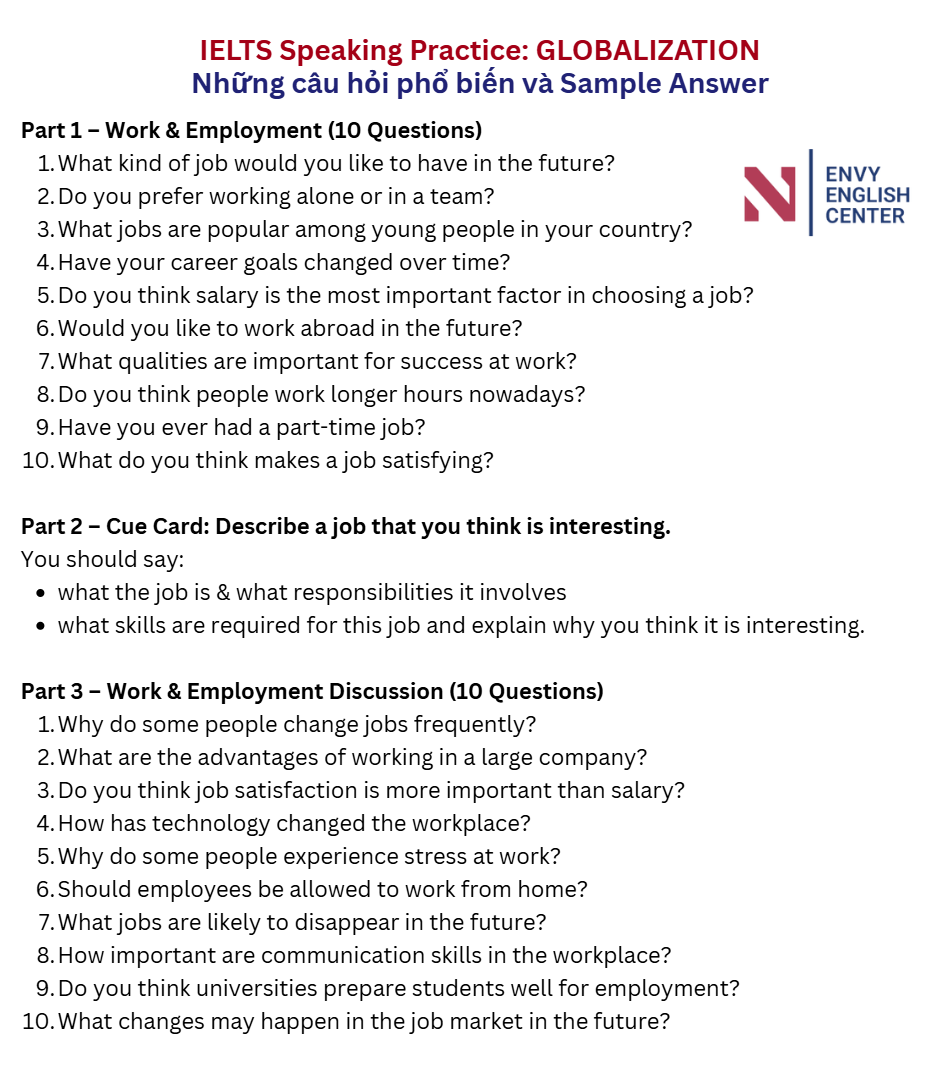
Part 1 – Work & Employment (10 Questions)
What kind of job would you like to have in the future?
Do you prefer working alone or in a team?
What jobs are popular among young people in your country?
Have your career goals changed over time?
Do you think salary is the most important factor in choosing a job?
Would you like to work abroad in the future?
What qualities are important for success at work?
Do you think people work longer hours nowadays?
Have you ever had a part-time job?
What do you think makes a job satisfying?
Part 2 – Cue Card: Describe a job that you think is interesting.
You should say:
what the job is
what responsibilities it involves
what skills are required for this job
and explain why you think it is interesting.
Part 3 – Work & Employment Discussion (10 Questions)
Why do some people change jobs frequently?
What are the advantages of working in a large company?
Do you think job satisfaction is more important than salary?
How has technology changed the workplace?
Why do some people experience stress at work?
Should employees be allowed to work from home?
What jobs are likely to disappear in the future?
How important are communication skills in the workplace?
Do you think universities prepare students well for employment?
What changes may happen in the job market in the future?
2. Questions & Answers
Question 1: What kind of job would you like to have in the future?
In the future, I would like to have a career that is both intellectually challenging and socially meaningful. I am particularly interested in jobs related to law and international business because these fields involve critical thinking, communication, and problem-solving skills. In addition, I hope to work in a professional environment where I can continue learning and developing my expertise. Most importantly, I want a career that allows me to make a positive contribution to society while achieving personal success.
Intellectually challenging (adj.phr): thử thách về trí tuệ
e.g: Many students prefer intellectually challenging careers.
Critical thinking (n.phr): tư duy phản biện
e.g: Universities should develop critical thinking skills.
Professional environment (n.phr): môi trường chuyên nghiệp
e.g: Employees perform better in a professional environment.
Make a positive contribution (v.phr): đóng góp tích cực
e.g: Volunteers want to make a positive contribution to society.
Question 2: Do you prefer working alone or in a team?
I personally prefer working in a team because teamwork allows people to exchange ideas and support one another more effectively. When individuals collaborate, they can combine different skills and perspectives to solve problems more efficiently. In addition, working in a team helps improve communication and interpersonal skills, which are extremely important in most professional environments. However, I also believe independent work is necessary for tasks that require deep concentration and personal responsibility.
Exchange ideas (v.phr): trao đổi ý tưởng
e.g: Team discussions help employees exchange ideas.
Interpersonal skills (n.phr): kỹ năng giao tiếp cá nhân
e.g: Managers need strong interpersonal skills.
Professional environment (n.phr): môi trường chuyên nghiệp
e.g: Communication is essential in professional environments.
Deep concentration (n.phr): sự tập trung cao độ
e.g: Writing often requires deep concentration.
Question 3: What jobs are popular among young people in your country?
Nowadays, many young people in my country are interested in careers related to technology, business, and digital media. Jobs such as software engineering, marketing, content creation, and finance are becoming increasingly attractive because they often offer high salaries and career growth opportunities. In addition, many students are interested in entrepreneurship and freelance work due to the flexibility these careers provide. I think social media and globalization have strongly influenced modern career preferences among young people.
Career growth opportunity (n.phr): cơ hội phát triển nghề nghiệp
e.g: Young employees seek career growth opportunities.
Entrepreneurship (n): tinh thần khởi nghiệp
e.g: Universities encourage entrepreneurship among students.
Freelance work (n.phr): công việc tự do
e.g: Freelance work offers flexible schedules.
Career preference (n.phr): định hướng nghề nghiệp
e.g: Technology changes students’ career preferences.
Question 4: Have your career goals changed over time?
Yes, my career goals have changed significantly as I have gained more experience and knowledge about different professions. When I was younger, I mainly focused on jobs that offered financial stability and high salaries. However, as I became older, I realized that personal interest, meaningful work, and long-term development are equally important. Nowadays, I prefer careers that allow me to combine professional success with personal fulfillment.
Financial stability (n.phr): sự ổn định tài chính
e.g: Many people choose careers for financial stability.
Long-term development (n.phr): phát triển lâu dài
e.g: Employees value long-term development opportunities.
Professional success (n.phr): thành công nghề nghiệp
e.g: Hard work often leads to professional success.
Personal fulfillment (n.phr): sự thỏa mãn cá nhân
e.g: Creative careers provide personal fulfillment.
Question 5: Do you think salary is the most important factor in choosing a job?
Although salary is certainly an important consideration, I do not think it is the only factor people should focus on when choosing a career. A satisfying job should also provide opportunities for personal growth, work-life balance, and professional development. In addition, working in a healthy and supportive environment can strongly influence employees’ happiness and motivation. Therefore, I believe job satisfaction depends on multiple factors rather than income alone.
Important consideration (n.phr): yếu tố cân nhắc quan trọng
e.g: Salary is an important consideration for employees.
Work-life balance (n.phr): cân bằng công việc và cuộc sống
e.g: Young workers value work-life balance.
Supportive environment (n.phr): môi trường hỗ trợ
e.g: Students learn better in supportive environments.
Job satisfaction (n.phr): sự hài lòng trong công việc
e.g: Flexible schedules improve job satisfaction.
Question 6: Would you like to work abroad in the future?
Yes, I would definitely like to work abroad at some point in the future because it would provide valuable international experience. Working in another country could help me improve my professional skills, expand my global perspective, and become more adaptable. In addition, international workplaces often expose employees to diverse cultures and communication styles. However, I would still want to maintain close relationships with my family and home country.
International experience (n.phr): kinh nghiệm quốc tế
e.g: International experience improves career prospects.
Global perspective (n.phr): góc nhìn toàn cầu
e.g: Studying abroad develops a global perspective.
Adaptable (adj): dễ thích nghi
e.g: Employees should be adaptable in modern workplaces.
Diverse culture (n.phr): văn hóa đa dạng
e.g: International companies include diverse cultures.
Question 7: What qualities are important for success at work?
I believe several qualities are essential for professional success. Firstly, strong communication and teamwork skills are necessary because most jobs require collaboration with other people. Secondly, discipline and responsibility help employees complete tasks efficiently and maintain professional standards. In addition, adaptability is becoming increasingly important because workplaces and technologies are changing rapidly. Finally, continuous learning is essential for long-term career development in today’s competitive job market.
Professional success (n.phr): thành công nghề nghiệp
e.g: Hard work contributes to professional success.
Professional standard (n.phr): tiêu chuẩn chuyên nghiệp
e.g: Employees should maintain professional standards.
Continuous learning (n.phr): học tập liên tục
e.g: Continuous learning improves job performance.
Competitive job market (n.phr): thị trường lao động cạnh tranh
e.g: Graduates face a competitive job market.
Question 8: Do you think people work longer hours nowadays?
Yes, I think many people work longer hours nowadays due to increasing economic pressure and competition in the workplace. In some industries, employees are expected to handle heavy workloads and meet strict deadlines regularly. In addition, digital technology allows people to stay connected to work even after office hours, which can blur the boundary between work and personal life. As a result, maintaining a healthy work-life balance has become more challenging for many workers.
Economic pressure (n.phr): áp lực kinh tế
e.g: Economic pressure affects employees’ mental health.
Heavy workload (n.phr): khối lượng công việc lớn
e.g: Doctors often deal with heavy workloads.
Strict deadline (n.phr): hạn chót nghiêm ngặt
e.g: Journalists work under strict deadlines.
Blur the boundary (v.phr): làm mờ ranh giới
e.g: Technology blurs the boundary between work and life.
Question 9: Have you ever had a part-time job?
Yes, I have had part-time work experience before, and I think it was extremely valuable for my personal development. Working part-time helped me improve my communication skills, time management, and sense of responsibility. In addition, it allowed me to gain practical experience and better understand workplace expectations. I believe part-time jobs can teach young people important life skills that cannot always be learned in school.
Part-time work experience (n.phr): kinh nghiệm làm thêm
e.g: Employers value part-time work experience.
Time management (n.phr): quản lý thời gian
e.g: Students need strong time management skills.
Workplace expectation (n.phr): kỳ vọng nơi làm việc
e.g: Internships help students understand workplace expectations.
Practical experience (n.phr): kinh nghiệm thực tế
e.g: Universities should provide more practical experience.
Question 10: What do you think makes a job satisfying?
I think a satisfying job is one that provides both financial stability and personal fulfillment. Employees are generally happier when they feel appreciated, respected, and motivated in the workplace. In addition, opportunities for career development and positive relationships with colleagues can strongly influence job satisfaction. Most importantly, people usually enjoy their work more when it matches their interests, strengths, and long-term goals.
Financial stability (n.phr): sự ổn định tài chính
e.g: Many workers seek financial stability.
Feel appreciated (v.phr): cảm thấy được trân trọng
e.g: Employees work harder when they feel appreciated.
Career development (n.phr): phát triển nghề nghiệp
e.g: Companies should support career development.
Long-term goal (n.phr): mục tiêu dài hạn
e.g: Students should set long-term goals.
Part 2 – Cue Card
Describe a job that you think is interesting.
One job that I think is particularly interesting is being a corporate lawyer because it combines legal knowledge, communication skills, and strategic thinking. Corporate lawyers usually advise companies on legal matters such as contracts, business transactions, intellectual property, and international regulations. I find this profession fascinating because it requires both analytical ability and strong interpersonal skills.
One of the main responsibilities of a corporate lawyer is reviewing legal documents and ensuring that businesses comply with laws and regulations. In addition, lawyers often negotiate contracts, resolve disputes, and provide legal advice to clients in order to protect their interests. Since businesses nowadays operate in highly competitive and globalized markets, legal professionals must stay updated on changing laws and international business practices. Therefore, the job requires continuous learning and excellent problem-solving abilities.
Another reason why I find this career interesting is that it involves working with people from different industries and cultural backgrounds. Corporate lawyers may cooperate with business executives, investors, or international clients on complex projects and negotiations. As a result, the profession provides valuable opportunities to develop communication skills and global perspectives. Furthermore, lawyers often play an important role in helping companies avoid legal risks and make strategic decisions.
To succeed in this field, individuals need several important skills and qualities. Firstly, strong critical thinking and analytical skills are necessary because lawyers must carefully examine legal issues and provide effective solutions. Secondly, excellent communication and negotiation skills are essential for dealing with clients and presenting arguments clearly. Time management and attention to detail are also extremely important because legal work often involves strict deadlines and complex documents.
What makes this job especially appealing to me is that it is both intellectually challenging and socially meaningful. Corporate law allows professionals to contribute to the business world while also protecting fairness and legal rights. Although the profession can sometimes be stressful due to heavy workloads and high expectations, I believe it offers long-term career growth and valuable professional experiences. Overall, I think being a corporate lawyer is an exciting career because it combines knowledge, responsibility, and continuous personal development.
Strategic thinking (n.phr): tư duy chiến lược
e.g: Managers need strong strategic thinking skills.
Business transaction (n.phr): giao dịch kinh doanh
e.g: Lawyers supervise important business transactions.
Comply with regulations (v.phr): tuân thủ quy định
e.g: Companies must comply with regulations.
Problem-solving ability (n.phr): khả năng giải quyết vấn đề
e.g: Employers value problem-solving abilities.
Global perspective (n.phr): góc nhìn toàn cầu
e.g: International experience develops a global perspective.
Critical thinking (n.phr): tư duy phản biện
e.g: Universities encourage critical thinking.
Attention to detail (n.phr): sự chú ý đến chi tiết
e.g: Legal professionals require attention to detail.
Intellectually challenging (adj.phr): thử thách trí tuệ
e.g: Research is intellectually challenging.
Part 3 – Discussion
Question: Why do some people change jobs frequently?
There are several reasons why some people change jobs frequently nowadays. Firstly, many employees seek better salaries, career growth opportunities, or improved working conditions. Secondly, younger generations often prioritize personal fulfillment and work-life balance more than long-term job stability. In addition, some individuals leave jobs because they experience stress, limited promotion opportunities, or unhealthy workplace environments. I think modern career paths are becoming increasingly flexible compared to the past.
Career growth opportunity (n.phr): cơ hội phát triển nghề nghiệp
e.g: Young workers seek career growth opportunities.
Work-life balance (n.phr): cân bằng công việc và cuộc sống
e.g: Employees value work-life balance.
Promotion opportunity (n.phr): cơ hội thăng tiến
e.g: Talented workers expect promotion opportunities.
Workplace environment (n.phr): môi trường làm việc
e.g: Companies should improve workplace environments.
Question: What are the advantages of working in a large company?
Working in a large company offers several important advantages for employees. Firstly, large organizations often provide higher salaries, stable employment, and attractive employee benefits such as healthcare and professional training programs. Secondly, employees usually have more opportunities for career advancement and networking because large companies operate in diverse departments and markets. In addition, working in a professional corporate environment helps individuals develop valuable communication and teamwork skills.
Employee benefit (n.phr): phúc lợi nhân viên
e.g: Large companies offer attractive employee benefits.
Professional training program (n.phr): chương trình đào tạo chuyên nghiệp
e.g: Companies invest in professional training programs.
Career advancement (n.phr): thăng tiến nghề nghiệp
e.g: Hard work can lead to career advancement.
Corporate environment (n.phr): môi trường doanh nghiệp
e.g: Graduates want experience in corporate environments.
Question: Do you think job satisfaction is more important than salary?
I believe job satisfaction is at least as important as salary because people spend a significant portion of their lives working. Although a high income provides financial stability, employees may still feel unhappy if they experience stress, boredom, or lack of motivation at work. On the other hand, individuals who enjoy their jobs are often more productive and emotionally fulfilled. Ideally, people should find careers that provide both reasonable salaries and personal satisfaction.
Financial stability (n.phr): sự ổn định tài chính
e.g: Many workers seek financial stability.
Lack of motivation (n.phr): thiếu động lực
e.g: Stress can lead to a lack of motivation.
Emotionally fulfilled (adj.phr): được thỏa mãn về cảm xúc
e.g: Teachers often feel emotionally fulfilled.
Reasonable salary (n.phr): mức lương hợp lý
e.g: Employees deserve reasonable salaries.
Question: How has technology changed the workplace?
Technology has transformed the workplace in many significant ways. Firstly, digital tools and communication platforms allow employees to work more efficiently and collaborate remotely. Secondly, automation and artificial intelligence have replaced some repetitive tasks, which increases productivity in many industries. In addition, technology enables businesses to operate internationally and communicate instantly with clients around the world. However, technological changes also require workers to continuously update their skills in order to remain competitive.
Communication platform (n.phr): nền tảng giao tiếp
e.g: Companies rely on communication platforms.
Artificial intelligence (n.phr): trí tuệ nhân tạo
e.g: Artificial intelligence changes many industries.
Increase productivity (v.phr): tăng năng suất
e.g: Technology increases productivity.
Remain competitive (v.phr): duy trì tính cạnh tranh
e.g: Employees must learn new skills to remain competitive.
Question: Why do some people experience stress at work?
Many people experience stress at work because of heavy workloads, strict deadlines, and high expectations from employers. In some cases, employees may also face job insecurity or unhealthy workplace relationships, which negatively affect mental health. In addition, balancing professional responsibilities with personal life can be extremely challenging for modern workers. I think companies should provide more support and create healthier working environments to reduce workplace stress.
Heavy workload (n.phr): khối lượng công việc lớn
e.g: Doctors often handle heavy workloads.
Job insecurity (n.phr): sự bất ổn công việc
e.g: Economic crises increase job insecurity.
Professional responsibility (n.phr): trách nhiệm nghề nghiệp
e.g: Managers have many professional responsibilities.
Mental health (n.phr): sức khỏe tinh thần
e.g: Employers should care about workers’ mental health.
Question: Should employees be allowed to work from home?
Yes, I believe employees should be allowed to work from home when possible because remote work offers several advantages. Firstly, it provides greater flexibility and allows workers to save time and transportation costs. Secondly, many employees feel more comfortable and productive when working in their own environment. However, remote work may also reduce face-to-face communication and teamwork in some situations. Therefore, I think hybrid working models are probably the most effective solution for many companies.
Remote work (n.phr): làm việc từ xa
e.g: Remote work became popular after the pandemic.
Transportation cost (n.phr): chi phí đi lại
e.g: Working from home reduces transportation costs.
Face-to-face communication (n.phr): giao tiếp trực tiếp
e.g: Face-to-face communication improves teamwork.
Hybrid working model (n.phr): mô hình làm việc kết hợp
e.g: Many businesses adopt hybrid working models.
Question: What jobs are likely to disappear in the future?
I think jobs involving repetitive and predictable tasks are most likely to disappear in the future due to automation and artificial intelligence. For example, some manufacturing, cashier, and data-entry positions may gradually be replaced by machines and software systems. However, careers that require creativity, emotional intelligence, and complex decision-making will probably remain important. Therefore, workers should continuously develop new skills in order to adapt to technological changes.
Predictable task (n.phr): công việc có tính lặp lại/dễ dự đoán
e.g: Robots can perform predictable tasks efficiently.
Data-entry position (n.phr): công việc nhập liệu
e.g: Data-entry positions are declining.
Emotional intelligence (n.phr): trí tuệ cảm xúc
e.g: Leaders need strong emotional intelligence.
Technological change (n.phr): thay đổi công nghệ
e.g: Workers must adapt to technological changes.
Question: How important are communication skills in the workplace?
Communication skills are extremely important in the workplace because employees constantly interact with colleagues, clients, and managers. Effective communication helps teams collaborate more efficiently and reduces misunderstandings during projects or negotiations. In addition, strong communication skills improve leadership ability and professional relationships. I believe employees with excellent communication skills often have better career advancement opportunities.
Effective communication (n.phr): giao tiếp hiệu quả
e.g: Effective communication improves teamwork.
Reduce misunderstanding (v.phr): giảm hiểu lầm
e.g: Clear instructions reduce misunderstandings.
Leadership ability (n.phr): khả năng lãnh đạo
e.g: Managers require leadership ability.
Professional relationship (n.phr): mối quan hệ nghề nghiệp
e.g: Networking strengthens professional relationships.
Question: Do you think universities prepare students well for employment?
I think universities provide important academic knowledge, but they do not always prepare students fully for real working environments. Many graduates possess theoretical understanding but lack practical experience and workplace skills such as communication, teamwork, and time management. Therefore, universities should cooperate more closely with businesses to provide internships and hands-on learning opportunities. I believe combining academic education with practical training would better prepare students for future careers.
Academic knowledge (n.phr): kiến thức học thuật
e.g: Universities provide academic knowledge.
Practical experience (n.phr): kinh nghiệm thực tế
e.g: Employers value practical experience.
Hands-on learning (n.phr): học thực hành
e.g: Students benefit from hands-on learning.
Practical training (n.phr): đào tạo thực tế
e.g: Medical students require practical training.
Question: What changes may happen in the job market in the future?
I think the future job market will become increasingly technology-driven and globally connected. Many traditional jobs may disappear due to automation, while new careers related to artificial intelligence, cybersecurity, and digital communication are likely to emerge. In addition, remote work and freelance employment may become more common because technology allows people to work from anywhere. As a result, continuous learning and adaptability will become essential skills for future employees.
Technology-driven (adj): được thúc đẩy bởi công nghệ
e.g: Modern industries are technology-driven.
Cybersecurity (n): an ninh mạng
e.g: Cybersecurity is an important industry.
Freelance employment (n.phr): việc làm tự do
e.g: Freelance employment offers flexibility.
Adaptability (n): khả năng thích nghi
e.g: Adaptability is important in changing workplaces.
Nếu bạn đang bắt đầu từ con số 0 hoặc đã học nhưng “dậm chân tại chỗ”, Envy English Center có thể đồng hành cùng bạn:
Test trình độ miễn phí theo format IELTS để biết chính xác điểm mạnh – điểm yếu.
Nhận lộ trình học cá nhân hóa từ 0 → 6.5+, phù hợp tốc độ và mục tiêu.
Trực tiếp học với giáo viên IELTS 8.0+, chuyên “gỡ rối” Speaking & Writing – hai kỹ năng khó nâng band nhất.
Đặc biệt, khi đăng ký trong tuần này, bạn được tặng bộ từ vựng chuẩn IELTS band 7+.
📞 Hotline: 028 7300 9677 / 0948 197 270 (Zalo)
🌐 Website: envyenglish.vn
📍 Địa chỉ: 46/5 Tân Cảng, Phường Thạnh Mỹ Tây, Quận Bình Thạnh, TP.HCM


Thông tin gửi đi không thành công, vui lòng thử lại sau.
Nếu bạn cần liên hệ gấp, vui lòng gọi hotline
02873009677

Cảm ơn bạn đã gửi thông tin đến Envy English Center.
Chúng tôi sẽ liên hệ với bạn sớm nhất khi có thể.
Nếu bạn cần liên hệ gấp, vui lòng gọi hotline
02873009677
Thông tin gửi đi không thành công, vui lòng thử lại sau.
Nếu bạn cần liên hệ gấp, vui lòng gọi hotline
02873009677
Bạn đang có một bài test chưa hoàn thành.
Bạn có muốn tiếp tục bài test đó không?
Bạn có chắc là muốn gửi bài test này không?

Số câu trả lời đúng/40

Số câu trả lời đúng/40
Thông tin gửi đi không thành công, vui lòng thử lại sau.
Nếu bạn cần liên hệ gấp, vui lòng gọi hotline
02873009677
Thời gian làm bài kiểm tra đã hết.
Cảm ơn bạn đã cố gắng.
