 02873009677
 contact@envyenglish.vn

1. Thu nhập & chi tiêu (income & expenses)
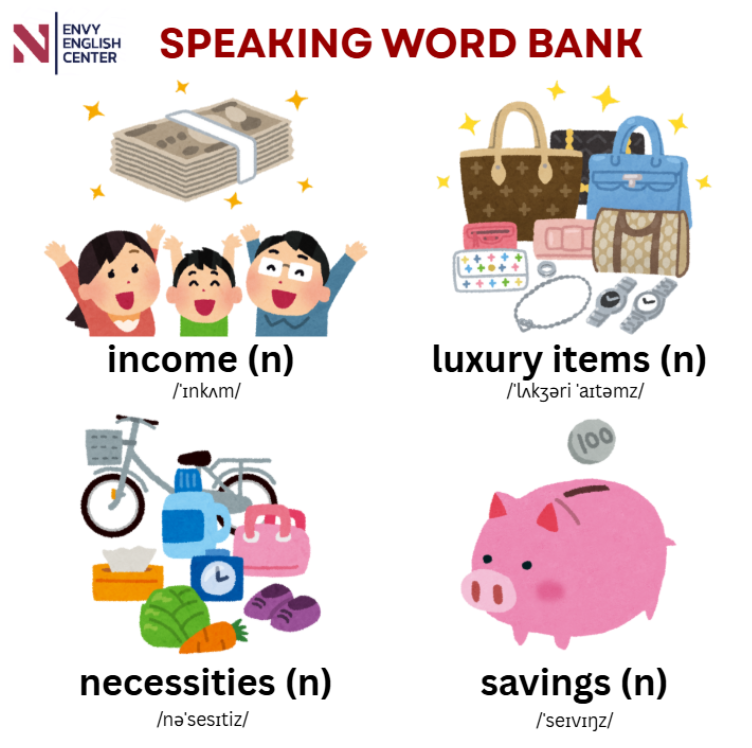
income (n): thu nhập
e.g: my monthly income is enough to cover my basic needs.
salary (n): lương
e.g: he negotiated a higher salary after receiving a job offer.
wages (n): tiền công
e.g: daily wages are common in casual labor jobs.
earnings (n): thu nhập kiếm được
e.g: online businesses can generate substantial earnings.
expenditure (n): chi tiêu
e.g: careful planning helps control monthly expenditure.
spending habit (n): thói quen chi tiêu
e.g: developing responsible spending habits is essential.
necessities (n): những thứ cần thiết
e.g: most people prioritize necessities over luxuries.
luxury items (n): hàng xa xỉ
e.g: he occasionally buys luxury items for special occasions.
budget (n/v): ngân sách; lập ngân sách
e.g: i always budget my expenses to avoid overspending.
savings (n): tiền tiết kiệm
e.g: building savings is important for future security.
2. Ngân hàng & phương tiện thanh toán
(Banking & payment methods)
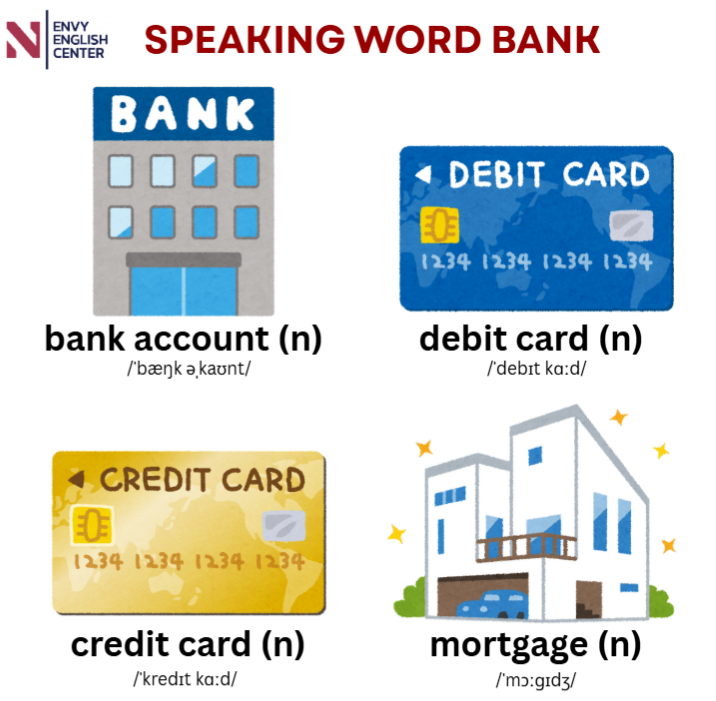
bank account (n): tài khoản ngân hàng
e.g: opening a bank account is essential for managing finances.
credit card (n): thẻ tín dụng
e.g: using a credit card wisely can help build a good credit history.
debit card (n): thẻ ghi nợ
e.g: i prefer using my debit card for everyday purchases.
online banking (n): ngân hàng trực tuyến
e.g: online banking makes transactions faster and more convenient.
mobile payment (n): thanh toán qua điện thoại
e.g: mobile payment is increasingly popular among young adults.
interest rate (n): lãi suất
e.g: high-interest rates can affect loan repayments significantly.
loan (n): khoản vay
e.g: many students take out a loan to fund their education.
mortgage (n): thế chấp
e.g: a mortgage allows people to buy a house without paying all at once.
atm (n): máy rút tiền
e.g: i withdrew cash from the atm nearby.
transaction fee (n): phí giao dịch
e.g: some banks charge a small transaction fee for international transfers.
3. Đầu tư & quản lý tài chính
(Investment & financial management)
invest (v): đầu tư
e.g: many people invest in stocks to increase their wealth.
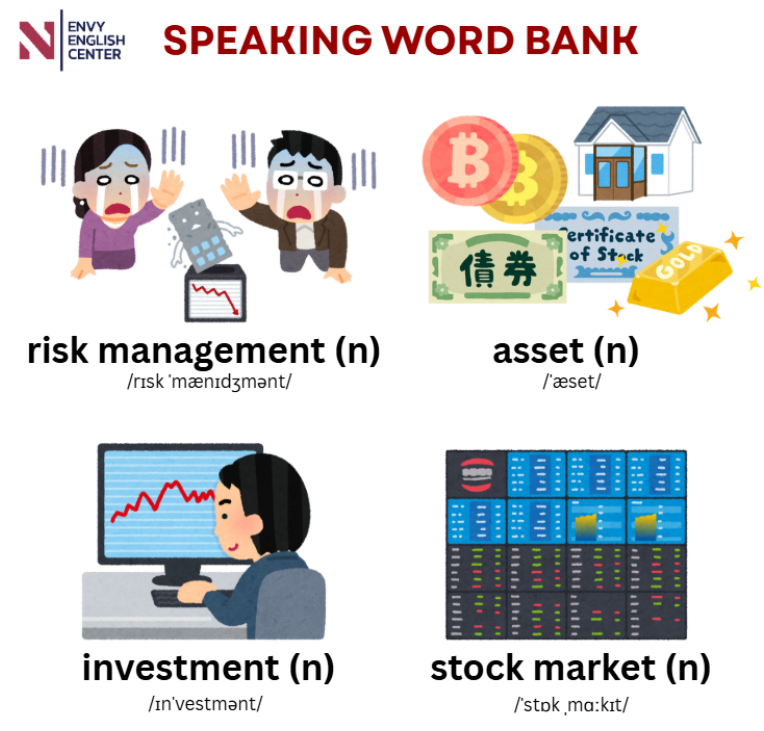
investment (n): khoản đầu tư
e.g: diversifying investments reduces financial risks.
asset (n): tài sản
e.g: property is considered a valuable asset.
liability (n): khoản nợ, trách nhiệm tài chính
e.g: excessive liabilities can lead to financial stress.
portfolio (n): danh mục đầu tư
e.g: a balanced portfolio is key to long-term growth.
financial planning (n): kế hoạch tài chính
e.g: financial planning helps achieve future goals.
return on investment (roi) (n): lợi nhuận đầu tư
e.g: high roi attracts more investors.
dividend (n): cổ tức
e.g: shareholders receive dividends based on profits.
stock market (n): thị trường chứng khoán
e.g: the stock market can be unpredictable but rewarding.
risk management (n): quản lý rủi ro
e.g: effective risk management is crucial in investments.
4. Thái độ đối với tiền (Attitudes)
financially secure (adj): an toàn về tài chính
e.g: being financially secure reduces stress in daily life.
wealthy (adj): giàu có
e.g: some people aim to become wealthy through smart investments.
frugal (adj): tiết kiệm
e.g: frugal habits help accumulate savings over time.
extravagant (adj): phung phí
e.g: extravagant spending can lead to debt problems.
debt-free (adj): không nợ nần
e.g: being debt-free gives a sense of relief.
financially independent (adj): độc lập tài chính
e.g: achieving financial independence is a long-term goal.
pressured (adj): chịu áp lực
e.g: young adults often feel pressured to earn more money.
content (adj): hài lòng
e.g: some people are content with a modest income.
anxious (adj): lo lắng
e.g: financial instability makes many feel anxious.
motivated (adj): có động lực
e.g: saving money motivates me to plan ahead.
5. Xu hướng tài chính (Financial trends)
money management (n): quản lý tiền bạc
e.g: good money management is essential for long-term stability.
financial literacy (n): kiến thức tài chính
e.g: financial literacy should be taught from a young age.
save for the future (v.phr): tiết kiệm cho tương lai
e.g: many people save for the future to buy a house or start a family.
spending priorities (n): ưu tiên chi tiêu
e.g: everyone has different spending priorities.
economic stability (n): sự ổn định kinh tế
e.g: economic stability affects personal finance decisions.
emergency fund (n): quỹ dự phòng
e.g: having an emergency fund is a wise financial habit.
financial goal (n): mục tiêu tài chính
e.g: setting a financial goal helps track progress.
peer pressure (n): áp lực bạn bè
e.g: peer pressure can influence spending habits.
money-saving strategy (n): chiến lược tiết kiệm
e.g: using coupons is a common money-saving strategy.
long-term investment (n): đầu tư dài hạn
e.g: real estate is often seen as a long-term investment.
Nếu bạn đang bắt đầu từ con số 0 hoặc đã học nhưng “dậm chân tại chỗ”, Envy English Center có thể đồng hành cùng bạn:
Test trình độ miễn phí theo format IELTS để biết chính xác điểm mạnh – điểm yếu.
Nhận lộ trình học cá nhân hóa từ 0 → 6.5+, phù hợp tốc độ và mục tiêu.
Trực tiếp học với giáo viên IELTS 8.0+, chuyên “gỡ rối” Speaking & Writing – hai kỹ năng khó nâng band nhất.
Đặc biệt, khi đăng ký trong tuần này, bạn được tặng bộ từ vựng chuẩn IELTS band 7+.
📞 Hotline: 028 7300 9677 / 0948 197 270 (Zalo)
🌐 Website: envyenglish.vn
📍 Địa chỉ: 46/5 Tân Cảng, Phường Thạnh Mỹ Tây, Quận Bình Thạnh, TP.HCM


Thông tin gửi đi không thành công, vui lòng thử lại sau.
Nếu bạn cần liên hệ gấp, vui lòng gọi hotline
02873009677

Cảm ơn bạn đã gửi thông tin đến Envy English Center.
Chúng tôi sẽ liên hệ với bạn sớm nhất khi có thể.
Nếu bạn cần liên hệ gấp, vui lòng gọi hotline
02873009677
Thông tin gửi đi không thành công, vui lòng thử lại sau.
Nếu bạn cần liên hệ gấp, vui lòng gọi hotline
02873009677
Bạn đang có một bài test chưa hoàn thành.
Bạn có muốn tiếp tục bài test đó không?
Bạn có chắc là muốn gửi bài test này không?

Số câu trả lời đúng/40

Số câu trả lời đúng/40
Thông tin gửi đi không thành công, vui lòng thử lại sau.
Nếu bạn cần liên hệ gấp, vui lòng gọi hotline
02873009677
Thời gian làm bài kiểm tra đã hết.
Cảm ơn bạn đã cố gắng.
