 02873009677
 contact@envyenglish.vn

Bước 1. Hiểu đúng câu hỏi (Task Analysis)
Đọc kỹ keywords và yêu cầu: discuss both views, to what extent, advantages / disadvantages, causes/solutions…
Xác định chủ đề cốt lõi (topic), khía cạnh được hỏi (aspect), và nhiệm vụ viết (task).
Bước 2. Brainstorm có định hướng
Tự hỏi 3 câu hỏi “vàng”:
Relevance - “Ý tưởng này có đúng trọng tâm câu hỏi không?”
Balance - “Các mặt lập luận có được trình bày cân bằng không?”
Depth - “Mình đưa ra giải thích và minh họa đủ sâu chưa?”
Bước 3. Phát triển ý tưởng theo một cấu trúc nhất định - PEEL
Some people think that students should study the science of food and how to prepare it. Others believe students should spend time on important subjects. Discuss both views and give your opinion.
Step-by-step brainstorm:
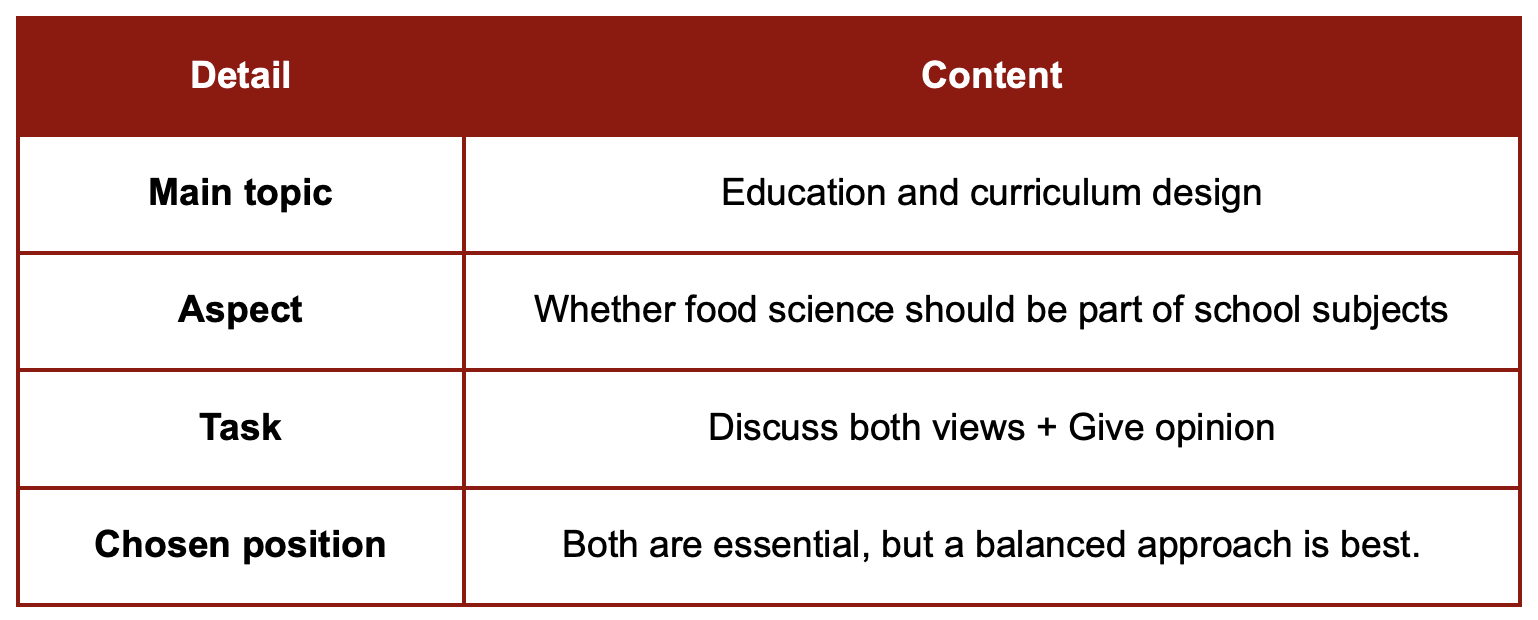
View 1 - Studying food science (việc học về khoa học thực phẩm)
Promotes health awareness and self-sufficiency.
Build practical life skills.
Encourages sustainability and responsible consumption.
View 2 - Focusing on core subjects (tập trung vào các môn học cốt lõi)
Academic subjects ensure career readiness.
School time is limited; core knowledge should be prioritized.
Sample Essay:
In contemporary education, there is a growing debate over whether schools should include food science as part of their curriculum. While traditional academic subjects play a critical role in intellectual development, I believe that teaching the science of food can equally contribute to holistic growth of students.
On the one hand, subjects such as mathematics, science, and languages remain fundamental to academic and professional success. Specifically, these disciplines cultivate analytical thinking and communication skills that are indispensable in most careers. For instance, mathematical reasoning enhances logical decision-making, while language proficiency improves collaboration and adaptability in international work environments. Therefore, focusing on core disciplines ensures students gain intellectual depth and transferable skills that serve them throughout their professional lives.
On the other hand, food education offers lifelong benefits that extend beyond academics. Understanding nutrition enables students to make informed dietary choices, which can reduce the prevalence of obesity and other lifestyle diseases. For example, countries that integrate food science into their school curricula, such as Japan, report lower obesity rates and higher awareness of sustainable eating habits among youth. Thus, incorporating food education not only supports individual well-being but also fosters a generation that is more responsible and self-reliant.
In conclusion, while academic excellence is essential, schools should also equip students with practical life knowledge. A well-rounded curriculum that integrates both intellectual and life skills would prepare students more effectively for adulthood.
Nếu bạn đang bắt đầu từ con số 0 hoặc đã học nhưng “dậm chân tại chỗ”, Envy English Center có thể đồng hành cùng bạn:
📞 Hotline: 028 7300 9677 / 0948 197 270 (Zalo)
🌐 Website: envyenglish.vn
📍 Địa chỉ: 46/5 Tân Cảng, Phường Thạnh Mỹ Tây, Quận Bình Thạnh, TP.HCM

Thông tin gửi đi không thành công, vui lòng thử lại sau.
Nếu bạn cần liên hệ gấp, vui lòng gọi hotline
02873009677

Cảm ơn bạn đã gửi thông tin đến Envy English Center.
Chúng tôi sẽ liên hệ với bạn sớm nhất khi có thể.
Nếu bạn cần liên hệ gấp, vui lòng gọi hotline
02873009677
Thông tin gửi đi không thành công, vui lòng thử lại sau.
Nếu bạn cần liên hệ gấp, vui lòng gọi hotline
02873009677
Bạn đang có một bài test chưa hoàn thành.
Bạn có muốn tiếp tục bài test đó không?
Bạn có chắc là muốn gửi bài test này không?

Số câu trả lời đúng/40

Số câu trả lời đúng/40
Thông tin gửi đi không thành công, vui lòng thử lại sau.
Nếu bạn cần liên hệ gấp, vui lòng gọi hotline
02873009677
Thời gian làm bài kiểm tra đã hết.
Cảm ơn bạn đã cố gắng.
