 02873009677
 contact@envyenglish.vn

Đề bài
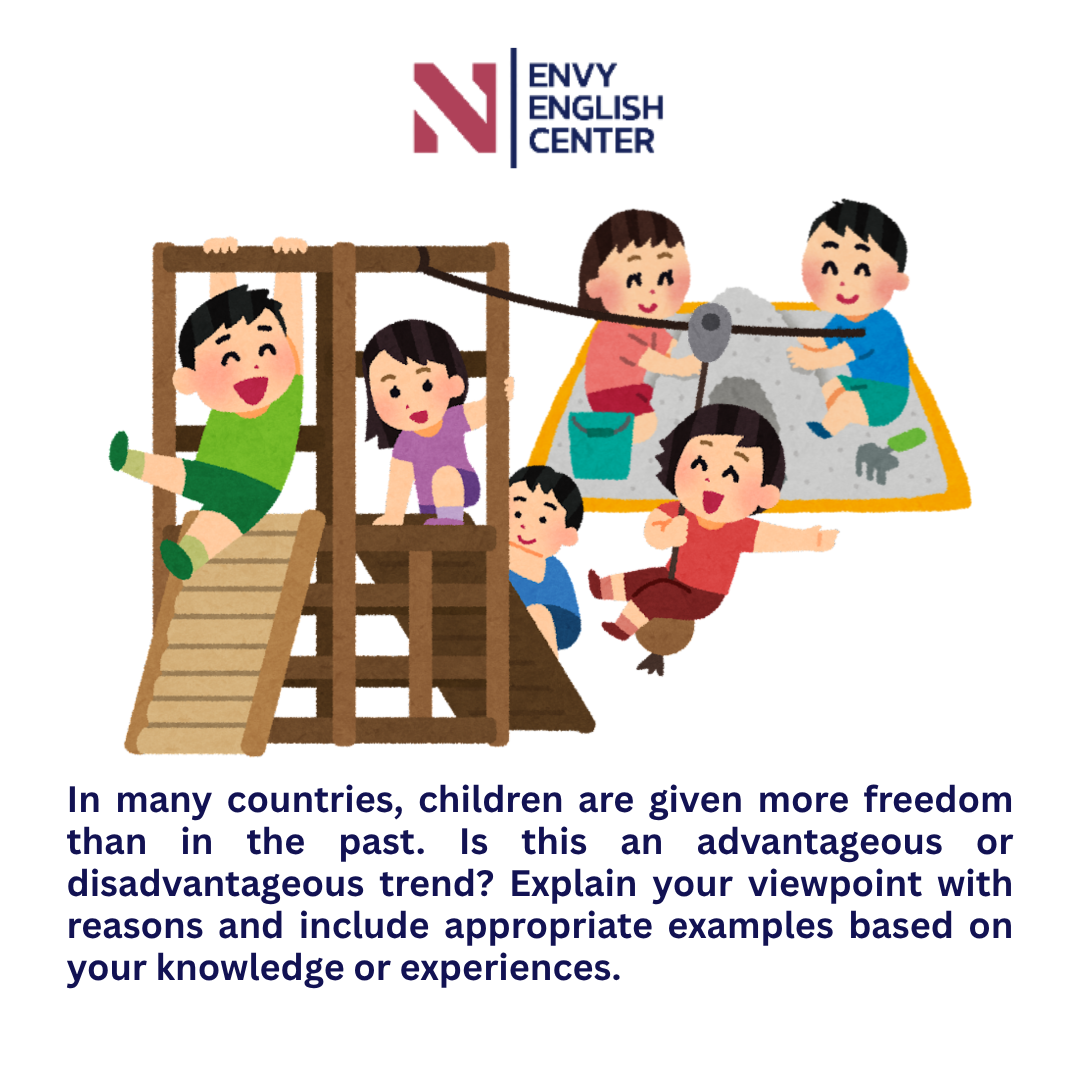
In many countries, children are given more freedom than in the past. Is this an advantageous or disadvantageous trend? Explain your viewpoint with reasons and include appropriate examples based on your knowledge or experiences
.
Dạng bài
Advantages and disadvantages essay
Xác định chủ đề và luận điểm
Topic: Children’s Freedom and Parenting Styles
Luận điểm 1: Advantages of giving children more freedom
Development of independence: phát triển tính tự lập
Improved decision-making skills: cải thiện kỹ năng ra quyết định
Greater self-confidence: tăng sự tự tin
Encouragement of creativity: khuyến khích sự sáng tạo
Better communication abilities: khả năng giao tiếp tốt hơn
Preparation for adult life: chuẩn bị cho cuộc sống trưởng thành
Stronger sense of responsibility: ý thức trách nhiệm cao hơn
Luận điểm 2: Disadvantages of excessive freedom
Lack of discipline: thiếu tính kỷ luật
Increased exposure to harmful influences: tăng tiếp xúc với ảnh hưởng tiêu cực
Addiction to technology and social media: nghiện công nghệ và mạng xã hội
Poor academic focus: giảm tập trung học tập
Risky behavior among teenagers: hành vi nguy hiểm ở thanh thiếu niên
Weak parental control: sự kiểm soát yếu từ cha mẹ
Emotional and behavioral problems: vấn đề cảm xúc và hành vi
Triển khai ý tưởng
Position 1
Although giving children greater freedom can help them become more independent and confident, I believe excessive freedom may create behavioral and academic problems if parents do not provide proper guidance.
→ Mặc dù cho trẻ em nhiều tự do hơn có thể giúp chúng trở nên tự lập và tự tin hơn, tôi tin rằng quá nhiều tự do có thể gây ra các vấn đề về hành vi và học tập nếu cha mẹ không đưa ra định hướng phù hợp.
Ví dụ:
Teenagers spending excessive time on social media
Children learning responsibility through part-time work
Position 2
This is largely a positive trend because children who are encouraged to make decisions independently are often better prepared for adulthood.
→ Đây chủ yếu là xu hướng tích cực vì trẻ em được khuyến khích tự đưa ra quyết định thường chuẩn bị tốt hơn cho cuộc sống trưởng thành.
Ví dụ:
Students managing personal schedules
Young people developing communication skills
Introduction
Paraphrase: children today are allowed greater freedom than previous generations
Question: whether this development is beneficial or harmful
Thesis: although increased freedom can help children develop independence and confidence, excessive freedom without parental guidance may create serious negative consequences
Body Paragraph 1
Point: greater freedom helps children develop important life skills
Evidence: independent decision-making, creativity, confidence, communication skills
Explanation: children learn responsibility by solving problems themselves
Link: controlled freedom prepares children for adulthood
Body Paragraph 2
Point: excessive freedom may negatively affect children’s behavior and education
Evidence: social media addiction, weak discipline, risky behavior, poor academic performance
Explanation: children still require supervision and guidance from parents
Link: freedom without boundaries can lead to harmful outcomes
Conclusion
Summary: children benefit from certain levels of freedom but still need parental guidance
Restate: this trend is positive only when freedom is balanced with discipline and supervision
In many modern societies, children are now allowed far more freedom than previous generations. While this development can help young people become more independent and confident, I believe it may also create negative consequences if children are given too much freedom without proper parental guidance.
One major advantage of increased freedom is the development of independence among children. Young people who are encouraged to make their own choices often improve their decision-making skills and become more capable of solving problems on their own. This can also lead to greater self-confidence, as children learn to trust their own judgment and abilities. Furthermore, giving children more freedom may encourage creativity and improve their communication abilities because they are more willing to express their opinions openly. In many cases, this freedom provides valuable preparation for adult life by helping young people develop a stronger sense of responsibility. For example, teenagers who manage part-time jobs or organize their own schedules often become more mature and self-disciplined.
However, excessive freedom can also create serious problems. One concern is the lack of discipline that may develop when parents place very few restrictions on children’s behavior. Many teenagers today experience addiction to technology and social media, which can reduce concentration and contribute to poor academic focus. In addition, children who receive little supervision may become more vulnerable to harmful influences and engage in risky behavior among teenagers, including smoking, drinking, or dangerous online activities. Weak parental control can also contribute to emotional and behavioral problems, especially when children struggle to understand boundaries and responsibilities. Without proper guidance, freedom may become harmful rather than beneficial.
Overall, I believe giving children a reasonable amount of freedom is a positive development because it encourages independence and responsibility. However, this freedom should always be balanced with parental supervision and clear limits.
(Word count: 315)
New Vocabulary
development of independence (noun phrase): phát triển tính tự lập
E.g. Parents should encourage the development of independence in children.
improved decision-making skills (noun phrase): cải thiện kỹ năng ra quyết định
E.g. Part-time work can lead to improved decision-making skills.
greater self-confidence (noun phrase): tăng sự tự tin
E.g. Public speaking helps students build greater self-confidence.
encouragement of creativity (noun phrase): khuyến khích sự sáng tạo
E.g. Schools should focus on the encouragement of creativity.
better communication abilities (noun phrase): khả năng giao tiếp tốt hơn
E.g. Group projects improve better communication abilities.
preparation for adult life (noun phrase): chuẩn bị cho cuộc sống trưởng thành
E.g. Financial education supports preparation for adult life.
stronger sense of responsibility (noun phrase): ý thức trách nhiệm cao hơn
E.g. Household chores develop a stronger sense of responsibility.
lack of discipline (noun phrase): thiếu tính kỷ luật
E.g. Excessive freedom may cause a lack of discipline.
increased exposure to harmful influences (noun phrase): tăng tiếp xúc với ảnh hưởng tiêu cực
E.g. Social media creates increased exposure to harmful influences.
addiction to technology and social media (noun phrase): nghiện công nghệ và mạng xã hội
E.g. Many parents worry about addiction to technology and social media.
poor academic focus (noun phrase): giảm tập trung học tập
E.g. Video games may contribute to poor academic focus.
risky behavior among teenagers (noun phrase): hành vi nguy hiểm ở thanh thiếu niên
E.g. Lack of supervision can increase risky behavior among teenagers.
weak parental control (noun phrase): sự kiểm soát yếu từ cha mẹ
E.g. Some social problems result from weak parental control.
emotional and behavioral problems (noun phrase): vấn đề cảm xúc và hành vi
E.g. Stress may lead to emotional and behavioral problems.
proper parental guidance (noun phrase): định hướng phù hợp từ cha mẹ
E.g. Children require proper parental guidance.
modern societies (noun phrase): xã hội hiện đại
E.g. Technology strongly influences modern societies.
problem-solving abilities (noun phrase): khả năng giải quyết vấn đề
E.g. Teamwork develops problem-solving abilities.
part-time jobs (noun phrase): công việc bán thời gian
E.g. Many students take part-time jobs during university.
harmful influences (noun phrase): ảnh hưởng tiêu cực
E.g. Parents should protect children from harmful influences.
clear limits (noun phrase): giới hạn rõ ràng
E.g. Children should grow up with clear limits.
Sentence Structures
1. While + clause, I believe + clause if + clause (dùng để nêu quan điểm cân bằng)
E.g. While this development can help young people become more independent and confident, I believe it may also create negative consequences if children are given too much freedom without proper parental guidance.
2. One major advantage of + noun phrase + is + noun phrase (dùng để mở đoạn nêu lợi ích)
E.g. One major advantage of increased freedom is the development of independence among children.
3. This can also lead to + noun phrase, as + clause (dùng để giải thích kết quả tích cực)
E.g. This can also lead to greater self-confidence, as children learn to trust their own judgment and abilities.
4. In many cases, + noun phrase + provides + noun phrase + by + V-ing (dùng để giải thích tác động lâu dài)
E.g. In many cases, this freedom provides valuable preparation for adult life by helping young people develop a stronger sense of responsibility.
5. One concern is + noun phrase + that may develop when + clause (dùng để trình bày tác hại)
E.g. One concern is the lack of discipline that may develop when parents place very few restrictions on children’s behavior.
6. Overall, I believe + clause because + clause. However, + clause (dùng để kết luận với lập trường rõ ràng)
E.g. Overall, I believe giving children a reasonable amount of freedom is a positive development because it encourages independence and responsibility. However, this freedom should always be balanced with parental supervision and clear limits.

Thông tin gửi đi không thành công, vui lòng thử lại sau.
Nếu bạn cần liên hệ gấp, vui lòng gọi hotline
02873009677

Cảm ơn bạn đã gửi thông tin đến Envy English Center.
Chúng tôi sẽ liên hệ với bạn sớm nhất khi có thể.
Nếu bạn cần liên hệ gấp, vui lòng gọi hotline
02873009677
Thông tin gửi đi không thành công, vui lòng thử lại sau.
Nếu bạn cần liên hệ gấp, vui lòng gọi hotline
02873009677
Bạn đang có một bài test chưa hoàn thành.
Bạn có muốn tiếp tục bài test đó không?
Bạn có chắc là muốn gửi bài test này không?

Số câu trả lời đúng/40

Số câu trả lời đúng/40
Thông tin gửi đi không thành công, vui lòng thử lại sau.
Nếu bạn cần liên hệ gấp, vui lòng gọi hotline
02873009677
Thời gian làm bài kiểm tra đã hết.
Cảm ơn bạn đã cố gắng.
