 02873009677
 contact@envyenglish.vn

1. Xây dựng ý tưởng
Đề bài
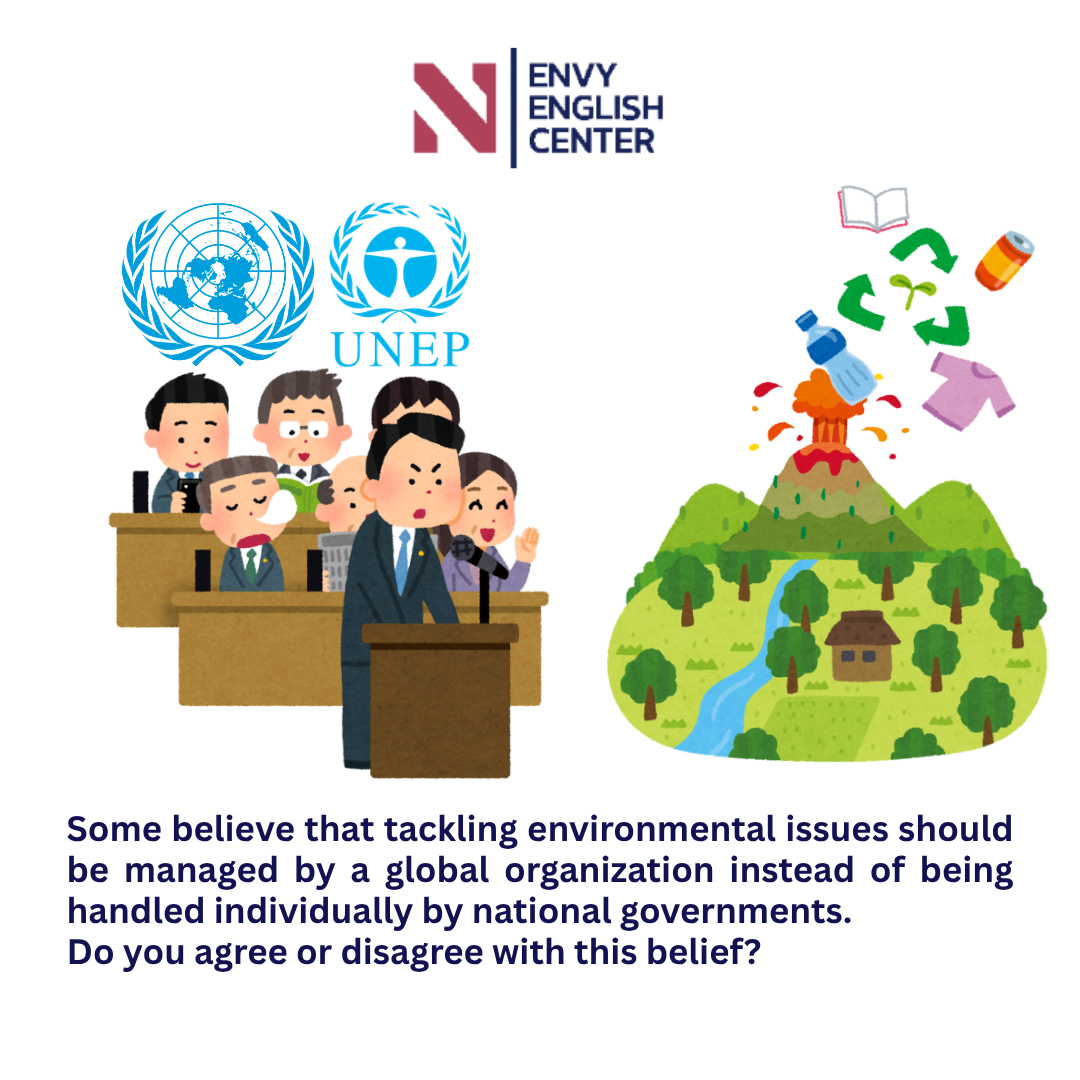
Some believe that tackling environmental issues should be managed by a global organization instead of being handled individually by national governments. Do you agree or disagree with this belief?
Dạng bài
Agree or disagree essay
Xác định chủ đề và luận điểm
Topic: Global Environmental Governance
Luận điểm 1: Reasons supporting global environmental management
International cooperation: hợp tác quốc tế
Cross-border pollution control: kiểm soát ô nhiễm xuyên biên giới
Unified environmental policies: chính sách môi trường thống nhất
Global climate action: hành động khí hậu toàn cầu
Resource-sharing efficiency: hiệu quả chia sẻ tài nguyên
Scientific collaboration: hợp tác khoa học
Stronger international enforcement: thực thi quốc tế mạnh mẽ hơn
Luận điểm 2: Reasons supporting national responsibility
Country-specific environmental conditions: điều kiện môi trường riêng của từng quốc gia
National sovereignty: chủ quyền quốc gia
Faster policy implementation: triển khai chính sách nhanh hơn
Economic development priorities: ưu tiên phát triển kinh tế
Local environmental knowledge: hiểu biết môi trường địa phương
Political independence: tính độc lập chính trị
Administrative flexibility: tính linh hoạt hành chính
Triển khai ý tưởng
Position 1
I strongly agree that environmental problems should be addressed through global organizations because many ecological issues affect multiple countries and require coordinated international action.
→ Tôi hoàn toàn đồng ý rằng các vấn đề môi trường nên được giải quyết thông qua các tổ chức toàn cầu vì nhiều vấn đề sinh thái ảnh hưởng đến nhiều quốc gia và cần hành động phối hợp quốc tế.
Ví dụ:
The Paris Climate Agreement
International carbon reduction targets
Position 2
Although international cooperation is important, national governments should remain primarily responsible because they better understand local environmental and economic conditions.
→ Mặc dù hợp tác quốc tế là quan trọng, các chính phủ quốc gia vẫn nên giữ vai trò chính vì họ hiểu rõ điều kiện môi trường và kinh tế địa phương hơn.
Ví dụ:
National forest protection laws
Country-specific pollution controls
2. Lập dàn ý cho đề theo PEEL
Introduction
Paraphrase: some people believe environmental issues should be managed globally rather than nationally
Question: whether global organizations should take primary responsibility
Thesis: although national governments remain important, global organizations are more effective for addressing large-scale environmental problems
Body Paragraph 1
Point: environmental problems require international cooperation
Evidence: climate change, ocean pollution, carbon emissions, shared ecosystems
Explanation: environmental damage crosses national borders and requires coordinated action
Link: global organizations can create unified environmental strategies
Body Paragraph 2
Point: national governments still play an important supporting role
Evidence: local laws, enforcement systems, country-specific conditions, economic priorities
Explanation: domestic policies are necessary for effective implementation
Link: cooperation between global and national institutions is essential
Conclusion
Summary: environmental protection requires both international and national action
Restate: global organizations should lead large-scale environmental efforts
3. Bài mẫu hoàn chỉnh
Environmental problems such as climate change, air pollution, and deforestation have become increasingly serious in recent decades. Some people believe these issues should be managed primarily by international organizations rather than individual governments. I largely agree with this view because many environmental challenges are global in nature and require coordinated international action.
One major reason why environmental protection should involve international cooperation is that many ecological problems extend beyond national borders. For example, carbon emissions produced in one country can contribute to global warming worldwide, making cross-border pollution control essential. Similarly, ocean pollution and deforestation often affect international ecosystems rather than isolated regions. A global organization could establish unified environmental policies and coordinate global climate action more effectively than individual governments acting independently. In addition, international institutions can improve resource-sharing efficiency by providing financial support, environmental technology, and scientific research to developing countries. Greater scientific collaboration may also accelerate the development of cleaner energy solutions and sustainable industrial practices. Furthermore, stronger international agreements could create stronger international enforcement against countries that ignore environmental responsibilities.
However, national governments should still play an important role in environmental management. Different countries face unique environmental and economic conditions, meaning that country-specific environmental conditions must be considered when implementing policies. National authorities are also better equipped to enforce local laws and respond quickly to domestic environmental problems. Moreover, issues such as national sovereignty and economic development priorities may make some countries unwilling to accept complete external control over environmental decision-making. Therefore, global organizations should cooperate closely with national governments rather than replace them entirely.
Overall, although national governments remain essential for policy implementation, I believe global organizations should take the leading role in addressing major environmental issues because international cooperation is necessary for solving problems that affect the entire planet.
(Word count: 317)
4. Lexical Resources List
New Vocabulary
international cooperation (noun phrase): hợp tác quốc tế
E.g. Climate change requires strong international cooperation.
cross-border pollution control (noun phrase): kiểm soát ô nhiễm xuyên biên giới
E.g. Neighboring countries often cooperate on cross-border pollution control.
unified environmental policies (noun phrase): chính sách môi trường thống nhất
E.g. International organizations encourage unified environmental policies.
global climate action (noun phrase): hành động khí hậu toàn cầu
E.g. Many nations support stronger global climate action.
resource-sharing efficiency (noun phrase): hiệu quả chia sẻ tài nguyên
E.g. Technology improves resource-sharing efficiency.
scientific collaboration (noun phrase): hợp tác khoa học
E.g. Medical progress often depends on scientific collaboration.
stronger international enforcement (noun phrase): thực thi quốc tế mạnh mẽ hơn
E.g. Environmental agreements require stronger international enforcement.
country-specific environmental conditions (noun phrase): điều kiện môi trường riêng của từng quốc gia
E.g. Policymakers must consider country-specific environmental conditions.
national sovereignty (noun phrase): chủ quyền quốc gia
E.g. Governments are often protective of national sovereignty.
economic development priorities (noun phrase): ưu tiên phát triển kinh tế
E.g. Developing countries may focus on economic development priorities.
local environmental knowledge (noun phrase): hiểu biết môi trường địa phương
E.g. Farmers often possess valuable local environmental knowledge.
political independence (noun phrase): tính độc lập chính trị
E.g. Some countries highly value political independence.
administrative flexibility (noun phrase): tính linh hoạt hành chính
E.g. Local governments often require greater administrative flexibility.
global warming (noun phrase): sự nóng lên toàn cầu
E.g. Scientists warn about the effects of global warming.
international ecosystems (noun phrase): hệ sinh thái quốc tế
E.g. Marine pollution damages international ecosystems.
financial support (noun phrase): hỗ trợ tài chính
E.g. Poorer countries may require financial support for green projects.
cleaner energy solutions (noun phrase): giải pháp năng lượng sạch hơn
E.g. Researchers continue developing cleaner energy solutions.
sustainable industrial practices (noun phrase): hoạt động công nghiệp bền vững
E.g. Companies are adopting sustainable industrial practices.
domestic environmental problems (noun phrase): vấn đề môi trường trong nước
E.g. Governments must respond quickly to domestic environmental problems.
environmental decision-making (noun phrase): quá trình ra quyết định về môi trường
E.g. Public opinion can influence environmental decision-making.
Sentence Structures
1. I largely agree with + noun phrase because + clause (dùng để khẳng định lập trường rõ ràng trong mở bài)
E.g. I largely agree with this view because many environmental challenges are global in nature and require coordinated international action.
2. One major reason why + noun phrase + should + verb + is that + clause (dùng để mở đoạn giải thích nguyên nhân)
E.g. One major reason why environmental protection should involve international cooperation is that many ecological problems extend beyond national borders.
3. A global organization could + verb + more effectively than + noun phrase (dùng để so sánh hiệu quả quản lý)
E.g. A global organization could establish unified environmental policies and coordinate global climate action more effectively than individual governments acting independently.
4. In addition, + noun phrase + can improve + noun phrase + by + gerund phrase (dùng để bổ sung lợi ích cụ thể)
E.g. In addition, international institutions can improve resource-sharing efficiency by providing financial support, environmental technology, and scientific research to developing countries.
5. However, + noun phrase + should still play + noun phrase + in + noun phrase (dùng để chuyển sang luận điểm đối lập)
E.g. However, national governments should still play an important role in environmental management.
6. Overall, although + clause, I believe + clause because + clause (dùng để kết luận với lập trường nhất quán)
E.g. Overall, although national governments remain essential for policy implementation, I believe global organizations should take the leading role in addressing major environmental issues because international cooperation is necessary for solving problems that affect the entire planet.
Nếu bạn đang bắt đầu từ con số 0 hoặc đã học nhưng “dậm chân tại chỗ”, Envy English Center có thể đồng hành cùng bạn:
Test trình độ miễn phí theo format IELTS để biết chính xác điểm mạnh – điểm yếu.
Nhận lộ trình học cá nhân hóa từ 0 → 6.5+, phù hợp tốc độ và mục tiêu.
Trực tiếp học với giáo viên IELTS 8.0+, chuyên “gỡ rối” Speaking & Writing – hai kỹ năng khó nâng band nhất.
Đặc biệt, khi đăng ký trong tuần này, bạn được tặng bộ từ vựng chuẩn IELTS band 7+.
📞 Hotline: 028 7300 9677 / 0948 197 270 (Zalo)
🌐 Website: envyenglish.vn
📍 Địa chỉ: 46/5 Tân Cảng, Phường Thạnh Mỹ Tây, Quận Bình Thạnh, TP.HCM


Thông tin gửi đi không thành công, vui lòng thử lại sau.
Nếu bạn cần liên hệ gấp, vui lòng gọi hotline
02873009677

Cảm ơn bạn đã gửi thông tin đến Envy English Center.
Chúng tôi sẽ liên hệ với bạn sớm nhất khi có thể.
Nếu bạn cần liên hệ gấp, vui lòng gọi hotline
02873009677
Thông tin gửi đi không thành công, vui lòng thử lại sau.
Nếu bạn cần liên hệ gấp, vui lòng gọi hotline
02873009677
Bạn đang có một bài test chưa hoàn thành.
Bạn có muốn tiếp tục bài test đó không?
Bạn có chắc là muốn gửi bài test này không?

Số câu trả lời đúng/40

Số câu trả lời đúng/40
Thông tin gửi đi không thành công, vui lòng thử lại sau.
Nếu bạn cần liên hệ gấp, vui lòng gọi hotline
02873009677
Thời gian làm bài kiểm tra đã hết.
Cảm ơn bạn đã cố gắng.
