 02873009677
 contact@envyenglish.vn

1. Phân tích đề và nhóm số liệu
Đề bài
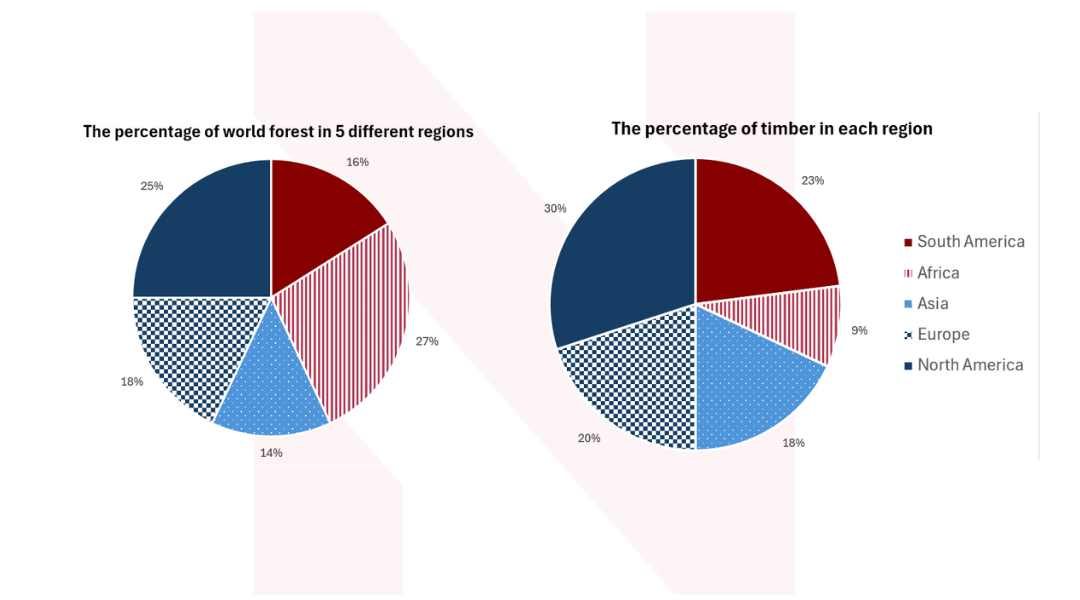
The pie charts provide data on the proportion of the world's forests in five different regions and the proportion of timber found in each region.
Dạng biểu đồ
Pie Charts (Static Comparison)
Xác định đặc điểm tổng quan (Overview Features)
Đặc điểm nổi bật 1: Châu Phi chiếm tỷ lệ diện tích rừng lớn nhất, trong khi Châu Á có tỷ lệ thấp nhất.
Đặc điểm nổi bật 2: Bắc Mỹ sở hữu tỷ lệ gỗ lớn nhất, còn Châu Phi có tỷ lệ gỗ thấp nhất, cho thấy diện tích rừng không phản ánh trực tiếp lượng gỗ.
Chia nhóm dữ liệu cho các đoạn Thân bài (Data Grouping)
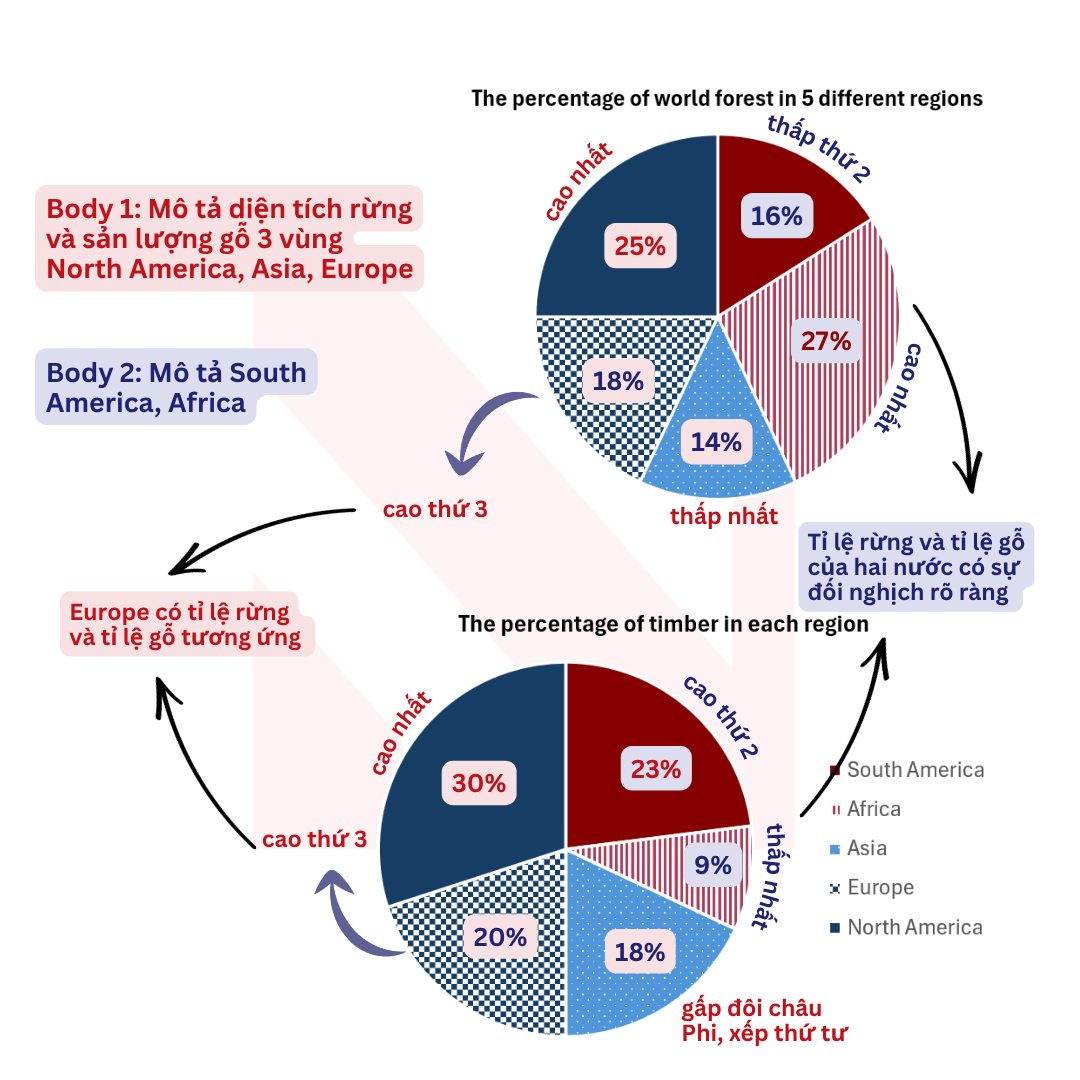
Body 1 Grouping: Những khu vực có tỷ lệ rừng và tỷ lệ gỗ tương đối đồng nhất
Ý 1: Châu Âu
Ý 2: Bắc Mỹ
Ý 3: Châu Á
Body 2 Grouping: Những khu vực có sự chênh lệch lớn giữa tỷ lệ rừng và tỷ lệ gỗ
Ý 1: Châu Phi
Ý 2: Nam Mỹ
Triển khai phân tích
Mở bài (Paraphrase)
The pie charts compare the distribution of the world's forests across five regions with the proportion of global timber found in each of these areas.
(Tạm dịch: Hai biểu đồ tròn so sánh sự phân bố diện tích rừng trên thế giới ở năm khu vực với tỷ lệ trữ lượng gỗ tương ứng của từng khu vực.)
Tóm tắt tổng quan (Overview)
Overall, Africa contained the largest share of the world's forests, whereas Asia had the smallest. However, North America accounted for the highest proportion of timber, suggesting that forest area did not necessarily correspond to timber resources.
(Tạm dịch: Nhìn chung, Châu Phi sở hữu tỷ lệ diện tích rừng lớn nhất thế giới, trong khi Châu Á có tỷ lệ thấp nhất. Tuy nhiên, Bắc Mỹ lại chiếm tỷ trọng gỗ cao nhất, cho thấy diện tích rừng không nhất thiết phản ánh lượng gỗ.)
2. Lập dàn ý chi tiết cho bài viết
Introduction
Paraphrase lại đề bài bằng cách thay thế provide data on → compare, proportion → share/distribution, found in → contained in.
Overview
Xu hướng chung:
Châu Phi có tỷ lệ diện tích rừng lớn nhất, còn Châu Á thấp nhất.
Bắc Mỹ dẫn đầu về tỷ lệ gỗ, trong khi Châu Phi đứng cuối.
Tỷ lệ diện tích rừng và tỷ lệ gỗ không phải lúc nào cũng tương ứng.
Body Paragraph 1
Trật tự sắp xếp: Châu Âu → Bắc Mỹ → Châu Á.
Topic sentence: Ba khu vực này nhìn chung thể hiện mối quan hệ khá tương đồng giữa tỷ lệ diện tích rừng và tỷ lệ gỗ.
Detail 1: Châu Âu chiếm 18% diện tích rừng và 20% lượng gỗ, đều nằm ở nhóm trung bình.
Detail 2: Bắc Mỹ sở hữu 25% diện tích rừng (lớn thứ hai) nhưng dẫn đầu về lượng gỗ với 30%.
Detail 3: Châu Á có tỷ lệ rừng thấp nhất (14%) và cũng chỉ chiếm 18% lượng gỗ.
Body Paragraph 2
Trật tự sắp xếp: Châu Phi → Nam Mỹ.
Topic sentence: Trái lại, hai khu vực này cho thấy sự khác biệt rõ rệt giữa diện tích rừng và lượng gỗ.
Detail 1: Châu Phi có tỷ lệ rừng lớn nhất (27%) nhưng chỉ đóng góp 9% lượng gỗ, thấp nhất trong năm khu vực.
Detail 2: Nam Mỹ chỉ chiếm 16% diện tích rừng nhưng lại sở hữu 23% lượng gỗ, đứng thứ hai sau Bắc Mỹ.
3. Bài mẫu hoàn chỉnh
The pie charts compare the distribution of the world's forests across five regions with the proportion of global timber found in each of these areas.
Overall, Africa contained the largest share of the world's forests, whereas Asia had the smallest. By contrast, North America accounted for the highest percentage of timber, while Africa ranked last in this category. This suggests that the extent of forest cover was not always associated with the amount of timber available.
Europe showed a relatively balanced pattern, accounting for 18% of global forests and 20% of timber. Likewise, North America possessed the second-largest forest area at 25% but contributed the greatest proportion of timber, at 30%. Asia had the smallest share of forests, at 14%, and also recorded a relatively low timber figure of 18%.
In contrast, Africa displayed the most noticeable difference between the two measurements. Although it contained the largest proportion of forests, at 27%, it accounted for only 9% of the world's timber, the lowest figure overall. South America showed the opposite trend, with just 16% of forest area but 23% of global timber, making it the second-largest contributor to timber resources.
(Word count: 173)
4. Lexical Resources List
New Vocabulary
distribution (noun): sự phân bố
E.g. The charts compare the distribution of forests across five regions.
proportion (noun): tỷ lệ
E.g. North America accounted for the largest proportion of timber.
account for (verb): chiếm
E.g. Europe accounted for one fifth of global timber.
forest cover (noun phrase): diện tích rừng
E.g. Africa had the largest forest cover among all regions.
timber resources (noun phrase): nguồn tài nguyên gỗ
E.g. Timber resources were concentrated in North America.
correspond to (verb): tương ứng với
E.g. Forest area did not always correspond to timber production.
relatively balanced (adjective phrase): tương đối cân bằng
E.g. Europe showed a relatively balanced distribution.
contribute (verb): đóng góp
E.g. South America contributed 23% of the world's timber.
noticeable difference (noun phrase): sự khác biệt đáng kể
E.g. Africa displayed the most noticeable difference.
by contrast (linking phrase): ngược lại
E.g. By contrast, Africa had the smallest timber proportion.
rank (verb): xếp hạng
E.g. Africa ranked last in terms of timber.
associated with (verb phrase): có liên hệ với
E.g. Forest size was not always associated with timber quantity.
Sentence Structures
The pie charts compare the distribution of + noun + across + place + with the proportion of + noun + in each region. (Dùng để mở bài cho hai biểu đồ tròn.)
E.g. The pie charts compare the distribution of the world's forests across five regions with the proportion of global timber found in each area.
Overall, + subject + accounted for the largest share of + noun, whereas + subject + had the smallest. (Dùng để viết Overview.)
E.g. Overall, Africa accounted for the largest share of forests, whereas Asia had the smallest.
Although + clause, + subject + accounted for only + percentage. (Dùng để mô tả sự tương phản.)
E.g. Although Africa contained the largest proportion of forests, it accounted for only 9% of timber.
By contrast, + subject + contributed + percentage, making it the + ranking + contributor. (Dùng để nhấn mạnh sự đối lập.)
E.g. By contrast, South America contributed 23% of global timber, making it the second-largest contributor.
This suggests that + noun + did not necessarily correspond to + noun. (Dùng để rút ra nhận xét tổng quát.)
E.g. This suggests that forest area did not necessarily correspond to timber resources.
The two figures were relatively similar, at + number + and + number + respectively. (Dùng để so sánh hai số liệu gần nhau.)
E.g. The two figures were relatively similar, at 18% and 20% respectively.
Nếu bạn đang bắt đầu từ con số 0 hoặc đã học nhưng “dậm chân tại chỗ”, Envy English Center có thể đồng hành cùng bạn:
Test trình độ miễn phí theo format IELTS để biết chính xác điểm mạnh – điểm yếu.
Nhận lộ trình học cá nhân hóa từ 0 → 6.5+, phù hợp tốc độ và mục tiêu.
Trực tiếp học với giáo viên IELTS 8.0+, chuyên “gỡ rối” Speaking & Writing – hai kỹ năng khó nâng band nhất.
Đặc biệt, khi đăng ký trong tuần này, bạn được tặng bộ từ vựng chuẩn IELTS band 7+.
📞 Hotline: 028 7300 9677 / 0948 197 270 (Zalo)
🌐 Website: envyenglish.vn
📍 Địa chỉ: 46/5 Tân Cảng, Phường Thạnh Mỹ Tây, Quận Bình Thạnh, TP.HCM


Thông tin gửi đi không thành công, vui lòng thử lại sau.
Nếu bạn cần liên hệ gấp, vui lòng gọi hotline
02873009677

Cảm ơn bạn đã gửi thông tin đến Envy English Center.
Chúng tôi sẽ liên hệ với bạn sớm nhất khi có thể.
Nếu bạn cần liên hệ gấp, vui lòng gọi hotline
02873009677
Thông tin gửi đi không thành công, vui lòng thử lại sau.
Nếu bạn cần liên hệ gấp, vui lòng gọi hotline
02873009677
Bạn đang có một bài test chưa hoàn thành.
Bạn có muốn tiếp tục bài test đó không?
Bạn có chắc là muốn gửi bài test này không?

Số câu trả lời đúng/40

Số câu trả lời đúng/40
Thông tin gửi đi không thành công, vui lòng thử lại sau.
Nếu bạn cần liên hệ gấp, vui lòng gọi hotline
02873009677
Thời gian làm bài kiểm tra đã hết.
Cảm ơn bạn đã cố gắng.
