 02873009677
 contact@envyenglish.vn


1. Phân tích đề và nhóm thông tin
Đề bài
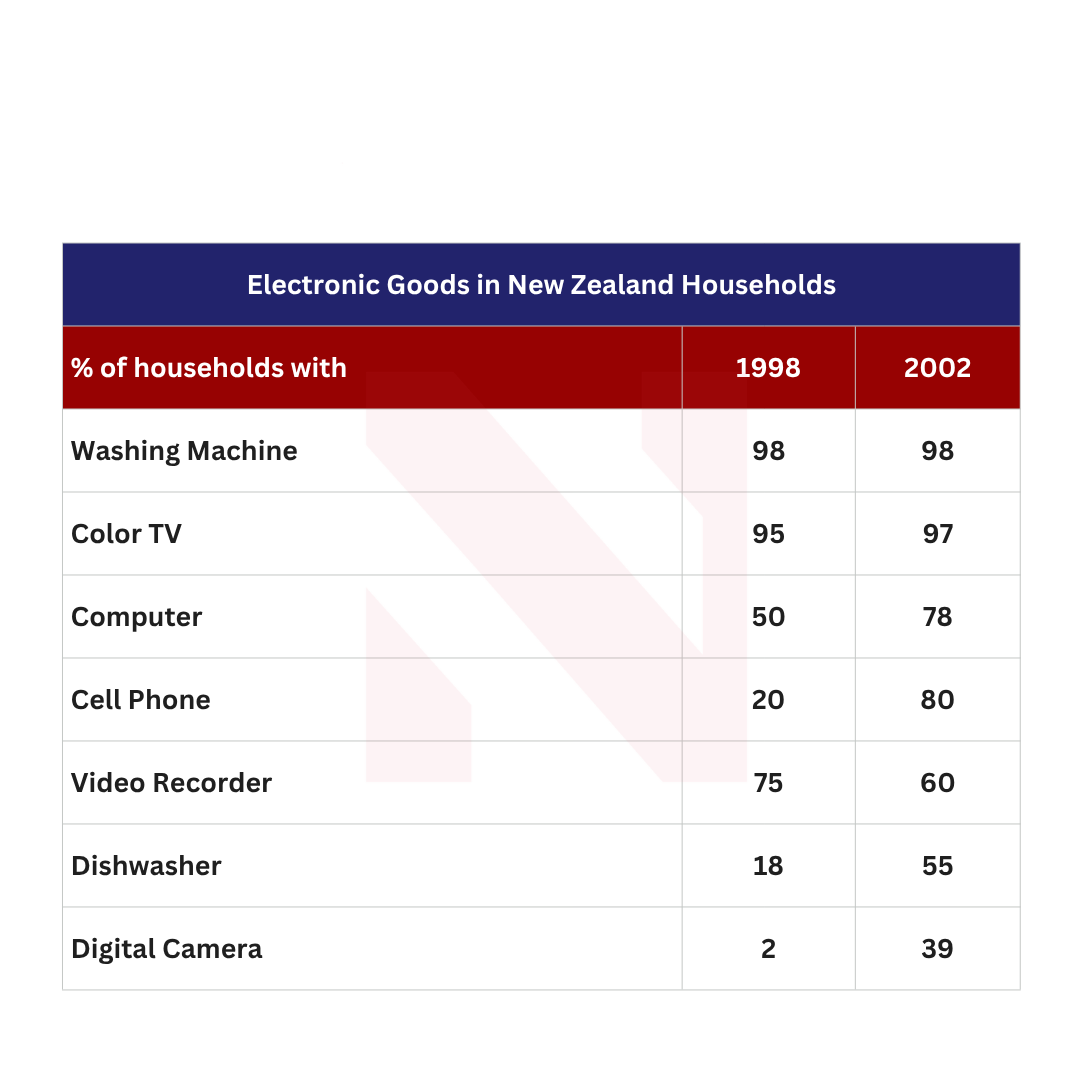
The table provides data on the proportion of households in New Zealand owning electronic goods in 1998 and 2002.
Dạng biểu đồ
Table
Xác định đặc điểm tổng quan (Overview Features)
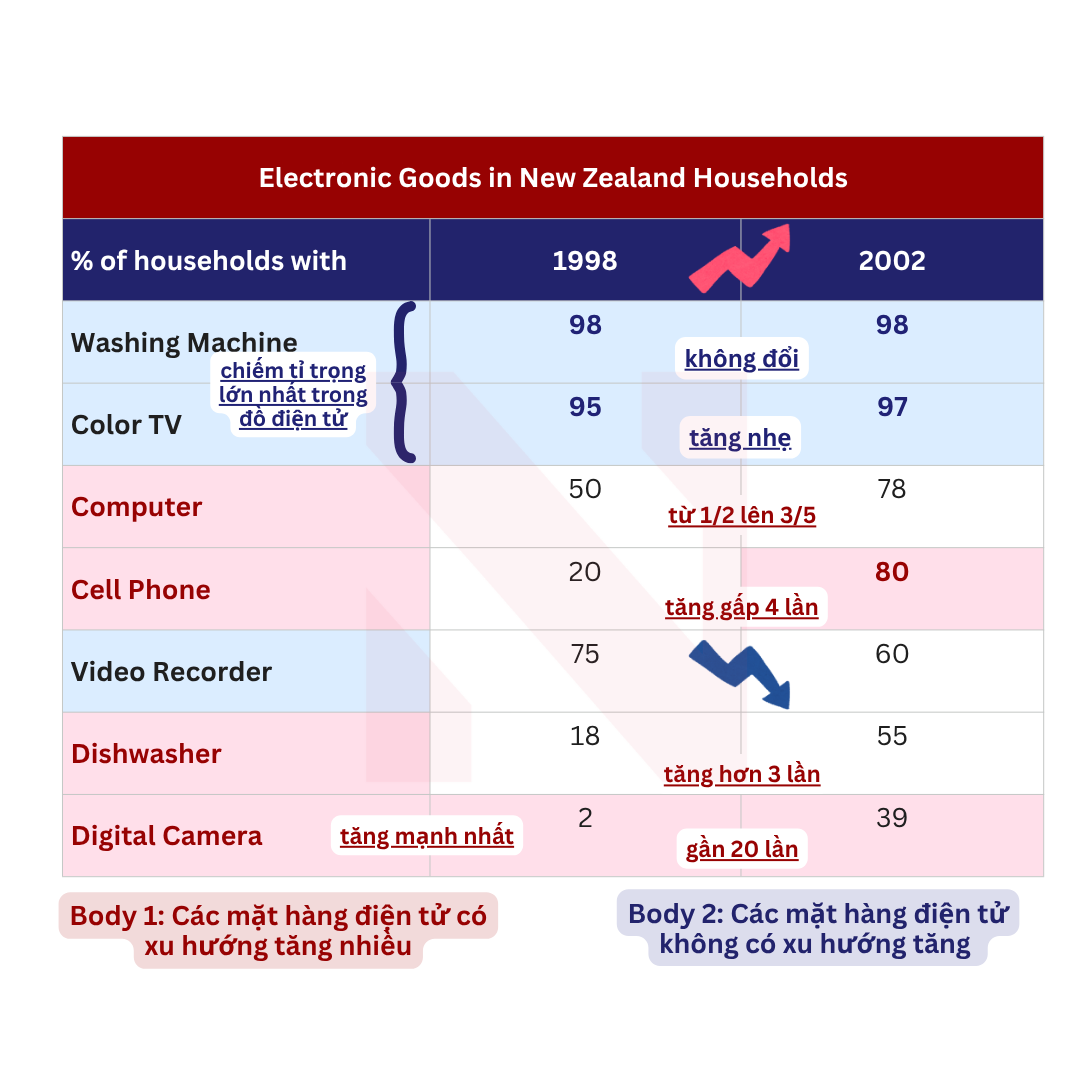
Đặc điểm nổi bật 1: Most electronic goods became more common in New Zealand households between 1998 and 2002, with cell phones, dishwashers, computers and digital cameras recording substantial increases.
Đặc điểm nổi bật 2: Washing machines remained unchanged at 98%, while colour TVs increased only slightly. In contrast, the proportion of households owning video recorders declined.
Chia nhóm dữ liệu cho các đoạn Thân bài (Data Grouping)
Body 1 Grouping: Electronic goods with significant increases
Ý 1: Computer
Ý 2: Cell phone
Ý 3: Dishwasher
Ý 4: Digital camera
Body 2 Grouping: Electronic goods with little or no growth
Ý 1: Washing machine
Ý 2: Colour TV
Ý 3: Video recorder
Triển khai phân tích
Mở bài (Paraphrase)
The table compares the percentages of households in New Zealand that owned seven types of electronic goods in 1998 and 2002.
(Tạm dịch: Bảng so sánh tỷ lệ hộ gia đình ở New Zealand sở hữu bảy loại thiết bị điện tử vào năm 1998 và 2002.)
Tóm tắt tổng quan (Overview)
Overall, ownership of most electronic goods increased over the four-year period, particularly in the cases of cell phones, computers, dishwashers and digital cameras. By contrast, washing machines remained at the same level, colour TV ownership rose only marginally, and video recorder ownership declined.
(Tạm dịch: Nhìn chung, tỷ lệ sở hữu hầu hết các thiết bị điện tử tăng trong giai đoạn bốn năm, đặc biệt là điện thoại di động, máy tính, máy rửa bát và máy ảnh kỹ thuật số. Ngược lại, tỷ lệ sở hữu máy giặt không thay đổi, TV màu chỉ tăng nhẹ, còn máy quay video giảm.)
2. Lập dàn ý chi tiết cho bài viết
Introduction
Paraphrase lại đề bài bằng cách thay thế provides data on → compares, proportion of households → percentage of households, owning electronic goods → that owned electronic goods, và in 1998 and 2002 → in the two years.
Overview
Đặc điểm chung:
Most electronic products became more widely owned between 1998 and 2002.
Four products experienced substantial growth.
Điểm nổi bật:
Cell phone ownership increased fourfold, from 20% to 80%.
Digital camera ownership showed the most dramatic relative increase, from 2% to 39%.
Washing machines remained unchanged, while video recorders became less common.
Body Paragraph 1
Trật tự sắp xếp: Computer → Cell phone → Dishwasher → Digital camera.
Topic sentence: Four types of electronic goods experienced significant increases in household ownership between 1998 and 2002.
Detail 1: Computer ownership rose considerably from 50% in 1998 to 78% in 2002, an increase of 28 percentage points.
Detail 2: Cell phones recorded an even larger rise, from 20% to 80%, meaning that the proportion of households owning one quadrupled over the period.
Detail 3: Dishwasher ownership increased from 18% to 55%, while digital cameras showed the most dramatic relative growth, rising from just 2% to 39%, or almost twenty times the initial figure.
Body Paragraph 2
Trật tự sắp xếp: Washing machine → Colour TV → Video recorder.
Topic sentence: The remaining three products showed little change overall, although video recorder ownership declined.
Detail 1: Washing machines were already almost universally owned in 1998, at 98%, and this figure remained unchanged in 2002. Colour TV ownership was similarly high, increasing only slightly from 95% to 97%.
Detail 2: In contrast, the proportion of households with a video recorder fell from 75% to 60%, making it the only product in the table to experience an overall decline.
3. Bài mẫu hoàn chỉnh
The table compares the percentages of households in New Zealand that owned seven types of electronic goods in 1998 and 2002.
Overall, ownership of most electronic goods increased over the four-year period, particularly in the cases of cell phones, computers, dishwashers and digital cameras. By contrast, washing machines remained at the same level, colour TV ownership rose only marginally, and video recorder ownership declined.
Four types of electronic goods experienced significant increases in household ownership between 1998 and 2002. Computer ownership rose considerably from 50% in 1998 to 78% in 2002, an increase of 28 percentage points. Cell phones recorded an even larger rise, from 20% to 80%, meaning that the proportion of households owning one quadrupled over the period. Meanwhile, dishwasher ownership increased from 18% to 55%. Digital cameras showed the most dramatic relative growth, rising from just 2% to 39%, or almost twenty times the initial figure.
The remaining three products showed little change overall, although video recorder ownership declined. Washing machines were already almost universally owned in 1998, at 98%, and this figure remained unchanged in 2002. Colour TV ownership was similarly high, increasing only slightly from 95% to 97%. In contrast, the proportion of households with a video recorder fell from 75% to 60%, making it the only product in the table to experience an overall decline.
(Word count: 184)
4. Lexical Resources List
New Vocabulary
household ownership (noun phrase): mức độ sở hữu của hộ gia đình
E.g. Household ownership of electronic goods increased significantly.
electronic goods (noun phrase): hàng hóa/thiết bị điện tử
E.g. The table presents data on electronic goods owned by households.
ownership rate (noun phrase): tỷ lệ sở hữu
E.g. The ownership rate of computers rose considerably.
be widely owned (verb phrase): được sở hữu phổ biến
E.g. Washing machines were widely owned in both years.
quadruple (verb): tăng gấp bốn lần
E.g. The proportion of households with cell phones quadrupled.
rise considerably (verb phrase): tăng đáng kể
E.g. Computer ownership rose considerably between 1998 and 2002.
increase by + number of percentage points (verb phrase): tăng thêm bao nhiêu điểm phần trăm
E.g. Computer ownership increased by 28 percentage points.
remain unchanged (verb phrase): không thay đổi
E.g. Washing machine ownership remained unchanged at 98%.
increase marginally (verb phrase): tăng nhẹ
E.g. Colour TV ownership increased marginally.
decline (verb): giảm
E.g. Video recorder ownership declined from 75% to 60%.
dramatic relative growth (noun phrase): mức tăng tương đối mạnh
E.g. Digital cameras showed dramatic relative growth.
almost universally owned (adjective phrase): được sở hữu gần như phổ biến hoàn toàn
E.g. Washing machines were already almost universally owned in 1998.
Sentence Structures
The table compares the percentages of households that owned + number/type of products + in + years. (Dùng để mở bài.)
E.g. The table compares the percentages of households that owned seven types of electronic goods in 1998 and 2002.
Overall, ownership of most + products + increased over the period, particularly in the cases of + products. (Dùng để viết Overview.)
E.g. Overall, ownership of most electronic goods increased over the period, particularly in the cases of cell phones and computers.
+ Product + ownership rose considerably from + figure + to + figure, an increase of + number + percentage points. (Dùng để mô tả mức tăng theo điểm phần trăm.)
E.g. Computer ownership rose considerably from 50% to 78%, an increase of 28 percentage points.
The proportion of households owning + product + quadrupled from + figure + to + figure. (Dùng để mô tả mức tăng gấp bốn lần.)
E.g. The proportion of households owning cell phones quadrupled from 20% to 80%.
+ Product + showed the most dramatic relative growth, rising from + figure + to + figure. (Dùng để nêu mức tăng tương đối lớn nhất.)
E.g. Digital cameras showed the most dramatic relative growth, rising from 2% to 39%.
+ Product + was already almost universally owned in + year +, at + figure, and this figure remained unchanged in + year. (Dùng để mô tả số liệu gần như phổ biến và không thay đổi.)
E.g. Washing machines were already almost universally owned in 1998, at 98%, and this figure remained unchanged in 2002.
In contrast, the proportion of households with + product + fell from + figure + to + figure. (Dùng để mô tả xu hướng giảm.)
E.g. In contrast, the proportion of households with a video recorder fell from 75% to 60%.
..., making it the only product in the table to experience an overall decline. (Dùng để nhấn mạnh trường hợp duy nhất có xu hướng giảm.)
E.g. The figure fell to 60%, making it the only product in the table to experience an overall decline.
Nếu bạn đang bắt đầu từ con số 0 hoặc đã học nhưng “dậm chân tại chỗ”, Envy English Center có thể đồng hành cùng bạn:
Test trình độ miễn phí theo format IELTS để biết chính xác điểm mạnh – điểm yếu.
Nhận lộ trình học cá nhân hóa từ 0 → 6.5+, phù hợp tốc độ và mục tiêu.
Trực tiếp học với giáo viên IELTS 8.0+, chuyên “gỡ rối” Speaking & Writing – hai kỹ năng khó nâng band nhất.
Đặc biệt, khi đăng ký trong tuần này, bạn được tặng bộ từ vựng chuẩn IELTS band 7+.
📞 Hotline: 028 7300 9677 / 0948 197 270 (Zalo)
🌐 Website: envyenglish.vn
📍 Địa chỉ: 46/5 Tân Cảng, Phường Thạnh Mỹ Tây, Quận Bình Thạnh, TP.HCM


Thông tin gửi đi không thành công, vui lòng thử lại sau.
Nếu bạn cần liên hệ gấp, vui lòng gọi hotline
02873009677

Cảm ơn bạn đã gửi thông tin đến Envy English Center.
Chúng tôi sẽ liên hệ với bạn sớm nhất khi có thể.
Nếu bạn cần liên hệ gấp, vui lòng gọi hotline
02873009677
Thông tin gửi đi không thành công, vui lòng thử lại sau.
Nếu bạn cần liên hệ gấp, vui lòng gọi hotline
02873009677
Bạn đang có một bài test chưa hoàn thành.
Bạn có muốn tiếp tục bài test đó không?
Bạn có chắc là muốn gửi bài test này không?

Số câu trả lời đúng/40

Số câu trả lời đúng/40
Thông tin gửi đi không thành công, vui lòng thử lại sau.
Nếu bạn cần liên hệ gấp, vui lòng gọi hotline
02873009677
Thời gian làm bài kiểm tra đã hết.
Cảm ơn bạn đã cố gắng.
