 02873009677
 contact@envyenglish.vn


1. Phân tích đề và nhóm thông tin
Đề bài
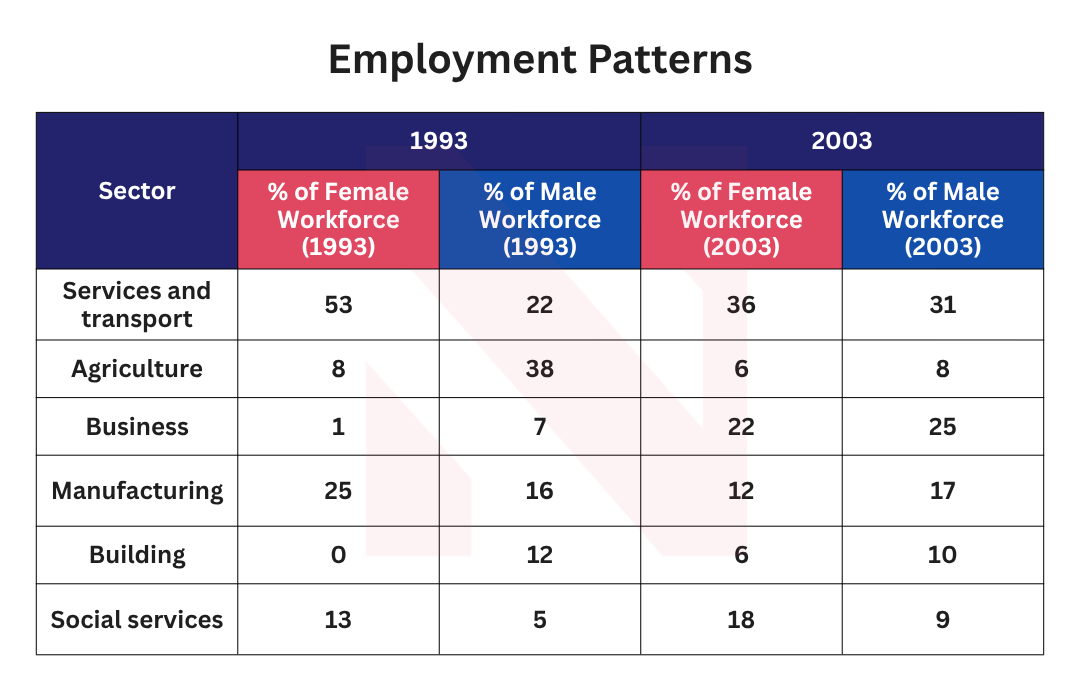
The table below gives information about employment patterns for men and women in New Zealand in two separate years.
Dạng biểu đồ
Table
Xác định đặc điểm tổng quan (Overview Features)
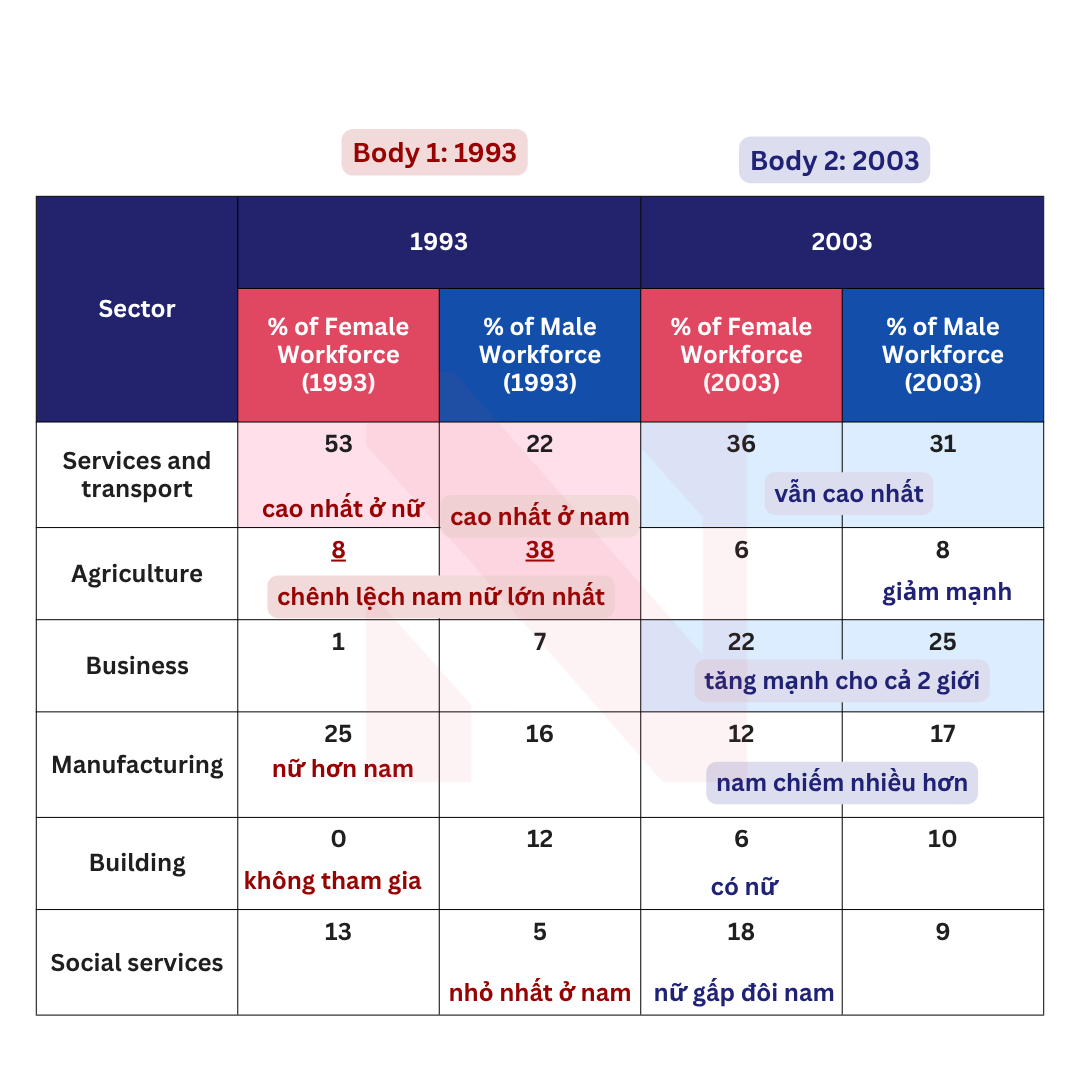
Đặc điểm nổi bật 1: Services and transport là lĩnh vực sử dụng lao động lớn nhất của cả nam và nữ ở cả hai năm, mặc dù tỷ lệ nữ giảm đáng kể theo thời gian.
Đặc điểm nổi bật 2: Cơ cấu việc làm của nam và nữ trở nên cân bằng hơn vào năm 2003, khi tỷ trọng lao động trong nông nghiệp giảm mạnh, còn lĩnh vực kinh doanh tăng đáng kể ở cả hai giới.
Chia nhóm dữ liệu cho các đoạn Thân bài (Data Grouping)
Body 1 Grouping: Employment patterns in 1993
Ý 1: Female workforce
Ý 2: Male workforce
Body 2 Grouping: Employment patterns in 2003
Ý 1: Changes in major sectors
Ý 2: Gender comparison
Triển khai phân tích
Mở bài (Paraphrase)
The table compares the percentages of male and female workers employed in six sectors in New Zealand in 1993 and 2003.
(Tạm dịch: Bảng so sánh tỷ lệ lao động nam và nữ làm việc trong sáu lĩnh vực tại New Zealand vào năm 1993 và 2003.)
Tóm tắt tổng quan (Overview)
Overall, services and transport remained the largest employment sector for both genders throughout the period, while agriculture became far less important, particularly for men. In addition, employment patterns became more balanced over time as business expanded and gender differences narrowed in several sectors.
(Tạm dịch: Nhìn chung, dịch vụ và vận tải vẫn là lĩnh vực sử dụng nhiều lao động nhất của cả hai giới trong suốt giai đoạn, trong khi nông nghiệp trở nên kém quan trọng hơn nhiều, đặc biệt đối với nam giới. Ngoài ra, cơ cấu việc làm trở nên cân bằng hơn khi lĩnh vực kinh doanh phát triển và khoảng cách giới tính thu hẹp ở nhiều ngành.)
2. Lập dàn ý chi tiết cho bài viết
Introduction
Paraphrase lại đề bài bằng cách thay thế gives information about → compares, employment patterns → the proportions of workers employed in different sectors, men and women → male and female workers.
Overview
Đặc điểm chung:
Services and transport vẫn là ngành lớn nhất của cả hai giới.
Agriculture giảm mạnh, đặc biệt ở nam giới.
Điểm nổi bật:
Business tăng đáng kể ở cả nam và nữ.
Khoảng cách giữa nam và nữ trong nhiều ngành thu hẹp vào năm 2003.
Body Paragraph 1
Trật tự sắp xếp: Female → Male.
Topic sentence: In 1993, there were considerable differences between the employment patterns of men and women.
Detail 1: Over half of women worked in services and transport (53%), while manufacturing was the second largest sector at 25%. By contrast, only 8% were employed in agriculture, 1% in business and none in building.
Detail 2: For men, agriculture was the dominant sector, accounting for 38% of the workforce, followed by services and transport at 22%. Manufacturing represented 16%, while business, building and social services accounted for 7%, 12% and 5%, respectively.
Body Paragraph 2
Trật tự sắp xếp: Major changes → Gender comparison.
Topic sentence: By 2003, employment patterns had become more evenly distributed across sectors.
Detail 1: Services and transport remained the largest employer, although the proportion of women fell to 36% while the figure for men increased to 31%. Agriculture declined sharply for men to 8%, almost matching the female figure of 6%.
Detail 2: Business experienced substantial growth, reaching 22% for women and 25% for men. Manufacturing fell markedly among women to 12% but edged up slightly for men to 17%. Women also entered the building sector for the first time at 6%, whereas the male figure decreased modestly to 10%. Social services continued to employ a higher proportion of women (18%) than men (9%).
3. Bài mẫu hoàn chỉnh
The table compares the percentages of male and female workers employed in six sectors in New Zealand in 1993 and 2003.
Overall, services and transport remained the largest employment sector for both genders throughout the period, while agriculture became far less important, particularly for men. In addition, employment patterns became more balanced over time as business expanded and gender differences narrowed in several sectors.
In 1993, there were considerable differences between the employment patterns of men and women. More than half of female workers were employed in services and transport (53%), followed by manufacturing at 25%. By comparison, only 8% worked in agriculture, 1% in business and none in building. For men, agriculture was the largest sector, accounting for 38%, ahead of services and transport at 22%, while manufacturing, business, building and social services represented 16%, 7%, 12% and 5%, respectively.
By 2003, services and transport still employed the largest shares of both genders, although the female figure had fallen to 36% while the male proportion rose to 31%. Agriculture dropped sharply among men to 8%, almost the same as the female figure of 6%. Meanwhile, business expanded significantly to 22% for women and 25% for men. Women also entered the building sector at 6%, while social services continued to attract a higher proportion of women than men, at 18% and 9%, respectively.
(Word count: 198)
4. Lexical Resources List
New Vocabulary
employment pattern (noun phrase): cơ cấu việc làm
E.g. Employment patterns changed considerably over the decade.
workforce (noun): lực lượng lao động
E.g. Women made up a large proportion of the workforce.
employment sector (noun phrase): lĩnh vực việc làm
E.g. Services remained the largest employment sector.
account for (verb phrase): chiếm
E.g. Agriculture accounted for 38% of male employment.
dominant sector (noun phrase): lĩnh vực chiếm ưu thế
E.g. Agriculture was the dominant sector for men.
expand significantly (verb phrase): tăng mạnh
E.g. Business expanded significantly over the period.
decline sharply (verb phrase): giảm mạnh
E.g. Employment in agriculture declined sharply.
edge up slightly (verb phrase): tăng nhẹ
E.g. The male figure edged up slightly to 17%.
gender difference (noun phrase): sự khác biệt giới tính
E.g. Gender differences became smaller by 2003.
be employed in (verb phrase): làm việc trong
E.g. Most women were employed in services.
male proportion (noun phrase): tỷ lệ nam giới
E.g. The male proportion increased over time.
female figure (noun phrase): tỷ lệ của nữ giới
E.g. The female figure fell from 53% to 36%.
Sentence Structures
The table compares the percentages of male and female workers employed in different sectors over a given period. (Dùng để mở bài cho dạng Table.)
E.g. The table compares the percentages of male and female workers employed in different sectors in New Zealand.
Overall, + sector + remained the largest employer, while + sector + became less significant over time. (Dùng để viết Overview.)
E.g. Overall, services remained the largest employer, while agriculture became less significant over time.
In + year +, + sector + accounted for + percentage + of the + male/female + workforce. (Dùng để mô tả số liệu.)
E.g. In 1993, agriculture accounted for 38% of the male workforce.
By + year +, the figure had fallen/risen to + percentage +, whereas the corresponding figure for + group + was + percentage. (Dùng để so sánh theo thời gian.)
E.g. By 2003, the figure had fallen to 36%, whereas the corresponding figure for men was 31%.
Meanwhile, + sector + experienced substantial growth, reaching + percentage + for women and + percentage + for men. (Dùng để mô tả xu hướng tăng.)
E.g. Meanwhile, business experienced substantial growth, reaching 22% for women and 25% for men.
Throughout the period, + sector + continued to employ a higher proportion of + group + than + group. (Dùng để so sánh giữa hai giới.)
E.g. Throughout the period, social services continued to employ a higher proportion of women than men.
Nếu bạn đang bắt đầu từ con số 0 hoặc đã học nhưng “dậm chân tại chỗ”, Envy English Center có thể đồng hành cùng bạn:
Test trình độ miễn phí theo format IELTS để biết chính xác điểm mạnh – điểm yếu.
Nhận lộ trình học cá nhân hóa từ 0 → 6.5+, phù hợp tốc độ và mục tiêu.
Trực tiếp học với giáo viên IELTS 8.0+, chuyên “gỡ rối” Speaking & Writing – hai kỹ năng khó nâng band nhất.
Đặc biệt, khi đăng ký trong tuần này, bạn được tặng bộ từ vựng chuẩn IELTS band 7+.
📞 Hotline: 028 7300 9677 / 0948 197 270 (Zalo)
🌐 Website: envyenglish.vn
📍 Địa chỉ: 46/5 Tân Cảng, Phường Thạnh Mỹ Tây, Quận Bình Thạnh, TP.HCM


Thông tin gửi đi không thành công, vui lòng thử lại sau.
Nếu bạn cần liên hệ gấp, vui lòng gọi hotline
02873009677

Cảm ơn bạn đã gửi thông tin đến Envy English Center.
Chúng tôi sẽ liên hệ với bạn sớm nhất khi có thể.
Nếu bạn cần liên hệ gấp, vui lòng gọi hotline
02873009677
Thông tin gửi đi không thành công, vui lòng thử lại sau.
Nếu bạn cần liên hệ gấp, vui lòng gọi hotline
02873009677
Bạn đang có một bài test chưa hoàn thành.
Bạn có muốn tiếp tục bài test đó không?
Bạn có chắc là muốn gửi bài test này không?

Số câu trả lời đúng/40

Số câu trả lời đúng/40
Thông tin gửi đi không thành công, vui lòng thử lại sau.
Nếu bạn cần liên hệ gấp, vui lòng gọi hotline
02873009677
Thời gian làm bài kiểm tra đã hết.
Cảm ơn bạn đã cố gắng.
