 02873009677
 contact@envyenglish.vn

1. Xây dựng ý tưởng
Đề bài
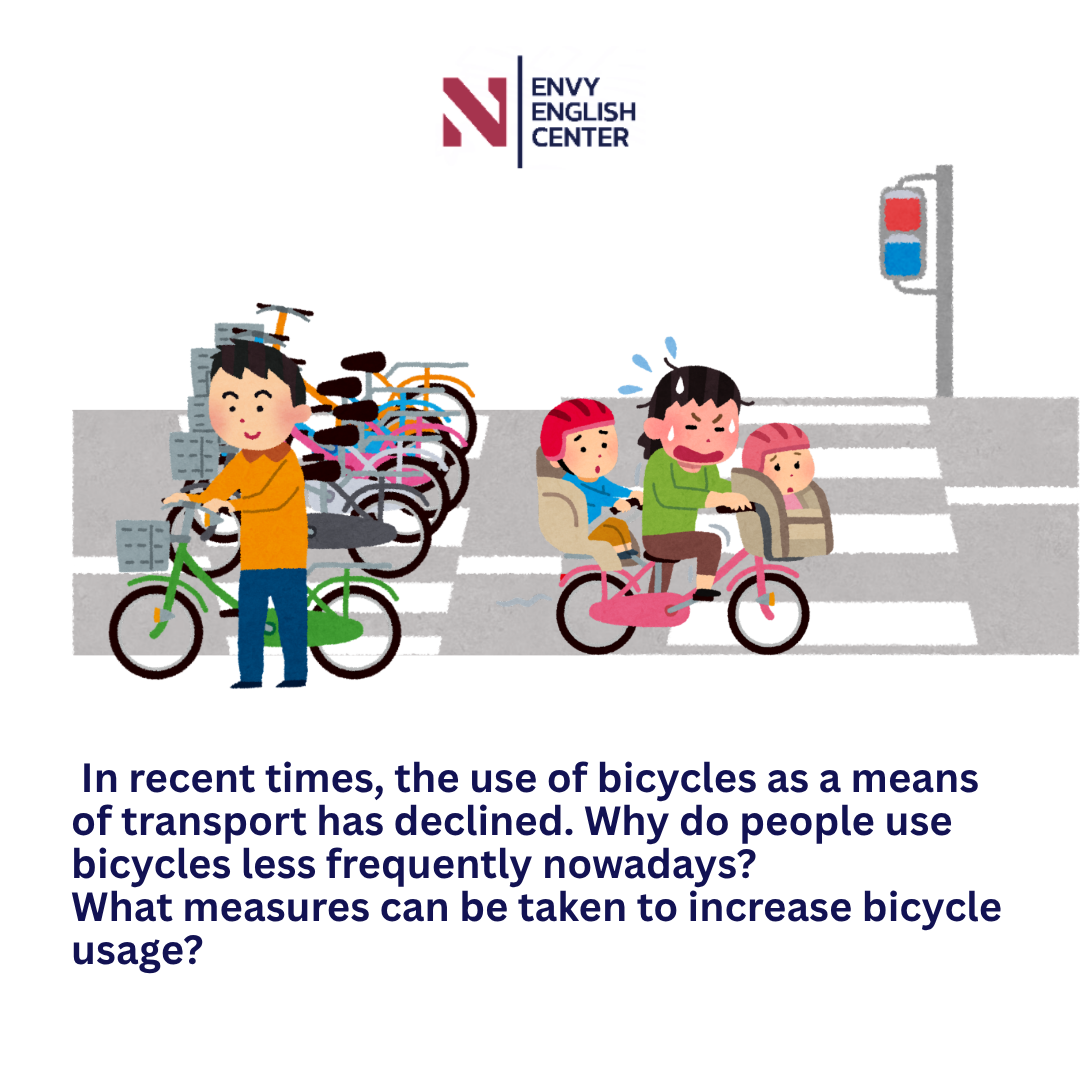
In recent times, the use of bicycles as a means of transport has declined.
Why do people use bicycles less frequently nowadays?
What measures can be taken to increase bicycle usage?
Dạng bài
Problem and Solution Essay
Xác định chủ đề và luận điểm
Topic: Declining Use of Bicycles
Nguyên nhân 1: Growing preference for motorized transport
Increased affordability of cars and motorcycles: ô tô và xe máy trở nên dễ mua hơn
Faster and more convenient travel: di chuyển nhanh chóng và thuận tiện hơn
Rising income levels allowing private vehicle ownership: thu nhập tăng giúp nhiều người sở hữu phương tiện cá nhân
Expansion of road infrastructure designed for motor vehicles: cơ sở hạ tầng giao thông ưu tiên xe cơ giới
Long commuting distances in urban areas: khoảng cách đi lại dài ở các đô thị
Greater comfort in adverse weather conditions: thoải mái hơn khi thời tiết xấu
Nguyên nhân 2: Lack of bicycle-friendly environments
Insufficient cycling lanes and infrastructure: thiếu làn đường và cơ sở hạ tầng dành cho xe đạp
Concerns about road safety and traffic accidents: lo ngại về an toàn giao thông và tai nạn
Limited bicycle parking facilities: thiếu khu vực đỗ xe đạp
Heavy traffic discouraging cyclists: giao thông đông đúc làm người dân ngại đi xe đạp
Urban planning that prioritizes motor vehicles: quy hoạch đô thị ưu tiên phương tiện cơ giới
Lack of public awareness of cycling benefits: thiếu nhận thức về lợi ích của việc đi xe đạp
Giải pháp
Develop dedicated cycling infrastructure: xây dựng cơ sở hạ tầng chuyên biệt cho xe đạp
Introduce bicycle-sharing programs: triển khai hệ thống chia sẻ xe đạp công cộng
Improve road safety measures: tăng cường các biện pháp an toàn giao thông
Provide financial incentives for cyclists: hỗ trợ tài chính hoặc ưu đãi cho người đi xe đạp
Raise awareness of health and environmental benefits: nâng cao nhận thức về lợi ích sức khỏe và môi trường
Integrate cycling with public transportation systems: kết hợp xe đạp với giao thông công cộng
2. Lập dàn ý cho đề theo PEEL
Introduction
Paraphrase: bicycle use has decreased in many places in recent years
Question: causes and solutions
Thesis: the decline is mainly due to the popularity of motorized transport and inadequate cycling infrastructure; governments can reverse the trend through investment and awareness campaigns
Body Paragraph 1 - Causes
Point: people increasingly prefer motorized vehicles
Evidence: affordability, speed, comfort, longer travel distances
Explanation: cars and motorcycles are often more practical than bicycles in modern cities
Link: therefore, bicycle usage has declined significantly
Point: cycling environments are often unsafe and inconvenient
Evidence: lack of cycling lanes, traffic congestion, accident risks
Explanation: people avoid cycling when they perceive it as dangerous
Link: this further reduces bicycle use
Body Paragraph 2 - Solutions
Point: governments should improve cycling infrastructure and safety
Evidence: dedicated bike lanes, secure parking, traffic regulations
Explanation: safer conditions encourage more people to cycle regularly
Link: infrastructure investment can increase bicycle usage
Point: authorities should promote cycling through incentives and awareness campaigns
Evidence: bike-sharing programs, educational campaigns, integration with public transport
Explanation: highlighting benefits and reducing barriers can make cycling more attractive
Link: these measures can help restore cycling as a common mode of transport
Conclusion
Summary: bicycle use has declined due to motorized transport and inadequate facilities
Restate: better infrastructure and stronger government support are the most effective ways to encourage cycling
3. Bài mẫu hoàn chỉnh
In many countries, bicycles were once a common means of transportation, but their use has declined considerably in recent years. This trend is mainly driven by the increasing popularity of motorized vehicles and the lack of bicycle-friendly infrastructure. However, several measures can be implemented to encourage more people to cycle.
One major reason for the decline in bicycle usage is the increased affordability of cars and motorcycles. As living standards rise, more people can purchase private vehicles, which offer faster and more convenient travel. In addition, modern urban lifestyles often involve long commuting distances in urban areas, making bicycles a less practical option. Another contributing factor is the insufficient cycling lanes and infrastructure in many cities. Cyclists frequently face heavy traffic and unsafe road conditions, leading to concerns about road safety and traffic accidents. Consequently, many people choose motorized transport instead of cycling.
To address this issue, governments should focus on creating a more supportive environment for cyclists. One effective solution is to develop dedicated cycling infrastructure, including protected bicycle lanes and secure parking facilities. Improving road safety through stricter traffic regulations can also make cycling more attractive. Furthermore, authorities can introduce bicycle-sharing programs and provide incentives such as tax benefits or subsidies for purchasing bicycles. Public campaigns should also raise awareness of health and environmental benefits, encouraging people to view cycling as both a practical and sustainable mode of transport. Finally, cities can integrate cycling with public transportation systems, allowing commuters to combine different forms of travel efficiently.
In conclusion, the decline in bicycle use is largely the result of the growing popularity of motorized vehicles and inadequate cycling infrastructure. Nevertheless, by investing in safer facilities and promoting the advantages of cycling, governments can encourage more people to adopt bicycles as a regular means of transport.
(Word count: 295)
4. Lexical Resources List
New Vocabulary
increased affordability of cars and motorcycles (noun phrase): ô tô và xe máy trở nên dễ mua hơn
E.g. The increased affordability of cars and motorcycles has reduced bicycle usage.
faster and more convenient travel (noun phrase): di chuyển nhanh chóng và thuận tiện hơn
E.g. Many people prefer private vehicles because they provide faster and more convenient travel.
rising income levels allowing private vehicle ownership (noun phrase): thu nhập tăng giúp sở hữu phương tiện cá nhân
E.g. Rising income levels allowing private vehicle ownership have changed transportation habits.
expansion of road infrastructure designed for motor vehicles (noun phrase): mở rộng hạ tầng giao thông dành cho xe cơ giới
E.g. The expansion of road infrastructure designed for motor vehicles often discourages cycling.
long commuting distances in urban areas (noun phrase): khoảng cách đi lại dài ở đô thị
E.g. Long commuting distances in urban areas make cycling less practical.
greater comfort in adverse weather conditions (noun phrase): thoải mái hơn khi thời tiết xấu
E.g. Cars provide greater comfort in adverse weather conditions.
insufficient cycling lanes and infrastructure (noun phrase): thiếu làn đường và cơ sở hạ tầng dành cho xe đạp
E.g. Many cities suffer from insufficient cycling lanes and infrastructure.
concerns about road safety and traffic accidents (noun phrase): lo ngại về an toàn giao thông và tai nạn
E.g. Cyclists often have concerns about road safety and traffic accidents.
limited bicycle parking facilities (noun phrase): thiếu khu vực đỗ xe đạp
E.g. Limited bicycle parking facilities discourage bicycle ownership.
heavy traffic discouraging cyclists (noun phrase): giao thông đông đúc khiến người dân ngại đi xe đạp
E.g. Heavy traffic discouraging cyclists is a common urban problem.
urban planning that prioritizes motor vehicles (noun phrase): quy hoạch đô thị ưu tiên xe cơ giới
E.g. Some cities have urban planning that prioritizes motor vehicles.
lack of public awareness of cycling benefits (noun phrase): thiếu nhận thức về lợi ích của việc đi xe đạp
E.g. There is often a lack of public awareness of cycling benefits.
develop dedicated cycling infrastructure (verb phrase): xây dựng cơ sở hạ tầng chuyên biệt cho xe đạp
E.g. Governments should develop dedicated cycling infrastructure.
introduce bicycle-sharing programs (verb phrase): triển khai hệ thống chia sẻ xe đạp công cộng
E.g. Many cities have introduced bicycle-sharing programs.
improve road safety measures (verb phrase): cải thiện các biện pháp an toàn giao thông
E.g. Authorities need to improve road safety measures.
provide financial incentives for cyclists (verb phrase): cung cấp ưu đãi tài chính cho người đi xe đạp
E.g. Governments can provide financial incentives for cyclists.
raise awareness of health and environmental benefits (verb phrase): nâng cao nhận thức về lợi ích sức khỏe và môi trường
E.g. Schools should raise awareness of health and environmental benefits.
integrate cycling with public transportation systems (verb phrase): kết hợp xe đạp với hệ thống giao thông công cộng
E.g. Cities can integrate cycling with public transportation systems.
sustainable mode of transport (noun phrase): phương tiện giao thông bền vững
E.g. Cycling is a sustainable mode of transport.
protected bicycle lanes (noun phrase): làn đường xe đạp được bảo vệ
E.g. Protected bicycle lanes encourage more residents to cycle.
Sentence Structures
1. One major reason for + noun phrase + is the + noun phrase (dùng để trình bày nguyên nhân)
E.g. One major reason for the decline in bicycle use is the increased affordability of cars and motorcycles.
2. In addition, + noun phrase + often involve(s) + noun phrase, making + noun phrase + less practical (dùng để giải thích)
E.g. In addition, modern lifestyles often involve long commuting distances, making bicycles less practical.
3. Another contributing factor is the + noun phrase (dùng để bổ sung nguyên nhân)
E.g. Another contributing factor is the insufficient cycling infrastructure in many cities.
4. One effective solution is to + verb phrase (dùng để nêu giải pháp)
E.g. One effective solution is to develop dedicated cycling infrastructure.
5. Furthermore, authorities can + verb phrase, encouraging + noun phrase + to + verb (dùng để mở rộng giải pháp)
E.g. Furthermore, authorities can introduce bicycle-sharing programs, encouraging residents to cycle more frequently.
6. In conclusion, while + noun phrase + has declined because + clause, + noun phrase + can be increased through + noun phrase (dùng để kết luận)
E.g. In conclusion, while bicycle usage has declined because of motorized transport, it can be increased through better infrastructure and government support.
Nếu bạn đang bắt đầu từ con số 0 hoặc đã học nhưng “dậm chân tại chỗ”, Envy English Center có thể đồng hành cùng bạn:
Test trình độ miễn phí theo format IELTS để biết chính xác điểm mạnh – điểm yếu.
Nhận lộ trình học cá nhân hóa từ 0 → 6.5+, phù hợp tốc độ và mục tiêu.
Trực tiếp học với giáo viên IELTS 8.0+, chuyên “gỡ rối” Speaking & Writing – hai kỹ năng khó nâng band nhất.
Đặc biệt, khi đăng ký trong tuần này, bạn được tặng bộ từ vựng chuẩn IELTS band 7+.
📞 Hotline: 028 7300 9677 / 0948 197 270 (Zalo)
🌐 Website: envyenglish.vn
📍 Địa chỉ: 46/5 Tân Cảng, Phường Thạnh Mỹ Tây, Quận Bình Thạnh, TP.HCM


Thông tin gửi đi không thành công, vui lòng thử lại sau.
Nếu bạn cần liên hệ gấp, vui lòng gọi hotline
02873009677

Cảm ơn bạn đã gửi thông tin đến Envy English Center.
Chúng tôi sẽ liên hệ với bạn sớm nhất khi có thể.
Nếu bạn cần liên hệ gấp, vui lòng gọi hotline
02873009677
Thông tin gửi đi không thành công, vui lòng thử lại sau.
Nếu bạn cần liên hệ gấp, vui lòng gọi hotline
02873009677
Bạn đang có một bài test chưa hoàn thành.
Bạn có muốn tiếp tục bài test đó không?
Bạn có chắc là muốn gửi bài test này không?

Số câu trả lời đúng/40

Số câu trả lời đúng/40
Thông tin gửi đi không thành công, vui lòng thử lại sau.
Nếu bạn cần liên hệ gấp, vui lòng gọi hotline
02873009677
Thời gian làm bài kiểm tra đã hết.
Cảm ơn bạn đã cố gắng.
