 02873009677
 contact@envyenglish.vn

1. Xây dựng ý tưởng
Đề bài
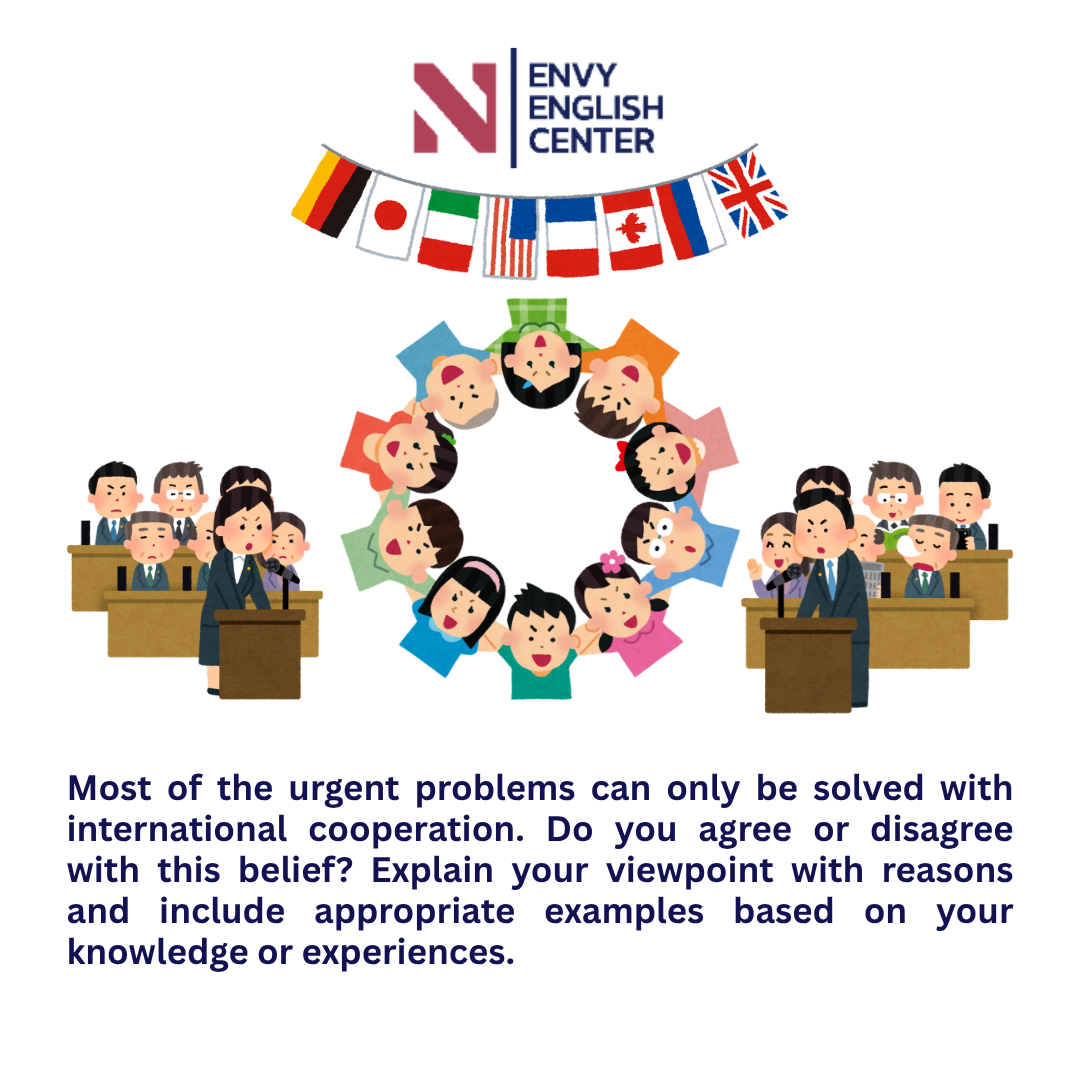
Most of the urgent problems can only be solved with international cooperation. Do you agree or disagree with this belief? Explain your viewpoint with reasons and include appropriate examples based on your knowledge or experiences.
Dạng bài
Opinion essay
Xác định chủ đề và luận điểm
Topic: International Cooperation and Global Problems
Luận điểm 1: Reasons supporting international cooperation
Global environmental protection: bảo vệ môi trường toàn cầu
Pandemic control efforts: nỗ lực kiểm soát đại dịch
International security maintenance: duy trì an ninh quốc tế
Scientific knowledge sharing: chia sẻ kiến thức khoa học
Economic crisis management: quản lý khủng hoảng kinh tế
Cross-border problem solving: giải quyết vấn đề xuyên biên giới
Humanitarian aid coordination: phối hợp viện trợ nhân đạo
Luận điểm 2: Limitations of international cooperation
Political conflicts between nations: xung đột chính trị giữa các quốc gia
Unequal economic interests: lợi ích kinh tế không đồng đều
Slow decision-making processes: quá trình ra quyết định chậm chạp
National policy differences: khác biệt chính sách quốc gia
Lack of global enforcement power: thiếu quyền thực thi toàn cầu
Dependence on government commitment: phụ thuộc vào cam kết chính phủ
Difficulties in resource distribution: khó khăn trong phân bổ nguồn lực
Triển khai ý tưởng
Position 1
I strongly agree that most urgent global problems require international cooperation because many modern challenges affect multiple countries and cannot be effectively addressed by individual governments alone.
→ Tôi hoàn toàn đồng ý rằng phần lớn các vấn đề cấp bách toàn cầu cần sự hợp tác quốc tế vì nhiều thách thức hiện đại ảnh hưởng đến nhiều quốc gia và không thể được giải quyết hiệu quả chỉ bởi từng chính phủ riêng lẻ.
Ví dụ:
International cooperation during COVID-19
Global climate agreements
Position 2
Although international cooperation is important, national governments should remain primarily responsible for solving domestic problems.
→ Mặc dù hợp tác quốc tế quan trọng, các chính phủ quốc gia vẫn nên chịu trách nhiệm chính trong việc giải quyết các vấn đề trong nước.
Ví dụ:
National healthcare reforms
Domestic education policies
2. Lập dàn ý cho đề theo PEEL
Introduction
Paraphrase: some people believe urgent global issues can only be solved through international cooperation
Question: whether global collaboration is necessary for solving major problems
Thesis: I strongly agree because many modern problems cross national borders and require shared solutions and resources
Body Paragraph 1
Point: international cooperation is essential for solving environmental and health crises
Evidence: climate change agreements, pandemic response, scientific research sharing
Explanation: global problems affect multiple countries simultaneously
Link: cooperation increases effectiveness and resource sharing
Body Paragraph 2
Point: economic and security challenges also require global coordination
Evidence: financial crises, terrorism prevention, humanitarian support
Explanation: individual governments often lack sufficient resources or influence
Link: international partnerships improve long-term global stability
Conclusion
Summary: most urgent modern problems are international in nature
Restate: international cooperation is necessary for effective and sustainable solutions
3. Bài mẫu hoàn chỉnh
In today’s interconnected world, many serious problems affect multiple countries at the same time. Some people believe that urgent global issues can only be solved through international cooperation. I strongly agree with this opinion because environmental, health, and economic challenges increasingly require countries to work together.
One important reason is that many modern problems are global by nature. For example, climate change cannot be effectively addressed by individual nations acting alone because pollution and greenhouse gas emissions easily cross national borders. Effective global environmental protection therefore depends on international agreements and shared environmental policies. Similarly, the COVID-19 pandemic demonstrated the importance of pandemic control efforts through cooperation between governments, scientists, and healthcare organizations worldwide. During the crisis, countries exchanged medical knowledge, vaccines, and scientific data, highlighting the value of scientific knowledge sharing. In addition, many developing countries relied heavily on humanitarian aid coordination from international organizations and wealthier nations. Without global cooperation, these large-scale problems would be much more difficult to manage effectively.
International collaboration is also essential for maintaining political and economic stability. Problems such as terrorism, cybercrime, and financial crises often involve multiple countries and require cross-border problem solving. Governments can improve international security maintenance by sharing intelligence and coordinating law enforcement activities. Likewise, global recessions require collective action and economic crisis management between major economies. Although some critics argue that international cooperation can be slow because of political conflicts between nations and national policy differences, global partnerships still provide the most practical solutions for many worldwide challenges. No single country has enough power or resources to solve these issues independently.
Overall, I strongly believe that most urgent global problems require international cooperation because modern environmental, economic, and security challenges extend beyond national borders and demand collective action.
(Word count: 317)
4. Lexical Resources List
New Vocabulary
global environmental protection (noun phrase): bảo vệ môi trường toàn cầu
E.g. International agreements support global environmental protection.
pandemic control efforts (noun phrase): nỗ lực kiểm soát đại dịch
E.g. Governments invested heavily in pandemic control efforts.
international security maintenance (noun phrase): duy trì an ninh quốc tế
E.g. Military alliances contribute to international security maintenance.
scientific knowledge sharing (noun phrase): chia sẻ kiến thức khoa học
E.g. Universities encourage scientific knowledge sharing.
economic crisis management (noun phrase): quản lý khủng hoảng kinh tế
E.g. Global organizations assist with economic crisis management.
cross-border problem solving (noun phrase): giải quyết vấn đề xuyên biên giới
E.g. Climate issues require cross-border problem solving.
humanitarian aid coordination (noun phrase): phối hợp viện trợ nhân đạo
E.g. International agencies provide humanitarian aid coordination.
political conflicts between nations (noun phrase): xung đột chính trị giữa các quốc gia
E.g. Trade agreements may reduce political conflicts between nations.
unequal economic interests (noun phrase): lợi ích kinh tế không đồng đều
E.g. Negotiations often fail because of unequal economic interests.
slow decision-making processes (noun phrase): quá trình ra quyết định chậm chạp
E.g. International organizations sometimes face slow decision-making processes.
national policy differences (noun phrase): khác biệt chính sách quốc gia
E.g. Cooperation may become difficult because of national policy differences.
lack of global enforcement power (noun phrase): thiếu quyền thực thi toàn cầu
E.g. Some treaties fail due to the lack of global enforcement power.
dependence on government commitment (noun phrase): phụ thuộc vào cam kết chính phủ
E.g. Climate agreements rely on dependence on government commitment.
difficulties in resource distribution (noun phrase): khó khăn trong phân bổ nguồn lực
E.g. Poor infrastructure causes difficulties in resource distribution.
greenhouse gas emissions (noun phrase): khí thải nhà kính
E.g. Factories contribute to greenhouse gas emissions.
shared environmental policies (noun phrase): chính sách môi trường chung
E.g. Neighboring countries should create shared environmental policies.
medical knowledge (noun phrase): kiến thức y khoa
E.g. Scientists exchanged important medical knowledge during the pandemic.
law enforcement activities (noun phrase): hoạt động thực thi pháp luật
E.g. Governments cooperate in international law enforcement activities.
global recessions (noun phrase): suy thoái kinh tế toàn cầu
E.g. Trade disruptions may trigger global recessions.
collective action (noun phrase): hành động tập thể
E.g. Environmental protection requires collective action.
Sentence Structures
1. I strongly agree with + noun phrase + because + clause (dùng để nêu lập trường rõ ràng)
E.g. I strongly agree with this opinion because environmental, health, and economic challenges increasingly require countries to work together.
2. One important reason is that + clause (dùng để mở đoạn giải thích lý do)
E.g. One important reason is that many modern problems are global by nature.
3. For example, + noun phrase + cannot be effectively addressed by + noun phrase + because + clause (dùng để đưa ví dụ và giải thích)
E.g. For example, climate change cannot be effectively addressed by individual nations acting alone because pollution and greenhouse gas emissions easily cross national borders.
4. In addition, + noun phrase + relied heavily on + noun phrase (dùng để bổ sung ví dụ thực tế)
E.g. In addition, many developing countries relied heavily on humanitarian aid coordination from international organizations and wealthier nations.
5. Although some critics argue that + clause, + noun phrase + still + verb + noun phrase (dùng để phản biện quan điểm đối lập)
E.g. Although some critics argue that international cooperation can be slow because of political conflicts between nations and national policy differences, global partnerships still provide the most practical solutions for many worldwide challenges.
6. Overall, I strongly believe that + clause because + clause (dùng để kết luận với lập trường nhất quán)
E.g. Overall, I strongly believe that most urgent global problems require international cooperation because modern environmental, economic, and security challenges extend beyond national borders and demand collective action.
Nếu bạn đang bắt đầu từ con số 0 hoặc đã học nhưng “dậm chân tại chỗ”, Envy English Center có thể đồng hành cùng bạn:
Test trình độ miễn phí theo format IELTS để biết chính xác điểm mạnh – điểm yếu.
Nhận lộ trình học cá nhân hóa từ 0 → 6.5+, phù hợp tốc độ và mục tiêu.
Trực tiếp học với giáo viên IELTS 8.0+, chuyên “gỡ rối” Speaking & Writing – hai kỹ năng khó nâng band nhất.
Đặc biệt, khi đăng ký trong tuần này, bạn được tặng bộ từ vựng chuẩn IELTS band 7+.
📞 Hotline: 028 7300 9677 / 0948 197 270 (Zalo)
🌐 Website: envyenglish.vn
📍 Địa chỉ: 46/5 Tân Cảng, Phường Thạnh Mỹ Tây, Quận Bình Thạnh, TP.HCM


Thông tin gửi đi không thành công, vui lòng thử lại sau.
Nếu bạn cần liên hệ gấp, vui lòng gọi hotline
02873009677

Cảm ơn bạn đã gửi thông tin đến Envy English Center.
Chúng tôi sẽ liên hệ với bạn sớm nhất khi có thể.
Nếu bạn cần liên hệ gấp, vui lòng gọi hotline
02873009677
Thông tin gửi đi không thành công, vui lòng thử lại sau.
Nếu bạn cần liên hệ gấp, vui lòng gọi hotline
02873009677
Bạn đang có một bài test chưa hoàn thành.
Bạn có muốn tiếp tục bài test đó không?
Bạn có chắc là muốn gửi bài test này không?

Số câu trả lời đúng/40

Số câu trả lời đúng/40
Thông tin gửi đi không thành công, vui lòng thử lại sau.
Nếu bạn cần liên hệ gấp, vui lòng gọi hotline
02873009677
Thời gian làm bài kiểm tra đã hết.
Cảm ơn bạn đã cố gắng.
