 02873009677
 contact@envyenglish.vn

1. Xây dựng ý tưởng
Đề bài
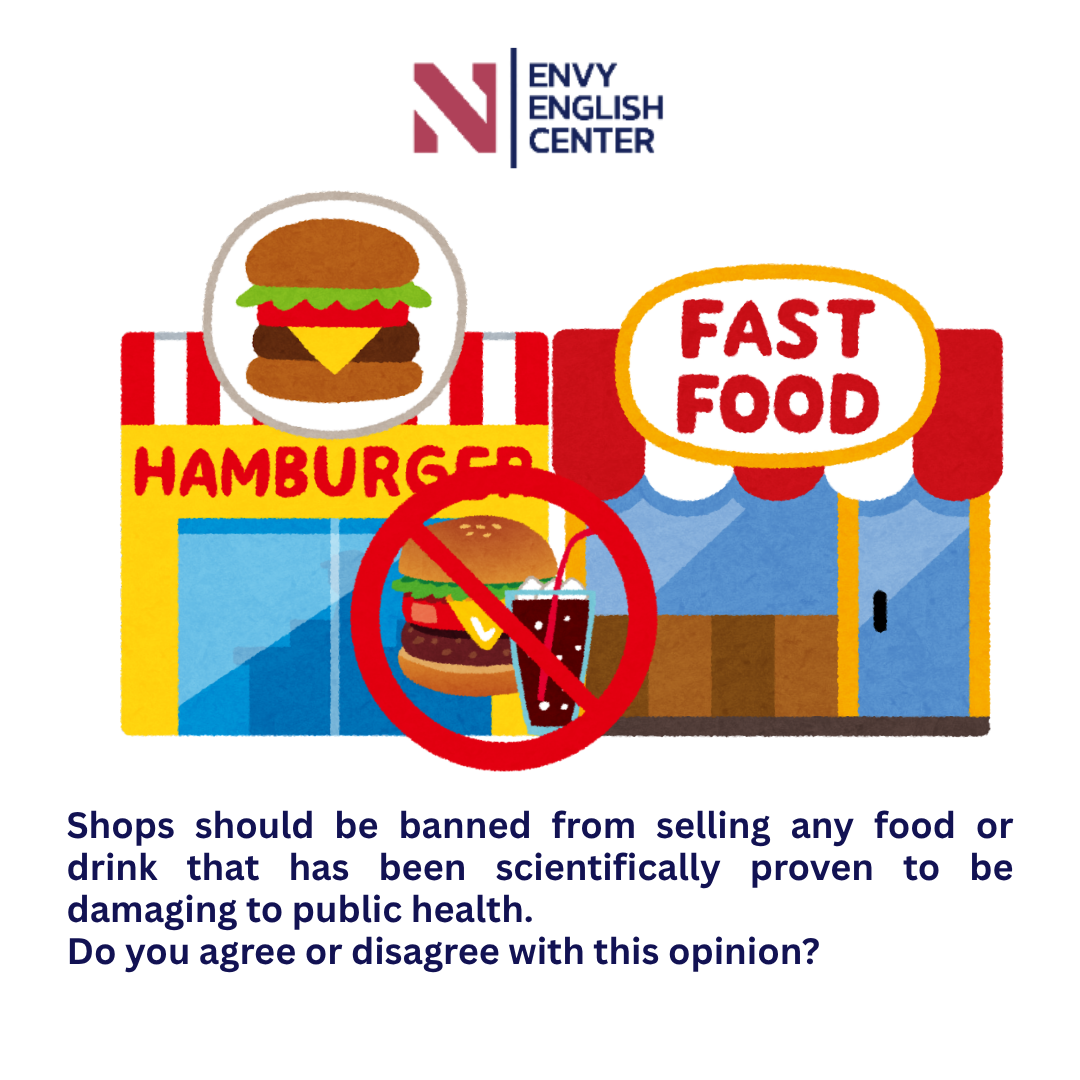
Shops should be banned from selling any food or drink that has been scientifically proven to be damaging to public health. Do you agree or disagree with this opinion?
Dạng bài
Opinion essay
Xác định chủ đề và luận điểm
Topic: Public Health and Food Regulation
Luận điểm 1: Reasons supporting the ban
Reduction in obesity rates: giảm tỷ lệ béo phì
Prevention of serious diseases: ngăn ngừa các bệnh nghiêm trọng
Lower healthcare costs: giảm chi phí y tế
Protection of children and teenagers: bảo vệ trẻ em và thanh thiếu niên
Encouragement of healthier lifestyles: khuyến khích lối sống lành mạnh
Limitation of harmful ingredients: hạn chế các thành phần có hại
Improved public health awareness: nâng cao nhận thức sức khỏe cộng đồng
Luận điểm 2: Reasons opposing the ban
Consumers should have freedom of choice: người tiêu dùng nên có quyền lựa chọn
Difficulties in defining unhealthy products: khó xác định sản phẩm không lành mạnh
Economic impact on businesses: tác động kinh tế đến doanh nghiệp
Personal responsibility for health: trách nhiệm cá nhân đối với sức khỏe
Moderate consumption may not be harmful: tiêu thụ vừa phải có thể không gây hại
Government control may become excessive: sự kiểm soát của chính phủ có thể trở nên quá mức
Public education is a better solution: giáo dục cộng đồng là giải pháp tốt hơn
Triển khai ý tưởng
Position 1
Although unhealthy food and drinks can damage public health, I disagree that governments should completely ban their sale because individuals should have the freedom to make personal dietary choices.
→ Mặc dù thực phẩm và đồ uống không lành mạnh có thể gây hại cho sức khỏe cộng đồng, tôi không đồng ý rằng chính phủ nên cấm hoàn toàn việc bán chúng vì mỗi cá nhân nên có quyền tự lựa chọn chế độ ăn uống.
Ví dụ:
Taxes on sugary drinks
Nutritional labeling on products
Position 2
Governments should ban harmful food products because public health problems such as obesity and diabetes are becoming increasingly serious worldwide.
→ Chính phủ nên cấm các sản phẩm thực phẩm có hại vì các vấn đề sức khỏe cộng đồng như béo phì và tiểu đường đang ngày càng nghiêm trọng trên toàn thế giới.
Ví dụ:
Restrictions on trans fats
Bans on unhealthy school meals
2. Lập dàn ý cho đề theo PEEL
Introduction
Paraphrase: some people believe shops should not be allowed to sell unhealthy food and drinks
Question: whether governments should ban products harmful to public health
Thesis: although unhealthy products can negatively affect society, I disagree with a complete ban because consumers should retain freedom of choice and education is a more practical solution
Body Paragraph 1
Point: unhealthy food contributes to serious health problems
Evidence: obesity, diabetes, heart disease, healthcare costs, unhealthy eating habits
Explanation: excessive consumption of harmful products damages public health
Link: governments should encourage healthier eating habits
Body Paragraph 2
Point: banning unhealthy products is not the best solution
Evidence: personal responsibility, consumer freedom, economic impact, difficulty defining unhealthy food
Explanation: education and regulation are more effective than complete prohibition
Link: balanced policies can protect public health without removing consumer choice
Conclusion
Summary: unhealthy food creates health risks but banning all harmful products is unrealistic
Restate: governments should focus on public education and regulation instead of complete prohibition
3. Bài mẫu hoàn chỉnh
Some people believe that shops should be prohibited from selling food and drinks that are scientifically proven to harm public health. Although I acknowledge that unhealthy products contribute to serious health problems, I disagree with the idea of a complete ban because individuals should maintain freedom of choice and governments can use more balanced approaches to improve public health.
There is no doubt that unhealthy food and drinks can damage society in many ways. Excessive consumption of processed food, sugary beverages, and fast food has contributed to rising obesity rates and various diseases such as diabetes and heart problems. Therefore, supporters of restrictions argue that banning harmful products could lead to reduction in obesity rates and the prevention of serious diseases. In addition, governments spend enormous amounts of money treating illnesses associated with poor diets, meaning that healthier eating habits could result in lower healthcare costs. Another concern is the protection of children and teenagers, who are heavily influenced by advertising and may not fully understand the long-term consequences of unhealthy eating. As a result, banning dangerous products may encourage healthier lifestyles and improve public awareness about nutrition.
However, I do not believe that completely banning these products is the most effective solution. One important reason is that consumers should have freedom of choice, including the right to decide what they eat and drink. Governments should not exercise excessive control over personal lifestyles. Another issue is the difficulty in identifying which products are truly unhealthy because moderate consumption may not be harmful in many cases. Furthermore, banning certain products could have a negative economic impact on businesses, especially restaurants and food manufacturers. Instead of prohibition, governments should focus on education and regulation. For example, authorities could introduce clear nutritional labeling, restrict unhealthy advertising aimed at children, and impose taxes on products containing excessive sugar or unhealthy ingredients. In my opinion, these measures would be more practical and effective than an outright ban.
Overall, although unhealthy food and drinks can seriously damage public health, I disagree that shops should be completely banned from selling them. Public education and reasonable regulation are better solutions for encouraging healthier lifestyles while still respecting personal freedom.
(Word count: 327)
4. Lexical Resources List
New Vocabulary
reduction in obesity rates (noun phrase): giảm tỷ lệ béo phì
E.g. Governments aim for a reduction in obesity rates through health campaigns.
prevention of serious diseases (noun phrase): ngăn ngừa các bệnh nghiêm trọng
E.g. Healthy diets support the prevention of serious diseases.
lower healthcare costs (noun phrase): giảm chi phí y tế
E.g. Exercise can contribute to lower healthcare costs.
protection of children and teenagers (noun phrase): bảo vệ trẻ em và thanh thiếu niên
E.g. Laws should focus on the protection of children and teenagers.
encouragement of healthier lifestyles (noun phrase): khuyến khích lối sống lành mạnh
E.g. Schools promote the encouragement of healthier lifestyles.
limitation of harmful ingredients (noun phrase): hạn chế các thành phần có hại
E.g. Governments support the limitation of harmful ingredients in food.
improved public health awareness (noun phrase): nâng cao nhận thức sức khỏe cộng đồng
E.g. Campaigns increase improved public health awareness.
consumers should have freedom of choice (clause): người tiêu dùng nên có quyền lựa chọn
E.g. Many people believe consumers should have freedom of choice.
difficulties in defining unhealthy products (noun phrase): khó xác định sản phẩm không lành mạnh
E.g. Policymakers face difficulties in defining unhealthy products.
economic impact on businesses (noun phrase): tác động kinh tế đến doanh nghiệp
E.g. Strict regulations may create an economic impact on businesses.
personal responsibility for health (noun phrase): trách nhiệm cá nhân đối với sức khỏe
E.g. Adults should accept personal responsibility for health.
moderate consumption may not be harmful (clause): tiêu thụ vừa phải có thể không gây hại
E.g. Nutritionists argue that moderate consumption may not be harmful.
government control may become excessive (clause): sự kiểm soát của chính phủ có thể trở nên quá mức
E.g. Some citizens fear government control may become excessive.
public education is a better solution (clause): giáo dục cộng đồng là giải pháp tốt hơn
E.g. Experts often believe public education is a better solution.
processed food (noun phrase): thực phẩm chế biến sẵn
E.g. Many teenagers consume too much processed food.
sugary beverages (noun phrase): đồ uống nhiều đường
E.g. Governments are taxing sugary beverages.
poor diets (noun phrase): chế độ ăn uống kém lành mạnh
E.g. Heart disease is linked to poor diets.
nutritional labeling (noun phrase): nhãn dinh dưỡng
E.g. Products should include clear nutritional labeling.
unhealthy advertising (noun phrase): quảng cáo không lành mạnh
E.g. Children are influenced by unhealthy advertising.
personal lifestyles (noun phrase): lối sống cá nhân
E.g. Governments should respect personal lifestyles.
Sentence Structures
1. Although + clause, I disagree with + noun phrase because + clause (dùng để nêu quan điểm phản đối)
E.g. Although I acknowledge that unhealthy products contribute to serious health problems, I disagree with the idea of a complete ban because individuals should maintain freedom of choice and governments can use more balanced approaches to improve public health.
2. There is no doubt that + clause (dùng để mở đoạn khẳng định vấn đề)
E.g. There is no doubt that unhealthy food and drinks can damage society in many ways.
3. Therefore, + noun phrase + argue that + clause (dùng để đưa quan điểm ủng hộ)
E.g. Therefore, supporters of restrictions argue that banning harmful products could lead to reduction in obesity rates and the prevention of serious diseases.
4. One important reason is that + clause, including + noun phrase (dùng để giải thích lý do phản đối)
E.g. One important reason is that consumers should have freedom of choice, including the right to decide what they eat and drink.
5. Instead of + noun phrase, + noun phrase + should focus on + noun phrase (dùng để đưa giải pháp thay thế)
E.g. Instead of prohibition, governments should focus on education and regulation.
6. Overall, although + noun phrase + can + verb + noun phrase, I disagree that + clause (dùng để kết luận rõ quan điểm)
E.g. Overall, although unhealthy food and drinks can seriously damage public health, I disagree that shops should be completely banned from selling them.
Nếu bạn đang bắt đầu từ con số 0 hoặc đã học nhưng “dậm chân tại chỗ”, Envy English Center có thể đồng hành cùng bạn:
Test trình độ miễn phí theo format IELTS để biết chính xác điểm mạnh – điểm yếu.
Nhận lộ trình học cá nhân hóa từ 0 → 6.5+, phù hợp tốc độ và mục tiêu.
Trực tiếp học với giáo viên IELTS 8.0+, chuyên “gỡ rối” Speaking & Writing – hai kỹ năng khó nâng band nhất.
Đặc biệt, khi đăng ký trong tuần này, bạn được tặng bộ từ vựng chuẩn IELTS band 7+.
📞 Hotline: 028 7300 9677 / 0948 197 270 (Zalo)
🌐 Website: envyenglish.vn
📍 Địa chỉ: 46/5 Tân Cảng, Phường Thạnh Mỹ Tây, Quận Bình Thạnh, TP.HCM


Thông tin gửi đi không thành công, vui lòng thử lại sau.
Nếu bạn cần liên hệ gấp, vui lòng gọi hotline
02873009677

Cảm ơn bạn đã gửi thông tin đến Envy English Center.
Chúng tôi sẽ liên hệ với bạn sớm nhất khi có thể.
Nếu bạn cần liên hệ gấp, vui lòng gọi hotline
02873009677
Thông tin gửi đi không thành công, vui lòng thử lại sau.
Nếu bạn cần liên hệ gấp, vui lòng gọi hotline
02873009677
Bạn đang có một bài test chưa hoàn thành.
Bạn có muốn tiếp tục bài test đó không?
Bạn có chắc là muốn gửi bài test này không?

Số câu trả lời đúng/40

Số câu trả lời đúng/40
Thông tin gửi đi không thành công, vui lòng thử lại sau.
Nếu bạn cần liên hệ gấp, vui lòng gọi hotline
02873009677
Thời gian làm bài kiểm tra đã hết.
Cảm ơn bạn đã cố gắng.
