 02873009677
 contact@envyenglish.vn

1. Xây dựng ý tưởng
Đề bài
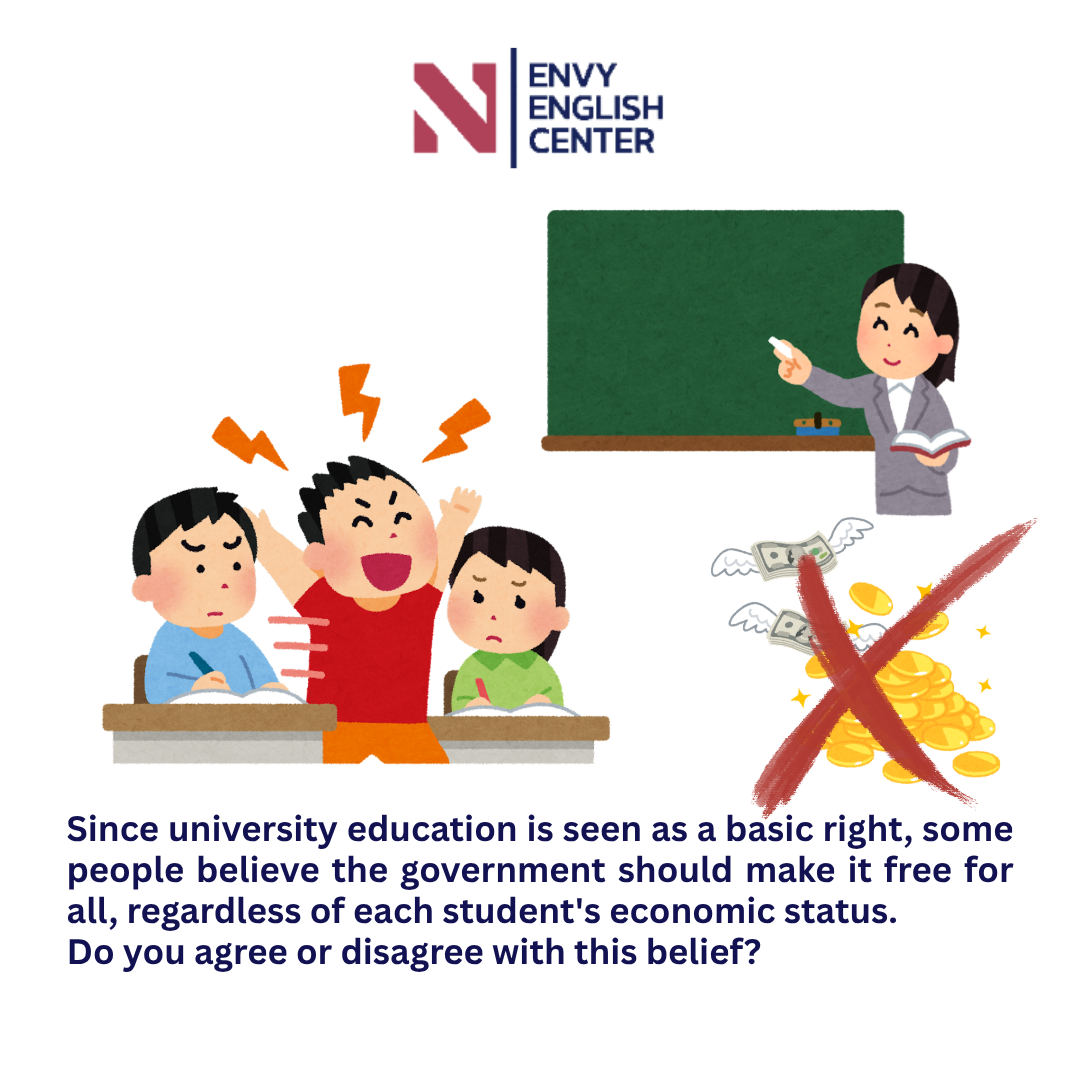
Since university education is seen as a basic right, some people believe the government should make it free for all, regardless of each student's economic status. Do you agree or disagree with this belief?
Dạng bài
Agree or disagree essay
Xác định chủ đề và luận điểm
Topic: Free University Education
Luận điểm 1: Reasons supporting free university education
Equal educational opportunities: cơ hội giáo dục bình đẳng
Financial burden reduction: giảm gánh nặng tài chính
Skilled workforce development: phát triển lực lượng lao động chất lượng cao
Social mobility improvement: cải thiện khả năng thăng tiến xã hội
Increased access to education: tăng khả năng tiếp cận giáo dục
National economic growth: tăng trưởng kinh tế quốc gia
Human capital investment: đầu tư vào nguồn nhân lực
Luận điểm 2: Reasons opposing completely free education
Government financial pressure: áp lực tài chính lên chính phủ
Wealthy students benefiting unfairly: sinh viên giàu hưởng lợi không công bằng
Reduced academic motivation: giảm động lực học tập
Limited public resources: nguồn lực công hạn chế
Declining educational quality: suy giảm chất lượng giáo dục
Taxpayer burden increase: tăng gánh nặng thuế
Alternative financial support systems: hệ thống hỗ trợ tài chính thay thế
Triển khai ý tưởng
Position 1
I strongly agree that university education should be free because higher education creates long-term social and economic benefits for the entire country.
→ Tôi hoàn toàn đồng ý rằng giáo dục đại học nên miễn phí vì giáo dục bậc cao tạo ra lợi ích kinh tế và xã hội lâu dài cho cả quốc gia.
Ví dụ:
Free university systems in Germany
Government-funded scholarships
Position 2
Although education should be accessible, completely free university education for all students would place excessive pressure on public finances and may not be the fairest solution.
→ Mặc dù giáo dục nên dễ tiếp cận, việc miễn phí hoàn toàn đại học cho mọi sinh viên sẽ tạo áp lực quá lớn lên ngân sách công và có thể không phải giải pháp công bằng nhất.
Ví dụ:
High taxation systems
Tuition support based on financial need
2. Lập dàn ý cho đề theo PEEL
Introduction
Paraphrase: some people believe university education should be free for everyone
Question: whether governments should fully fund higher education
Thesis: although free education improves equality, governments should provide targeted financial support rather than completely free university education for all students
Body Paragraph 1
Point: free university education offers social and economic advantages
Evidence: equal opportunities, skilled workforce, social mobility, reduced debt
Explanation: affordable education increases participation and economic productivity
Link: higher education benefits both individuals and society
Body Paragraph 2
Point: completely free education creates financial and practical challenges
Evidence: taxpayer burden, limited budgets, wealthy students benefiting, quality concerns
Explanation: governments must balance educational investment with other public services
Link: financial assistance should focus on students who genuinely need support
Conclusion
Summary: free university education provides important benefits but also creates financial pressures
Restate: targeted support systems are more sustainable than universal free education
3. Bài mẫu hoàn chỉnh
Many people believe that university education should be provided free of charge because it is considered a fundamental right. Although I agree that higher education should be widely accessible, I disagree with the idea that governments should make university completely free for all students regardless of their financial background.
There is no doubt that free university education could create several social and economic advantages. One important benefit is the creation of equal educational opportunities, allowing students from disadvantaged backgrounds to pursue higher education without facing serious financial barriers. This could contribute to social mobility improvement by helping talented individuals secure better employment and improve their living standards. In addition, reducing tuition fees may lead to greater participation in higher education and support skilled workforce development. Countries with highly educated populations often experience stronger national economic growth because educated workers contribute more effectively to innovation and productivity. Free education can therefore be viewed as a form of human capital investment that benefits society in the long term.
However, providing completely free university education for all students could create serious financial problems for governments. Funding higher education entirely through taxation would increase government financial pressure and potentially lead to a significant taxpayer burden increase. Moreover, universal free education may allow wealthy families to receive unnecessary financial support, resulting in wealthy students benefiting unfairly from public resources. Governments also face limited public resources, meaning excessive spending on universities could reduce funding for healthcare, infrastructure, and other essential services. In some cases, rapidly expanding free education systems may even contribute to declining educational quality if universities become overcrowded or underfunded. Instead, governments should focus on alternative financial support systems such as scholarships and student loans for those who genuinely need assistance.
Overall, although university education should be accessible to everyone, I believe targeted financial support is a more practical and sustainable solution than completely free higher education for all students.
(Word count: 319)
4. Lexical Resources List
New Vocabulary
equal educational opportunities (noun phrase): cơ hội giáo dục bình đẳng
E.g. Governments should promote equal educational opportunities for all citizens.
financial burden reduction (noun phrase): giảm gánh nặng tài chính
E.g. Scholarships contribute to financial burden reduction for students.
skilled workforce development (noun phrase): phát triển lực lượng lao động chất lượng cao
E.g. Universities play an important role in skilled workforce development.
social mobility improvement (noun phrase): cải thiện khả năng thăng tiến xã hội
E.g. Education supports social mobility improvement.
increased access to education (noun phrase): tăng khả năng tiếp cận giáo dục
E.g. Online learning encourages increased access to education.
national economic growth (noun phrase): tăng trưởng kinh tế quốc gia
E.g. Technology contributes to national economic growth.
human capital investment (noun phrase): đầu tư vào nguồn nhân lực
E.g. Many governments prioritize human capital investment.
government financial pressure (noun phrase): áp lực tài chính lên chính phủ
E.g. Economic crises often create government financial pressure.
wealthy students benefiting unfairly (noun phrase): sinh viên giàu hưởng lợi không công bằng
E.g. Critics argue that free tuition results in wealthy students benefiting unfairly.
limited public resources (noun phrase): nguồn lực công hạn chế
E.g. Policymakers must allocate limited public resources carefully.
declining educational quality (noun phrase): suy giảm chất lượng giáo dục
E.g. Overcrowded classrooms may cause declining educational quality.
taxpayer burden increase (noun phrase): tăng gánh nặng thuế
E.g. Expensive welfare systems can lead to taxpayer burden increase.
alternative financial support systems (noun phrase): hệ thống hỗ trợ tài chính thay thế
E.g. Many countries use alternative financial support systems for students.
fundamental right (noun phrase): quyền cơ bản
E.g. Some people view healthcare as a fundamental right.
financial barriers (noun phrase): rào cản tài chính
E.g. Poor families often face serious financial barriers.
living standards (noun phrase): mức sống
E.g. Stable employment improves living standards.
innovation and productivity (noun phrase): đổi mới và năng suất
E.g. Education encourages innovation and productivity.
public resources (noun phrase): nguồn lực công
E.g. Governments should manage public resources responsibly.
essential services (noun phrase): dịch vụ thiết yếu
E.g. Healthcare and transportation are considered essential services.
student loans (noun phrase): khoản vay sinh viên
E.g. Many graduates struggle to repay student loans.
Sentence Structures
1. Although + clause, I disagree with + noun phrase because + clause (dùng để thể hiện quan điểm phản đối có nhượng bộ)
E.g. Although I agree that higher education should be widely accessible, I disagree with the idea that governments should make university completely free for all students regardless of their financial background.
2. One important benefit is + noun phrase, allowing + noun phrase + to + verb (dùng để mở rộng lợi ích bằng cụm V-ing)
E.g. One important benefit is the creation of equal educational opportunities, allowing students from disadvantaged backgrounds to pursue higher education without facing serious financial barriers.
3. Countries with + noun phrase + often experience + noun phrase because + clause (dùng để đưa ví dụ khái quát)
E.g. Countries with highly educated populations often experience stronger national economic growth because educated workers contribute more effectively to innovation and productivity.
4. Funding + noun phrase + entirely through + noun phrase + would + verb (dùng để phân tích hệ quả chính sách)
E.g. Funding higher education entirely through taxation would increase government financial pressure and potentially lead to a significant taxpayer burden increase.
5. In some cases, + noun phrase + may even + verb if + clause (dùng để cảnh báo hệ quả tiêu cực)
E.g. In some cases, rapidly expanding free education systems may even contribute to declining educational quality if universities become overcrowded or underfunded.
6. Instead, + subject + should focus on + noun phrase + such as + examples (dùng để đề xuất giải pháp thay thế)
E.g. Instead, governments should focus on alternative financial support systems such as scholarships and student loans for those who genuinely need assistance.
Nếu bạn đang bắt đầu từ con số 0 hoặc đã học nhưng “dậm chân tại chỗ”, Envy English Center có thể đồng hành cùng bạn:
Test trình độ miễn phí theo format IELTS để biết chính xác điểm mạnh – điểm yếu.
Nhận lộ trình học cá nhân hóa từ 0 → 6.5+, phù hợp tốc độ và mục tiêu.
Trực tiếp học với giáo viên IELTS 8.0+, chuyên “gỡ rối” Speaking & Writing – hai kỹ năng khó nâng band nhất.
Đặc biệt, khi đăng ký trong tuần này, bạn được tặng bộ từ vựng chuẩn IELTS band 7+.
📞 Hotline: 028 7300 9677 / 0948 197 270 (Zalo)
🌐 Website: envyenglish.vn
📍 Địa chỉ: 46/5 Tân Cảng, Phường Thạnh Mỹ Tây, Quận Bình Thạnh, TP.HCM


Thông tin gửi đi không thành công, vui lòng thử lại sau.
Nếu bạn cần liên hệ gấp, vui lòng gọi hotline
02873009677

Cảm ơn bạn đã gửi thông tin đến Envy English Center.
Chúng tôi sẽ liên hệ với bạn sớm nhất khi có thể.
Nếu bạn cần liên hệ gấp, vui lòng gọi hotline
02873009677
Thông tin gửi đi không thành công, vui lòng thử lại sau.
Nếu bạn cần liên hệ gấp, vui lòng gọi hotline
02873009677
Bạn đang có một bài test chưa hoàn thành.
Bạn có muốn tiếp tục bài test đó không?
Bạn có chắc là muốn gửi bài test này không?

Số câu trả lời đúng/40

Số câu trả lời đúng/40
Thông tin gửi đi không thành công, vui lòng thử lại sau.
Nếu bạn cần liên hệ gấp, vui lòng gọi hotline
02873009677
Thời gian làm bài kiểm tra đã hết.
Cảm ơn bạn đã cố gắng.
