 02873009677
 contact@envyenglish.vn

1. Xây dựng ý tưởng
Đề bài
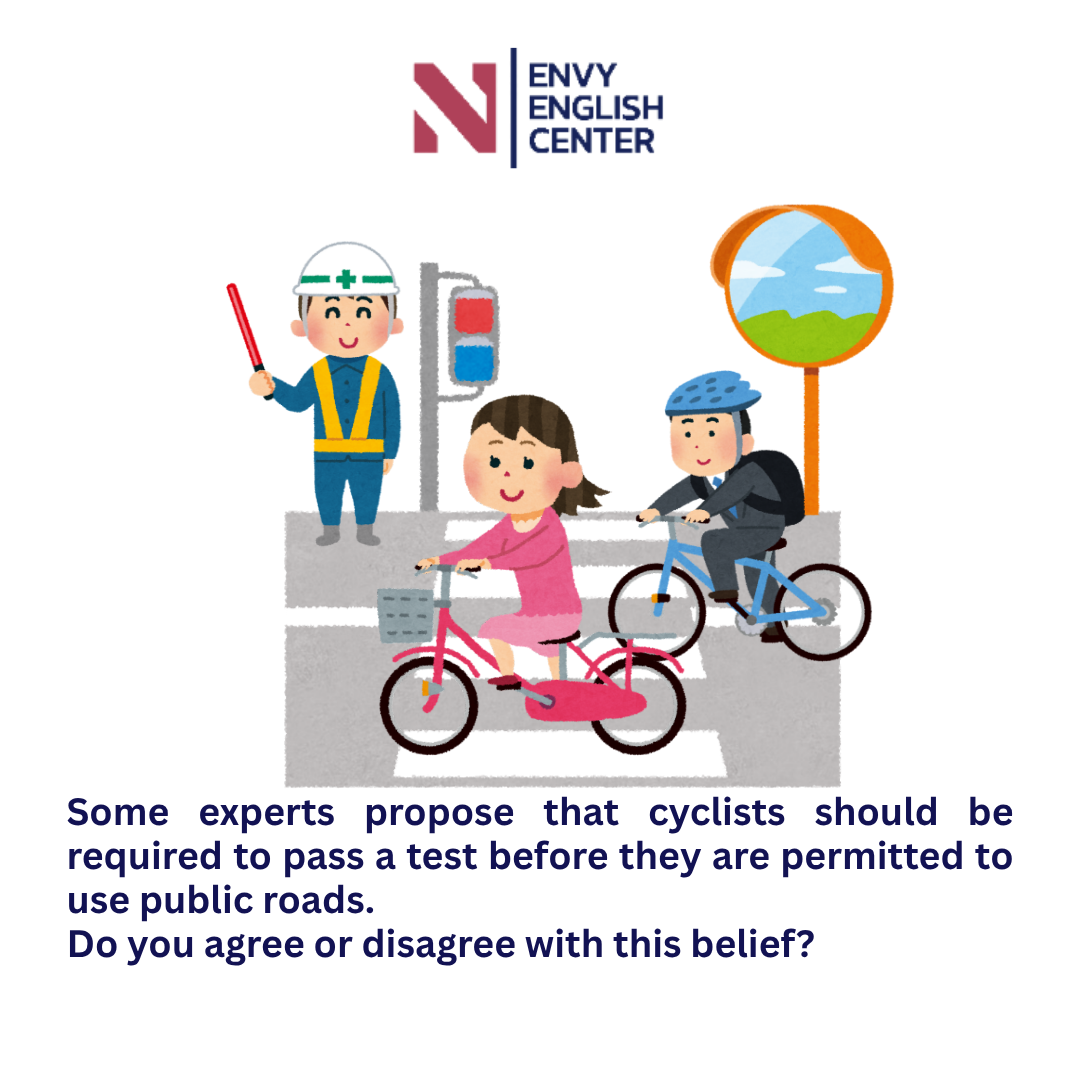
Some experts propose that cyclists should be required to pass a test before they are permitted to use public roads. Do you agree or disagree with this belief?
Dạng bài
Agree or disagree essay
Xác định chủ đề và luận điểm
Topic: Road Safety and Cycling Regulations
Luận điểm 1: Reasons supporting cycling tests
Road safety improvement: cải thiện an toàn giao thông
Traffic law awareness: nhận thức về luật giao thông
Accident prevention: phòng tránh tai nạn
Shared road responsibility: trách nhiệm chung khi tham gia giao thông
Cyclist accountability: trách nhiệm của người đi xe đạp
Safer urban transportation: giao thông đô thị an toàn hơn
Public traffic discipline: kỷ luật giao thông công cộng
Luận điểm 2: Reasons opposing compulsory testing
Reduced cycling participation: giảm số lượng người đi xe đạp
Financial and administrative burden: gánh nặng tài chính và hành chính
Environmental transportation benefits: lợi ích giao thông thân thiện môi trường
Accessibility concerns: vấn đề tiếp cận giao thông
Practical enforcement difficulties: khó khăn trong thực thi
Healthy lifestyle promotion: thúc đẩy lối sống lành mạnh
Overregulation risks: nguy cơ quản lý quá mức
Triển khai ý tưởng
Position 1
Although compulsory cycling tests may improve road safety, I believe making them mandatory for all cyclists would be unnecessarily restrictive and impractical.
→ Mặc dù các bài kiểm tra bắt buộc cho người đi xe đạp có thể cải thiện an toàn giao thông, tôi tin rằng việc áp dụng bắt buộc cho tất cả mọi người sẽ quá hạn chế và thiếu thực tế.
Ví dụ:
Children riding bicycles to school
Community cycling programs
Position 2
Cyclists should pass basic road safety tests because they share public roads with drivers and pedestrians and therefore must understand traffic regulations.
→ Người đi xe đạp nên vượt qua các bài kiểm tra an toàn giao thông cơ bản vì họ sử dụng chung đường với tài xế và người đi bộ nên cần hiểu luật giao thông.
Ví dụ:
Urban cycling accidents
Traffic signal violations
2. Lập dàn ý cho đề theo PEEL
Introduction
Paraphrase: some people believe cyclists should pass tests before using public roads
Question: whether compulsory cycling tests are necessary
Thesis: although road safety is important, mandatory testing for all cyclists is unnecessary and difficult to implement
Body Paragraph 1
Point: cycling tests may improve road safety and traffic awareness
Evidence: understanding road signs, accident prevention, shared road responsibility
Explanation: trained cyclists are more likely to follow traffic rules
Link: basic road knowledge can improve public safety
Body Paragraph 2
Point: compulsory testing creates practical and social disadvantages
Evidence: reduced cycling participation, enforcement costs, accessibility issues, environmental concerns
Explanation: excessive regulation may discourage healthy and eco-friendly transportation
Link: education campaigns are more effective than mandatory testing
Conclusion
Summary: cycling knowledge is important but compulsory testing has limitations
Restate: education and awareness are preferable to strict legal requirements
3. Bài mẫu hoàn chỉnh
Some experts argue that cyclists should be required to pass a test before being allowed to use public roads. Although I acknowledge that better cycling education could improve safety, I disagree with making such tests compulsory for all cyclists because this policy would be difficult to enforce and could discourage environmentally friendly transportation.
Supporters of compulsory testing often argue that it could contribute to road safety improvement. Cyclists share roads with cars, buses, and pedestrians, so understanding traffic rules is clearly important. A formal test could increase traffic law awareness and help reduce dangerous behavior such as ignoring traffic lights or cycling in restricted areas. In addition, testing could support accident prevention by ensuring that cyclists understand basic safety procedures and shared road responsibility. Advocates also believe that stronger cyclist accountability would create safer urban transportation and improve overall public traffic discipline in crowded cities.
However, I believe compulsory testing would create more disadvantages than benefits. One major concern is reduced cycling participation, especially among children, students, and low-income individuals who rely on bicycles as affordable transportation. Introducing mandatory tests could also create a significant financial and administrative burden for local governments. Furthermore, cycling provides important environmental transportation benefits by reducing pollution and traffic congestion, so governments should encourage rather than discourage this activity. There are also serious accessibility concerns, particularly in rural areas where formal testing centers may not exist. In practice, there would likely be many practical enforcement difficulties, making the policy inefficient. Instead of introducing strict regulations, governments should focus on road safety campaigns and cycling education programs in schools.
Overall, while cyclists should certainly understand traffic rules, I believe compulsory testing is an excessive solution that may create unnecessary problems and discourage healthy, sustainable transportation.
(Word count: 319)
4. Lexical Resources List
New Vocabulary
road safety improvement (noun phrase): cải thiện an toàn giao thông
E.g. Governments continue investing in road safety improvement projects.
traffic law awareness (noun phrase): nhận thức về luật giao thông
E.g. Schools can help increase traffic law awareness among teenagers.
accident prevention (noun phrase): phòng tránh tai nạn
E.g. Speed limits contribute to accident prevention.
shared road responsibility (noun phrase): trách nhiệm chung khi tham gia giao thông
E.g. Drivers and cyclists both have shared road responsibility.
cyclist accountability (noun phrase): trách nhiệm của người đi xe đạp
E.g. Some cities are strengthening cyclist accountability.
safer urban transportation (noun phrase): giao thông đô thị an toàn hơn
E.g. Dedicated bike lanes support safer urban transportation.
public traffic discipline (noun phrase): kỷ luật giao thông công cộng
E.g. Strict regulations can improve public traffic discipline.
reduced cycling participation (noun phrase): giảm số lượng người đi xe đạp
E.g. Expensive regulations may lead to reduced cycling participation.
financial and administrative burden (noun phrase): gánh nặng tài chính và hành chính
E.g. New policies sometimes create a heavy financial and administrative burden.
environmental transportation benefits (noun phrase): lợi ích giao thông thân thiện môi trường
E.g. Public transport provides many environmental transportation benefits.
accessibility concerns (noun phrase): vấn đề tiếp cận giao thông
E.g. Rural communities often face accessibility concerns.
practical enforcement difficulties (noun phrase): khó khăn trong thực thi
E.g. Governments may encounter practical enforcement difficulties.
healthy lifestyle promotion (noun phrase): thúc đẩy lối sống lành mạnh
E.g. Sports programs support healthy lifestyle promotion.
overregulation risks (noun phrase): nguy cơ quản lý quá mức
E.g. Businesses sometimes complain about overregulation risks.
environmentally friendly transportation (noun phrase): phương tiện giao thông thân thiện môi trường
E.g. Cycling is considered environmentally friendly transportation.
restricted areas (noun phrase): khu vực hạn chế
E.g. Vehicles are prohibited from entering restricted areas.
crowded cities (noun phrase): thành phố đông đúc
E.g. Traffic congestion is common in crowded cities.
low-income individuals (noun phrase): người có thu nhập thấp
E.g. Public services should support low-income individuals.
traffic congestion (noun phrase): ùn tắc giao thông
E.g. Governments are trying to reduce traffic congestion.
cycling education programs (noun phrase): chương trình giáo dục đạp xe an toàn
E.g. Schools should introduce cycling education programs for children.
Sentence Structures
1. Although + clause, I disagree with + noun phrase because + clause (dùng để nhượng bộ trước khi phản đối quan điểm đề bài)
E.g. Although I acknowledge that better cycling education could improve safety, I disagree with making such tests compulsory for all cyclists because this policy would be difficult to enforce and could discourage environmentally friendly transportation.
2. Supporters of + noun phrase + often argue that + clause (dùng để trình bày quan điểm đối lập)
E.g. Supporters of compulsory testing often argue that it could contribute to road safety improvement.
3. A formal test could + verb + and help + verb (dùng để nêu lợi ích tiềm năng)
E.g. A formal test could increase traffic law awareness and help reduce dangerous behavior such as ignoring traffic lights or cycling in restricted areas.
4. One major concern is + noun phrase, especially among + noun phrase (dùng để nêu bất lợi chính)
E.g. One major concern is reduced cycling participation, especially among children, students, and low-income individuals who rely on bicycles as affordable transportation.
5. Instead of + gerund phrase, + subject + should + verb (dùng để đề xuất giải pháp thay thế)
E.g. Instead of introducing strict regulations, governments should focus on road safety campaigns and cycling education programs in schools.
6. Overall, while + clause, I believe + clause because + clause (dùng để kết luận với lập trường rõ ràng)
E.g. Overall, while cyclists should certainly understand traffic rules, I believe compulsory testing is an excessive solution that may create unnecessary problems and discourage healthy, sustainable transportation.
Nếu bạn đang bắt đầu từ con số 0 hoặc đã học nhưng “dậm chân tại chỗ”, Envy English Center có thể đồng hành cùng bạn:
Test trình độ miễn phí theo format IELTS để biết chính xác điểm mạnh – điểm yếu.
Nhận lộ trình học cá nhân hóa từ 0 → 6.5+, phù hợp tốc độ và mục tiêu.
Trực tiếp học với giáo viên IELTS 8.0+, chuyên “gỡ rối” Speaking & Writing – hai kỹ năng khó nâng band nhất.
Đặc biệt, khi đăng ký trong tuần này, bạn được tặng bộ từ vựng chuẩn IELTS band 7+.
📞 Hotline: 028 7300 9677 / 0948 197 270 (Zalo)
🌐 Website: envyenglish.vn
📍 Địa chỉ: 46/5 Tân Cảng, Phường Thạnh Mỹ Tây, Quận Bình Thạnh, TP.HCM


Thông tin gửi đi không thành công, vui lòng thử lại sau.
Nếu bạn cần liên hệ gấp, vui lòng gọi hotline
02873009677

Cảm ơn bạn đã gửi thông tin đến Envy English Center.
Chúng tôi sẽ liên hệ với bạn sớm nhất khi có thể.
Nếu bạn cần liên hệ gấp, vui lòng gọi hotline
02873009677
Thông tin gửi đi không thành công, vui lòng thử lại sau.
Nếu bạn cần liên hệ gấp, vui lòng gọi hotline
02873009677
Bạn đang có một bài test chưa hoàn thành.
Bạn có muốn tiếp tục bài test đó không?
Bạn có chắc là muốn gửi bài test này không?

Số câu trả lời đúng/40

Số câu trả lời đúng/40
Thông tin gửi đi không thành công, vui lòng thử lại sau.
Nếu bạn cần liên hệ gấp, vui lòng gọi hotline
02873009677
Thời gian làm bài kiểm tra đã hết.
Cảm ơn bạn đã cố gắng.
