 02873009677
 contact@envyenglish.vn
1. Xây dựng ý tưởng
Đề bài
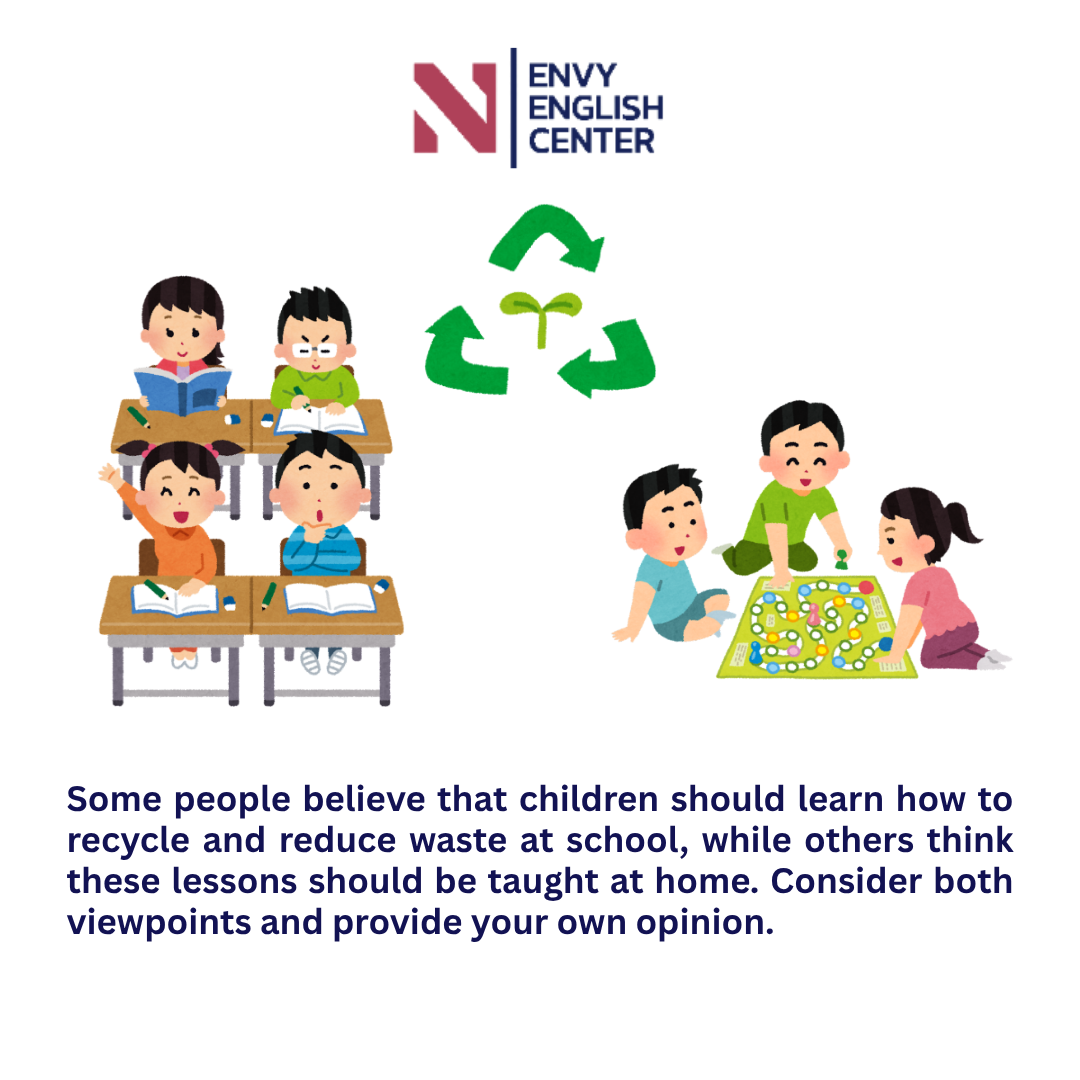
Some people believe that children should learn how to recycle and reduce waste at school, while others think these lessons should be taught at home. Consider both viewpoints and provide your own opinion.
Dạng bài
Discuss both views and give your opinion
Xác định chủ đề và luận điểm
Topic: Environmental Education for Children
Luận điểm 1: Reasons supporting environmental education at school
Structured environmental education: giáo dục môi trường có hệ thống
Equal learning opportunities: cơ hội học tập bình đẳng
Professional instruction quality: chất lượng giảng dạy chuyên môn
School recycling programs: chương trình tái chế tại trường
Environmental awareness development: phát triển nhận thức môi trường
Group learning activities: hoạt động học tập theo nhóm
Long-term behavioral change: thay đổi hành vi lâu dài
Luận điểm 2: Reasons supporting environmental education at home
Parental influence strength: ảnh hưởng mạnh mẽ từ cha mẹ
Daily habit formation: hình thành thói quen hằng ngày
Practical household experience: trải nghiệm thực tế trong gia đình
Consistent behavioral guidance: định hướng hành vi nhất quán
Family responsibility values: giá trị trách nhiệm gia đình
Personalized learning approach: cách học cá nhân hóa
Real-life environmental practices: thực hành môi trường thực tế
Triển khai ý tưởng
Position 1
Although parents play an important role in shaping children’s habits, I believe schools should take primary responsibility for teaching recycling and waste reduction because they provide structured and equal education.
→ Mặc dù cha mẹ đóng vai trò quan trọng trong việc hình thành thói quen của trẻ, tôi tin rằng trường học nên chịu trách nhiệm chính trong việc dạy tái chế và giảm rác thải vì họ cung cấp nền giáo dục có hệ thống và công bằng.
Ví dụ:
School recycling campaigns
Environmental science lessons
Position 2
Environmental responsibility should mainly be taught at home because parents influence children’s daily habits more directly than teachers.
→ Trách nhiệm môi trường nên chủ yếu được dạy ở nhà vì cha mẹ ảnh hưởng trực tiếp đến thói quen hằng ngày của trẻ nhiều hơn giáo viên.
Ví dụ:
Sorting household waste
Reusing plastic containers at home
2. Lập dàn ý cho đề theo PEEL
Introduction
Paraphrase: some people believe schools should teach recycling while others think parents should do so at home
Question: whether environmental education belongs mainly to schools or families
Thesis: although families strongly influence children’s habits, schools should play the leading role because they provide organized and consistent environmental education
Body Paragraph 1
Point: schools provide effective environmental education for all children
Evidence: structured lessons, recycling programs, trained teachers, group activities
Explanation: schools ensure consistent knowledge and long-term awareness
Link: formal education can shape responsible environmental behavior
Body Paragraph 2
Point: parents also influence children’s environmental habits at home
Evidence: daily routines, waste sorting, reusable products, family guidance
Explanation: practical experiences help children apply environmental knowledge
Link: cooperation between schools and families is necessary
Conclusion
Summary: both schools and families contribute to environmental education
Restate: schools should take the primary role while parents reinforce habits at home
3. Bài mẫu hoàn chỉnh
Teaching children how to recycle and reduce waste has become increasingly important due to growing environmental concerns. While some people believe these lessons should mainly be taught at school, others argue that parents should take responsibility at home. In my opinion, although families play a valuable role in shaping children’s habits, schools should be primarily responsible because they provide more organized and consistent environmental education.
One major advantage of teaching environmental responsibility at school is the availability of structured environmental education. Schools can design formal lessons and activities that help students understand the importance of recycling, waste reduction, and environmental protection. In addition, schools provide equal learning opportunities, ensuring that all children receive the same information regardless of their family background. Teachers can also deliver lessons with high professional instruction quality, using interactive methods and practical activities to improve engagement. Many schools organize school recycling programs, which encourage students to apply environmental concepts in real-life situations. As a result, schools can support environmental awareness development and promote long-term behavioral change among young people.
However, parents also play a crucial role in environmental education. Children spend a large amount of time at home, making families important for daily habit formation. Through practical household experience, children can learn how to separate waste, reuse products, and reduce unnecessary consumption. In addition, strong parental influence strength may encourage children to maintain environmentally responsible behaviors outside school. Parents are also able to provide consistent behavioral guidance through daily routines and real-life examples.
Overall, although environmental responsibility should be supported both at school and at home, I believe schools should take the leading role because they can provide structured education and ensure all children develop strong environmental awareness.
(Word count: 314)
4. Lexical Resources List
New Vocabulary
structured environmental education (noun phrase): giáo dục môi trường có hệ thống
E.g. Schools should provide structured environmental education.
equal learning opportunities (noun phrase): cơ hội học tập bình đẳng
E.g. Public education promotes equal learning opportunities.
professional instruction quality (noun phrase): chất lượng giảng dạy chuyên môn
E.g. Teacher training improves professional instruction quality.
school recycling programs (noun phrase): chương trình tái chế tại trường
E.g. Many schools organize school recycling programs.
environmental awareness development (noun phrase): phát triển nhận thức môi trường
E.g. Social media can support environmental awareness development.
group learning activities (noun phrase): hoạt động học tập theo nhóm
E.g. Teachers often use group learning activities in class.
long-term behavioral change (noun phrase): thay đổi hành vi lâu dài
E.g. Education can encourage long-term behavioral change.
parental influence strength (noun phrase): ảnh hưởng mạnh mẽ từ cha mẹ
E.g. Children are strongly affected by parental influence strength.
daily habit formation (noun phrase): hình thành thói quen hằng ngày
E.g. Childhood is important for daily habit formation.
practical household experience (noun phrase): trải nghiệm thực tế trong gia đình
E.g. Cooking helps children gain practical household experience.
consistent behavioral guidance (noun phrase): định hướng hành vi nhất quán
E.g. Parents should provide consistent behavioral guidance.
family responsibility values (noun phrase): giá trị trách nhiệm gia đình
E.g. Schools and parents should teach family responsibility values.
personalized learning approach (noun phrase): cách học cá nhân hóa
E.g. Online courses support a personalized learning approach.
real-life environmental practices (noun phrase): thực hành môi trường thực tế
E.g. Recycling is one example of real-life environmental practices.
environmental protection (noun phrase): bảo vệ môi trường
E.g. Governments should invest more in environmental protection.
interactive methods (noun phrase): phương pháp tương tác
E.g. Modern teachers often use interactive methods.
real-life situations (noun phrase): tình huống thực tế
E.g. Students learn better through real-life situations.
environmentally responsible behaviors (noun phrase): hành vi có trách nhiệm với môi trường
E.g. Schools should encourage environmentally responsible behaviors.
daily routines (noun phrase): thói quen hằng ngày
E.g. Exercise should become part of daily routines.
environmental awareness (noun phrase): nhận thức môi trường
E.g. Campaigns can increase environmental awareness.
Sentence Structures
1. While some people believe + clause, others argue that + clause (dùng để mở bài với hai quan điểm đối lập)
E.g. While some people believe these lessons should mainly be taught at school, others argue that parents should take responsibility at home.
2. One major advantage of + gerund phrase + is + noun phrase (dùng để mở đoạn nêu lợi ích)
E.g. One major advantage of teaching environmental responsibility at school is the availability of structured environmental education.
3. In addition, + subject + provide(s) + noun phrase, ensuring that + clause (dùng để bổ sung lợi ích và kết quả)
E.g. In addition, schools provide equal learning opportunities, ensuring that all children receive the same information regardless of their family background.
4. As a result, + subject + can + verb + and + verb (dùng để nêu kết quả tích cực)
E.g. As a result, schools can support environmental awareness development and promote long-term behavioral change among young people.
5. Through + noun phrase, + subject + can learn how to + verb series (dùng để mô tả quá trình học kỹ năng)
E.g. Through practical household experience, children can learn how to separate waste, reuse products, and reduce unnecessary consumption.
6. Overall, although + clause, I believe + clause because + clause (dùng để kết luận với lập trường rõ ràng)
E.g. Overall, although environmental responsibility should be supported both at school and at home, I believe schools should take the leading role because they can provide structured education and ensure all children develop strong environmental awareness.
Nếu bạn đang bắt đầu từ con số 0 hoặc đã học nhưng “dậm chân tại chỗ”, Envy English Center có thể đồng hành cùng bạn:
Test trình độ miễn phí theo format IELTS để biết chính xác điểm mạnh – điểm yếu.
Nhận lộ trình học cá nhân hóa từ 0 → 6.5+, phù hợp tốc độ và mục tiêu.
Trực tiếp học với giáo viên IELTS 8.0+, chuyên “gỡ rối” Speaking & Writing – hai kỹ năng khó nâng band nhất.
Đặc biệt, khi đăng ký trong tuần này, bạn được tặng bộ từ vựng chuẩn IELTS band 7+.
📞 Hotline: 028 7300 9677 / 0948 197 270 (Zalo)
🌐 Website: envyenglish.vn
📍 Địa chỉ: 46/5 Tân Cảng, Phường Thạnh Mỹ Tây, Quận Bình Thạnh, TP.HCM

Thông tin gửi đi không thành công, vui lòng thử lại sau.
Nếu bạn cần liên hệ gấp, vui lòng gọi hotline
02873009677

Cảm ơn bạn đã gửi thông tin đến Envy English Center.
Chúng tôi sẽ liên hệ với bạn sớm nhất khi có thể.
Nếu bạn cần liên hệ gấp, vui lòng gọi hotline
02873009677
Thông tin gửi đi không thành công, vui lòng thử lại sau.
Nếu bạn cần liên hệ gấp, vui lòng gọi hotline
02873009677
Bạn đang có một bài test chưa hoàn thành.
Bạn có muốn tiếp tục bài test đó không?
Bạn có chắc là muốn gửi bài test này không?

Số câu trả lời đúng/40

Số câu trả lời đúng/40
Thông tin gửi đi không thành công, vui lòng thử lại sau.
Nếu bạn cần liên hệ gấp, vui lòng gọi hotline
02873009677
Thời gian làm bài kiểm tra đã hết.
Cảm ơn bạn đã cố gắng.
