 02873009677
 contact@envyenglish.vn

1. Xây dựng ý tưởng
Đề bài
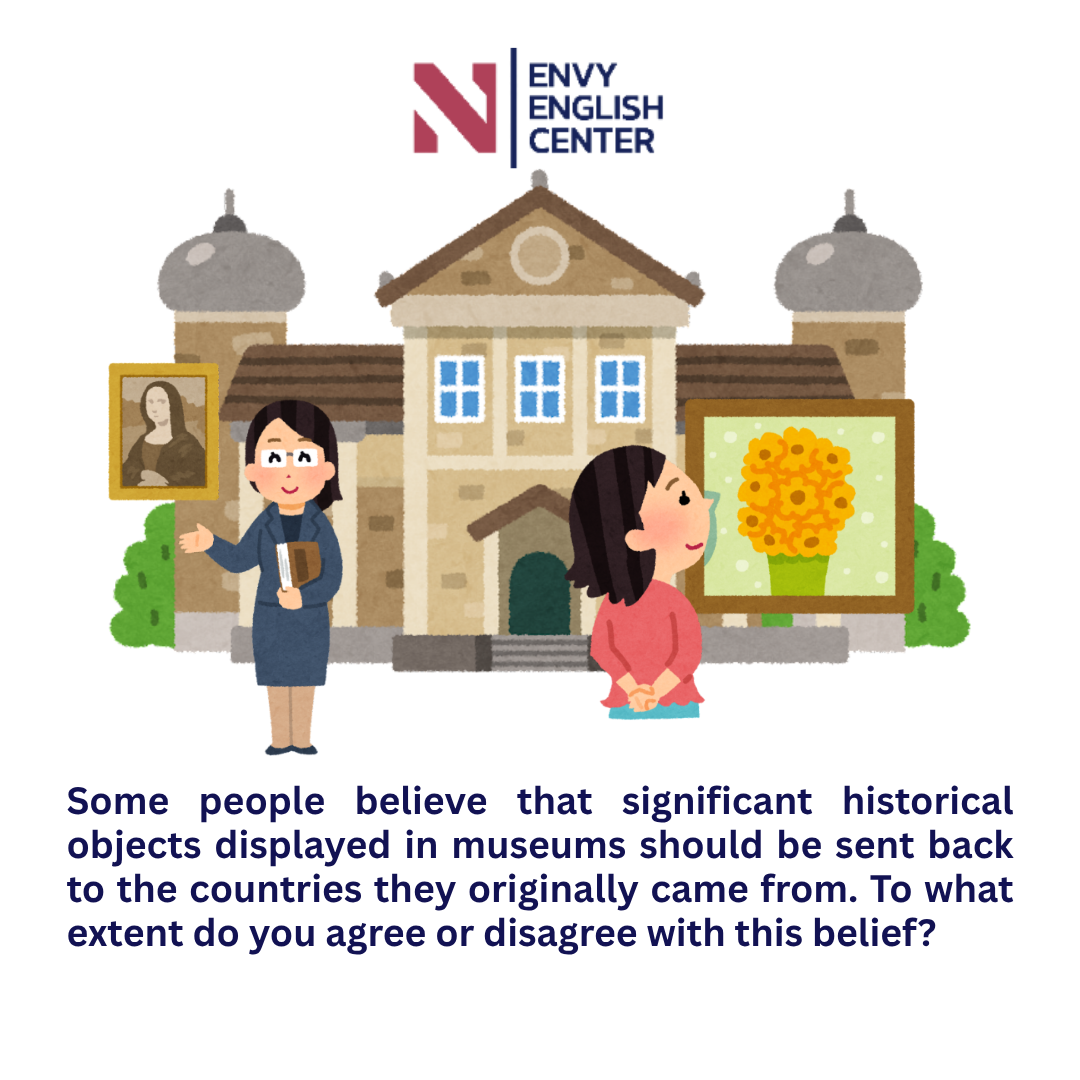
Some people believe that significant historical objects displayed in museums should be sent back to the countries they originally came from. To what extent do you agree or disagree with this belief?
Dạng bài
Agree or disagree essay
Xác định chủ đề và luận điểm
Topic: Cultural Heritage and Museum Repatriation
Luận điểm 1: Historical objects should be returned
Cultural ownership: quyền sở hữu văn hóa
National identity: bản sắc dân tộc
Historical justice: công bằng lịch sử
Cultural preservation: bảo tồn văn hóa
Ethical responsibility: trách nhiệm đạo đức
Post-colonial restoration: khôi phục sau thời kỳ thuộc địa
Public access for local citizens: cơ hội tiếp cận cho người dân bản địa
Luận điểm 2: Historical objects should remain in international museums
Global education: giáo dục toàn cầu
Professional conservation: bảo tồn chuyên nghiệp
International accessibility: khả năng tiếp cận quốc tế
Cultural exchange: giao lưu văn hóa
Tourism development: phát triển du lịch
Shared human history: lịch sử chung của nhân loại
Museum security: an ninh bảo tàng
Triển khai ý tưởng
Position 1
Although international museums provide valuable educational opportunities, I strongly believe that historically significant artifacts should be returned to their countries of origin.
→ Mặc dù các bảo tàng quốc tế mang lại giá trị giáo dục lớn, tôi tin rằng những hiện vật lịch sử quan trọng nên được trả về quốc gia gốc.
Ví dụ:
Ancient Egyptian artifacts
Greek marble sculptures
Position 2
While certain artifacts may belong to their original nations, keeping them in major international museums can also benefit global education and cultural exchange.
→ Mặc dù một số hiện vật thuộc về quốc gia gốc, việc lưu giữ chúng tại các bảo tàng quốc tế lớn cũng mang lại lợi ích cho giáo dục toàn cầu và giao lưu văn hóa.
Ví dụ:
British Museum collections
Louvre Museum exhibitions
2. Lập dàn ý cho đề theo PEEL
Introduction
Paraphrase: debate over ownership of historical artifacts displayed abroad
Debate: repatriation versus international preservation
Thesis: most significant artifacts should be returned to their countries of origin
Body Paragraph 1
Point: historical objects represent cultural identity and national heritage
Evidence: colonial acquisitions, symbolic artifacts, public cultural access
Explanation: returning objects supports historical justice and cultural preservation
Link: nations should control their own heritage
Body Paragraph 2
Point: international museums also provide educational and conservation benefits
Evidence: advanced security, professional restoration, global visitors
Explanation: wider public access and stronger preservation standards
Link: international cooperation remains important despite repatriation
Conclusion
Summary: both perspectives offer valid arguments
Restate: culturally significant objects should primarily belong to their original nations
3. Bài mẫu hoàn chỉnh
Many important historical artifacts are currently displayed in museums far from the countries where they were originally discovered. While some people argue that these objects should remain in international museums for educational purposes, I strongly believe that culturally significant artifacts should be returned to their countries of origin because they represent national identity, historical justice, and cultural ownership.
One of the strongest arguments in favor of returning historical objects is their deep connection to a nation's history and identity. Many artifacts were removed during periods of war, colonial expansion, or political instability, meaning their acquisition was not always ethically justified. Returning these objects can therefore promote historical justice and support post-colonial restoration. In addition, many artifacts hold spiritual, cultural, or symbolic value that cannot be fully understood outside their original context. By returning them, governments can strengthen national identity and improve public access for local citizens, allowing future generations to connect more directly with their own heritage. This also contributes to long-term cultural preservation.
On the other hand, international museums also offer certain advantages. Major institutions often have better funding, stronger museum security, and more advanced conservation technology, which can support professional conservation of fragile objects. Furthermore, displaying artifacts in global museums can promote global education and encourage meaningful cultural exchange among international visitors. Millions of tourists visit famous museums every year, allowing people from different backgrounds to appreciate shared human history.
Despite these benefits, I believe ownership should remain with the countries where these artifacts originated. International cooperation, temporary exhibitions, and cultural partnerships can still ensure worldwide accessibility without permanently removing cultural treasures from their historical homes.
Overall, I strongly agree that significant historical objects should be returned to their countries of origin, as cultural heritage should primarily belong to the communities that created it.
(Word count: 316)
4. Lexical Resources List
New Vocabulary
cultural ownership (noun phrase): quyền sở hữu văn hóa
E.g. Indigenous communities often fight for cultural ownership of sacred artifacts.
historical justice (noun phrase): công bằng lịch sử
E.g. Returning stolen artifacts may support historical justice.
post-colonial restoration (noun phrase): khôi phục sau thời kỳ thuộc địa
E.g. Some nations view repatriation as post-colonial restoration.
national identity (noun phrase): bản sắc dân tộc
E.g. Traditional festivals strengthen national identity.
public access for local citizens (noun phrase): cơ hội tiếp cận cho người dân bản địa
E.g. Museums should improve public access for local citizens.
cultural preservation (noun phrase): bảo tồn văn hóa
E.g. Education plays an important role in cultural preservation.
museum security (noun phrase): an ninh bảo tàng
E.g. Rare artifacts require high-level museum security.
professional conservation (noun phrase): bảo tồn chuyên nghiệp
E.g. Ancient paintings need professional conservation.
global education (noun phrase): giáo dục toàn cầu
E.g. International museums contribute to global education.
cultural exchange (noun phrase): giao lưu văn hóa
E.g. Student exchange programs promote cultural exchange.
shared human history (noun phrase): lịch sử chung của nhân loại
E.g. Ancient monuments reflect shared human history.
colonial expansion (noun phrase): sự mở rộng thuộc địa
E.g. Many territories suffered during colonial expansion.
political instability (noun phrase): bất ổn chính trị
E.g. Wars often create long periods of political instability.
symbolic value (noun phrase): giá trị biểu tượng
E.g. National monuments often carry strong symbolic value.
conservation technology (noun phrase): công nghệ bảo tồn
E.g. Modern conservation technology helps protect fragile artifacts.
temporary exhibitions (noun phrase): triển lãm tạm thời
E.g. Museums often organize temporary exhibitions for international visitors.
cultural partnerships (noun phrase): quan hệ hợp tác văn hóa
E.g. Governments can build stronger cultural partnerships.
cultural treasures (noun phrase): báu vật văn hóa
E.g. Nations should protect their cultural treasures.
historical homes (noun phrase): quê hương lịch sử
E.g. Ancient artifacts deserve to return to their historical homes.
countries of origin (noun phrase): quốc gia gốc
E.g. Many museums face pressure to return objects to their countries of origin.
Sentence Structures
1. While + clause, I strongly believe + clause (dùng để thừa nhận quan điểm đối lập trước khi bảo vệ lập trường)
E.g. While some people argue that these objects should remain in international museums for educational purposes, I strongly believe that culturally significant artifacts should be returned to their countries of origin because they represent national identity, historical justice, and cultural ownership.
2. Returning + noun phrase + can + verb (dùng để nhấn mạnh lợi ích của hành động)
E.g. Returning these objects can therefore promote historical justice and support post-colonial restoration.
3. By + V-ing, subject + can + verb (dùng để diễn đạt phương thức tạo ra kết quả)
E.g. By returning them, governments can strengthen national identity and improve public access for local citizens, allowing future generations to connect more directly with their own heritage.
4. Furthermore, V-ing + can + verb (dùng để mở rộng lợi ích)
E.g. Furthermore, displaying artifacts in global museums can promote global education and encourage meaningful cultural exchange among international visitors.
5. Despite + noun phrase, I believe + clause (dùng để bảo vệ lập trường sau khi thừa nhận lợi ích đối lập)
E.g. Despite these benefits, I believe ownership should remain with the countries where these artifacts originated.
6. Overall, I strongly agree that + clause (dùng để kết luận rõ ràng trong dạng agree or disagree)
E.g. Overall, I strongly agree that significant historical objects should be returned to their countries of origin, as cultural heritage should primarily belong to the communities that created it.
Nếu bạn đang bắt đầu từ con số 0 hoặc đã học nhưng “dậm chân tại chỗ”, Envy English Center có thể đồng hành cùng bạn:
Test trình độ miễn phí theo format IELTS để biết chính xác điểm mạnh – điểm yếu.
Nhận lộ trình học cá nhân hóa từ 0 → 6.5+, phù hợp tốc độ và mục tiêu.
Trực tiếp học với giáo viên IELTS 8.0+, chuyên “gỡ rối” Speaking & Writing – hai kỹ năng khó nâng band nhất.
Đặc biệt, khi đăng ký trong tuần này, bạn được tặng bộ từ vựng chuẩn IELTS band 7+.
📞 Hotline: 028 7300 9677 / 0948 197 270 (Zalo)
🌐 Website: envyenglish.vn
📍 Địa chỉ: 46/5 Tân Cảng, Phường Thạnh Mỹ Tây, Quận Bình Thạnh, TP.HCM

Thông tin gửi đi không thành công, vui lòng thử lại sau.
Nếu bạn cần liên hệ gấp, vui lòng gọi hotline
02873009677

Cảm ơn bạn đã gửi thông tin đến Envy English Center.
Chúng tôi sẽ liên hệ với bạn sớm nhất khi có thể.
Nếu bạn cần liên hệ gấp, vui lòng gọi hotline
02873009677
Thông tin gửi đi không thành công, vui lòng thử lại sau.
Nếu bạn cần liên hệ gấp, vui lòng gọi hotline
02873009677
Bạn đang có một bài test chưa hoàn thành.
Bạn có muốn tiếp tục bài test đó không?
Bạn có chắc là muốn gửi bài test này không?

Số câu trả lời đúng/40

Số câu trả lời đúng/40
Thông tin gửi đi không thành công, vui lòng thử lại sau.
Nếu bạn cần liên hệ gấp, vui lòng gọi hotline
02873009677
Thời gian làm bài kiểm tra đã hết.
Cảm ơn bạn đã cố gắng.
