 02873009677
 contact@envyenglish.vn

1. Xây dựng ý tưởng
Đề bài
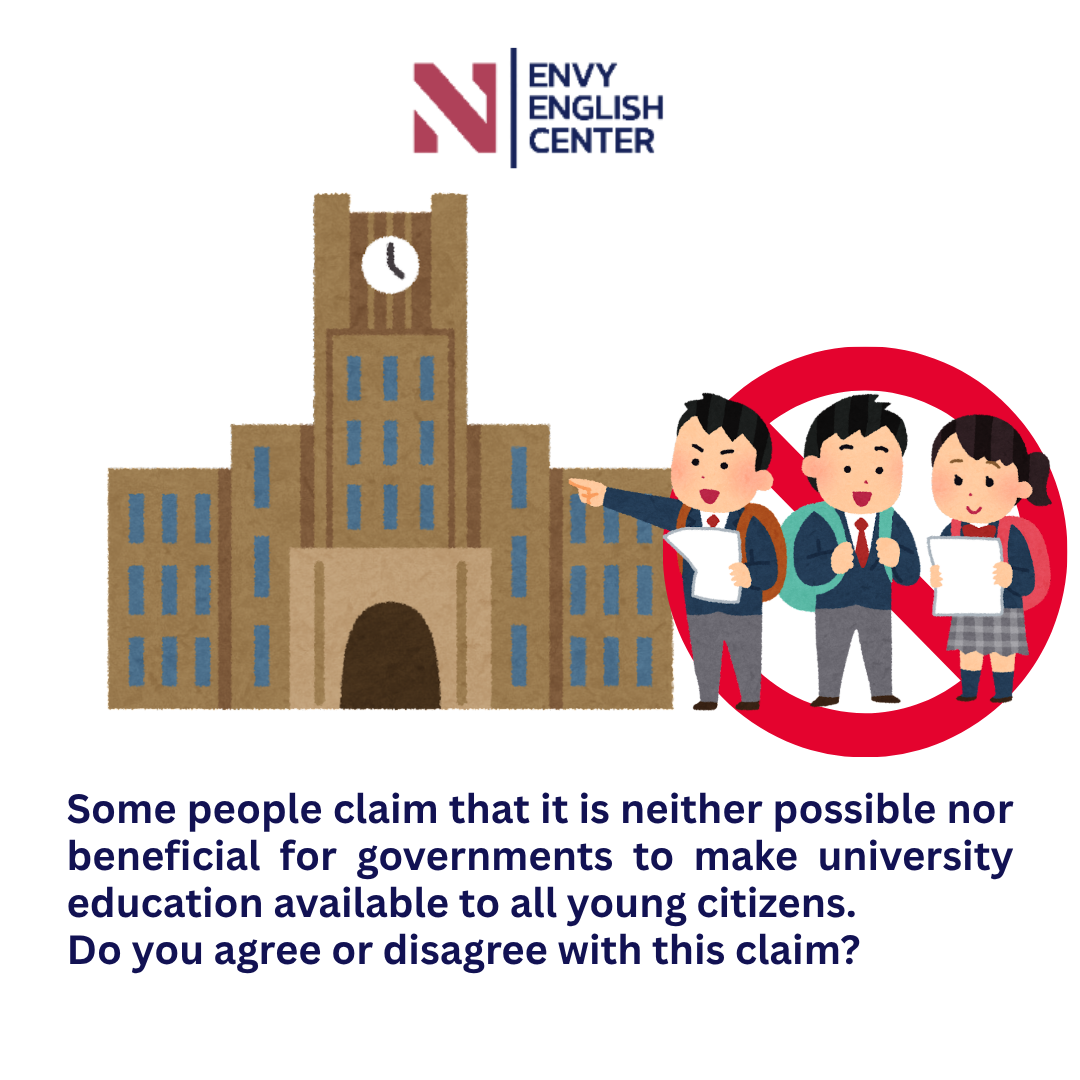
Some people claim that it is neither possible nor beneficial for governments to make university education available to all young citizens. Do you agree or disagree with this claim?
Dạng bài
Opinion essay
Xác định chủ đề và luận điểm
Topic: University Education and Government Responsibility
Luận điểm 1: Reasons supporting wider access to university education
Equal educational opportunities: cơ hội giáo dục bình đẳng
Higher-skilled workforce: lực lượng lao động trình độ cao hơn
Economic growth and innovation: tăng trưởng kinh tế và đổi mới
Improved social mobility: cải thiện cơ hội thăng tiến xã hội
Reduction in poverty levels: giảm tỷ lệ nghèo đói
Increased employment opportunities: tăng cơ hội việc làm
Development of professional expertise: phát triển chuyên môn nghề nghiệp
Luận điểm 2: Reasons opposing universal university education
Financial burden on governments: gánh nặng tài chính cho chính phủ
Limited educational resources: nguồn lực giáo dục hạn chế
Not all students are academically suitable: không phải học sinh nào cũng phù hợp học thuật
Oversupply of university graduates: dư thừa sinh viên tốt nghiệp đại học
Vocational training may be more practical: đào tạo nghề có thể thực tế hơn
Decline in educational quality: suy giảm chất lượng giáo dục
University education is not essential for every career: đại học không cần thiết cho mọi nghề nghiệp
Triển khai ý tưởng
Position 1
Although providing university education for all young people may create financial challenges, I disagree with the claim because wider access to higher education can bring significant social and economic benefits.
→ Mặc dù việc cung cấp giáo dục đại học cho tất cả thanh niên có thể tạo ra thách thức tài chính, tôi không đồng ý với quan điểm này vì việc mở rộng cơ hội học đại học có thể mang lại nhiều lợi ích xã hội và kinh tế đáng kể.
Ví dụ:
Government scholarship programs
Countries with strong higher education systems
Position 2
Governments should not make university education universally available because many careers require vocational skills rather than academic qualifications.
→ Chính phủ không nên phổ cập giáo dục đại học vì nhiều nghề nghiệp yêu cầu kỹ năng nghề thay vì bằng cấp học thuật.
Ví dụ:
Technical training programs
Skilled trade professions
2. Lập dàn ý cho đề theo PEEL
Introduction
Paraphrase: some people argue governments should not provide university education for all young citizens
Question: whether universal access to higher education is practical and beneficial
Thesis: although universal university education may place pressure on public budgets, I disagree with this claim because higher education creates major long-term benefits for individuals and society
Body Paragraph 1
Point: wider access to university education benefits society and the economy
Evidence: skilled workforce, innovation, employment opportunities, poverty reduction
Explanation: educated citizens contribute more effectively to economic and social development
Link: higher education supports national progress and social mobility
Body Paragraph 2
Point: universal university education also creates challenges
Evidence: financial costs, limited resources, oversupply of graduates, importance of vocational training
Explanation: not every student is suited to academic education
Link: governments should balance university education with vocational alternatives rather than restricting access completely
Conclusion
Summary: university education brings major benefits despite practical challenges
Restate: governments should continue expanding educational access while also supporting vocational pathways
3. Bài mẫu hoàn chỉnh
Some people argue that governments should not attempt to make university education available to all young citizens because doing so is unrealistic and unnecessary. Although I acknowledge that this policy may create financial and practical difficulties, I disagree with this claim because wider access to higher education can generate substantial benefits for both individuals and society.
One major advantage of expanding university access is the creation of equal educational opportunities for young people from different social backgrounds. Higher education allows students to develop professional knowledge and improve their future career prospects. As a result, societies may benefit from a higher-skilled workforce, which is essential for economic competitiveness and technological advancement. In addition, university graduates often contribute to economic growth and innovation by participating in research, business development, and scientific progress. Greater access to education can also support improved social mobility because students from disadvantaged families may achieve higher incomes and better living conditions. Furthermore, education is closely linked to reduction in poverty levels and increased employment opportunities, both of which contribute to long-term national development.
However, there are also valid concerns regarding universal university education. One major challenge is the financial burden on governments, since providing free or highly subsidized education for all students requires enormous public investment. Another issue is the possibility of an oversupply of university graduates, which may increase unemployment among degree holders in certain fields. In addition, not all students are academically suitable for university study, and some individuals may achieve greater success through technical or vocational education. In many cases, vocational training may be more practical because economies also require skilled workers such as electricians, mechanics, and technicians. Expanding university access too rapidly could even result in a decline in educational quality if institutions become overcrowded or underfunded.
Overall, although universal university education presents financial and practical difficulties, I disagree with the claim that it is neither possible nor beneficial. Governments should continue improving access to higher education while also investing in strong vocational training systems.
(Word count: 323)
4. Lexical Resources List
New Vocabulary
equal educational opportunities (noun phrase): cơ hội giáo dục bình đẳng
E.g. Governments should provide equal educational opportunities for all students.
higher-skilled workforce (noun phrase): lực lượng lao động trình độ cao hơn
E.g. Universities help create a higher-skilled workforce.
economic growth and innovation (noun phrase): tăng trưởng kinh tế và đổi mới
E.g. Technology supports economic growth and innovation.
improved social mobility (noun phrase): cải thiện cơ hội thăng tiến xã hội
E.g. Education promotes improved social mobility.
reduction in poverty levels (noun phrase): giảm tỷ lệ nghèo đói
E.g. Job creation contributes to reduction in poverty levels.
increased employment opportunities (noun phrase): tăng cơ hội việc làm
E.g. Training programs provide increased employment opportunities.
development of professional expertise (noun phrase): phát triển chuyên môn nghề nghiệp
E.g. University study supports the development of professional expertise.
financial burden on governments (noun phrase): gánh nặng tài chính cho chính phủ
E.g. Public healthcare creates a large financial burden on governments.
limited educational resources (noun phrase): nguồn lực giáo dục hạn chế
E.g. Rural schools often suffer from limited educational resources.
not all students are academically suitable (clause): không phải học sinh nào cũng phù hợp học thuật
E.g. Experts agree that not all students are academically suitable for university.
oversupply of university graduates (noun phrase): dư thừa sinh viên tốt nghiệp đại học
E.g. Some countries face an oversupply of university graduates.
vocational training may be more practical (clause): đào tạo nghề có thể thực tế hơn
E.g. In technical industries, vocational training may be more practical.
decline in educational quality (noun phrase): suy giảm chất lượng giáo dục
E.g. Overcrowded schools may cause a decline in educational quality.
university education is not essential for every career (clause): đại học không cần thiết cho mọi nghề nghiệp
E.g. Many people believe university education is not essential for every career.
career prospects (noun phrase): triển vọng nghề nghiệp
E.g. Higher education improves career prospects.
technological advancement (noun phrase): tiến bộ công nghệ
E.g. Research encourages technological advancement.
disadvantaged families (noun phrase): gia đình có hoàn cảnh khó khăn
E.g. Scholarships help students from disadvantaged families.
public investment (noun phrase): đầu tư công
E.g. Education requires significant public investment.
degree holders (noun phrase): người có bằng đại học
E.g. Some industries employ too many degree holders.
strong vocational training systems (noun phrase): hệ thống đào tạo nghề vững mạnh
E.g. Governments should build strong vocational training systems.
Sentence Structures
1. Although + clause, I disagree with + noun phrase because + clause (dùng để nêu quan điểm phản đối)
E.g. Although I acknowledge that this policy may create financial and practical difficulties, I disagree with this claim because wider access to higher education can generate substantial benefits for both individuals and society.
2. One major advantage of + V-ing + noun phrase + is + noun phrase (dùng để mở đoạn lợi ích)
E.g. One major advantage of expanding university access is the creation of equal educational opportunities for young people from different social backgrounds.
3. As a result, + noun phrase + may benefit from + noun phrase (dùng để nêu hệ quả tích cực)
E.g. As a result, societies may benefit from a higher-skilled workforce, which is essential for economic competitiveness and technological advancement.
4. Another issue is the possibility of + noun phrase, which may + verb + noun phrase (dùng để mở rộng vấn đề)
E.g. Another issue is the possibility of an oversupply of university graduates, which may increase unemployment among degree holders in certain fields.
5. In many cases, + noun phrase + may be more practical because + clause (dùng để đưa giải pháp thay thế)
E.g. In many cases, vocational training may be more practical because economies also require skilled workers such as electricians, mechanics, and technicians.
6. Overall, although + noun phrase + presents + noun phrase, I disagree that + clause (dùng để kết luận rõ quan điểm)
E.g. Overall, although universal university education presents financial and practical difficulties, I disagree with the claim that it is neither possible nor beneficial.
Nếu bạn đang bắt đầu từ con số 0 hoặc đã học nhưng “dậm chân tại chỗ”, Envy English Center có thể đồng hành cùng bạn:
Test trình độ miễn phí theo format IELTS để biết chính xác điểm mạnh – điểm yếu.
Nhận lộ trình học cá nhân hóa từ 0 → 6.5+, phù hợp tốc độ và mục tiêu.
Trực tiếp học với giáo viên IELTS 8.0+, chuyên “gỡ rối” Speaking & Writing – hai kỹ năng khó nâng band nhất.
Đặc biệt, khi đăng ký trong tuần này, bạn được tặng bộ từ vựng chuẩn IELTS band 7+.
📞 Hotline: 028 7300 9677 / 0948 197 270 (Zalo)
🌐 Website: envyenglish.vn
📍 Địa chỉ: 46/5 Tân Cảng, Phường Thạnh Mỹ Tây, Quận Bình Thạnh, TP.HCM


Thông tin gửi đi không thành công, vui lòng thử lại sau.
Nếu bạn cần liên hệ gấp, vui lòng gọi hotline
02873009677

Cảm ơn bạn đã gửi thông tin đến Envy English Center.
Chúng tôi sẽ liên hệ với bạn sớm nhất khi có thể.
Nếu bạn cần liên hệ gấp, vui lòng gọi hotline
02873009677
Thông tin gửi đi không thành công, vui lòng thử lại sau.
Nếu bạn cần liên hệ gấp, vui lòng gọi hotline
02873009677
Bạn đang có một bài test chưa hoàn thành.
Bạn có muốn tiếp tục bài test đó không?
Bạn có chắc là muốn gửi bài test này không?

Số câu trả lời đúng/40

Số câu trả lời đúng/40
Thông tin gửi đi không thành công, vui lòng thử lại sau.
Nếu bạn cần liên hệ gấp, vui lòng gọi hotline
02873009677
Thời gian làm bài kiểm tra đã hết.
Cảm ơn bạn đã cố gắng.
