 02873009677
 contact@envyenglish.vn

1. Xây dựng ý tưởng
Đề bài
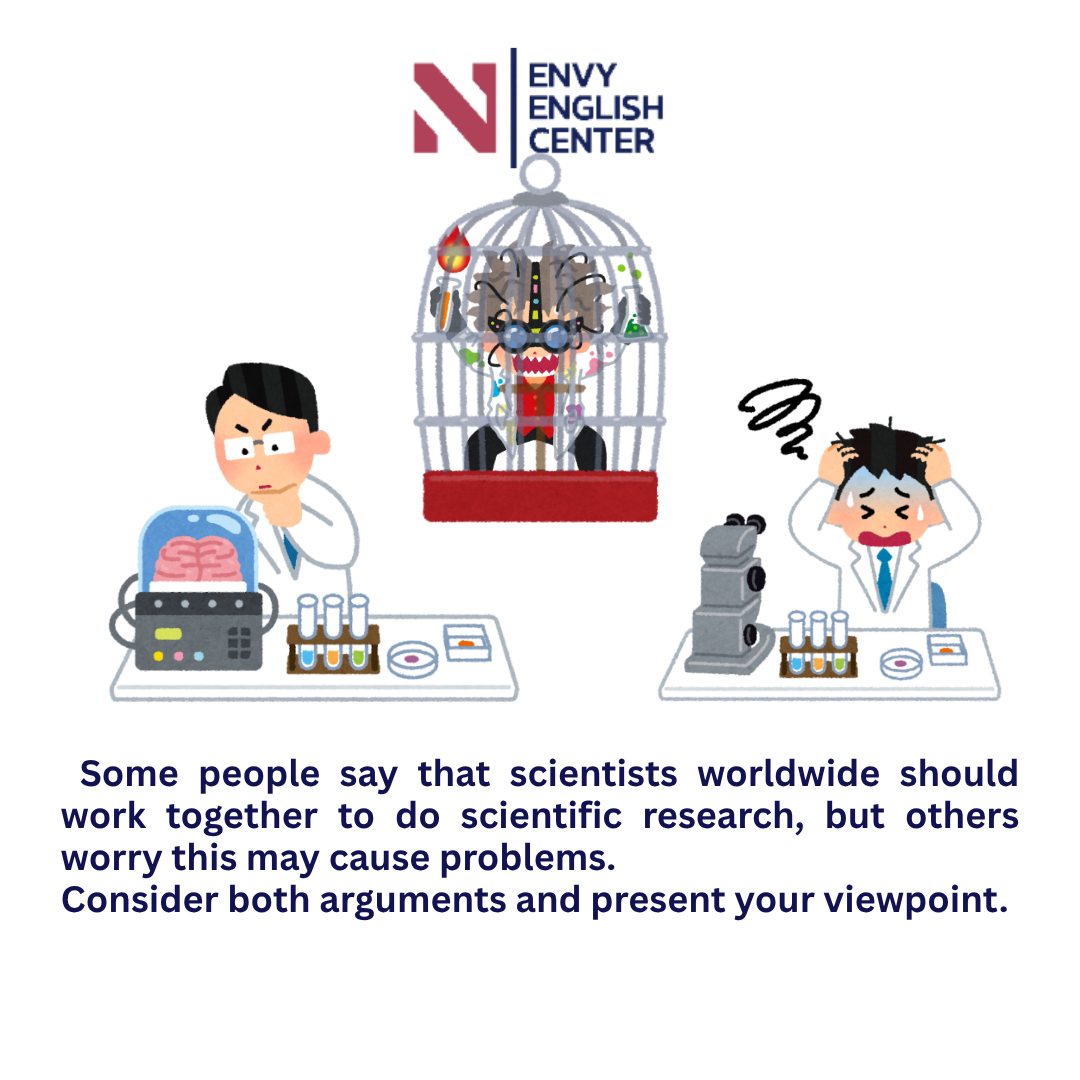
Some people say that scientists worldwide should work together to do scientific research, but others worry this may cause problems. Consider both arguments and present your viewpoint.
Dạng bài
Discussion essay
Xác định chủ đề và luận điểm
Topic: International Scientific Cooperation
Luận điểm 1: Benefits of global scientific cooperation
Sharing knowledge and expertise: chia sẻ kiến thức và chuyên môn
Faster scientific progress: tiến bộ khoa học nhanh hơn
Solving global problems more effectively: giải quyết vấn đề toàn cầu hiệu quả hơn
Reduced research costs: giảm chi phí nghiên cứu
Access to advanced technology and resources: tiếp cận công nghệ và tài nguyên tiên tiến
Improved medical and environmental research: cải thiện nghiên cứu y học và môi trường
Stronger international relationships: củng cố quan hệ quốc tế
Luận điểm 2: Concerns about international cooperation
Risk of intellectual property theft: nguy cơ đánh cắp tài sản trí tuệ
Political conflicts and national competition: xung đột chính trị và cạnh tranh quốc gia
Unequal distribution of research benefits: phân chia lợi ích nghiên cứu không công bằng
Security risks related to sensitive technology: rủi ro an ninh liên quan đến công nghệ nhạy cảm
Differences in research ethics and regulations: khác biệt về đạo đức và quy định nghiên cứu
Dependence on foreign expertise: phụ thuộc vào chuyên môn nước ngoài
Potential misuse of scientific discoveries: khả năng lạm dụng các phát minh khoa học
Triển khai ý tưởng
Position 1
International scientific cooperation is highly beneficial because global challenges such as climate change and disease outbreaks require shared knowledge and coordinated research efforts.
→ Hợp tác khoa học quốc tế rất có lợi vì các thách thức toàn cầu như biến đổi khí hậu và dịch bệnh cần kiến thức chung và nỗ lực nghiên cứu phối hợp.
Ví dụ:
International vaccine development projects
Climate change research partnerships
Position 2
However, governments should carefully regulate international research cooperation to protect national security and intellectual property rights.
→ Tuy nhiên, chính phủ nên quản lý chặt chẽ hợp tác nghiên cứu quốc tế để bảo vệ an ninh quốc gia và quyền sở hữu trí tuệ.
Ví dụ:
Restrictions on military technology sharing
International ethical guidelines for research
2. Lập dàn ý cho đề theo PEEL
Introduction
Paraphrase: some people believe scientists from different countries should collaborate on research, while others fear potential problems
Question: benefits and drawbacks of international scientific cooperation
Thesis: although international research cooperation may create certain risks, I believe its advantages outweigh the disadvantages because it accelerates scientific progress and helps solve global challenges
Body Paragraph 1
Point: international cooperation improves the quality and speed of scientific research
Evidence: knowledge sharing, lower costs, medical breakthroughs, climate research, advanced technology
Explanation: combining expertise and resources leads to more effective solutions
Link: global scientific collaboration benefits humanity as a whole
Body Paragraph 2
Point: there are also risks associated with international scientific cooperation
Evidence: intellectual property theft, security risks, political tensions, unethical research use
Explanation: countries may worry about losing control over sensitive information or technology
Link: strong regulations are necessary to reduce these dangers
Conclusion
Summary: international scientific cooperation brings both opportunities and risks
Restate: despite potential concerns, global collaboration in science should continue with appropriate regulations and ethical standards
3. Bài mẫu hoàn chỉnh
Some people believe that scientists around the world should cooperate in conducting scientific research, while others worry that such cooperation may create certain problems. In my opinion, although international collaboration involves some risks, its overall benefits are far greater because it promotes scientific progress and helps solve global issues more effectively.
One major advantage of international cooperation is the sharing of knowledge and expertise between scientists from different countries. When researchers collaborate, they can exchange ideas, combine skills, and access a wider range of scientific information. This often leads to faster scientific progress and more innovative discoveries. In addition, many modern problems such as climate change, pandemics, and food shortages affect the entire world, making solving global problems more effectively possible only through international teamwork. For example, scientists from multiple countries cooperated to develop vaccines during global disease outbreaks, which significantly improved public health worldwide. International research projects also allow countries to share expensive equipment and facilities, resulting in reduced research costs and better access to advanced technologies. Furthermore, cooperation in science can strengthen diplomatic relationships and encourage peaceful communication between nations.
However, some people are concerned about the disadvantages of international scientific cooperation. One important issue is the risk of intellectual property theft, as countries or organizations may copy valuable research without permission. Another concern involves security risks related to sensitive technology, especially in areas such as military science, artificial intelligence, or nuclear research. In addition, there may be differences in research ethics and regulations between countries, which could lead to disagreements or unethical practices. Some governments also fear becoming too dependent on foreign expertise or losing control over important scientific discoveries. Therefore, international cooperation should be carefully regulated to ensure fairness, security, and ethical responsibility.
Overall, although international scientific cooperation may create certain challenges, I believe its advantages greatly outweigh the drawbacks. By sharing knowledge and resources responsibly, scientists can make faster progress and contribute to solving many of the world’s most urgent problems.
(Word count: 322)
4. Lexical Resources List
New Vocabulary
sharing knowledge and expertise (noun phrase): chia sẻ kiến thức và chuyên môn
E.g. International conferences encourage sharing knowledge and expertise.
faster scientific progress (noun phrase): tiến bộ khoa học nhanh hơn
E.g. Cooperation between universities leads to faster scientific progress.
solving global problems more effectively (noun phrase): giải quyết vấn đề toàn cầu hiệu quả hơn
E.g. Countries should focus on solving global problems more effectively.
reduced research costs (noun phrase): giảm chi phí nghiên cứu
E.g. Collaboration can result in reduced research costs.
access to advanced technology and resources (noun phrase): tiếp cận công nghệ và tài nguyên tiên tiến
E.g. Scientists benefit from access to advanced technology and resources.
improved medical and environmental research (noun phrase): cải thiện nghiên cứu y học và môi trường
E.g. International projects support improved medical and environmental research.
stronger international relationships (noun phrase): củng cố quan hệ quốc tế
E.g. Scientific collaboration promotes stronger international relationships.
risk of intellectual property theft (noun phrase): nguy cơ đánh cắp tài sản trí tuệ
E.g. Companies worry about the risk of intellectual property theft.
political conflicts and national competition (noun phrase): xung đột chính trị và cạnh tranh quốc gia
E.g. Research projects may be affected by political conflicts and national competition.
unequal distribution of research benefits (noun phrase): phân chia lợi ích nghiên cứu không công bằng
E.g. Some nations criticize the unequal distribution of research benefits.
security risks related to sensitive technology (noun phrase): rủi ro an ninh liên quan đến công nghệ nhạy cảm
E.g. Governments fear security risks related to sensitive technology.
differences in research ethics and regulations (noun phrase): khác biệt về đạo đức và quy định nghiên cứu
E.g. International teams face differences in research ethics and regulations.
dependence on foreign expertise (noun phrase): phụ thuộc vào chuyên môn nước ngoài
E.g. Some countries dislike dependence on foreign expertise.
potential misuse of scientific discoveries (noun phrase): khả năng lạm dụng các phát minh khoa học
E.g. Experts worry about the potential misuse of scientific discoveries.
global disease outbreaks (noun phrase): các đợt bùng phát dịch bệnh toàn cầu
E.g. Scientists cooperated during global disease outbreaks.
expensive equipment and facilities (noun phrase): thiết bị và cơ sở vật chất đắt tiền
E.g. Universities share expensive equipment and facilities.
diplomatic relationships (noun phrase): quan hệ ngoại giao
E.g. Scientific exchange improves diplomatic relationships.
ethical responsibility (noun phrase): trách nhiệm đạo đức
E.g. Researchers should maintain ethical responsibility.
scientific discoveries (noun phrase): các phát minh khoa học
E.g. Modern scientific discoveries improve daily life.
global challenges (noun phrase): thách thức toàn cầu
E.g. Climate change is one of today’s biggest global challenges.
Sentence Structures
1. Although + noun phrase + involves + noun phrase, I believe + clause because + clause (dùng để nêu quan điểm)
E.g. Although international collaboration involves some risks, I believe its overall benefits are far greater because it promotes scientific progress and helps solve global issues more effectively.
2. One major advantage of + noun phrase + is + noun phrase (dùng để mở đoạn lợi ích)
E.g. One major advantage of international cooperation is the sharing of knowledge and expertise between scientists from different countries.
3. When + noun phrase + collaborate, + clause (dùng để giải thích tác động tích cực)
E.g. When researchers collaborate, they can exchange ideas, combine skills, and access a wider range of scientific information.
4. Another concern involves + noun phrase, especially in areas such as + noun phrase (dùng để nêu vấn đề)
E.g. Another concern involves security risks related to sensitive technology, especially in areas such as military science, artificial intelligence, or nuclear research.
5. Therefore, + noun phrase + should be carefully regulated to + verb + noun phrase (dùng để đưa giải pháp)
E.g. Therefore, international cooperation should be carefully regulated to ensure fairness, security, and ethical responsibility.
6. Overall, although + noun phrase + may + verb + noun phrase, I believe + clause (dùng để kết luận)
E.g. Overall, although international scientific cooperation may create certain challenges, I believe its advantages greatly outweigh the drawbacks.
Nếu bạn đang bắt đầu từ con số 0 hoặc đã học nhưng “dậm chân tại chỗ”, Envy English Center có thể đồng hành cùng bạn:
Test trình độ miễn phí theo format IELTS để biết chính xác điểm mạnh – điểm yếu.
Nhận lộ trình học cá nhân hóa từ 0 → 6.5+, phù hợp tốc độ và mục tiêu.
Trực tiếp học với giáo viên IELTS 8.0+, chuyên “gỡ rối” Speaking & Writing – hai kỹ năng khó nâng band nhất.
Đặc biệt, khi đăng ký trong tuần này, bạn được tặng bộ từ vựng chuẩn IELTS band 7+.
📞 Hotline: 028 7300 9677 / 0948 197 270 (Zalo)
🌐 Website: envyenglish.vn
📍 Địa chỉ: 46/5 Tân Cảng, Phường Thạnh Mỹ Tây, Quận Bình Thạnh, TP.HCM


Thông tin gửi đi không thành công, vui lòng thử lại sau.
Nếu bạn cần liên hệ gấp, vui lòng gọi hotline
02873009677

Cảm ơn bạn đã gửi thông tin đến Envy English Center.
Chúng tôi sẽ liên hệ với bạn sớm nhất khi có thể.
Nếu bạn cần liên hệ gấp, vui lòng gọi hotline
02873009677
Thông tin gửi đi không thành công, vui lòng thử lại sau.
Nếu bạn cần liên hệ gấp, vui lòng gọi hotline
02873009677
Bạn đang có một bài test chưa hoàn thành.
Bạn có muốn tiếp tục bài test đó không?
Bạn có chắc là muốn gửi bài test này không?

Số câu trả lời đúng/40

Số câu trả lời đúng/40
Thông tin gửi đi không thành công, vui lòng thử lại sau.
Nếu bạn cần liên hệ gấp, vui lòng gọi hotline
02873009677
Thời gian làm bài kiểm tra đã hết.
Cảm ơn bạn đã cố gắng.
