 02873009677
 contact@envyenglish.vn

1. Xây dựng ý tưởng
Đề bài
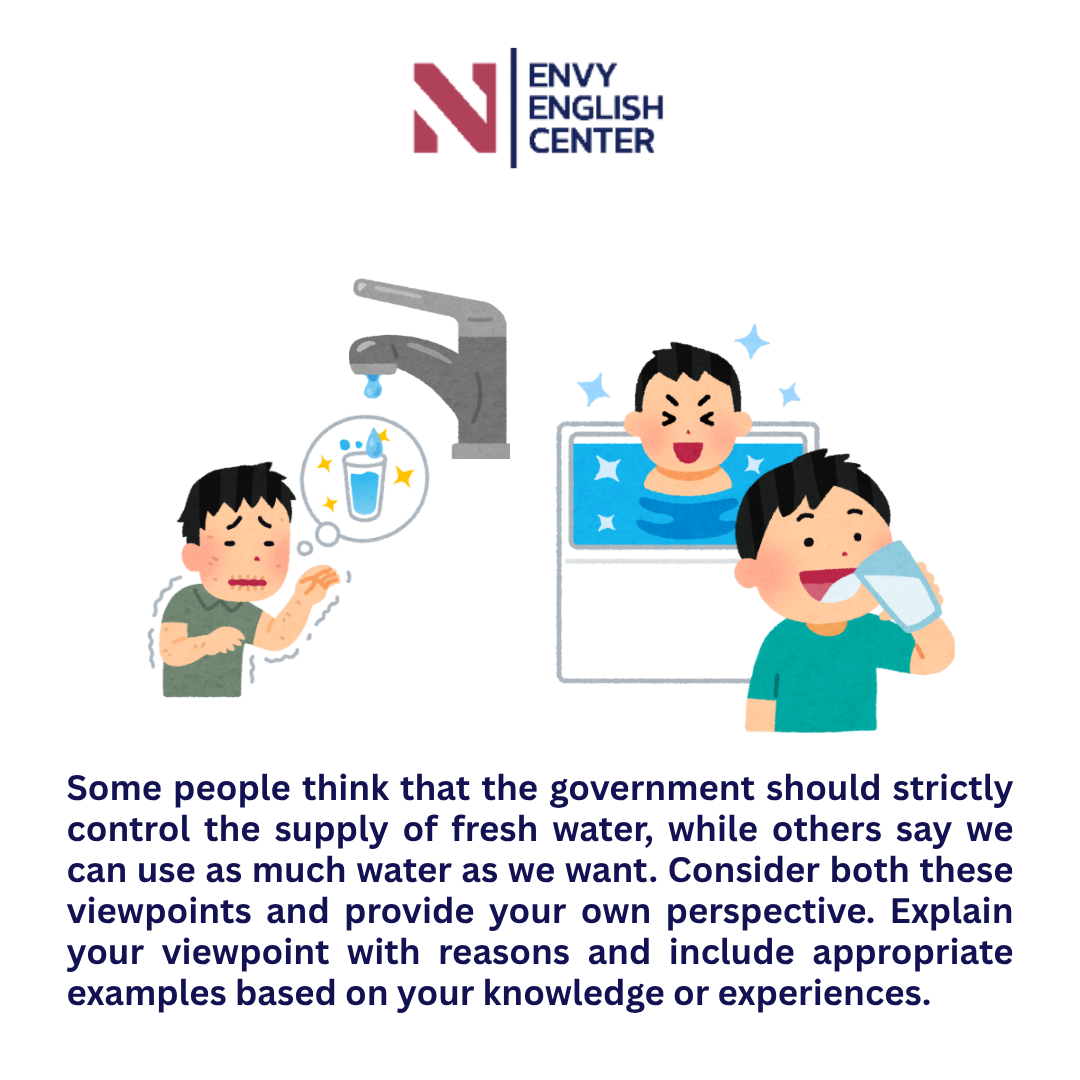
Some people think that the government should strictly control the supply of fresh water, while others say we can use as much water as we want. Consider both these viewpoints and provide your own perspective. Explain your viewpoint with reasons and include appropriate examples based on your knowledge or experiences.
Dạng bài
Discuss both views and give your opinion
Xác định chủ đề và luận điểm
Topic: Government Control of Fresh Water Usage
Luận điểm 1: Reasons supporting strict government control of water
Water scarcity prevention: ngăn chặn tình trạng khan hiếm nước
Sustainable resource management: quản lý tài nguyên bền vững
Environmental protection measures: biện pháp bảo vệ môi trường
Fair water distribution: phân phối nước công bằng
Climate change adaptation: thích ứng với biến đổi khí hậu
Reduction of water waste: giảm lãng phí nước
Long-term public benefits: lợi ích công cộng lâu dài
Luận điểm 2: Reasons supporting unrestricted water usage
Personal freedom of consumption: quyền tự do tiêu dùng cá nhân
Natural resource abundance belief: niềm tin tài nguyên tự nhiên dồi dào
Economic activity support: hỗ trợ hoạt động kinh tế
Convenience for households and industries: sự thuận tiện cho hộ gia đình và doanh nghiệp
Opposition to government interference: phản đối sự can thiệp của chính phủ
Technological solutions confidence: niềm tin vào giải pháp công nghệ
Consumer choice rights: quyền lựa chọn của người tiêu dùng
Triển khai ý tưởng
Position 1
Although individuals should have reasonable access to fresh water, I believe governments must strictly regulate water usage because fresh water is a limited resource that is essential for future generations.
→ Mặc dù mọi người nên có quyền tiếp cận nước sạch hợp lý, tôi tin rằng chính phủ phải quản lý chặt chẽ việc sử dụng nước vì nước ngọt là nguồn tài nguyên có hạn và cần thiết cho các thế hệ tương lai.
Ví dụ:
Water restrictions during droughts in Australia
Government campaigns promoting water conservation
Position 2
People should be allowed to use water freely because technological advancements can solve future water shortages without strict government control.
→ Mọi người nên được phép sử dụng nước tự do vì tiến bộ công nghệ có thể giải quyết tình trạng thiếu nước trong tương lai mà không cần sự kiểm soát nghiêm ngặt từ chính phủ.
Ví dụ:
Desalination technology
Water recycling systems
2. Lập dàn ý cho đề theo PEEL
Introduction
Paraphrase: some people support strict government control of fresh water while others believe people should use water freely
Question: whether water usage should be regulated or unrestricted
Thesis: although individuals should have access to sufficient water, governments must control water usage to ensure sustainability and environmental protection
Body Paragraph 1
Point: strict water control is necessary for sustainable resource management
Evidence: droughts, climate change, water shortages, environmental damage
Explanation: uncontrolled water usage may threaten future water supplies
Link: governments should regulate water consumption responsibly
Body Paragraph 2
Point: some people believe water usage should remain unrestricted
Evidence: personal freedom, economic convenience, technological developments
Explanation: modern technology may reduce future water shortages
Link: however, technology alone cannot guarantee sustainable water use
Conclusion
Summary: unrestricted water use offers convenience but creates environmental risks
Restate: governments should regulate fresh water carefully to protect long-term public interests
3. Bài mẫu hoàn chỉnh
Fresh water is one of the most essential natural resources for human survival and economic development. While some people believe governments should strictly regulate the supply and use of fresh water, others argue that individuals should be free to use as much water as they want. In my opinion, although people should have reasonable access to water, governments must control its usage carefully to ensure long-term sustainability.
One major reason for strict regulation is the need for water scarcity prevention. In many regions, growing populations and climate change have already created serious water shortages. Without effective policies, excessive water consumption could threaten future supplies for households, agriculture, and industry. Governments therefore need to introduce measures that support sustainable resource management and reduction of water waste. For example, during severe droughts in Australia, authorities implemented restrictions on household water usage to protect national reserves. In addition, proper regulation can improve fair water distribution, ensuring that all citizens have access to clean water regardless of income or location. Strict policies may also encourage environmental protection measures and help societies prepare for future environmental challenges through climate change adaptation.
On the other hand, some people believe individuals should be free to consume water without government interference. They argue that access to water is a basic necessity and that restrictions may negatively affect personal lifestyles and businesses. Supporters of this view also have confidence in modern technology, such as desalination systems and water recycling facilities. This reflects growing technological solutions confidence and belief in human innovation. Furthermore, unrestricted water access may support industries and economic growth by improving economic activity support. However, relying entirely on future technology is risky because these solutions are often expensive and unavailable in poorer regions.
Overall, although unrestricted water usage may provide short-term convenience, I believe governments should strictly regulate fresh water consumption in order to protect natural resources and guarantee sustainable access for future generations.
(Word count: 320)
4. Lexical Resources List
New Vocabulary
water scarcity prevention (noun phrase): ngăn chặn tình trạng khan hiếm nước
E.g. Governments should prioritize water scarcity prevention.
sustainable resource management (noun phrase): quản lý tài nguyên bền vững
E.g. Environmental policies encourage sustainable resource management.
environmental protection measures (noun phrase): biện pháp bảo vệ môi trường
E.g. Many countries are introducing environmental protection measures.
fair water distribution (noun phrase): phân phối nước công bằng
E.g. Authorities should ensure fair water distribution.
climate change adaptation (noun phrase): thích ứng với biến đổi khí hậu
E.g. Coastal cities require effective climate change adaptation.
reduction of water waste (noun phrase): giảm lãng phí nước
E.g. Public campaigns promote the reduction of water waste.
long-term public benefits (noun phrase): lợi ích công cộng lâu dài
E.g. Renewable energy provides long-term public benefits.
personal freedom of consumption (noun phrase): quyền tự do tiêu dùng cá nhân
E.g. Some people value personal freedom of consumption.
natural resource abundance belief (noun phrase): niềm tin tài nguyên tự nhiên dồi dào
E.g. Excessive consumption may result from natural resource abundance belief.
economic activity support (noun phrase): hỗ trợ hoạt động kinh tế
E.g. Infrastructure investment provides economic activity support.
convenience for households and industries (noun phrase): sự thuận tiện cho hộ gia đình và doanh nghiệp
E.g. Reliable utilities improve convenience for households and industries.
opposition to government interference (noun phrase): phản đối sự can thiệp của chính phủ
E.g. Some citizens express opposition to government interference.
technological solutions confidence (noun phrase): niềm tin vào giải pháp công nghệ
E.g. Many people have strong technological solutions confidence.
consumer choice rights (noun phrase): quyền lựa chọn của người tiêu dùng
E.g. Advertising regulations may affect consumer choice rights.
water shortages (noun phrase): tình trạng thiếu nước
E.g. Many countries are facing severe water shortages.
household water usage (noun phrase): việc sử dụng nước trong gia đình
E.g. Governments may limit household water usage during droughts.
national reserves (noun phrase): nguồn dự trữ quốc gia
E.g. Countries should protect their national reserves.
clean water access (noun phrase): khả năng tiếp cận nước sạch
E.g. Millions of people still lack clean water access.
desalination systems (noun phrase): hệ thống khử muối
E.g. Some countries invest heavily in desalination systems.
future generations (noun phrase): các thế hệ tương lai
E.g. Environmental protection benefits future generations.
Sentence Structures
1. While some people believe + clause, others argue that + clause (dùng để mở bài với hai quan điểm đối lập)
E.g. While some people believe governments should strictly regulate the supply and use of fresh water, others argue that individuals should be free to use as much water as they want.
2. One major reason for + noun phrase + is the need for + noun phrase (dùng để giải thích nguyên nhân quan trọng)
E.g. One major reason for strict regulation is the need for water scarcity prevention.
3. Without + noun phrase, + clause could + verb + noun phrase (dùng để cảnh báo hậu quả tiêu cực)
E.g. Without effective policies, excessive water consumption could threaten future supplies for households, agriculture, and industry.
4. For example, during + noun phrase, + subject + implemented + noun phrase + to + verb (dùng để đưa ví dụ thực tế)
E.g. For example, during severe droughts in Australia, authorities implemented restrictions on household water usage to protect national reserves.
5. Supporters of this view also have confidence in + noun phrase (dùng để trình bày quan điểm đối lập)
E.g. Supporters of this view also have confidence in modern technology, such as desalination systems and water recycling facilities.
6. Overall, although + noun phrase + may + verb, I believe + clause in order to + verb (dùng để kết luận với lập trường rõ ràng)
E.g. Overall, although unrestricted water usage may provide short-term convenience, I believe governments should strictly regulate fresh water consumption in order to protect natural resources and guarantee sustainable access for future generations.
Nếu bạn đang bắt đầu từ con số 0 hoặc đã học nhưng “dậm chân tại chỗ”, Envy English Center có thể đồng hành cùng bạn:
Test trình độ miễn phí theo format IELTS để biết chính xác điểm mạnh – điểm yếu.
Nhận lộ trình học cá nhân hóa từ 0 → 6.5+, phù hợp tốc độ và mục tiêu.
Trực tiếp học với giáo viên IELTS 8.0+, chuyên “gỡ rối” Speaking & Writing – hai kỹ năng khó nâng band nhất.
Đặc biệt, khi đăng ký trong tuần này, bạn được tặng bộ từ vựng chuẩn IELTS band 7+.
📞 Hotline: 028 7300 9677 / 0948 197 270 (Zalo)
🌐 Website: envyenglish.vn
📍 Địa chỉ: 46/5 Tân Cảng, Phường Thạnh Mỹ Tây, Quận Bình Thạnh, TP.HCM


Thông tin gửi đi không thành công, vui lòng thử lại sau.
Nếu bạn cần liên hệ gấp, vui lòng gọi hotline
02873009677

Cảm ơn bạn đã gửi thông tin đến Envy English Center.
Chúng tôi sẽ liên hệ với bạn sớm nhất khi có thể.
Nếu bạn cần liên hệ gấp, vui lòng gọi hotline
02873009677
Thông tin gửi đi không thành công, vui lòng thử lại sau.
Nếu bạn cần liên hệ gấp, vui lòng gọi hotline
02873009677
Bạn đang có một bài test chưa hoàn thành.
Bạn có muốn tiếp tục bài test đó không?
Bạn có chắc là muốn gửi bài test này không?

Số câu trả lời đúng/40

Số câu trả lời đúng/40
Thông tin gửi đi không thành công, vui lòng thử lại sau.
Nếu bạn cần liên hệ gấp, vui lòng gọi hotline
02873009677
Thời gian làm bài kiểm tra đã hết.
Cảm ơn bạn đã cố gắng.
