 02873009677
 contact@envyenglish.vn

1. Xây dựng ý tưởng
Đề bài
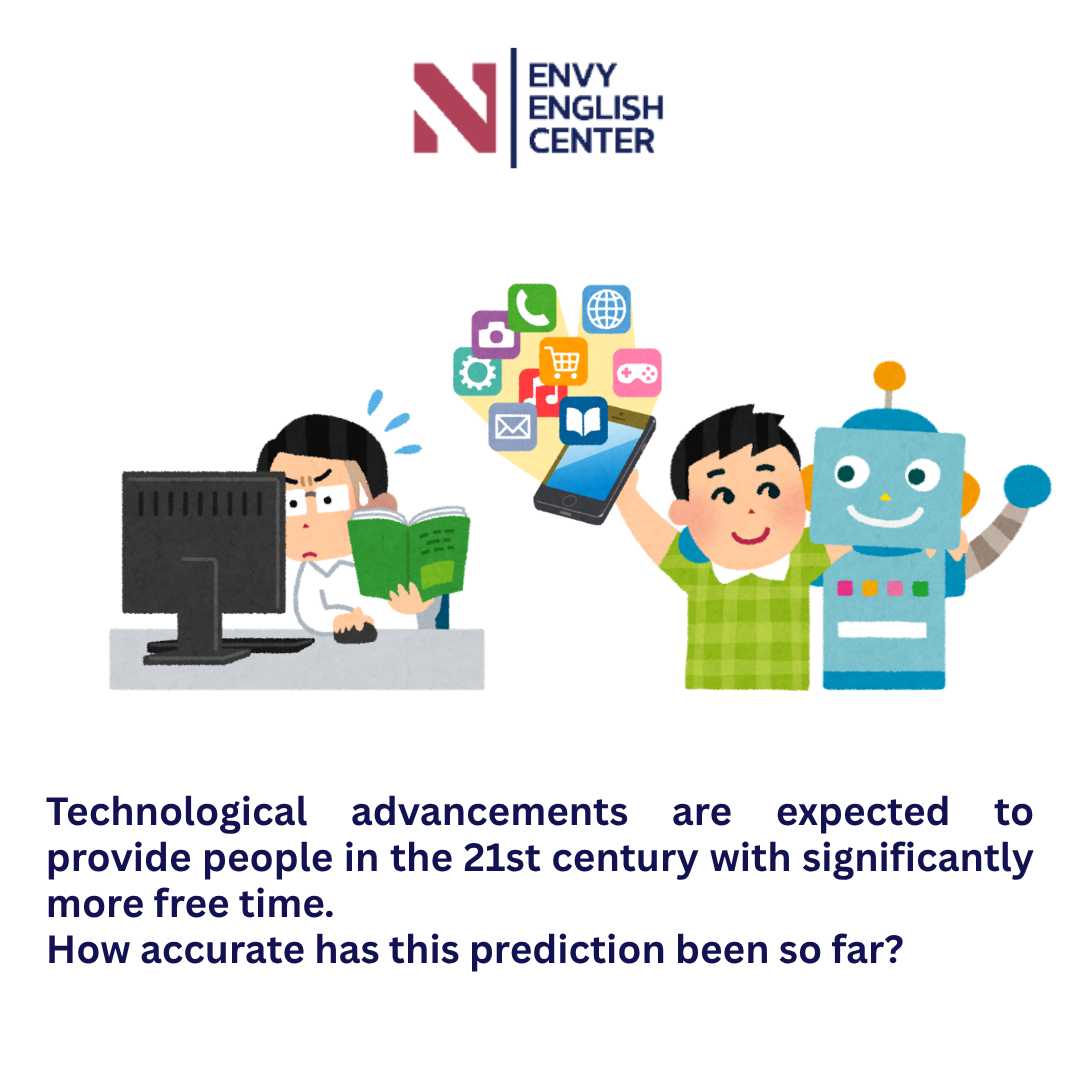
Technological advancements are expected to provide people in the 21st century with significantly more free time. How accurate has this prediction been so far?
Dạng bài
Opinion Essay
Xác định chủ đề và luận điểm
Topic: Technology and Leisure Time
Luận điểm 1: The prediction is accurate to some extent
Automation of routine tasks: tự động hóa các công việc lặp đi lặp lại
Increased workplace efficiency: nâng cao hiệu quả làm việc
Time-saving household appliances: thiết bị gia dụng tiết kiệm thời gian
Faster communication and information access: giao tiếp và tiếp cận thông tin nhanh hơn
Online services reducing travel time: dịch vụ trực tuyến giúp giảm thời gian di chuyển
Greater flexibility through remote work: tính linh hoạt cao hơn nhờ làm việc từ xa
Luận điểm 2: The prediction has not been fully realized
Technology has increased work expectations: công nghệ làm gia tăng kỳ vọng trong công việc
Constant connectivity blurs work-life boundaries: kết nối liên tục làm mờ ranh giới giữa công việc và cuộc sống
People spend more time on digital activities: con người dành nhiều thời gian hơn cho các hoạt động kỹ thuật số
Information overload creates new demands: quá tải thông tin tạo ra những áp lực mới
Longer working hours in competitive industries: thời gian làm việc kéo dài trong các ngành cạnh tranh cao
Productivity gains do not always translate into leisure time: năng suất tăng không đồng nghĩa với nhiều thời gian rảnh hơn
Triển khai ý tưởng
Position
While technology has undoubtedly made many tasks faster and more efficient, the prediction that people would enjoy significantly more free time has only been partially accurate because technological progress has also created new demands and expectations.
→ Mặc dù công nghệ chắc chắn đã giúp nhiều công việc trở nên nhanh chóng và hiệu quả hơn, dự đoán rằng con người sẽ có nhiều thời gian rảnh hơn đáng kể chỉ đúng một phần vì tiến bộ công nghệ cũng tạo ra những yêu cầu và kỳ vọng mới.
Ví dụ:
Online banking eliminating the need for visits to physical branches
Employees responding to work emails outside office hours
2. Lập dàn ý cho đề theo PEEL
Introduction
Paraphrase: technology was expected to reduce workloads and increase leisure time
Question: evaluate the accuracy of this prediction
Thesis: the prediction is only partly accurate because technology saves time but also encourages people to work more and remain constantly connected
Body Paragraph 1
Point: technology has reduced the time needed for many daily tasks
Evidence: automation, household appliances, online services, remote work
Explanation: activities that once took hours can now be completed in minutes
Link: therefore, technology has created opportunities for greater leisure time
Body Paragraph 2
Point: however, people have not gained as much free time as expected
Evidence: constant connectivity, higher work expectations, digital distractions
Explanation: technology often increases workloads and encourages people to remain available at all times
Link: consequently, productivity gains have not always translated into additional leisure time
Conclusion
Summary: technology has both saved and consumed time
Restate: the prediction has been partially accurate, but the increase in free time has been far smaller than originally anticipated
3. Bài mẫu hoàn chỉnh
Technological progress has transformed nearly every aspect of modern life. Many people once predicted that advances in technology would dramatically reduce workloads and provide individuals with significantly more leisure time. In my view, this prediction has been only partially accurate because technology has both saved time and created new demands.
On the one hand, technological advancements have undoubtedly made daily life more efficient. The automation of routine tasks in workplaces has reduced the amount of manual labor required, allowing employees to complete tasks more quickly. Similarly, time-saving household appliances such as washing machines, dishwashers, and robotic vacuum cleaners have reduced the time spent on domestic chores. In addition, the internet provides faster communication and information access, enabling people to obtain information within seconds. Online banking, shopping, and government services have also minimized the need for travel. As a result, technology has created numerous opportunities for people to save time in both their professional and personal lives.
On the other hand, these gains have not always resulted in substantially more free time. One reason is that technology has increased work expectations. Employees are often expected to respond to emails and messages outside traditional working hours. Furthermore, constant connectivity blurs work-life boundaries, making it difficult for individuals to disconnect from their jobs. Another issue is that many people spend large amounts of time on social media, streaming platforms, and other digital activities. Combined with information overload, these factors can consume much of the time that technology has helped save. Consequently, productivity gains do not always translate into leisure time, particularly in highly competitive industries.
In conclusion, technology has undoubtedly improved efficiency and reduced the time required for many activities. However, I believe the prediction that people would enjoy significantly more free time has only been partly realized because technological progress has also increased work demands and digital distractions.
(Word count: 299)
4. Lexical Resources List
New Vocabulary
automation of routine tasks (noun phrase): tự động hóa các công việc lặp đi lặp lại
E.g. The automation of routine tasks has improved workplace efficiency.
increased workplace efficiency (noun phrase): nâng cao hiệu quả làm việc
E.g. Technology has led to increased workplace efficiency.
time-saving household appliances (noun phrase): thiết bị gia dụng tiết kiệm thời gian
E.g. Time-saving household appliances reduce domestic workloads.
faster communication and information access (noun phrase): giao tiếp và tiếp cận thông tin nhanh hơn
E.g. Smartphones enable faster communication and information access.
online services reducing travel time (noun phrase): dịch vụ trực tuyến giúp giảm thời gian di chuyển
E.g. Online banking is an example of online services reducing travel time.
greater flexibility through remote work (noun phrase): tính linh hoạt cao hơn nhờ làm việc từ xa
E.g. Many employees enjoy greater flexibility through remote work.
technology has increased work expectations (clause): công nghệ làm gia tăng kỳ vọng trong công việc
E.g. In many professions, technology has increased work expectations.
constant connectivity blurs work-life boundaries (clause): kết nối liên tục làm mờ ranh giới giữa công việc và cuộc sống
E.g. Smartphones mean that constant connectivity blurs work-life boundaries.
people spend more time on digital activities (clause): con người dành nhiều thời gian hơn cho các hoạt động kỹ thuật số
E.g. Today, people spend more time on digital activities than ever before.
information overload creates new demands (clause): quá tải thông tin tạo ra những áp lực mới
E.g. Many workers feel that information overload creates new demands.
longer working hours in competitive industries (noun phrase): thời gian làm việc dài hơn trong các ngành cạnh tranh cao
E.g. Technology sometimes contributes to longer working hours in competitive industries.
productivity gains do not always translate into leisure time (clause): năng suất tăng không đồng nghĩa với thời gian rảnh tăng
E.g. Unfortunately, productivity gains do not always translate into leisure time.
manual labor (noun phrase): lao động thủ công
E.g. Machines have reduced the need for manual labor.
domestic chores (noun phrase): việc nhà
E.g. Household appliances simplify domestic chores.
online banking (noun phrase): ngân hàng trực tuyến
E.g. Many people use online banking instead of visiting branches.
government services (noun phrase): dịch vụ công của chính phủ
E.g. Many government services are now available online.
traditional working hours (noun phrase): giờ làm việc truyền thống
E.g. Employees often work beyond traditional working hours.
streaming platforms (noun phrase): nền tảng phát trực tuyến
E.g. People spend hours on streaming platforms each week.
digital distractions (noun phrase): những yếu tố gây xao nhãng kỹ thuật số
E.g. Smartphones are a major source of digital distractions.
professional and personal lives (noun phrase): cuộc sống công việc và cá nhân
E.g. Technology affects both professional and personal lives.
Sentence Structures
1. While + noun phrase + has undoubtedly + past participle, I believe + clause because + clause (dùng để nêu quan điểm)
E.g. While technology has undoubtedly improved efficiency, I believe it has not greatly increased leisure time because it has also created new demands.
2. One way technology has helped people is through + noun phrase (dùng để trình bày lợi ích)
E.g. One way technology has helped people is through the automation of routine tasks.
3. In addition, + noun phrase + enable(s) + noun phrase + to + verb (dùng để mở rộng ý)
E.g. In addition, online services enable people to complete tasks more quickly.
4. One reason this prediction has not been fully realized is that + clause (dùng để giải thích nguyên nhân)
E.g. One reason this prediction has not been fully realized is that technology has increased work expectations.
5. Furthermore, + noun phrase + make(s) it difficult for + noun phrase + to + verb (dùng để trình bày tác động tiêu cực)
E.g. Furthermore, constant connectivity makes it difficult for employees to disconnect from work.
6. In conclusion, although + clause, I believe + clause because + clause (dùng để kết luận)
E.g. In conclusion, although technology saves time, I believe it has only partly increased leisure time because it has also encouraged people to remain constantly connected.
Nếu bạn đang bắt đầu từ con số 0 hoặc đã học nhưng “dậm chân tại chỗ”, Envy English Center có thể đồng hành cùng bạn:
Test trình độ miễn phí theo format IELTS để biết chính xác điểm mạnh – điểm yếu.
Nhận lộ trình học cá nhân hóa từ 0 → 6.5+, phù hợp tốc độ và mục tiêu.
Trực tiếp học với giáo viên IELTS 8.0+, chuyên “gỡ rối” Speaking & Writing – hai kỹ năng khó nâng band nhất.
Đặc biệt, khi đăng ký trong tuần này, bạn được tặng bộ từ vựng chuẩn IELTS band 7+.
📞 Hotline: 028 7300 9677 / 0948 197 270 (Zalo)
🌐 Website: envyenglish.vn
📍 Địa chỉ: 46/5 Tân Cảng, Phường Thạnh Mỹ Tây, Quận Bình Thạnh, TP.HCM


Thông tin gửi đi không thành công, vui lòng thử lại sau.
Nếu bạn cần liên hệ gấp, vui lòng gọi hotline
02873009677

Cảm ơn bạn đã gửi thông tin đến Envy English Center.
Chúng tôi sẽ liên hệ với bạn sớm nhất khi có thể.
Nếu bạn cần liên hệ gấp, vui lòng gọi hotline
02873009677
Thông tin gửi đi không thành công, vui lòng thử lại sau.
Nếu bạn cần liên hệ gấp, vui lòng gọi hotline
02873009677
Bạn đang có một bài test chưa hoàn thành.
Bạn có muốn tiếp tục bài test đó không?
Bạn có chắc là muốn gửi bài test này không?

Số câu trả lời đúng/40

Số câu trả lời đúng/40
Thông tin gửi đi không thành công, vui lòng thử lại sau.
Nếu bạn cần liên hệ gấp, vui lòng gọi hotline
02873009677
Thời gian làm bài kiểm tra đã hết.
Cảm ơn bạn đã cố gắng.
