 02873009677
 contact@envyenglish.vn

1. Xây dựng ý tưởng
Đề bài
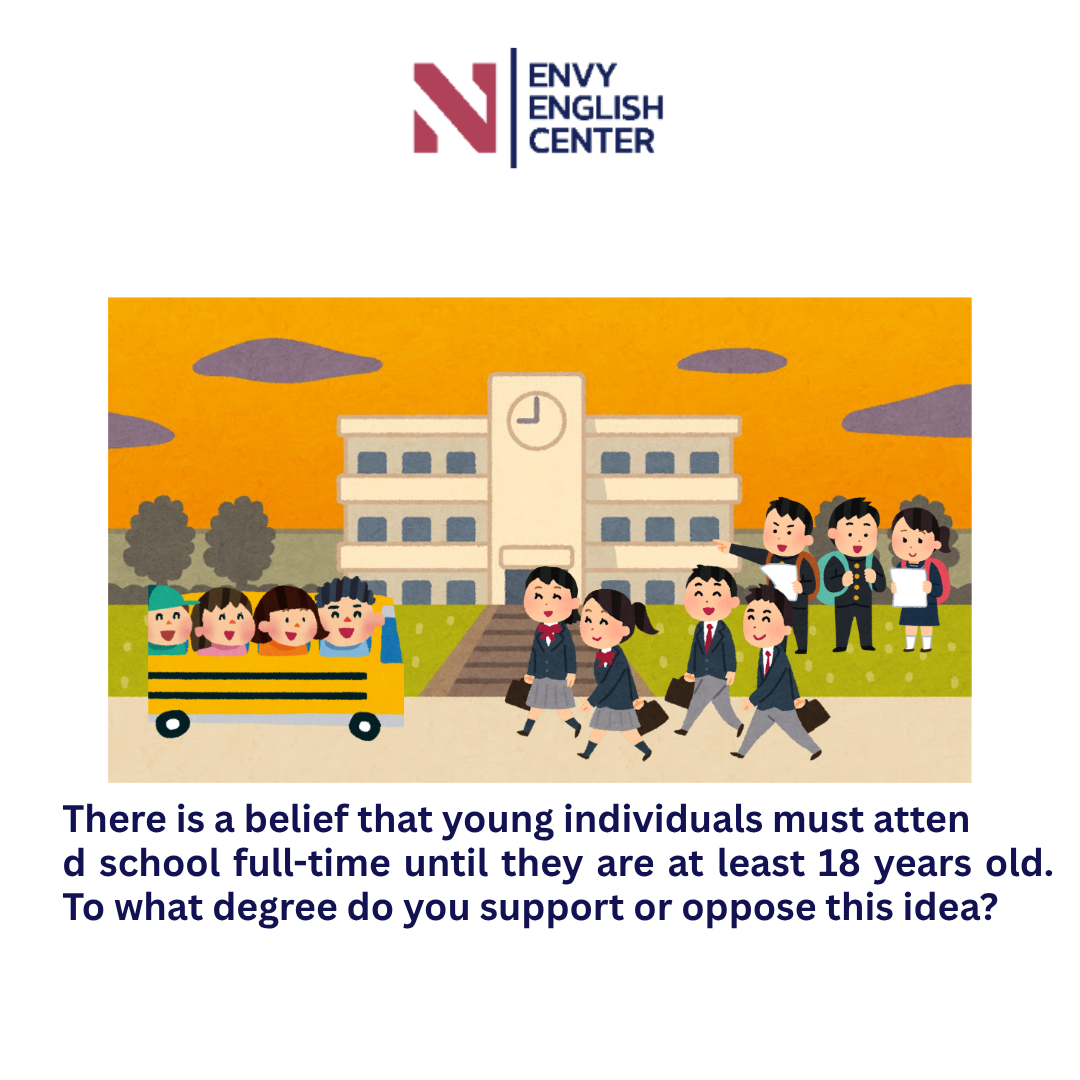
There is a belief that young individuals must attend school full-time until they are at least 18 years old. To what degree do you support or oppose this idea?
Dạng bài
Agree or Disagree essay
Xác định chủ đề và luận điểm
Topic: Compulsory Education
Luận điểm 1: Reasons supporting compulsory full-time education until 18
Equal access to educational opportunities: tiếp cận cơ hội giáo dục bình đẳng
Development of essential knowledge and skills: phát triển kiến thức và kỹ năng thiết yếu
Better career prospects in the future: cơ hội nghề nghiệp tốt hơn trong tương lai
Reduction in youth unemployment: giảm thất nghiệp ở thanh thiếu niên
Improved social and personal development: phát triển xã hội và cá nhân tốt hơn
Preparation for higher education and modern workplaces: chuẩn bị cho giáo dục đại học và môi trường làm việc hiện đại
Luận điểm 2: Arguments against compulsory education until 18
Different learning preferences and career goals: sở thích học tập và định hướng nghề nghiệp khác nhau
Interest in vocational training: mong muốn học nghề
Financial pressures on some families: áp lực tài chính đối với một số gia đình
Early entry into the workforce: tham gia lao động sớm
Lack of motivation among some students: thiếu động lực học tập ở một số học sinh
Need for flexible educational pathways: cần những lộ trình giáo dục linh hoạt
Triển khai ý tưởng
Position
I largely agree that young people should remain in full-time education until the age of 18 because it equips them with the knowledge and skills needed for adulthood. However, vocational programs should also be available for students with different career aspirations.
→ Tôi phần lớn đồng ý rằng thanh niên nên học toàn thời gian đến năm 18 tuổi vì điều này trang bị cho họ kiến thức và kỹ năng cần thiết cho cuộc sống trưởng thành. Tuy nhiên, các chương trình đào tạo nghề cũng nên được cung cấp cho những học sinh có định hướng nghề nghiệp khác nhau.
Ví dụ:
Students gaining qualifications before entering the labor market
Vocational schools preparing learners for skilled occupations
2. Lập dàn ý cho đề theo PEEL
Introduction
Paraphrase: some people believe all young people should stay in school full-time until at least 18
Question: extent of agreement or disagreement
Thesis: I largely agree because education improves future opportunities, although flexible vocational options should be available
Body Paragraph 1
Point: staying in school until 18 provides important benefits
Evidence: knowledge, skills, qualifications, social development, employability
Explanation: modern jobs increasingly require advanced education and training
Link: compulsory education helps young people prepare for adulthood
Body Paragraph 2
Point: some students may benefit from alternative pathways
Evidence: vocational education, practical training, different learning styles
Explanation: not all students thrive in traditional academic settings
Link: governments should maintain compulsory learning while allowing flexibility in how it is delivered
Conclusion
Summary: education until 18 is generally beneficial
Restate: compulsory learning should continue, but students should have access to both academic and vocational routes
3. Bài mẫu hoàn chỉnh
Some people believe that all young individuals should attend school full-time until they reach the age of 18. I largely agree with this view because education plays a vital role in preparing young people for future employment and responsible adulthood. However, I also believe that vocational pathways should be available for those with different interests and abilities.
One major reason for keeping students in education until 18 is that it provides equal access to educational opportunities and helps them acquire essential knowledge. Modern societies increasingly require workers to possess advanced qualifications and a broad range of skills. Remaining in school allows students to continue the development of essential knowledge and skills, improving their chances of securing stable employment later in life. In addition, schools contribute to improved social and personal development by teaching communication, teamwork, and critical thinking. These abilities are valuable not only in the workplace but also in everyday life. Therefore, compulsory education can help young people build a stronger foundation for the future.
Nevertheless, not all students benefit equally from a purely academic education. Some may have practical talents and prefer vocational training instead. Providing flexible educational pathways enables students to develop job-specific skills while continuing their education. For example, vocational programs can prepare learners for careers in engineering, construction, or healthcare. This approach allows students to pursue their strengths without leaving education prematurely. Consequently, compulsory learning should not necessarily mean compulsory academic study.
In conclusion, I support the idea that young people should remain in education until the age of 18 because it enhances their future opportunities and personal development. However, governments should ensure that both academic and vocational options are available to meet the needs of different learners.
(Word count: 295)
4. Lexical Resources List
New Vocabulary
equal access to educational opportunities (noun phrase): tiếp cận cơ hội giáo dục bình đẳng
E.g. Governments should promote equal access to educational opportunities.
development of essential knowledge and skills (noun phrase): phát triển kiến thức và kỹ năng thiết yếu
E.g. Schools support the development of essential knowledge and skills.
better career prospects in the future (noun phrase): cơ hội nghề nghiệp tốt hơn trong tương lai
E.g. Education leads to better career prospects in the future.
reduction in youth unemployment (noun phrase): giảm thất nghiệp ở thanh thiếu niên
E.g. Training programs contribute to the reduction in youth unemployment.
improved social and personal development (noun phrase): phát triển xã hội và cá nhân tốt hơn
E.g. School activities encourage improved social and personal development.
preparation for higher education and modern workplaces (noun phrase): chuẩn bị cho giáo dục đại học và môi trường làm việc hiện đại
E.g. Secondary education provides preparation for higher education and modern workplaces.
different learning preferences and career goals (noun phrase): sở thích học tập và định hướng nghề nghiệp khác nhau
E.g. Students have different learning preferences and career goals.
interest in vocational training (noun phrase): mong muốn học nghề
E.g. Some teenagers show an interest in vocational training.
financial pressures on some families (noun phrase): áp lực tài chính đối với một số gia đình
E.g. Financial pressures on some families may affect educational choices.
early entry into the workforce (noun phrase): tham gia lao động sớm
E.g. Some young people prefer early entry into the workforce.
lack of motivation among some students (noun phrase): thiếu động lực học tập ở một số học sinh
E.g. Schools must address the lack of motivation among some students.
flexible educational pathways (noun phrase): lộ trình giáo dục linh hoạt
E.g. Governments should provide flexible educational pathways.
advanced qualifications (noun phrase): bằng cấp chuyên môn cao
E.g. Many professions require advanced qualifications.
stable employment (noun phrase): việc làm ổn định
E.g. Education increases access to stable employment.
critical thinking (noun phrase): tư duy phản biện
E.g. Schools help students develop critical thinking.
practical talents (noun phrase): năng khiếu thực hành
E.g. Some learners possess strong practical talents.
job-specific skills (noun phrase): kỹ năng chuyên biệt cho công việc
E.g. Vocational courses teach job-specific skills.
vocational programs (noun phrase): chương trình đào tạo nghề
E.g. Many students benefit from vocational programs.
prematurely leave education (verb phrase): rời bỏ giáo dục quá sớm
E.g. Governments should discourage students from prematurely leaving education.
future opportunities (noun phrase): cơ hội trong tương lai
E.g. Education creates more future opportunities.
Sentence Structures
1. I largely agree with this view because + clause (dùng để nêu quan điểm)
E.g. I largely agree with this view because education plays a vital role in preparing young people for future employment.
2. One major reason for + V-ing + noun phrase + is that + clause (dùng để trình bày lý do)
E.g. One major reason for keeping students in education until 18 is that it provides equal access to educational opportunities.
3. Remaining in + noun phrase + allows + noun phrase + to + verb + noun phrase (dùng để giải thích lợi ích)
E.g. Remaining in school allows students to continue the development of essential knowledge and skills.
4. In addition, + noun phrase + contribute(s) to + noun phrase + by + V-ing (dùng để mở rộng ý)
E.g. In addition, schools contribute to improved social and personal development by teaching communication and teamwork.
5. Providing + noun phrase + enables + noun phrase + to + verb + noun phrase (dùng để đề xuất giải pháp)
E.g. Providing flexible educational pathways enables students to develop job-specific skills while continuing their education.
6. In conclusion, I support the idea that + clause because + clause (dùng để kết luận)
E.g. In conclusion, I support the idea that young people should remain in education until the age of 18 because it enhances their future opportunities and personal development.
Nếu bạn đang bắt đầu từ con số 0 hoặc đã học nhưng “dậm chân tại chỗ”, Envy English Center có thể đồng hành cùng bạn:
Test trình độ miễn phí theo format IELTS để biết chính xác điểm mạnh – điểm yếu.
Nhận lộ trình học cá nhân hóa từ 0 → 6.5+, phù hợp tốc độ và mục tiêu.
Trực tiếp học với giáo viên IELTS 8.0+, chuyên “gỡ rối” Speaking & Writing – hai kỹ năng khó nâng band nhất.
Đặc biệt, khi đăng ký trong tuần này, bạn được tặng bộ từ vựng chuẩn IELTS band 7+.
📞 Hotline: 028 7300 9677 / 0948 197 270 (Zalo)
🌐 Website: envyenglish.vn
📍 Địa chỉ: 46/5 Tân Cảng, Phường Thạnh Mỹ Tây, Quận Bình Thạnh, TP.HCM


Thông tin gửi đi không thành công, vui lòng thử lại sau.
Nếu bạn cần liên hệ gấp, vui lòng gọi hotline
02873009677

Cảm ơn bạn đã gửi thông tin đến Envy English Center.
Chúng tôi sẽ liên hệ với bạn sớm nhất khi có thể.
Nếu bạn cần liên hệ gấp, vui lòng gọi hotline
02873009677
Thông tin gửi đi không thành công, vui lòng thử lại sau.
Nếu bạn cần liên hệ gấp, vui lòng gọi hotline
02873009677
Bạn đang có một bài test chưa hoàn thành.
Bạn có muốn tiếp tục bài test đó không?
Bạn có chắc là muốn gửi bài test này không?

Số câu trả lời đúng/40

Số câu trả lời đúng/40
Thông tin gửi đi không thành công, vui lòng thử lại sau.
Nếu bạn cần liên hệ gấp, vui lòng gọi hotline
02873009677
Thời gian làm bài kiểm tra đã hết.
Cảm ơn bạn đã cố gắng.
