 02873009677
 contact@envyenglish.vn

1. Xây dựng ý tưởng
Đề bài
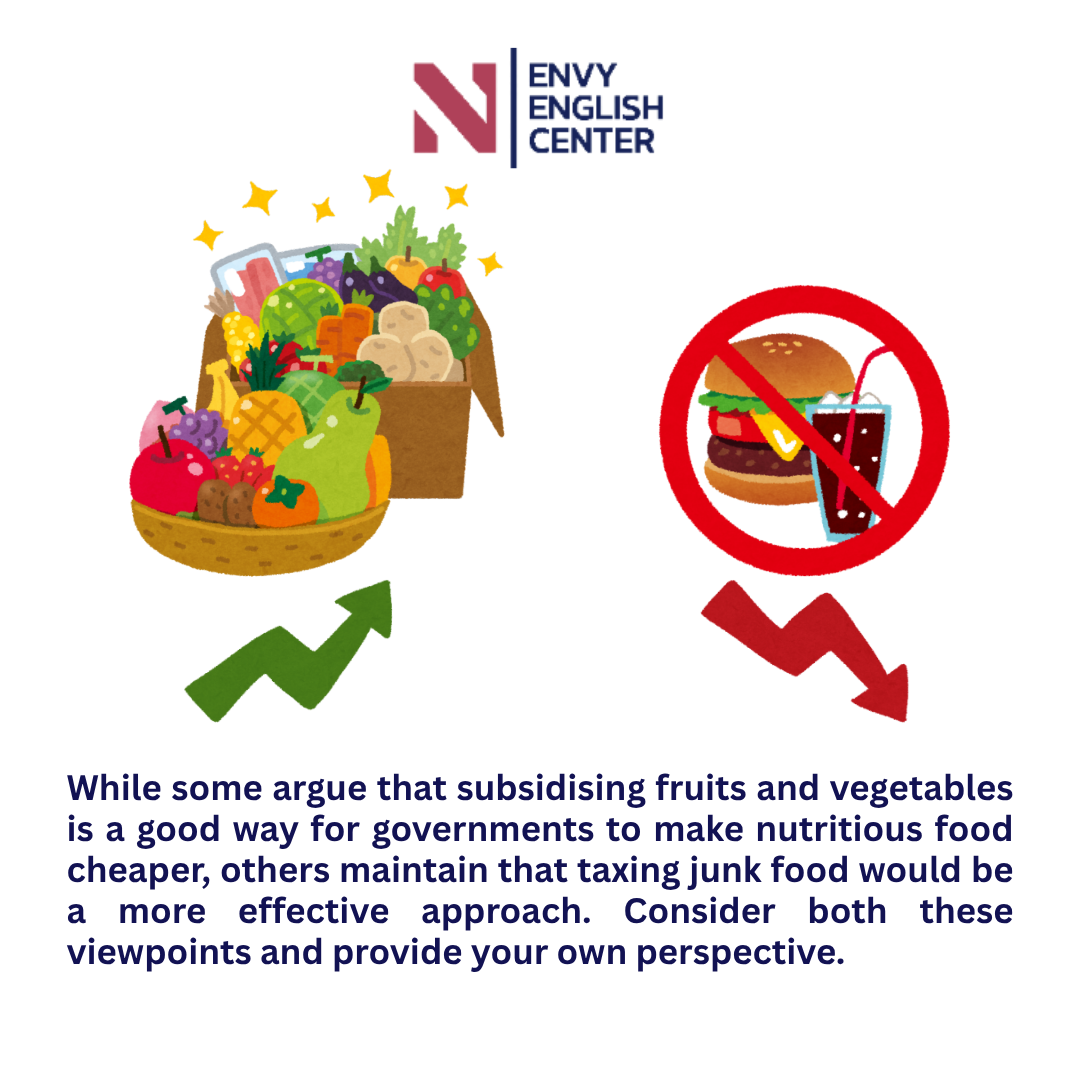
While some argue that subsidising fruits and vegetables is a good way for governments to make nutritious food cheaper, others maintain that taxing junk food would be a more effective approach. Consider both these viewpoints and provide your own perspective.
Dạng bài
Discuss both views and give your opinion
Xác định chủ đề và luận điểm
Topic: Government Policies for Healthy Eating
Luận điểm 1: Reasons supporting subsidies for healthy food
Affordable nutritious food: thực phẩm bổ dưỡng giá phải chăng
Increased healthy food consumption: tăng tiêu thụ thực phẩm lành mạnh
Public health improvement: cải thiện sức khỏe cộng đồng
Financial support for low-income families: hỗ trợ tài chính cho gia đình thu nhập thấp
Preventive healthcare benefits: lợi ích phòng ngừa bệnh tật
Better dietary habits: thói quen ăn uống tốt hơn
Agricultural industry support: hỗ trợ ngành nông nghiệp
Luận điểm 2: Reasons supporting taxes on junk food
Reduced unhealthy food consumption: giảm tiêu thụ thực phẩm không lành mạnh
Obesity rate reduction: giảm tỷ lệ béo phì
Higher public awareness: nâng cao nhận thức cộng đồng
Increased government revenue: tăng nguồn thu chính phủ
Discouragement of unhealthy lifestyles: hạn chế lối sống không lành mạnh
Pressure on food companies: tạo áp lực lên công ty thực phẩm
Healthcare cost reduction: giảm chi phí y tế
Triển khai ý tưởng
Position 1
Although taxing junk food may discourage unhealthy eating, I believe subsidising healthy food is a more positive and sustainable solution because it encourages better dietary habits without financially punishing consumers.
→ Mặc dù đánh thuế đồ ăn nhanh có thể hạn chế việc ăn uống không lành mạnh, tôi tin rằng trợ giá thực phẩm lành mạnh là giải pháp tích cực và bền vững hơn vì nó khuyến khích thói quen ăn uống tốt mà không gây áp lực tài chính cho người tiêu dùng.
Ví dụ:
Subsidized vegetables in schools
Reduced fruit prices in supermarkets
Position 2
Governments should impose higher taxes on junk food because financial penalties are more effective in reducing unhealthy eating behaviors.
→ Chính phủ nên áp thuế cao hơn lên đồ ăn nhanh vì hình phạt tài chính hiệu quả hơn trong việc giảm hành vi ăn uống không lành mạnh.
Ví dụ:
Sugar taxes in the UK
Higher taxes on soft drinks
2. Lập dàn ý cho đề theo PEEL
Introduction
Paraphrase: some people support subsidies for healthy food while others prefer taxes on unhealthy products
Question: whether governments should lower healthy food prices or increase junk food taxes
Thesis: although taxing junk food may reduce unhealthy consumption, subsidising nutritious food is a more effective and socially beneficial solution
Body Paragraph 1
Point: subsidising healthy food encourages better eating habits
Evidence: cheaper fruits and vegetables, support for low-income families, public health benefits
Explanation: affordable healthy food increases accessibility and long-term dietary improvement
Link: positive incentives are more sustainable than punishment-based policies
Body Paragraph 2
Point: taxing junk food can discourage unhealthy consumption
Evidence: sugar taxes, obesity reduction, increased awareness, government revenue
Explanation: higher prices may reduce demand for unhealthy products
Link: however, taxes may disproportionately affect low-income consumers
Conclusion
Summary: both policies can improve public health in different ways
Restate: subsidising healthy food is the more balanced and sustainable approach overall
3. Bài mẫu hoàn chỉnh
As unhealthy diets become increasingly common, many governments are searching for effective ways to improve public health. Some people believe subsidising fruits and vegetables is the best solution, while others argue that imposing taxes on junk food would be more effective. In my opinion, although taxing unhealthy products may reduce their consumption, subsidising nutritious food is a more balanced and sustainable approach.
One major advantage of government subsidies is the creation of affordable nutritious food for a wider population. Lower prices for fruits and vegetables could encourage increased healthy food consumption, particularly among low-income households that often struggle to afford fresh produce. This may contribute significantly to public health improvement by reducing diet-related illnesses such as obesity, diabetes, and heart disease. In addition, subsidies provide valuable financial support for low-income families, helping them maintain healthier diets without additional financial pressure. Encouraging healthier eating habits may also create long-term preventive healthcare benefits, reducing the burden on national healthcare systems. Furthermore, these policies can promote better dietary habits among children and support local farmers through agricultural industry support.
On the other hand, taxing junk food may also produce certain benefits. Higher prices could lead to reduced unhealthy food consumption and support obesity rate reduction, especially among frequent consumers of fast food and sugary drinks. Governments may also raise higher public awareness about the dangers of unhealthy diets when introducing these taxes. Additionally, junk food taxes can generate increased government revenue, which could be invested in healthcare or nutrition programs. However, this policy may unfairly affect low-income individuals, who already spend a large proportion of their income on food. As a result, taxation alone may not fully solve unhealthy eating habits.
Overall, although taxing junk food can discourage unhealthy consumption, I believe subsidising healthy food is a more effective and socially responsible solution because it encourages positive dietary choices without creating excessive financial pressure.
(Word count: 320)
4. Lexical Resources List
New Vocabulary
affordable nutritious food (noun phrase): thực phẩm bổ dưỡng giá phải chăng
E.g. Governments should improve access to affordable nutritious food.
increased healthy food consumption (noun phrase): tăng tiêu thụ thực phẩm lành mạnh
E.g. Nutrition campaigns encourage increased healthy food consumption.
public health improvement (noun phrase): cải thiện sức khỏe cộng đồng
E.g. Exercise programs contribute to public health improvement.
financial support for low-income families (noun phrase): hỗ trợ tài chính cho gia đình thu nhập thấp
E.g. Welfare policies provide financial support for low-income families.
preventive healthcare benefits (noun phrase): lợi ích phòng ngừa bệnh tật
E.g. Healthy lifestyles offer significant preventive healthcare benefits.
better dietary habits (noun phrase): thói quen ăn uống tốt hơn
E.g. Schools should encourage better dietary habits.
agricultural industry support (noun phrase): hỗ trợ ngành nông nghiệp
E.g. Subsidies provide important agricultural industry support.
reduced unhealthy food consumption (noun phrase): giảm tiêu thụ thực phẩm không lành mạnh
E.g. Advertising restrictions may lead to reduced unhealthy food consumption.
obesity rate reduction (noun phrase): giảm tỷ lệ béo phì
E.g. Governments are aiming for obesity rate reduction.
higher public awareness (noun phrase): nâng cao nhận thức cộng đồng
E.g. Media campaigns create higher public awareness.
increased government revenue (noun phrase): tăng nguồn thu chính phủ
E.g. Tourism contributes to increased government revenue.
discouragement of unhealthy lifestyles (noun phrase): hạn chế lối sống không lành mạnh
E.g. Education supports the discouragement of unhealthy lifestyles.
pressure on food companies (noun phrase): tạo áp lực lên công ty thực phẩm
E.g. New regulations place pressure on food companies.
healthcare cost reduction (noun phrase): giảm chi phí y tế
E.g. Exercise may contribute to healthcare cost reduction.
fresh produce (noun phrase): nông sản tươi sống
E.g. Supermarkets should provide affordable fresh produce.
diet-related illnesses (noun phrase): bệnh liên quan đến chế độ ăn uống
E.g. Poor nutrition causes many diet-related illnesses.
national healthcare systems (noun phrase): hệ thống y tế quốc gia
E.g. Aging populations place pressure on national healthcare systems.
fast food and sugary drinks (noun phrase): đồ ăn nhanh và nước ngọt có đường
E.g. Children often consume too much fast food and sugary drinks.
nutrition programs (noun phrase): chương trình dinh dưỡng
E.g. Schools should invest in nutrition programs.
positive dietary choices (noun phrase): lựa chọn ăn uống tích cực
E.g. Parents should encourage positive dietary choices.
Sentence Structures
1. While some people believe + clause, others argue that + clause (dùng để mở bài với hai quan điểm đối lập)
E.g. Some people believe subsidising fruits and vegetables is the best solution, while others argue that imposing taxes on junk food would be more effective.
2. One major advantage of + noun phrase + is the creation of + noun phrase (dùng để mở đoạn nêu lợi ích)
E.g. One major advantage of government subsidies is the creation of affordable nutritious food for a wider population.
3. This may contribute significantly to + noun phrase + by + gerund phrase (dùng để giải thích tác động tích cực)
E.g. This may contribute significantly to public health improvement by reducing diet-related illnesses such as obesity, diabetes, and heart disease.
4. On the other hand, + gerund phrase + may also + verb + noun phrase (dùng để chuyển sang quan điểm đối lập)
E.g. On the other hand, taxing junk food may also produce certain benefits.
5. However, + noun phrase + may unfairly affect + noun phrase (dùng để nêu hạn chế của chính sách)
E.g. However, this policy may unfairly affect low-income individuals, who already spend a large proportion of their income on food.
6. Overall, although + gerund phrase + can + verb, I believe + clause because + clause (dùng để kết luận với lập trường rõ ràng)
E.g. Overall, although taxing junk food can discourage unhealthy consumption, I believe subsidising healthy food is a more effective and socially responsible solution because it encourages positive dietary choices without creating excessive financial pressure.
Nếu bạn đang bắt đầu từ con số 0 hoặc đã học nhưng “dậm chân tại chỗ”, Envy English Center có thể đồng hành cùng bạn:
Test trình độ miễn phí theo format IELTS để biết chính xác điểm mạnh – điểm yếu.
Nhận lộ trình học cá nhân hóa từ 0 → 6.5+, phù hợp tốc độ và mục tiêu.
Trực tiếp học với giáo viên IELTS 8.0+, chuyên “gỡ rối” Speaking & Writing – hai kỹ năng khó nâng band nhất.
Đặc biệt, khi đăng ký trong tuần này, bạn được tặng bộ từ vựng chuẩn IELTS band 7+.
📞 Hotline: 028 7300 9677 / 0948 197 270 (Zalo)
🌐 Website: envyenglish.vn
📍 Địa chỉ: 46/5 Tân Cảng, Phường Thạnh Mỹ Tây, Quận Bình Thạnh, TP.HCM


Thông tin gửi đi không thành công, vui lòng thử lại sau.
Nếu bạn cần liên hệ gấp, vui lòng gọi hotline
02873009677

Cảm ơn bạn đã gửi thông tin đến Envy English Center.
Chúng tôi sẽ liên hệ với bạn sớm nhất khi có thể.
Nếu bạn cần liên hệ gấp, vui lòng gọi hotline
02873009677
Thông tin gửi đi không thành công, vui lòng thử lại sau.
Nếu bạn cần liên hệ gấp, vui lòng gọi hotline
02873009677
Bạn đang có một bài test chưa hoàn thành.
Bạn có muốn tiếp tục bài test đó không?
Bạn có chắc là muốn gửi bài test này không?

Số câu trả lời đúng/40

Số câu trả lời đúng/40
Thông tin gửi đi không thành công, vui lòng thử lại sau.
Nếu bạn cần liên hệ gấp, vui lòng gọi hotline
02873009677
Thời gian làm bài kiểm tra đã hết.
Cảm ơn bạn đã cố gắng.
